

Epoxy heat resistant paint is a specialized coating designed to protect surfaces exposed to high temperatures, harsh environments, and corrosive conditions. Widely used in industrial and commercial applications, this type of coating combines the strength of epoxy resins with heat-resistant properties to deliver long-lasting performance and durability.
These coatings form a tough, protective layer that adheres strongly to metal and concrete surfaces. When exposed to elevated temperatures, epoxy heat resistant paint maintains its structural integrity, preventing damage such as cracking, peeling, or corrosion. This makes it an ideal solution for equipment and structures that operate under continuous thermal stress.
One of the key advantages of epoxy heat resistant paint is its excellent resistance to chemicals, moisture, and environmental factors. It not only protects against heat but also acts as a barrier against rust and corrosion, extending the lifespan of industrial assets. This dual protection makes it highly suitable for demanding environments like power plants, manufacturing units, and oil & gas facilities.
Epoxy heat resistant coatings are available in different formulations to withstand varying temperature ranges, typically from moderate heat up to 400°C or more. Choosing the right type depends on the specific application and operating conditions.
By using high-quality epoxy heat resistant paint and following proper application techniques, industries can achieve improved safety, reduced maintenance costs, and enhanced equipment performance. This makes it a reliable and cost-effective solution for high-temperature protection needs.
Introduction to Epoxy Heat Resistant Paint
Epoxy heat resistant paint is a high-performance coating specifically designed to protect surfaces exposed to elevated temperatures and harsh operating conditions. It is widely used in industrial environments where durability, heat resistance, and corrosion protection are critical. By forming a strong and resilient protective layer, this coating helps maintain the integrity and performance of equipment and structures.
What is Epoxy Heat Resistant Paint?
Epoxy heat resistant paint is a specialized formulation made from epoxy resins combined with heat-stable additives and pigments. Unlike conventional paints, it is engineered to withstand high temperatures without losing its adhesion, strength, or protective properties.
These coatings are commonly applied to metal surfaces, pipelines, machinery, and industrial equipment to provide long-lasting protection against heat, corrosion, and chemical exposure. Their excellent bonding capability ensures a durable finish even in demanding conditions.
How It Works in High-Temperature Environments
Epoxy heat resistant paint works by creating a tough, protective barrier that shields the surface from direct heat and environmental damage. When exposed to high temperatures, the coating maintains its structural stability, preventing cracking, peeling, or degradation.
Additionally, it resists oxidation and corrosion, which are common issues in high-temperature environments. This ensures that the underlying surface remains protected, improving equipment lifespan and maintaining consistent performance under thermal stress.
Key Benefits of Epoxy Heat Resistant Paint
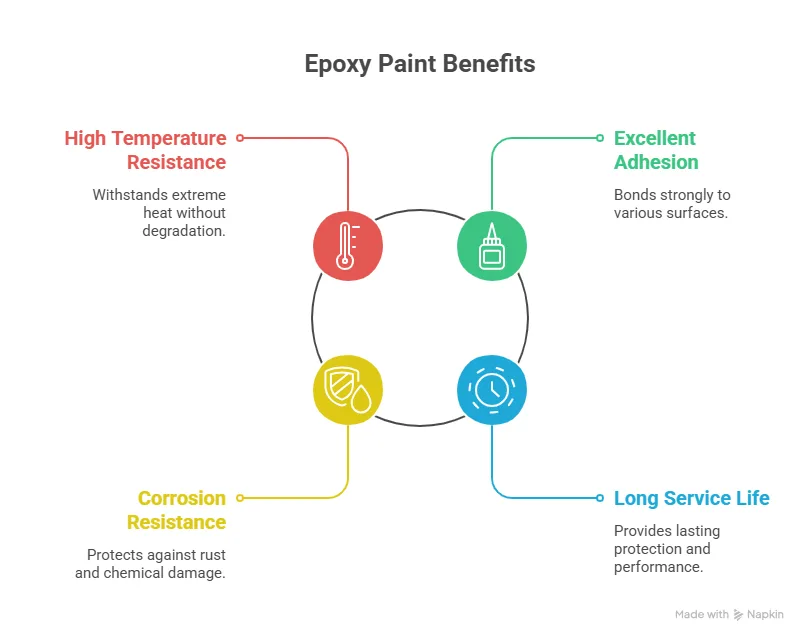
Epoxy heat resistant paint offers a range of benefits that make it a preferred choice for protecting surfaces exposed to high temperatures and harsh industrial environments. Its advanced formulation ensures durability, strong adhesion, and long-term performance, making it ideal for demanding applications.
High Temperature Resistance
One of the primary advantages of epoxy heat resistant paint is its ability to withstand elevated temperatures without degrading. It maintains its structural integrity even under continuous heat exposure, preventing issues such as cracking, blistering, or peeling.
This makes it suitable for applications like boilers, exhaust systems, pipelines, and industrial machinery where high-temperature resistance is essential.
Excellent Adhesion and Durability
Epoxy coatings are known for their superior adhesion to a variety of surfaces, including metal and concrete. This strong bonding ensures that the coating remains intact even under thermal stress and mechanical wear.
Its durability helps protect surfaces from damage caused by temperature fluctuations, ensuring long-lasting performance with minimal maintenance.
Corrosion and Chemical Resistance
In addition to heat resistance, epoxy coatings provide excellent protection against corrosion and chemical exposure. They act as a barrier that prevents moisture, chemicals, and environmental pollutants from reaching the surface.
This is particularly important in industries such as oil & gas, manufacturing, and power plants where equipment is exposed to aggressive conditions.
Long Service Life
Epoxy heat resistant paint is designed for long-term use, reducing the need for frequent repairs or recoating. Its ability to withstand harsh conditions ensures consistent performance over an extended period.
By extending the lifespan of surfaces and equipment, it helps reduce maintenance costs and improves overall operational efficiency.
Types of Epoxy Heat Resistant Paints
Epoxy heat resistant paints are available in different formulations designed to perform under specific temperature ranges and operating conditions. Selecting the right type is crucial to ensure optimal protection, durability, and performance in high-temperature environments.
Standard Heat Resistant Epoxy (Up to 200°C)
Standard heat resistant epoxy coatings are designed for moderate temperature applications, typically up to 200°C. These coatings provide reliable protection against heat, corrosion, and environmental exposure.
They are commonly used on metal structures, pipelines, and equipment that operate under controlled temperature conditions. Their cost-effectiveness and ease of application make them suitable for general industrial use.
High-Temperature Epoxy (200°C–400°C)
High-temperature epoxy coatings are formulated to withstand more demanding environments, with temperature resistance ranging from 200°C to 400°C. These coatings maintain their strength and protective properties even under continuous heat exposure.
They are ideal for applications such as boilers, exhaust systems, industrial machinery, and power plant equipment where higher temperature resistance is required.
Modified Epoxy Systems
Modified epoxy systems are advanced formulations that combine epoxy resins with additional heat-resistant materials to enhance performance. These coatings are designed to improve flexibility, thermal stability, and resistance to extreme conditions.
They are often used in specialized industrial applications where standard epoxy coatings may not provide sufficient performance. Modified systems offer improved durability, better resistance to thermal cycling, and extended service life.
How Epoxy Heat Resistant Paint Works
Epoxy heat resistant paint is engineered to perform under high-temperature conditions by combining strong adhesion with thermal stability. Its effectiveness lies in its ability to form a durable protective layer that resists heat, chemicals, and environmental damage. Understanding how this coating works helps in selecting the right solution for demanding industrial applications.
Heat Resistance Mechanism
The heat resistance of epoxy coatings comes from specially formulated resins and heat-stable additives that can withstand elevated temperatures without breaking down.
When exposed to heat, the coating maintains its structure and does not soften or degrade easily. This prevents surface damage such as cracking, blistering, or peeling, ensuring reliable protection even under continuous thermal stress.
Protective Barrier Formation
Epoxy heat resistant paint forms a tough, continuous film over the surface, acting as a protective barrier against external elements. This barrier prevents direct contact between the substrate and heat, moisture, and corrosive agents.
By sealing the surface, it reduces oxidation and corrosion, which are common in high-temperature environments. This protective layer enhances durability and extends the lifespan of the coated surface.
Chemical Stability at High Temperatures
One of the key strengths of epoxy coatings is their chemical stability. Even at elevated temperatures, they resist chemical reactions that could otherwise weaken the coating.
This stability ensures that the coating retains its protective properties in environments where exposure to chemicals, oils, or industrial pollutants is common. As a result, epoxy heat resistant paint delivers consistent performance and long-term reliability.
Best Surfaces for Application
Epoxy heat resistant paint is highly versatile and can be applied to a wide range of surfaces exposed to elevated temperatures and harsh conditions. Choosing the right surface ensures maximum adhesion, durability, and long-term performance. These coatings are especially effective on materials that require both heat protection and corrosion resistance.
Metal Structures
Metal structures are one of the most common applications for epoxy heat resistant paint. Steel frameworks, supports, and structural components are often exposed to heat and environmental stress.
Applying epoxy coating helps protect these surfaces from oxidation, corrosion, and thermal damage while maintaining structural integrity over time.
Industrial Equipment
Industrial equipment such as boilers, reactors, and machinery operate under high temperatures and demanding conditions. Epoxy heat resistant paint provides a protective layer that reduces heat impact and prevents surface degradation.
This helps improve equipment efficiency, reduce maintenance, and extend operational life.
Pipelines and Storage Tanks
Pipelines and storage tanks in industries like oil & gas and chemical processing require protection from both heat and corrosion. Epoxy coatings help maintain the temperature of contents while shielding the surface from environmental and chemical exposure.
This ensures consistent performance and enhances the durability of critical infrastructure.
Automotive Parts and Exhaust Systems
Automotive components such as exhaust systems, engine parts, and heat-exposed surfaces benefit greatly from epoxy heat resistant coatings. These areas are subject to high temperatures and require reliable protection.
The coating helps prevent heat damage, corrosion, and wear, ensuring better performance and longer service life of automotive parts.
Application Process of Epoxy Heat Resistant Paint
The performance and durability of epoxy heat resistant paint depend greatly on proper application. Following the correct process ensures strong adhesion, uniform coating thickness, and long-lasting protection against heat and corrosion. A well-applied coating system enhances both efficiency and lifespan in high-temperature environments.
Surface Preparation
Surface preparation is the most critical step before applying epoxy heat resistant paint. The surface must be clean, dry, and free from dust, oil, grease, rust, and loose particles.
For metal surfaces, sandblasting or mechanical cleaning is often recommended to remove corrosion and create a rough profile for better adhesion. Proper surface preparation ensures the coating bonds effectively and performs reliably under high temperatures.
Mixing and Application Methods
Epoxy coatings are typically two-component systems that require proper mixing of the base and hardener in the correct ratio. Accurate mixing is essential to achieve the desired chemical properties and performance.
The coating can be applied using brush, roller, or spray methods depending on the project size and surface type. Spray application is preferred for large industrial areas as it provides uniform coverage, while brush or roller is suitable for smaller or detailed work.
Curing and Drying Time
Curing is a crucial stage where the epoxy coating develops its full strength and heat resistance. After application, the coating must be allowed to dry and cure as per manufacturer specifications.
Curing time may vary based on temperature, humidity, and coating thickness. In some cases, heat curing may be required to achieve optimal performance. Proper curing ensures strong adhesion, chemical resistance, and long-term durability in high-temperature conditions.
Factors to Consider Before Choosing Epoxy Paint
Selecting the right epoxy heat resistant paint is essential to ensure optimal performance, durability, and long-term protection. Different applications require specific coating properties, so evaluating key factors before selection helps achieve reliable results in high-temperature environments.
Temperature Range Requirements
Understanding the operating temperature is crucial when choosing epoxy heat resistant paint. Different epoxy systems are designed to withstand specific temperature ranges.
For moderate heat applications, standard epoxy coatings may be sufficient, while high-temperature environments require specialized formulations. Choosing a coating that matches the temperature range ensures stability and prevents premature failure.
Surface Condition
The condition of the surface plays a major role in coating performance. Surfaces that are corroded, uneven, or contaminated may reduce adhesion and effectiveness.
Proper surface preparation, including cleaning and repairing damaged areas, is essential before application. Selecting a coating compatible with the substrate ensures better bonding and long-term durability.
Environmental Exposure
Environmental factors such as moisture, chemicals, UV exposure, and weather conditions can impact the performance of epoxy coatings.
In harsh industrial environments, coatings with enhanced chemical and corrosion resistance are necessary. For outdoor applications, selecting coatings that can withstand UV and weathering ensures consistent performance over time.
Thickness and Coating System
The thickness of the epoxy coating and the overall coating system (primer, intermediate, and topcoat) are critical for achieving desired performance.
A properly designed coating system provides better protection against heat, corrosion, and mechanical wear. Following manufacturer recommendations for thickness ensures optimal insulation and durability without over-application.
Maintenance and Lifespan
Proper maintenance is essential to ensure the long-term performance and durability of epoxy heat resistant paint. Although these coatings are designed to withstand high temperatures and harsh environments, regular upkeep helps maintain their protective properties and extends their service life. A well-maintained coating system ensures consistent performance and reduces the need for frequent replacements.
Inspection and Cleaning
Routine inspection and cleaning are important to keep the coating in optimal condition. Regular visual checks help identify early signs of damage such as cracks, peeling, discoloration, or corrosion.
Cleaning the surface to remove dust, grease, and industrial contaminants helps maintain the coating’s effectiveness. Using mild cleaning methods prevents damage while preserving the integrity of the coating.
Repair and Touch-Up
Minor damages such as scratches, chips, or localized coating failure should be repaired promptly to prevent further deterioration. Spot repairs help restore the protective barrier and maintain overall performance.
Proper surface preparation is necessary before applying touch-up coatings to ensure strong adhesion and seamless integration with the existing layer.
Recoating Guidelines
Over time, epoxy heat resistant coatings may lose some of their protective properties due to continuous exposure to heat and environmental factors. Recoating is required to restore their effectiveness.
The timing for recoating depends on operating conditions, coating quality, and maintenance practices. Regular inspections help determine when recoating is needed, ensuring uninterrupted protection and long-term durability.
Common Issues and Solutions
Even high-performance epoxy heat resistant paints can face issues if not properly applied or maintained. Identifying common problems early and applying the right solutions helps maintain coating performance, durability, and protection in high-temperature environments.
Peeling or Cracking
Peeling or cracking is a common issue caused by poor surface preparation, incorrect application, or exposure to temperatures beyond the coating’s limit.
Solution:
Ensure proper surface cleaning and preparation before application. Apply the coating at the recommended thickness and within the specified temperature range. Using the correct primer and following application guidelines can significantly reduce the risk of cracking or peeling.
Discoloration at High Heat
Discoloration may occur when the coating is exposed to temperatures higher than its rated capacity or due to prolonged heat exposure.
Solution:
Select a coating designed for the required temperature range. While slight color changes may not affect performance, choosing high-temperature stable pigments can help maintain appearance and consistency.
Loss of Adhesion
Loss of adhesion happens when the coating fails to bond properly with the surface. This can result from contaminants, moisture, or improper curing.
Solution:
Thoroughly clean and prepare the surface to remove oil, dust, and rust. Ensure the coating is applied under suitable environmental conditions and allowed to cure properly. Using compatible primers and following manufacturer instructions improves adhesion and long-term performance.
Applications Across Industries
Epoxy heat resistant paint is widely used across multiple industries where surfaces are exposed to high temperatures, corrosion, and harsh operating conditions. Its durability, strong adhesion, and resistance to heat and chemicals make it an ideal choice for protecting critical assets and improving operational efficiency.
Oil & Gas Industry
In the oil and gas sector, pipelines, storage tanks, and processing equipment are regularly exposed to high temperatures and corrosive substances. Epoxy heat resistant paint provides a protective barrier that helps prevent corrosion, reduces heat damage, and ensures long-term durability of infrastructure.
This enhances operational safety and minimizes maintenance requirements in demanding environments.
Power Plants
Power plants involve high-temperature systems such as boilers, turbines, and exhaust units. Epoxy heat resistant coatings help protect these components by maintaining their structural integrity under continuous thermal stress.
By reducing heat-related damage and corrosion, these coatings contribute to improved efficiency and reliable performance in power generation operations.
Manufacturing Units
Manufacturing facilities often use machinery and equipment that operate under elevated temperatures. Epoxy heat resistant paint helps protect these assets from heat, chemicals, and mechanical wear.
This results in improved productivity, reduced downtime, and lower maintenance costs, making it a valuable solution for industrial operations.
Automotive Industry
In the automotive sector, components such as exhaust systems, engine parts, and heat-exposed surfaces require protection from high temperatures and corrosion. Epoxy heat resistant coatings provide a durable finish that enhances performance and extends the lifespan of these components.
They also help maintain the appearance and reliability of automotive parts under extreme operating conditions.
Conclusion – Is Epoxy Heat Resistant Paint the Right Choice?
Epoxy heat resistant paint stands out as a reliable solution for protecting surfaces exposed to high temperatures, harsh chemicals, and demanding industrial conditions. Its strong adhesion, durability, and ability to withstand thermal stress make it a preferred choice across multiple industries. When applied correctly, it delivers long-term protection and enhances the performance of critical assets.
Performance Benefits
Epoxy heat resistant coatings offer excellent resistance to heat, corrosion, and chemical exposure. They form a tough protective layer that maintains its integrity even under continuous high-temperature conditions.
This ensures consistent performance, reduces surface degradation, and extends the lifespan of equipment and structures.
Cost vs Durability
While the initial cost of epoxy heat resistant paint may be higher than conventional coatings, its long-term durability provides significant value. Reduced maintenance, fewer repairs, and extended service life contribute to overall cost savings.
Investing in high-quality epoxy coatings ensures better performance and minimizes operational expenses over time.
Ideal Use Cases
Epoxy heat resistant paint is ideal for applications involving moderate to high temperatures, such as pipelines, boilers, industrial machinery, and automotive components.
It is particularly suitable for environments where both heat resistance and corrosion protection are required. For industries seeking a balance between performance, durability, and cost-effectiveness, epoxy heat resistant paint is a practical and efficient solution.