

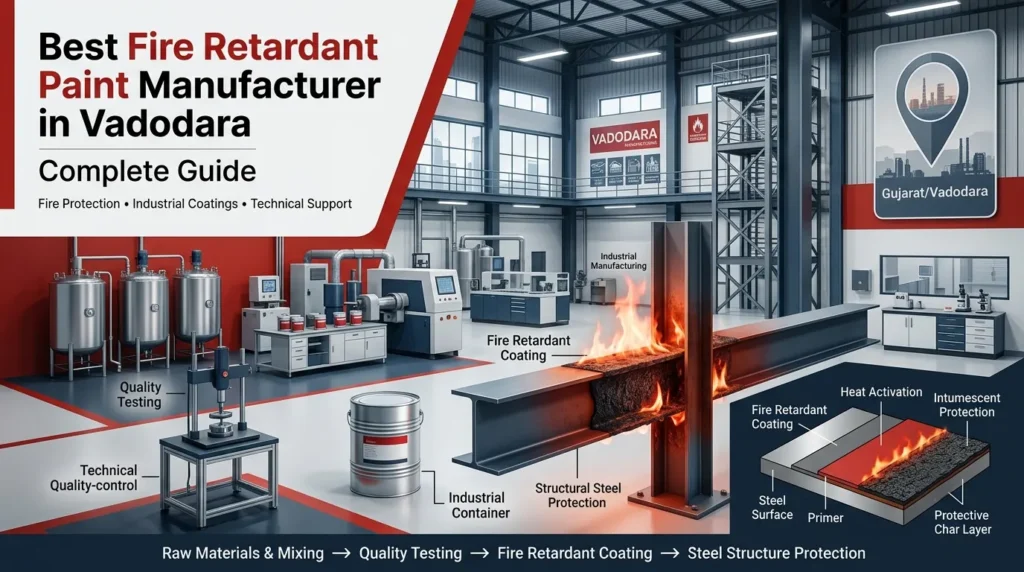
Fire safety is an important consideration for industrial buildings, manufacturing facilities, warehouses, commercial structures, steel frameworks, electrical installations, and other high-risk environments. Fire retardant paint and protective coating systems are used to reduce the impact of heat and fire on different substrates and provide additional time for emergency response and fire protection measures.
Choosing a suitable fire retardant paint manufacturer in Vadodara requires more than comparing product prices. Factors such as the type of substrate, required fire-resistance period, coating thickness, fire-test documentation, application method, primer compatibility, environmental conditions, and technical support should be evaluated before selecting a coating system.
Vadodara is an important industrial centre with manufacturing, engineering, chemical, pharmaceutical, infrastructure, and other industrial activities. This creates demand for reliable fire protection solutions for steel structures, metal surfaces, cables, wood, walls, gypsum boards, and other applications.
This guide explains the key factors to consider when selecting a fire retardant paint manufacturer in Vadodara, different types of fire protection coating
s, important testing and documentation requirements, major industrial applications, the coating application process, and how to evaluate a manufacturer for project-specific requirements.
Understanding Fire Retardant Paint for Industrial Applications
What Is Fire Retardant Paint?
Fire retardant paint is a specially formulated protective coating designed to improve the fire performance of a surface or substrate. It can be formulated for applications such as structural steel, metal sheets, wood, cables, walls, gypsum boards, and other industrial surfaces.
Depending on the coating technology, fire retardant systems can reduce flame spread, delay heat penetration, or create an insulating protective layer when exposed to elevated temperatures. The appropriate product must be selected according to the substrate, required fire-resistance period, application environment, and tested performance of the coating system.
How Fire Retardant Paint Protects Surfaces
Fire retardant coatings work by changing the way a protected surface responds to heat and fire. Some systems form an insulating layer when exposed to high temperatures, while others are formulated to resist flame propagation or reduce the spread of fire across the coated surface.
For structural steel, an intumescent fire protection coating can expand when heated and form a protective char layer. This insulating layer slows the transfer of heat to the steel and helps delay the temperature rise of the structural member. The actual level of protection depends on the complete tested coating system, application thickness, substrate, and fire exposure conditions.
Fire Retardant vs Fire Resistant vs Intumescent Coating
These terms describe related but different aspects of fire protection. Fire retardant paint generally refers to a coating formulated to reduce or delay the effects or spread of fire on a surface. Fire resistant coating is commonly used for systems designed to maintain protective performance for a specified period under defined fire conditions.
Intumescent coating uses a specific mechanism in which the coating expands under heat and forms an insulating char layer. Intumescent technology is widely used for passive fire protection of structural steel and other suitable substrates.
The correct terminology and performance claim should always be based on the product’s technical documentation and relevant fire-test evidence rather than the product name alone.
Why Fire Protection Is Important for Industrial Facilities
Industrial facilities can contain combustible materials, electrical systems, process equipment, storage areas, pipelines, and structural components that may be exposed to fire hazards. Protecting critical surfaces can help reduce the effects of heat and fire and support the overall passive fire protection strategy.
Fire retardant coatings may be used on selected steel structures, metal surfaces, cables, walls, wood, and other substrates depending on the product specification. Their effectiveness depends on correct product selection, surface preparation, application thickness, curing, inspection, and maintenance. Fire protection coating should therefore be considered as one component of a broader industrial fire-safety system.
Why Choose a Fire Retardant Paint Manufacturer in Vadodara?
Vadodara’s Industrial and Manufacturing Environment
Vadodara has a strong industrial base covering manufacturing, engineering, chemical, pharmaceutical, power, and other process-oriented industries. These facilities may require fire protection solutions for structural steel, equipment, electrical systems, walls, storage areas, and other substrates.
Working with a manufacturer located in the same industrial region can make it easier to discuss application requirements according to the type of facility, operating environment, substrate, and project specifications.
Faster Technical Support and Site Assistance
Fire protection coatings often require technical decisions related to surface preparation, primer compatibility, application method, coating thickness, drying conditions, and inspection. A local manufacturer can provide more accessible communication for technical discussions and, where available, coordinate site visits or application assistance.
This can be particularly useful when projects involve large steel structures, industrial equipment, multiple coating stages, or specific fire-resistance requirements.
Easier Product Supply and Project Coordination
Working with a manufacturer based in Vadodara can simplify communication related to product availability, quantities, delivery schedules, technical documents, and project requirements. Local coordination can also be useful when coating materials are required in stages as a project progresses.
For industrial projects with defined application schedules, closer supplier coordination can help reduce unnecessary delays between material planning and site execution.
Local Understanding of Industrial Coating Requirements
Industrial coating requirements can vary according to the substrate, operating conditions, fire exposure, environmental conditions, and project specifications. A manufacturer serving industries in and around Vadodara may have greater familiarity with the types of coating applications commonly required by local industrial projects.
However, location alone should not determine manufacturer selection. Product performance, relevant fire-test documentation, technical specifications, application support, quality practices, and suitability for the intended substrate should also be evaluated before selecting a fire protection coating system.
What to Look for in a Fire Retardant Paint Manufacturer
Product Range and Application Coverage
A capable fire retardant paint manufacturer should offer products suitable for different substrates and fire protection requirements. The product range may include coatings for structural steel, metal surfaces, wood, cables, walls, gypsum boards, and other specialized applications.
A broader application range can simplify project procurement, particularly when a facility requires different fire protection systems for multiple substrates. However, each product should be selected according to its specific technical data and intended application rather than assuming that one coating is suitable for every surface.
Fire Testing and Technical Documentation
Fire-test evidence and technical documentation are essential when evaluating a fire protection coating manufacturer. Request relevant test reports, technical data sheets, application instructions, fire-resistance information, and certification documents where applicable.
The documentation should clearly indicate the tested substrate, coating system, required thickness, fire exposure conditions, and applicable limitations. This allows engineers and project teams to determine whether the product is appropriate for the intended application.
Quality Control and Manufacturing Practices
Consistent manufacturing quality is important because variations in coating formulation can affect application characteristics and product performance. A manufacturer should have defined quality-control procedures covering raw materials, production, batch consistency, packaging, and finished-product inspection.
Customers can also review available quality-management certifications and technical quality documentation when evaluating a manufacturer’s manufacturing practices.
Technical Consultation and Application Support
Fire protection coatings require correct surface preparation, primer selection, application technique, DFT control, drying, and curing. Technical consultation can help project teams understand these requirements before and during application.
A manufacturer that provides product-specific guidance, application instructions, DFT recommendations, troubleshooting support, and technical assistance can help reduce application errors and improve project coordination.
Custom Coating Requirements
Some industrial projects have specific substrate, temperature, environmental, appearance, application, or performance requirements that may not be covered by a standard product. In such cases, discuss the requirement with the manufacturer before selecting a coating.
The manufacturer should clarify whether the requested modification or custom formulation has supporting technical data and whether its performance has been evaluated for the intended application. Customization should not be treated as equivalent to tested fire performance unless appropriate evidence is available.
Supply Capacity and Project Support
Material availability can become an important consideration for large industrial projects or applications requiring multiple coating stages. Evaluate the manufacturer’s ability to supply the required quantity, maintain batch consistency, provide technical documents, and coordinate deliveries according to the project schedule.
For larger projects, it is also useful to establish clear communication regarding product quantities, packaging, lead times, application requirements, inspection records, and technical support. This helps maintain continuity from material procurement through final application.
Fire Retardant Paint Products for Different Applications
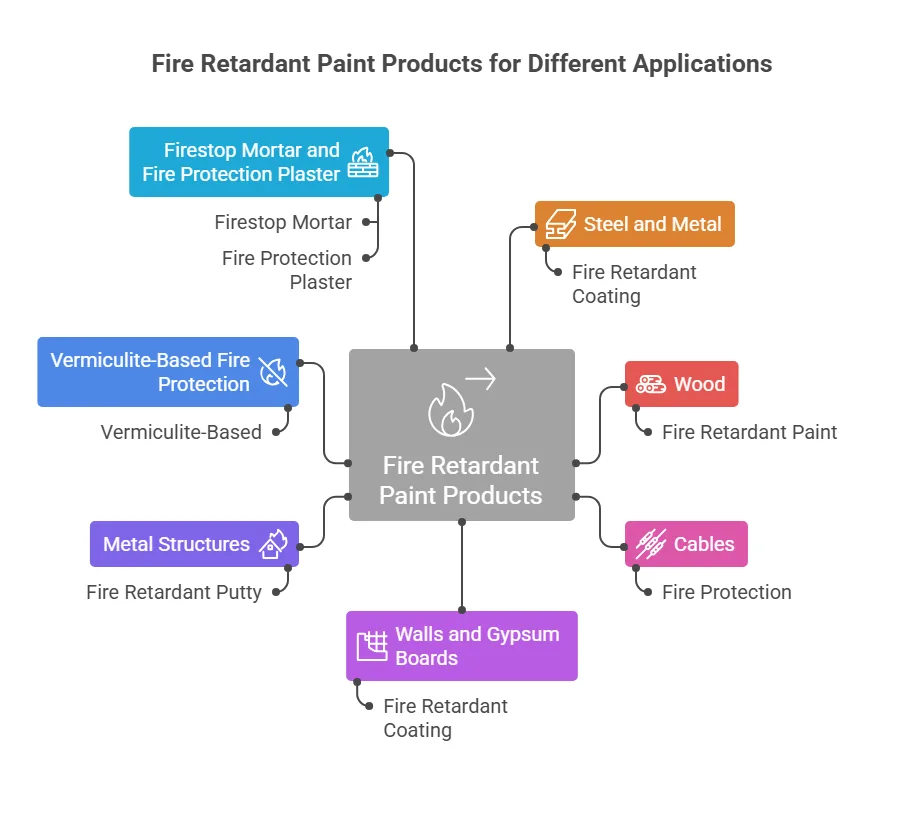
Fire protection requirements vary according to the substrate, operating environment, and intended application. A fire retardant paint manufacturer may therefore offer different coating systems for steel, wood, cables, walls, gypsum boards, and specialized structural protection. Selecting the appropriate product for the specific substrate is important for achieving the intended fire-protection performance.
Fire Retardant Coating for Steel and Metal
Fire retardant coatings for steel and metal structures are used to provide passive fire protection to structural and industrial components. Depending on the product specification, applications can include MS, SS, GI sheets, fabricated structures, and other metal surfaces.
For example, ALTIC’s FRP 050 is listed for FRC and GI sheet applications, while FRP 060 is specified for MS and SS surfaces. The required coating thickness and application system should be determined from the applicable product documentation and fire-test requirements.
Fire Retardant Paint for Wood
Wood requires a fire protection system because it is a combustible substrate. Fire retardant coatings can be formulated to improve the fire performance of wooden surfaces and reduce the effects of flame exposure.
ALTIC FRP 040 and FRP 080 are included in the fire-retardant product range for wood-related applications. The appropriate product should be selected according to the type of wood, surface condition, intended environment, and documented performance requirements.
Fire Protection for Cables
Electrical and instrumentation cables can require specialized fire protection because maintaining circuit integrity can be important during a fire emergency. Cable protection coatings are designed specifically for cable surfaces and should not be replaced with a general-purpose fire retardant coating.
ALTIC FRP 007 is a dedicated cable fire protection product. Its application should follow the product’s specified system, required thickness, and applicable test documentation.
Fire Retardant Coating for Walls and Gypsum Boards
Walls and gypsum boards may require fire-protection coatings as part of a building’s passive fire protection system. The coating system must be compatible with the substrate and suitable for the required fire-performance application.
ALTIC FRP 090 is listed for wall and gypsum board applications. Surface preparation, application thickness, drying, and the complete tested system should be considered when using a fire retardant coating on these substrates.
Fire Retardant Putty for Metal Structures
Fire retardant putty can be used as part of a specialized protection system for metal structures. It can be particularly relevant where a putty-based protective layer is specified for structural or detail-oriented applications.
ALTIC FR Putty 010 is listed for metal and structural applications. Its use should follow the manufacturer’s technical requirements and the applicable fire-test documentation for the intended system.
Vermiculite-Based Fire Protection
Vermiculite-based fire protection provides a mineral-based approach to protecting structures from elevated temperatures. It can be used for structural, metal, and wall applications where a thicker insulating protection layer is appropriate.
ALTIC’s vermiculite range includes systems for structure, metal, and wall protection. The product system should be selected according to the substrate, application environment, required protection level, and specified application thickness.
Firestop Mortar and Fire Protection Plaster
Firestop mortar and fire protection plaster are additional materials used for specialized passive fire protection applications. They can be considered where a mortar or plaster-based protective system is specified rather than a conventional paint coating.
ALTIC’s product range includes Firestop Mortar 0120 and Fire Resistant & Heat Proof Plaster 022. These products should be applied according to their respective technical specifications and the requirements of the particular construction or industrial application.
ALTIC Fire Retardant Paint Solutions in Vadodara
Fire Protection Products Manufactured by Ugam Technology
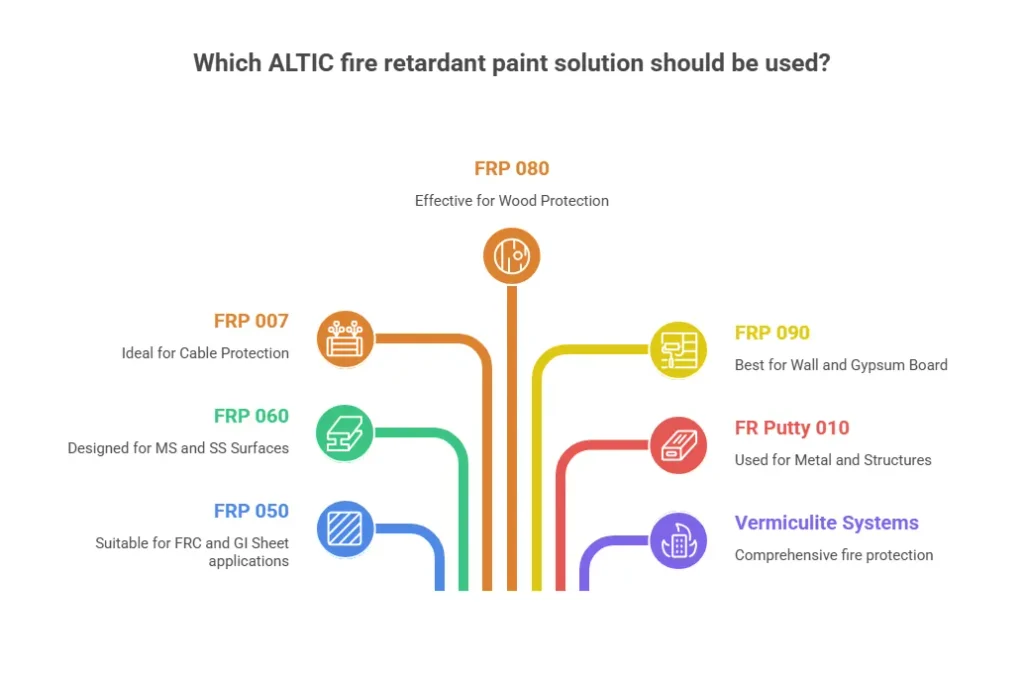
ALTIC Paint offers fire retardant and passive fire protection solutions manufactured by Ugam Technology in Vadodara. The product range covers different substrates and applications, including metal, steel, cables, wood, walls, gypsum boards, and structural protection.
The range includes specialized coatings and protective materials such as FRP coatings, fire retardant putty, and vermiculite-based systems. Product selection should be based on the substrate, required fire protection performance, application conditions, and relevant technical documentation.
FRP 050 for FRC and GI Sheet
ALTIC FRP 050 is a fire retardant coating specified for FRC and GI sheet applications. It is intended for use where these substrates require additional fire protection through a dedicated coating system.
Application should follow the specified surface preparation, coating thickness, drying, and technical requirements for the product.
FRP 060 for MS and SS Surfaces
ALTIC FRP 060 is designed for MS and SS surfaces, making it suitable for selected steel and metal applications requiring fire protection.
The coating system should be selected according to the substrate condition and required fire-resistance performance. Correct surface preparation and application thickness are important for achieving the specified coating performance.
FRP 007 for Cable Protection
ALTIC FRP 007 is a specialized fire protection coating for cables. Cable protection requires a product specifically designed and tested for cable applications because the objective may include maintaining protection and circuit performance during fire exposure.
The product should be applied according to its specified application procedure, thickness requirements, and supporting technical documentation.
FRP 080 for Wood Protection
ALTIC FRP 080 is a fire retardant coating for wood applications. It can be used where wooden surfaces require an additional layer of fire protection.
The coating system should be selected according to the type and condition of the wood, intended environment, and documented product requirements. Proper surface preparation and application are important for maintaining uniform protection across the wooden surface.
FRP 090 for Wall and Gypsum Board
ALTIC FRP 090 is specified for walls and gypsum boards. These substrates may form part of building partitions and interior construction where fire performance is an important consideration.
The product should be applied according to the specified system and substrate requirements, with attention to surface condition, coating thickness, drying, and final inspection.
FR Putty 010 for Metal and Structures
ALTIC FR Putty 010 is a fire protection putty specified for metal and structural applications. It provides an alternative protective material where a putty-based fire protection system is appropriate.
Before application, the substrate and complete protection system should be evaluated against the project’s fire-resistance requirements and the manufacturer’s technical documentation.
Vermiculite Fire Protection Systems
ALTIC also offers vermiculite-based fire protection systems for structural, metal, and wall applications. Vermiculite protection uses a mineral-based insulating layer to provide thermal protection to the underlying substrate.
These systems can be considered where a thicker protective layer is appropriate for the project. Product selection, preparation, application thickness, curing, and environmental conditions should follow the applicable technical requirements for the specified vermiculite system.
Fire Testing, Standards and Certification
Importance of Fire-Tested Coating Systems
Fire-test evidence helps establish how a coating system performs under defined fire exposure conditions. For industrial fire protection, the performance of a coating should be considered as a complete system rather than based only on the product name or a general statement such as “fire resistant.”
The substrate, coating formulation, application thickness, primer or supporting layers, fire exposure, and test conditions can all affect the reported performance. Therefore, project teams should select products with technical documentation relevant to the intended application.
Indian Standards and Applicable Requirements
For projects in India, applicable Indian Standards (IS) and project-specific fire-safety requirements should be reviewed before selecting a fire protection coating. The relevant requirement can vary according to the substrate, building type, application, and specified fire-resistance period.
Where a manufacturer provides an IS reference or test claim, the documentation should be checked to understand exactly which product, substrate, application, and performance requirement it covers. A standard associated with one coating application should not automatically be assumed to apply to every product or substrate.
Reviewing Fire-Test Reports
A fire-test report should be reviewed carefully rather than relying only on a certificate number or stated fire rating. Important details include the tested substrate, coating system, applied thickness, test method, fire exposure conditions, test duration, application procedure, and limitations.
For a project-specific selection, the test evidence should be relevant to the proposed coating system and intended application. Technical data sheets and application instructions should also be reviewed alongside the fire-test report.
Understanding Fire Resistance Ratings
Fire resistance ratings indicate the period for which a tested protection system can meet specified performance criteria under defined fire-test conditions. Depending on the project, requirements may be expressed in minutes such as 30, 60, 90, or 120 minutes.
A stated rating should not be treated as a universal property of the paint. The achievable protection period can depend on the substrate, coating thickness, geometry, fire exposure, and complete tested system. The required rating should therefore be established from the project specification and applicable test documentation.
Importance of Correct DFT for Fire Protection
Dry Film Thickness (DFT) is a critical parameter in many fire protection coating systems. Applying less than the specified thickness can result in inadequate protection, while excessive or uneven application may create drying, adhesion, cracking, or other application problems.
DFT should be controlled throughout the application process using appropriate measurement equipment. Measurements should be recorded and compared with the approved coating specification so that the completed system achieves the required thickness consistently across the protected surface.
Industrial Applications of Fire Retardant Paint in Vadodara
Manufacturing Plants
Manufacturing facilities contain production equipment, electrical installations, storage areas, steel structures, and other components that may require passive fire protection. Fire retardant coatings can be considered for suitable substrates where additional protection against fire and heat exposure is required.
Applications may include structural steel, metal surfaces, walls, cables, and other components, depending on the coating system and project requirements.
Chemical and Process Industries
Chemical and process facilities can contain process equipment, pipelines, storage systems, electrical installations, and structural supports operating in demanding environments. Fire protection requirements in these facilities need to account for both fire exposure and the surrounding industrial conditions.
The selected coating system should be suitable for the specific substrate and environmental exposure, with appropriate technical documentation supporting the intended application.
Warehouses and Storage Facilities
Warehouses and storage facilities may contain large quantities of stored materials and often use steel structures for roofs, frames, platforms, and supporting elements. Fire retardant coatings can be used on suitable surfaces as part of the facility’s passive fire protection strategy.
The required coating system should be selected according to the substrate, required fire-resistance period, storage environment, and applicable project specifications.
Power and Utility Infrastructure
Power and utility facilities contain electrical systems, equipment supports, steel structures, cables, and other infrastructure where fire protection can be an important consideration. Specialized fire protection coatings may be used for appropriate substrates and applications.
Product selection should consider operating conditions, substrate compatibility, environmental exposure, required protection period, and the applicable technical documentation.
Commercial and Industrial Buildings
Commercial and industrial buildings may use structural steel, metal partitions, walls, gypsum boards, cables, and wooden components. Different fire protection products may therefore be required for different substrates within the same facility.
A coating system should be selected according to the specific application rather than applying one fire protection product across all surfaces.
Steel Structures and Equipment
Steel structures and industrial equipment may require fire protection where exposure to elevated temperatures could affect structural or operational performance. Fire retardant or intumescent systems can be considered for suitable steel and metal applications.
For structural steel, factors such as section geometry, required fire rating, coating thickness, primer compatibility, surface preparation, and environmental conditions should be evaluated before application.
How to Select the Right Fire Retardant Paint
Identify the Substrate
The first step is to identify the surface that requires fire protection. Steel, MS, SS, GI sheet, wood, cables, walls, and gypsum boards can require different coating systems because their physical properties and fire-protection requirements are different.
Select a product specifically intended for the substrate rather than assuming that a general-purpose fire retardant paint is suitable for every application. The substrate condition should also be assessed for rust, contamination, moisture, existing coatings, or surface defects before application.
Determine the Required Fire Rating
Establish the required fire-resistance period before selecting the coating. Project requirements may specify a particular duration, such as 30, 60, 90, or 120 minutes, depending on the application and applicable requirements.
The required rating should be matched with the manufacturer’s tested system and specified coating thickness. A coating should not be selected solely because its product name indicates fire resistance.
Consider Indoor or Outdoor Exposure
The application environment can affect coating selection and the complete protection system. Indoor applications may have relatively controlled conditions, while exterior or exposed industrial environments can involve moisture, rain, UV exposure, temperature changes, and corrosion.
For exposed applications, check whether the fire protection system requires a compatible primer, protective topcoat, or additional environmental protection according to the manufacturer’s technical specifications.
Check Primer and Topcoat Compatibility
Primer and topcoat compatibility should be confirmed before applying a fire retardant coating. An incompatible layer can affect adhesion, drying, durability, and the performance of the overall coating system.
Use the primer and topcoat specified or approved for the particular fire protection system. Avoid combining products from different systems unless their compatibility and suitability have been technically confirmed.
Review Coverage and Required DFT
Coverage information helps estimate material requirements, but fire protection should primarily be controlled through the specified Dry Film Thickness (DFT). The required DFT can vary according to the substrate, fire rating, coating system, and application conditions.
During application, measure the coating thickness using appropriate inspection equipment and maintain records where required. Applying too little material can compromise the intended protection, while excessive or uneven thickness can create application and curing problems.
Verify Testing and Technical Documentation
Before final selection, review the available technical data sheet, fire-test report, certification documents, application instructions, and other relevant documentation. Check that the evidence corresponds to the intended substrate, coating system, thickness, fire exposure, and required fire-resistance period.
For industrial projects, technical documentation should be evaluated together with the project specification and applicable standards. This provides a stronger basis for selecting a fire retardant paint system than relying only on product claims or price.
Fire Retardant Paint Application Process
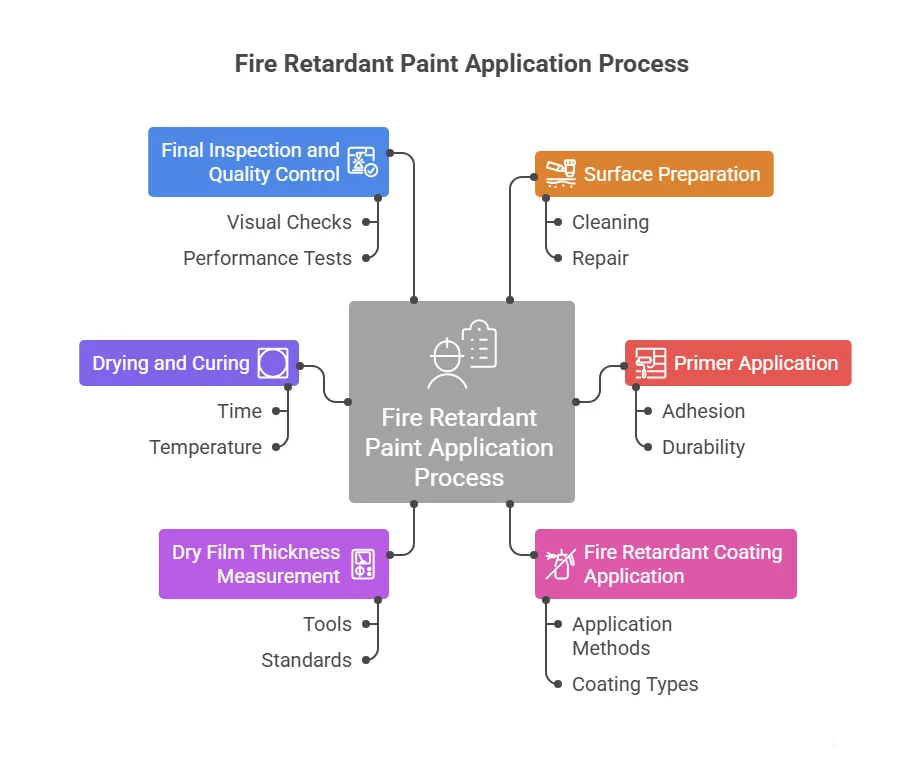
Surface Preparation
Proper surface preparation is essential for achieving good adhesion and long-term coating performance. The steel or other substrate should be clean, dry, and free from rust, oil, grease, dust, loose particles, moisture, and unsuitable existing coatings.
The preparation method should be selected according to the substrate condition and the coating manufacturer’s specifications. Any surface defects or contamination should be addressed before proceeding to the next stage.
Primer Application
Where the specified fire protection system requires a primer, apply a compatible primer uniformly over the prepared surface. The primer provides a suitable base for the fire retardant coating and can also contribute to corrosion protection on metal substrates.
Primer type, application thickness, drying time, and recoat interval should follow the approved coating system and manufacturer’s technical instructions. The surface should be inspected before applying the fire retardant layer.
Fire Retardant Coating Application
Apply the fire retardant coating using the recommended method, such as airless spray, brush, or roller, depending on the product and project requirements. The coating should be applied uniformly without excessive runs, sagging, pinholes, or missed areas.
Multiple coats may be required to achieve the specified protection thickness. Allow each coat to dry sufficiently before applying the next layer, following the manufacturer’s recommended application conditions and recoat intervals.
Dry Film Thickness Measurement
Dry Film Thickness (DFT) is a critical quality-control parameter in fire protection coating systems. The required thickness should be established from the tested coating system and the specified fire-resistance requirement.
After the coating has dried sufficiently, measure the DFT at appropriate locations using a suitable thickness gauge. Record the measurements and identify areas where additional coating is required to achieve the specified thickness.
Drying and Curing
Adequate drying and curing are necessary before the coated surface is exposed to service conditions or subsequent coating layers. Drying time can be affected by ambient temperature, relative humidity, ventilation, coating thickness, and the number of coats applied.
Follow the manufacturer’s specified drying and curing conditions rather than relying only on surface dryness. The coating should reach the required condition before handling, topcoating, inspection, or service exposure.
Final Inspection and Quality Control
The completed fire protection system should be inspected to confirm that the coating is continuous, properly bonded, and free from visible defects such as cracking, peeling, blistering, pinholes, sagging, or uncoated areas.
Quality control should include verification of surface preparation, primer application, coating thickness, drying or curing conditions, and any specified inspection or test requirements. DFT records and application details should be maintained for project documentation and future maintenance.
A properly documented inspection process helps confirm that the installed coating system corresponds with the specified fire protection requirements and provides a useful reference for future inspection and repair.
Common Mistakes When Choosing a Fire Retardant Paint Manufacturer
Choosing Only on Price
Selecting a fire retardant paint manufacturer based only on the lowest price can overlook important factors such as product performance, testing, technical documentation, application requirements, and support. A lower material cost may also become less economical if additional coats, higher consumption, or corrective work are required.
Compare manufacturers based on the complete coating system, required DFT, coverage, documentation, technical support, and project requirements rather than price alone.
Ignoring Fire-Test Documentation
Fire protection claims should be supported by appropriate technical and test documentation. Ignoring fire-test reports or certification can make it difficult to determine whether the coating has been evaluated for the intended substrate, thickness, fire exposure, and protection period.
Before selection, request the relevant technical data sheet, fire-test documentation, application instructions, and certification where applicable. The documents should be reviewed against the actual project requirements.
Selecting the Wrong Product for the Substrate
Fire retardant coatings are not automatically interchangeable between steel, wood, cables, walls, gypsum boards, and other substrates. Each surface can require a different formulation, application method, and tested coating system.
The substrate should therefore be identified before product selection. The manufacturer’s technical documentation should confirm that the selected product is intended for the specific surface and application.
Applying Incorrect Coating Thickness
Incorrect coating thickness is a common application problem. Insufficient thickness may prevent the system from achieving its specified fire-protection performance, while excessive or uneven application can create drying, curing, adhesion, or appearance issues.
The required DFT should be established from the approved coating system and applied under controlled conditions. Measurements should be taken during inspection to verify that the specified thickness has been achieved.
Ignoring Primer Compatibility
Using an unsuitable primer beneath a fire retardant coating can affect adhesion and the performance of the complete coating system. This is particularly important for metal substrates where corrosion protection and fire protection may form part of the same system.
The primer should be compatible with the fire retardant coating and approved or specified by the manufacturer. Existing coatings should also be evaluated before recoating.
Not Considering Technical Support
Fire protection coating performance depends not only on the product but also on correct preparation, application, thickness control, drying, curing, and inspection. Choosing a manufacturer without considering technical support can make it more difficult to resolve application issues or meet project specifications.
A suitable manufacturer should be able to provide relevant technical documentation and guidance on substrate preparation, primer selection, application methods, DFT requirements, drying conditions, and inspection procedures.
Why Ugam Technology for Fire Retardant Paint in Vadodara?
Industrial Coating Manufacturing Experience
Ugam Technology has been operating in Vadodara since 2011, with a focus on industrial paints and protective coating solutions. Its ALTIC Paint range covers applications across fire protection, heat resistance, anti-corrosion, flooring, waterproofing, and other industrial coating requirements.
For fire protection projects, this industrial coating experience provides a foundation for understanding substrate preparation, coating application, thickness control, and project-specific requirements.
Complete Fire Protection Product Range
Ugam Technology offers a range of fire protection products designed for different substrates and applications. The ALTIC range includes fire retardant coatings for metal and steel, wood, cables, walls, and gypsum boards, along with fire protection putty and vermiculite-based systems.
Products such as FRP 050, FRP 060, FRP 007, FRP 080, FRP 090, and FR Putty 010 can be selected according to the substrate and specified application requirements. Firestop mortar and fire-resistant plaster are also available for specific passive fire protection applications.
Technical Consultation and Application Support
Selecting and applying a fire retardant coating requires attention to surface preparation, primer compatibility, application method, coating thickness, drying conditions, and inspection. Ugam Technology can provide technical consultation to help customers understand the appropriate product and application requirements for their project.
Technical discussions can also help identify substrate conditions, required protection levels, material requirements, and application considerations before the coating system is finalized.
Local Manufacturing and Supply from Vadodara
With manufacturing operations in Vadodara, Ugam Technology can support customers looking for industrial coating products from a local supplier. Local manufacturing and supply can simplify communication, product coordination, documentation, and project-related requirements for customers in Vadodara and surrounding industrial areas.
For larger or phased projects, product availability and delivery requirements should be discussed with the manufacturer in advance.
Project-Specific Fire Protection Solutions
Fire protection requirements can vary according to the substrate, fire-resistance period, environmental exposure, coating thickness, existing coating system, and project specifications. A single fire retardant product may therefore not be suitable for every application.
Ugam Technology can evaluate the project requirements and help identify an appropriate ALTIC fire protection product or coating system. The final selection should be based on the relevant technical documentation, tested performance, substrate compatibility, application requirements, and applicable project standards.
Frequently Asked Questions About Fire Retardant Paint Manufacturers in Vadodara
Who manufactures fire retardant paint in Vadodara?
Ugam Technology, based in Vadodara, manufactures industrial coating products under the ALTIC Paint brand. Its fire protection range includes products for metal and steel, wood, cables, walls, gypsum boards, and other specific applications.
How do I choose a fire retardant paint manufacturer?
Evaluate the manufacturer based on product suitability, fire-test documentation, technical data sheets, quality-control practices, manufacturing capability, application guidance, supply capacity, and technical support. The manufacturer’s products should also be appropriate for the specific substrate, required fire rating, environmental conditions, and project specifications.
What surfaces can fire retardant paint protect?
Fire protection coatings are available for different substrates, but the appropriate product depends on the application. Common surfaces include steel, MS, SS, GI sheets, wood, cables, walls, and gypsum boards. Products should always be selected according to the manufacturer’s technical documentation for the intended substrate.
What fire rating can fire retardant paint provide?
The fire rating depends on the specific coating system, substrate, coating thickness, fire-test method, and application conditions. Fire protection systems may be designed for different protection periods, including 30, 60, 90, or 120 minutes, where supported by relevant testing and documentation. A particular rating should not be assumed without checking the tested system.
Is fire-test certification important when selecting a manufacturer?
Yes. Fire-test reports and relevant certification help verify how a coating system performed under defined test conditions. Documentation should be reviewed to confirm the substrate, coating system, thickness, fire exposure, test method, and protection period relevant to the intended application.
Can fire retardant paint be used on steel structures?
Yes, specific fire protection coatings can be used on steel structures such as beams, columns, frames, and other structural members. The selected system must be suitable for the steel substrate and specified fire-resistance requirement. Surface preparation, primer compatibility, DFT, application method, and inspection are also important.
Does the manufacturer provide technical application support?
Technical support can be an important part of industrial fire protection projects. Ugam Technology can provide guidance related to product selection, substrate preparation, primer compatibility, application methods, coating thickness, drying conditions, and inspection requirements, depending on the project and product.
Conclusion – Choosing a Fire Retardant Paint Manufacturer in Vadodara
Importance of Selecting the Right Fire Protection System
Selecting fire retardant paint should begin with the actual application requirements rather than the product name alone. The substrate, required fire-resistance period, exposure conditions, coating thickness, and applicable project specifications should all be considered when selecting the protection system.
Evaluating Product Quality and Fire-Test Documentation
A reliable selection should be supported by appropriate technical documentation, including technical data sheets, fire-test reports, certification where applicable, and application instructions. These documents help establish whether the coating system is suitable for the intended substrate, thickness, fire exposure, and required protection period.
Importance of Technical Support and Application Expertise
Fire protection performance depends on correct surface preparation, primer compatibility, application, DFT control, drying, curing, and inspection. Technical guidance from the manufacturer or qualified applicator can help ensure that the specified coating system is installed according to its requirements.
Building Long-Term Industrial Fire Protection
Fire retardant paint is one component of an overall passive fire protection strategy. Regular inspection, maintenance, appropriate repairs, and documentation can help preserve the condition of the coating system over its service life.
For industrial projects in Vadodara and surrounding areas, Ugam Technology provides ALTIC fire protection coating solutions for different substrates and applications. Project requirements should be discussed with the manufacturer to identify the appropriate product and application system based on relevant technical documentation and tested performance.