

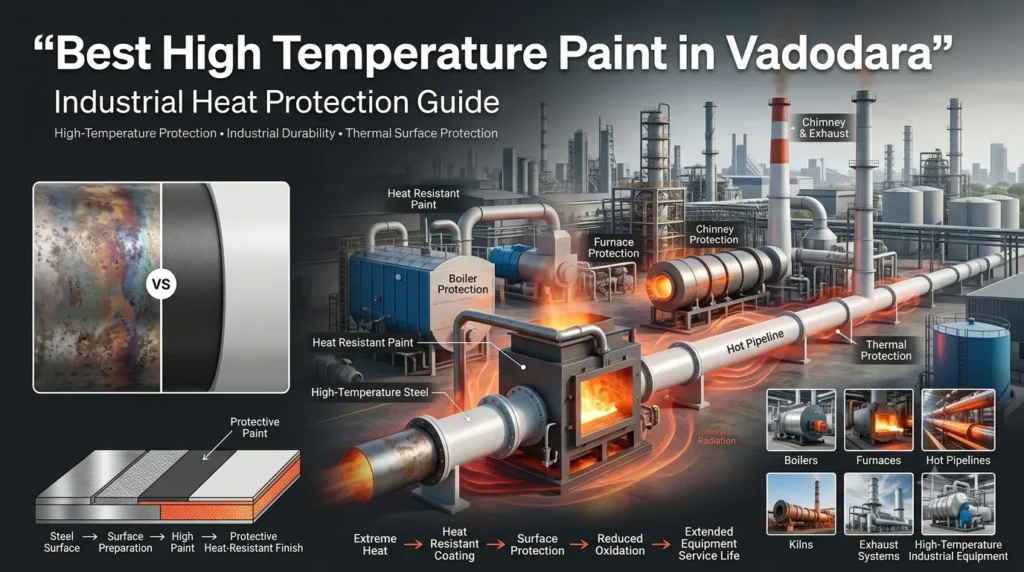
Industrial equipment operating under elevated temperatures requires suitable surface protection to maintain performance, durability, and service life. Boilers, furnaces, chimneys, pipelines, kilns, exhaust systems, and other high-temperature equipment can experience continuous thermal exposure that may affect coating performance and surface condition.
High temperature paint is designed for applications where conventional industrial paints may not be suitable because of elevated operating temperatures. Selecting the right coating requires consideration of the operating temperature, substrate, surface condition, application method, and service environment.
Introduction to High Temperature Paint
What Is High Temperature Paint?
High temperature paint is a specialized industrial coating designed for surfaces exposed to elevated operating temperatures. It is used where conventional paints may not be suitable for continuous or intermittent heat exposure. Depending on the coating formulation and specified temperature range, high temperature paints can be used on suitable industrial metal surfaces and equipment.
The selection of high temperature paint should be based on the actual surface temperature, substrate, operating conditions, and application requirements. Using the appropriate coating system can help provide durable surface protection while maintaining coating performance under specified thermal conditions.
Why High Temperature Protection Is Important for Industrial Equipment
Industrial equipment such as boilers, furnaces, chimneys, pipelines, kilns, and exhaust systems can be exposed to significant heat during operation. Continuous thermal exposure and repeated heating and cooling can place additional stress on protective coatings and underlying surfaces.
A suitable high temperature coating provides a protective layer designed for the intended service temperature. It can help protect appropriate industrial surfaces while also providing a suitable finish for equipment exposed to heat.
For this reason, industries should consider factors such as maximum operating temperature, surface material, thermal cycling, environmental exposure, surface preparation, and application method when selecting a high temperature paint.
Where High Temperature Paint Is Used in Vadodara Industries
Vadodara is an important industrial centre with manufacturing and process-based industries where equipment can operate under elevated temperatures. High temperature paint can be considered for suitable applications involving:
- Boilers and associated metal equipment
- Furnaces and heating equipment
- Chimneys and exhaust systems
- Hot pipelines and process lines
- Kilns and industrial processing equipment
- Industrial machinery exposed to elevated temperatures
- Metal structures and equipment operating under specified heat conditions
Choosing the right high temperature coating requires understanding the equipment’s actual operating conditions rather than selecting a product based only on a general temperature rating. For industries in Vadodara, working with a manufacturer or technical coating supplier can help identify a coating system appropriate for the substrate and required temperature range.
What Makes a High Temperature Paint Suitable for Industrial Applications?
Choosing a high temperature paint for industrial equipment involves more than simply checking its maximum temperature rating. The coating should be selected according to the operating temperature, substrate, thermal conditions, environmental exposure, and application requirements. A suitable coating system should also be applied according to the manufacturer’s technical recommendations.
Temperature Resistance
Temperature resistance is one of the most important factors when selecting a high temperature paint. Different industrial equipment operates at different temperatures, so the coating should be suitable for the actual surface temperature of the equipment.
Boilers, furnaces, pipelines, chimneys, kilns, and exhaust systems may require different temperature-resistant coating systems. Selecting a coating with an appropriate temperature range helps ensure that the paint is suitable for its intended service conditions.
It is important to consider the continuous operating temperature as well as occasional peak temperatures when choosing the coating.
Adhesion and Surface Compatibility
A high temperature coating should be compatible with the surface on which it is applied. Metal substrates such as carbon steel, stainless steel, and other industrial surfaces may have different preparation and coating requirements.
Good adhesion depends significantly on proper substrate preparation. The surface should be free from contaminants such as oil, grease, dust, loose rust, moisture, and other materials that can interfere with coating adhesion.
Before application, the substrate and existing coating condition should therefore be evaluated to determine the appropriate preparation and coating system.
Resistance to Thermal Cycling
Industrial equipment may not remain at one temperature throughout its operating cycle. It can repeatedly heat up during operation and cool down after shutdown.
These repeated temperature changes are known as thermal cycling. A coating system should be appropriate for the expected heating and cooling conditions of the equipment.
When selecting high temperature paint, industries should consider whether the equipment experiences continuous heat exposure, intermittent heating, or frequent temperature changes.
Durability Under Industrial Conditions
Temperature is not the only factor affecting coating performance. Industrial surfaces can also be exposed to moisture, chemicals, outdoor weather conditions, abrasion, dust, and mechanical contact.
Therefore, the coating should be selected according to the complete service environment. For example, a coating used on an outdoor chimney may have different requirements from one used on equipment inside a controlled industrial area.
Evaluating both thermal exposure and surrounding operating conditions helps industries select a more appropriate protective coating system.
Proper Surface Preparation and Application
Even a technically suitable high temperature paint may not perform as intended if the surface is inadequately prepared or the coating is incorrectly applied.
Surface preparation, recommended coating thickness, application method, drying time, curing requirements, and service conditions should be followed according to the product’s technical documentation.
Depending on the coating system, application may involve methods such as brush, roller, or spray. The required number of coats and thickness should be determined from the manufacturer’s technical recommendations.
Proper preparation and application help establish the coating system required for reliable performance under the specified industrial operating conditions.
Applications of High Temperature Paint

High temperature paint is used across industries where equipment and metal surfaces are exposed to elevated temperatures. The appropriate coating depends on the surface temperature, substrate, operating environment, and required coating system. Common industrial applications include boilers, furnaces, chimneys, pipelines, kilns, exhaust systems, and heat-exposed machinery.
High Temperature Paint for Boilers
Boilers operate under elevated temperatures and require suitable protective coatings for applicable external metal surfaces and associated equipment. High temperature paint can be selected according to the boiler’s surface temperature and operating conditions.
Before application, the substrate condition, temperature range, surface preparation, and coating requirements should be evaluated to ensure compatibility with the intended service environment.
High Temperature Paint for Furnaces
Furnaces generate significant heat and can expose surrounding metal surfaces and equipment to elevated temperatures. A suitable high temperature coating can provide a protective finish on appropriate surfaces where the coating’s specified temperature range matches the application.
The coating should be selected based on the actual surface temperature rather than only the internal furnace temperature.
High Temperature Paint for Chimneys
Industrial chimneys are exposed to heat from hot gases and exhaust processes. High temperature paint can be used on suitable chimney surfaces to provide a heat-resistant protective coating and maintain the appearance of exposed metal surfaces.
For outdoor chimneys, factors such as weather exposure, moisture, surface condition, and operating temperature should also be considered.
High Temperature Paint for Pipelines
Hot process pipelines can develop elevated surface temperatures depending on the material being transported and operating conditions. High temperature paint can be considered for suitable pipeline surfaces where conventional coatings may not meet the required temperature conditions.
The coating selection should account for surface temperature, thermal cycling, substrate condition, and surrounding industrial environment.
High Temperature Paint for Kilns
Kilns used in industrial processing can operate under continuous or intermittent high-temperature conditions. Suitable high temperature coatings may be applied to appropriate external metal surfaces and supporting equipment.
The coating system should be selected according to the kiln’s operating temperature and the specific substrate requiring protection.
High Temperature Paint for Exhaust Systems
Exhaust systems can experience substantial heat during operation. High temperature paint can be used on suitable metal exhaust components where the coating is designed for the expected operating temperature.
Proper surface preparation is particularly important because exhaust components may also be exposed to dirt, oil, moisture, and repeated heating and cooling.
High Temperature Paint for Industrial Machinery
Various types of industrial machinery and process equipment can experience elevated surface temperatures during operation. High temperature paint can be considered where equipment surfaces require a coating capable of operating within a specified temperature range.
Applications may include heat-exposed metal equipment, process machinery, heated pipelines, and other industrial components. Selecting the coating according to the equipment’s actual temperature and service environment helps ensure that the coating system is appropriate for its intended application.
Types of High Temperature Paint Based on Operating Temperature
High temperature paints can be broadly selected according to the temperature conditions of the surface being coated. The required coating depends on the maximum operating temperature, continuous heat exposure, thermal cycling, substrate, and service environment. Instead of selecting a coating only by its advertised temperature rating, the actual surface temperature should be considered.
Coatings for Moderate Temperature Applications
Moderate-temperature applications involve industrial surfaces exposed to elevated heat but operating below the higher temperature ranges encountered in furnaces and other extreme thermal environments.
These coatings may be suitable for applications such as heated pipelines, certain boilers, industrial equipment, and exhaust-related surfaces, provided the actual surface temperature falls within the coating’s specified operating range.
Important considerations include surface preparation, substrate compatibility, coating thickness, and the expected heating and cooling cycle.
Coatings for High Temperature Applications
High temperature coatings are designed for industrial surfaces exposed to substantially elevated temperatures. They may be considered for applications involving boilers, furnaces, chimneys, kilns, pipelines, and other heat-exposed equipment.
The coating should be selected according to the actual operating temperature of the surface. Where equipment experiences continuous heating or repeated thermal cycling, the coating system should also be evaluated for those service conditions.
Coatings for Very High Temperature Applications
Very high temperature applications require specialized coating systems designed for extreme thermal exposure. Such applications can include certain furnace components, high-temperature process equipment, kilns, chimneys, and other industrial surfaces operating at particularly high temperatures.
At these temperatures, product selection becomes especially important. Factors such as the maximum surface temperature, duration of heat exposure, substrate, thermal cycling, surface preparation, and curing requirements should be reviewed against the manufacturer’s technical documentation.
For all three temperature categories, the actual surface temperature should be measured or established before selecting the coating. A technically appropriate temperature rating, combined with correct surface preparation and application, is essential for achieving the intended coating performance.
Benefits of Using High Temperature Paint
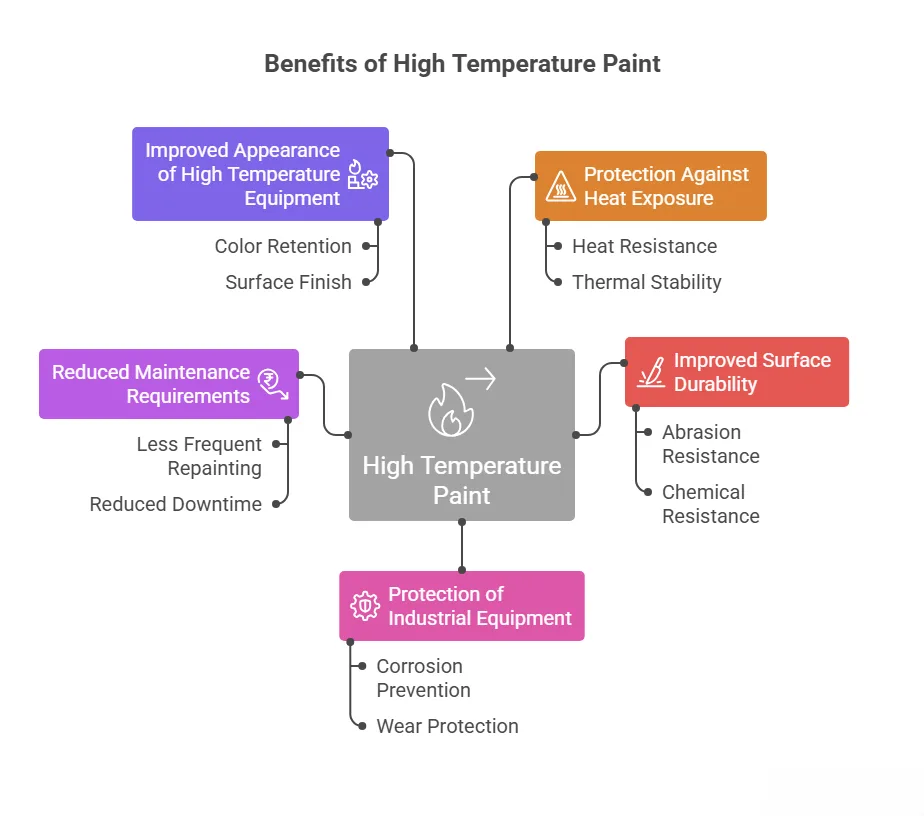
High temperature paint is selected for industrial applications where surfaces are exposed to elevated operating temperatures. When the coating is matched correctly to the substrate and service conditions, it can provide heat-resistant surface protection and help maintain the condition and appearance of industrial equipment.
Protection Against Heat Exposure
High temperature paint is formulated for use on surfaces exposed to specified elevated temperatures. It creates a protective coating layer that is designed to perform within its recommended temperature range.
This makes high temperature coatings suitable for applications involving boilers, furnaces, chimneys, pipelines, kilns, exhaust systems, and other heat-exposed equipment, subject to the product’s technical specifications.
Improved Surface Durability
Industrial equipment can experience repeated heating and cooling during normal operation. A suitable high temperature coating can provide a durable protective layer over the substrate under the specified service conditions.
Proper product selection, surface preparation, coating thickness, and application are important factors in achieving the expected durability of the coating system.
Protection of Industrial Equipment
Heat-exposed equipment can require specialized surface protection depending on its operating conditions. High temperature paint can be used on appropriate industrial substrates to provide a protective coating designed for elevated-temperature environments.
It can be considered for metal equipment, pipelines, boilers, furnaces, chimneys, kilns, and industrial machinery, provided the coating is compatible with the substrate and operating temperature.
Reduced Maintenance Requirements
A properly selected and applied coating can help maintain the protective condition of industrial surfaces during their intended service period. This may help reduce the need for frequent coating-related maintenance when the coating remains suitable for the operating environment.
However, maintenance requirements depend on factors such as temperature exposure, surface condition, thermal cycling, environmental conditions, mechanical damage, and coating quality.
Improved Appearance of High Temperature Equipment
In addition to functional surface protection, high temperature paint can provide a consistent and finished appearance to suitable industrial equipment.
It can help maintain the visual condition of boilers, chimneys, pipelines, furnaces, exhaust systems, and other exposed metal equipment where an appropriate high temperature coating system is specified.
How to Select the Right High Temperature Paint
Selecting the right high temperature paint requires evaluating the actual operating conditions of the equipment rather than choosing a coating based only on its advertised temperature rating. The maximum operating temperature, substrate material, application environment, coating thickness, and technical documentation should all be considered before selecting a coating system.
Identify the Maximum Operating Temperature
The first step is to determine the actual surface temperature of the equipment during operation. Different industrial applications can operate at significantly different temperatures, so the coating should have a specified temperature range suitable for the intended service conditions.
Consider both the normal continuous operating temperature and any expected peak temperature. This is particularly important for boilers, furnaces, chimneys, pipelines, kilns, and exhaust systems.
Consider the Substrate Material
The substrate on which the paint will be applied is another important selection factor. Industrial surfaces may include carbon steel, stainless steel, and other metal substrates, each with potentially different preparation and coating requirements.
Before selecting a product, check whether the coating is recommended for the specific substrate and whether a primer, surface treatment, or particular preparation method is required.
Evaluate Application Conditions
The surrounding service environment should also be evaluated. Consider factors such as:
- Continuous or intermittent heat exposure
- Heating and cooling cycles
- Indoor or outdoor installation
- Moisture and humidity
- Chemical exposure
- Abrasion or mechanical contact
- Existing coating condition
These conditions can influence the suitability and expected performance of the high temperature coating.
Check Coating Thickness Requirements
Coating thickness can affect the performance of an industrial coating system. The recommended dry film thickness (DFT), number of coats, and application method should be checked before application.
Applying too little or too much material may affect the intended coating performance. The manufacturer’s technical instructions should therefore be followed for the specific product and application.
Review Technical Data and Test Documentation
Before purchasing a high temperature paint, review the manufacturer’s Technical Data Sheet (TDS) and available supporting documentation.
Important information may include:
- Recommended operating temperature
- Recommended substrates
- Surface preparation requirements
- Application method
- Recommended coating thickness
- Drying and curing requirements
- Coverage information
- Finish and appearance
- Storage and handling instructions
- Applicable test or performance documentation
For industrial applications, technical documentation provides a more reliable basis for coating selection than marketing claims alone. The final coating should be selected according to the actual equipment conditions and the manufacturer’s specified application requirements.
High Temperature Paint Application Process
Proper application is essential for achieving the intended performance of a high temperature paint system. The application process should follow the product’s Technical Data Sheet (TDS) and take into account the substrate, operating temperature, coating system, and site conditions.
Surface Cleaning and Preparation
The surface should be properly cleaned and prepared before applying high temperature paint. Remove contaminants such as oil, grease, dust, loose rust, scale, moisture, and other materials that could affect coating adhesion.
The required preparation method depends on the substrate and its existing condition. Where applicable, mechanical or abrasive surface preparation may be used to achieve a suitable surface profile.
A properly prepared surface provides a better foundation for coating adhesion and overall coating performance.
Primer Requirements
Not every high temperature coating system requires a separate primer. Primer requirements depend on the specific product, substrate, operating temperature, and manufacturer’s recommended coating system.
Where a primer is specified, it should be compatible with the high temperature topcoat and applied according to the manufacturer’s recommendations.
The primer’s temperature resistance and compatibility should be verified before application, particularly for equipment exposed to elevated operating temperatures.
Paint Application
After surface preparation and any required primer application, the high temperature paint can be applied using the recommended application method.
Depending on the product, application may involve brush, roller, or spray. The recommended number of coats and coating thickness should be followed according to the product’s technical documentation.
Uniform application is important to achieve the specified coating thickness across the surface. Areas such as welds, edges, corners, joints, and difficult-to-reach sections should receive appropriate attention during application.
Drying and Curing
The coating should be allowed to dry and cure according to the manufacturer’s specified conditions before the equipment is returned to service.
Drying and curing requirements can vary depending on the coating formulation, ambient conditions, coating thickness, and application system. Some high temperature coatings may also require a specified heat-curing procedure.
The equipment should therefore not be exposed to operating temperatures before the coating has achieved the required curing condition.
Inspection Before Service
Before putting the equipment back into operation, the completed coating should be inspected to verify that the application meets the specified requirements.
Inspection may include checking:
- Surface coverage and uniformity
- Coating thickness
- Adhesion or visible coating defects, where applicable
- Pinholes, runs, sags, cracks, or missed areas
- Proper drying and curing
- Condition of edges, welds, joints, and difficult areas
Any identified defects should be corrected according to the coating manufacturer’s recommendations before the equipment is returned to service.
Following the manufacturer’s TDS throughout surface preparation, application, drying, curing, and inspection is important for achieving the intended performance of a high temperature coating system.
High Temperature Paint for Different Industrial Surfaces
High temperature paint can be used on various industrial surfaces that are exposed to elevated temperatures. However, the coating system should always be selected according to the substrate, actual surface temperature, operating environment, and manufacturer’s technical recommendations. Different surfaces may require different preparation methods and coating systems.
Steel Surfaces
Steel is widely used in industrial structures, machinery, pipelines, boilers, furnaces, and process equipment. When steel surfaces are exposed to elevated temperatures, a suitable high temperature coating can provide a protective finish designed for the specified operating conditions.
Before application, the steel surface should be properly cleaned and prepared. Rust, scale, oil, grease, dust, and other contaminants should be removed according to the coating manufacturer’s preparation requirements.
The selected coating should be compatible with the steel substrate and capable of handling the expected surface temperature.
Metal Pipelines
Metal pipelines carrying hot fluids or gases can develop elevated surface temperatures during operation. High temperature paint may be used on suitable pipeline surfaces where the coating’s specified temperature range matches the application.
Pipeline coating selection should consider the surface temperature, thermal cycling, substrate condition, environmental exposure, and existing coating system. Proper preparation is also important to achieve adequate adhesion and coating performance.
Boilers and Furnaces
Boilers and furnaces involve significant heat exposure and may contain multiple metal surfaces operating at different temperatures. High temperature paint can be considered for appropriate external surfaces and associated equipment when the coating is suitable for the actual service conditions.
The coating should not be selected solely based on the internal process temperature. The actual temperature of the surface being coated should be established before choosing the coating system.
Chimneys and Exhaust Systems
Chimneys and exhaust systems can be exposed to heat from hot gases and industrial processes. A suitable high temperature coating can provide a heat-resistant finish for applicable metal surfaces.
For outdoor applications, selection should also account for moisture, weather exposure, corrosion conditions, and temperature fluctuations. Exhaust components may additionally experience repeated heating and cooling cycles, making proper coating selection and application important.
Industrial Equipment
Industrial equipment operating near heat-generating processes may require specialized coating protection. High temperature paint can be considered for suitable metal machinery, process equipment, heated components, and other surfaces exposed to elevated temperatures.
The coating system should be selected according to the equipment’s actual operating temperature, substrate material, thermal cycling, surrounding environment, and required coating thickness.
For all industrial surfaces, proper surface preparation and adherence to the manufacturer’s Technical Data Sheet (TDS) are essential. The coating should be applied only within its specified temperature and substrate limitations.
High Temperature Paint in Vadodara
Vadodara is home to a wide range of manufacturing and process-based industries where equipment, pipelines, boilers, furnaces, and other industrial surfaces may operate under elevated temperatures. High temperature paint can be considered for suitable applications where conventional coatings are not designed for the required thermal conditions.
For industries searching for high temperature paint in Vadodara, product selection should be based on the actual surface temperature, substrate, operating environment, and application requirements rather than temperature rating alone.
Industrial Applications in Vadodara
High temperature coatings can be relevant to several industrial applications in Vadodara, particularly where equipment and metal surfaces are exposed to heat during manufacturing or processing.
Common applications include:
- Boilers and heating equipment
- Furnaces and process equipment
- Industrial chimneys
- Hot process pipelines
- Kilns
- Exhaust systems
- Heat-exposed industrial machinery
- Metal equipment operating at elevated temperatures
Different industries may have different temperature and environmental requirements. Therefore, the coating should be selected according to the specific equipment and service conditions.
Importance of Local Technical Support
Selecting a high temperature paint is not only about choosing a product with a suitable temperature rating. Industrial users may also need guidance regarding surface preparation, substrate compatibility, coating thickness, application method, drying, curing, and operating conditions.
Local technical support can help industries communicate their application requirements and identify the relevant product documentation before coating work begins.
For projects in Vadodara, access to a local manufacturer or supplier can also simplify communication, product availability, application guidance, and follow-up support.
Selecting a High Temperature Paint Manufacturer and Supplier
When selecting a high temperature paint manufacturer or supplier in Vadodara, industries should evaluate the product and technical support based on their specific requirements.
Important factors to consider include:
- Specified operating temperature range
- Compatibility with the intended substrate
- Recommended surface preparation
- Application method
- Recommended coating thickness
- Drying and curing requirements
- Technical Data Sheet (TDS)
- Available test or performance documentation
- Technical application support
- Product availability and supply requirements
A reliable selection process should focus on whether the coating is technically suitable for the intended application. Reviewing the manufacturer’s technical documentation before purchase and application can help ensure that the selected high temperature paint is appropriate for the equipment and operating conditions.
Why Consider ALTIC Paint for High Temperature Coating Solutions?
ALTIC Paint, manufactured by UGAM TECHNOLOGY in Vadodara, provides industrial coating solutions for applications where surfaces are exposed to elevated temperatures. The selection of a high temperature coating should be based on the equipment’s operating conditions, surface temperature, substrate, and application requirements.
Industrial Heat Protection Product Range
ALTIC Paint offers a range of heat-resistant coating solutions intended for different temperature requirements and industrial applications. The product range includes coatings designed for applications involving boilers, furnaces, pipelines, chimneys, kilns, exhaust systems, and other heat-exposed industrial equipment.
The appropriate product should be selected according to the required operating temperature and the manufacturer’s technical specifications.
Temperature-Based Coating Selection
Different industrial applications require different levels of temperature resistance. ALTIC’s high temperature coating range can be considered according to the operating temperature of the surface.
Temperature-based selection helps industries identify a coating system appropriate for their specific equipment rather than using the same coating for every heat-exposed application.
Before selection, factors such as maximum operating temperature, continuous heat exposure, thermal cycling, substrate, and environmental conditions should be evaluated.
Technical Application Support
High temperature coating performance depends not only on the product but also on correct preparation and application. ALTIC Paint can support industrial users with technical considerations related to surface preparation, substrate compatibility, coating application, thickness, drying, and curing requirements, according to the relevant product specifications.
Reviewing the applicable Technical Data Sheet (TDS) before application helps ensure that the coating is used within its recommended conditions.
Solutions for Different Industrial Requirements
Industrial facilities may have different requirements depending on their equipment, operating temperature, substrate, and working environment. ALTIC Paint’s heat-resistant coating solutions can be considered for different industrial applications, including boilers, furnaces, chimneys, pipelines, kilns, exhaust systems, and heat-exposed machinery.
For industries in Vadodara and surrounding industrial areas, selecting the coating based on the actual surface temperature and application conditions can help establish an appropriate high temperature protection system.
Frequently Asked Questions About High Temperature Paint
What Is High Temperature Paint Used For?
High temperature paint is used to provide protective coating systems for suitable surfaces exposed to elevated operating temperatures. Common applications include boilers, furnaces, chimneys, pipelines, kilns, exhaust systems, and heat-exposed industrial machinery.
The coating should always be selected according to the actual surface temperature, substrate, and operating environment.
How Does High Temperature Paint Work?
High temperature paint forms a protective coating layer over the prepared substrate. The coating is formulated to maintain its intended properties within a specified temperature range.
Its performance depends on factors such as coating formulation, surface preparation, application thickness, curing, substrate compatibility, and operating conditions.
What Temperature Can High Temperature Paint Withstand?
The temperature resistance varies from one high temperature coating to another. There is no single temperature rating applicable to all high temperature paints.
The manufacturer’s Technical Data Sheet (TDS) should be checked for the specified operating temperature of the particular product. The actual surface temperature of the equipment should also be established before selecting the coating.
Can High Temperature Paint Be Used on Steel?
Yes, high temperature paint can be used on suitable steel surfaces when the coating is specified for the particular substrate and operating conditions.
The steel should be properly prepared by removing rust, scale, oil, grease, dust, moisture, and other contaminants before application. Any primer requirements should also be confirmed from the product’s technical documentation.
Can High Temperature Paint Be Used on Boilers and Furnaces?
High temperature paint can be considered for suitable surfaces of boilers and furnaces when the coating’s specified temperature range and substrate compatibility match the application.
Selection should be based on the actual surface temperature, rather than simply the temperature inside the boiler or furnace. Surface preparation, coating thickness, application method, and curing requirements should also be followed.
How Should High Temperature Paint Be Applied?
Application begins with proper surface cleaning and preparation. Where required, a compatible primer is applied before the high temperature coating.
The paint can then be applied using the recommended method, such as brush, roller, or spray, depending on the product. Recommended coating thickness, number of coats, drying time, and curing requirements should be followed according to the manufacturer’s TDS.
The equipment should not be returned to service until the coating has achieved the required drying or curing condition.
How Do I Choose the Right High Temperature Paint?
Start by identifying the actual maximum surface temperature of the equipment. Then consider:
- Substrate material
- Continuous and peak operating temperatures
- Thermal cycling
- Indoor or outdoor exposure
- Chemical or moisture exposure
- Required coating thickness
- Surface preparation requirements
- Primer compatibility
- Application and curing requirements
- Available TDS and technical documentation
Choosing the coating based on these factors helps ensure that the selected product is appropriate for the intended industrial application.
Where Can I Buy High Temperature Paint in Vadodara?
High temperature paint can be sourced from industrial paint manufacturers and suppliers in Vadodara. When selecting a supplier, buyers should consider product suitability, temperature specifications, substrate compatibility, technical documentation, product availability, and application support.
For industrial requirements, it is advisable to discuss the equipment type, actual surface temperature, substrate, and application environment with the manufacturer or technical supplier before finalizing the coating system.
Conclusion – Choosing High Temperature Paint in Vadodara
Selecting the right high temperature paint is an important part of protecting industrial surfaces exposed to elevated temperatures. For industries in Vadodara, the coating should be selected based on the actual operating temperature, substrate, application environment, and service conditions rather than relying only on a general temperature rating.
Matching the Coating to Operating Temperature
The first consideration is the actual surface temperature of the equipment. Boilers, furnaces, chimneys, pipelines, kilns, and exhaust systems can operate under different thermal conditions.
A high temperature coating should therefore have a specified operating range suitable for the intended application, including consideration of continuous and peak temperatures.
Considering Surface, Application and Service Conditions
Temperature alone does not determine coating suitability. The substrate material, surface condition, thermal cycling, moisture, chemicals, outdoor exposure, and mechanical conditions should also be evaluated.
Proper surface preparation and application are equally important. Following the recommended coating thickness, application method, drying, and curing conditions helps establish the intended coating system.
Importance of Technical Documentation and Application Support
Before selecting a high temperature paint, industries should review the manufacturer’s Technical Data Sheet (TDS) and available technical or test documentation. Important information includes temperature resistance, substrate compatibility, surface preparation, application procedure, coating thickness, drying, and curing requirements.
Technical application support can also help industries understand whether a particular coating is appropriate for their equipment and operating conditions.
Building Long-Term Industrial Heat Protection
High temperature paint can be an important component of an industrial surface protection system when correctly selected and applied. For industries in Vadodara, choosing a coating based on actual operating conditions, technical specifications, and application requirements provides a practical foundation for long-term heat protection.
Whether the requirement involves a boiler, furnace, chimney, pipeline, kiln, exhaust system, or other heat-exposed equipment, the right coating system should be selected according to the manufacturer’s recommendations and the specific requirements of the application.