

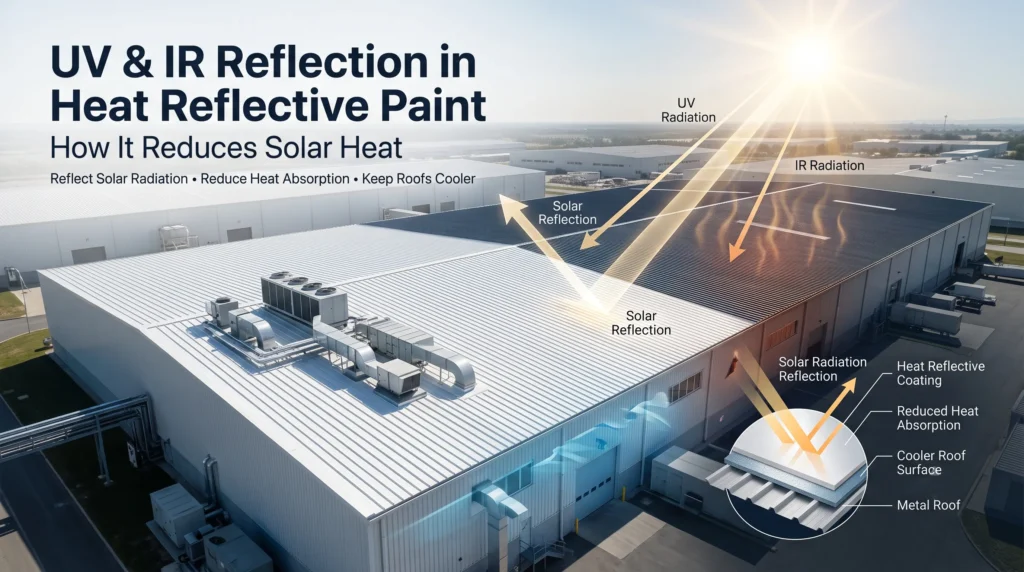
Heat reflective paint is designed to manage solar heat by reflecting a portion of the sun’s radiation away from the coated surface. Two important aspects of this performance are UV (ultraviolet) reflection and IR (infrared) reflection. Together, they help reduce solar heat absorption, lower surface temperatures, and limit the amount of heat transferred into buildings.
When sunlight falls on a conventional roof, part of the solar radiation is absorbed and converted into heat. This can make RCC, concrete, and metal roofs extremely hot during sunny conditions. A heat reflective coating uses specialized reflective properties to reduce this heat absorption, helping the roof remain cooler and improving the thermal performance of the building.
Understanding UV and IR reflection is particularly important when selecting a coating for residential roofs, commercial buildings, warehouses, industrial sheds, and other sun-exposed surfaces. The effectiveness of a coating depends on factors such as its formulation, solar reflectance, thermal emittance, surface condition, application quality, and environmental exposure.
Understanding UV and IR Solar Radiation
How Sunlight Heats Roofs and Exterior Surfaces
Sunlight carries energy that reaches roofs, walls, and other exterior surfaces throughout the day. When solar radiation strikes a conventional roof, a portion of that energy is absorbed by the surface and converted into heat. This can cause RCC, concrete, metal, and other roofing materials to become significantly hotter than the surrounding air. The absorbed heat can then transfer through the roof into the building, increasing indoor temperatures and placing greater demand on cooling systems.
Heat reflective paint is designed to reduce this heat gain by reflecting a portion of incoming solar radiation instead of allowing it to be absorbed. This helps keep the coated surface cooler and can reduce the amount of heat transferred into the building.
Difference Between UV, Visible Light, and IR Radiation
Solar radiation contains different wavelengths, including ultraviolet (UV), visible light, and infrared (IR) radiation. UV radiation has shorter wavelengths and is associated with solar exposure that can contribute to the degradation of exterior coatings and materials. Visible light is the portion of sunlight that can be detected by the human eye and is responsible for the colors we see. Infrared radiation, particularly the near-infrared portion of sunlight, contributes significantly to solar heat gain.
Heat reflective coatings are formulated to manage solar radiation through their reflective properties. Depending on the coating technology, reflective pigments can help reflect portions of UV and IR radiation while maintaining the desired surface appearance.
Why Solar Radiation Matters for Building Heat
Solar radiation is a major source of heat gain through exposed roofs and exterior surfaces. When a roof absorbs more solar energy, its surface temperature increases, which can contribute to higher indoor temperatures and greater cooling requirements. This is particularly important for buildings with large exposed roofs, such as factories, warehouses, commercial facilities, and residential properties.
By reducing solar heat absorption, heat reflective paint can help lower roof surface temperatures and limit heat transfer into the building. This can support improved indoor comfort, reduced cooling demand, and better overall thermal performance, particularly in buildings exposed to strong sunlight for extended periods.
What Is UV & IR Reflection?
Understanding Ultraviolet (UV) Reflection
Ultraviolet (UV) radiation is a high-energy part of sunlight that reaches exposed outdoor surfaces. Continuous UV exposure can contribute to fading, surface degradation, and deterioration of certain coating materials over time. For roofs, walls, tanks, and industrial structures exposed to direct sunlight, resistance to UV exposure is therefore an important consideration.
UV reflection refers to the ability of a coating to reflect a portion of incoming ultraviolet radiation rather than allowing it to be absorbed by the surface. In heat reflective paint, this property can help reduce the impact of prolonged solar exposure on the coated surface. However, the level of UV reflection depends on the coating formulation, pigments, surface characteristics, and application quality.
Understanding Infrared (IR) Reflection
Infrared (IR) radiation forms an important portion of the solar energy that contributes to surface heating. When IR radiation is absorbed by a roof or exterior surface, it can increase the surface temperature and contribute to heat transfer into the building.
IR reflection is the ability of a coating to reflect a portion of incoming infrared radiation away from the coated surface. Heat reflective paints can use specialized reflective pigments and coating technologies to reduce the amount of solar energy absorbed by the surface.
By reflecting more solar energy, an IR-reflective coating can help maintain a lower surface temperature under sunlight. The actual cooling performance depends on factors such as solar exposure, coating formulation, roof material, coating thickness, and application quality.
How Reflective Coatings Interact With Solar Radiation
When sunlight reaches a coated surface, the incoming solar energy can be reflected, absorbed, or transmitted depending on the properties of the coating and substrate. A reflective coating is designed to increase the portion of solar radiation that is reflected away from the surface and reduce unnecessary heat absorption.
UV and IR reflection are therefore two important aspects of solar-reflective coating performance. UV-related properties can support resistance to long-term solar exposure, while IR reflection can help reduce solar heat absorption and surface heating.
The overall performance of a heat reflective paint depends on its complete formulation rather than UV or IR reflection alone. Solar reflectance, thermal emittance, coating thickness, surface preparation, roof material, weather conditions, and correct application all influence how effectively the coating manages solar heat.
How Heat Reflective Paint Works
Reflecting Solar Radiation From the Surface
Heat reflective paint works by increasing the amount of solar radiation reflected away from the coated surface. When sunlight falls on a roof, wall, or other exterior surface, the coating interacts with the incoming radiation through its reflective properties.
Specialized reflective pigments and coating formulations can reflect a portion of the solar energy instead of allowing it to be absorbed by the substrate. This is particularly useful on large, sun-exposed surfaces such as industrial shed roofs, warehouses, RCC terraces, and metal roofing.
The effectiveness of solar reflection depends on the coating formulation, surface condition, colour, application quality, and environmental exposure.
Reducing Heat Absorption
Not all solar radiation that reaches a surface is reflected. The portion that is absorbed can be converted into heat, causing the surface temperature to rise. Heat reflective paint helps reduce this heat absorption by reflecting more of the incoming solar energy away from the surface.
As a result, the coated roof or exterior surface can remain cooler compared with a similar surface that absorbs more solar radiation. This can be particularly beneficial in buildings that remain exposed to direct sunlight for several hours each day.
Limiting Heat Transfer Into the Building
Once a roof becomes hot, some of that heat can transfer through the roofing material into the building below. This increases indoor heat gain and can make occupied spaces uncomfortable, especially during hot weather.
By reducing the amount of solar energy absorbed at the roof surface, heat reflective paint can help reduce the heat available for transfer through the roof. This may help lower indoor heat gain and reduce the cooling load required to maintain comfortable indoor conditions.
The actual effect depends on factors such as roof construction, insulation, ventilation, climate, coating performance, and the intensity and duration of solar exposure.
Maintaining Lower Surface Temperatures
One of the most noticeable effects of a heat reflective coating is its ability to help maintain a lower surface temperature under sunlight. By reflecting a portion of incoming solar radiation and reducing heat absorption, the coating can limit excessive heating of the roof or exterior surface.
Lower surface temperatures can support better thermal performance and reduce the temperature difference between the exterior surface and the surrounding environment. Over time, this can also contribute to reduced thermal stress on exposed roofing and coating systems.
For industrial buildings, warehouses, factories, and commercial facilities with large roof areas, maintaining lower surface temperatures can be an important part of an overall strategy for managing solar heat and improving building energy efficiency.
Role of UV Reflection in Heat Reflective Paint
Protection Against UV Exposure
Roofs and exterior surfaces remain exposed to ultraviolet (UV) radiation whenever they are subjected to direct sunlight. Continuous UV exposure can affect certain coating materials and exposed substrates over time, contributing to weathering, surface deterioration, and changes in appearance.
Heat reflective paints with suitable UV-resistant properties are formulated to withstand prolonged outdoor exposure more effectively. UV reflection can help reduce the amount of ultraviolet radiation interacting with the coated surface, supporting the coating’s ability to withstand solar exposure.
This is particularly important for industrial roofs, warehouses, commercial buildings, tanks, pipelines, and other structures that remain exposed to sunlight for extended periods.
Reducing Surface Fading and Degradation
Long-term exposure to sunlight can contribute to fading, chalking, and gradual degradation of some exterior coatings. The extent of these effects depends on the coating chemistry, pigments, substrate, environmental conditions, and duration of exposure.
A coating with good UV resistance can help maintain its appearance and protective properties for longer under outdoor conditions. By managing UV exposure, reflective coating technology can support better colour stability and reduce the rate of solar-related surface deterioration.
However, UV reflection should not be considered the only factor determining coating durability. The overall formulation and weathering resistance of the coating are equally important.
Supporting Longer Roof and Coating Life
Outdoor roofs experience continuous environmental stress from sunlight, temperature changes, moisture, dust, and seasonal weather conditions. UV radiation is one of the factors that can contribute to the gradual ageing of exposed coating systems.
A heat reflective coating with appropriate UV resistance can help protect the coating surface from prolonged solar exposure. By maintaining the integrity of the coating, it can support longer-lasting surface protection and help reduce the frequency of maintenance or recoating when the system is properly selected and applied.
The expected service life will vary depending on the coating formulation, roof material, climate, surface preparation, application quality, and maintenance practices.
Importance of UV Resistance in Outdoor Applications
UV resistance becomes especially important when a coating is intended for continuously exposed outdoor surfaces. Industrial sheds, factory roofs, warehouses, RCC terraces, commercial buildings, storage tanks, and exterior equipment may receive intense sunlight throughout the year.
For these applications, selecting a heat reflective paint should involve more than simply looking at its ability to reflect solar radiation. UV resistance, weather resistance, adhesion, durability, surface compatibility, and application requirements should also be considered.
A well-designed UV-resistant heat reflective coating can therefore serve two purposes: helping manage solar heat while supporting the long-term protection of the exposed surface. This combination makes UV resistance an important performance consideration for outdoor heat-reflective coating systems.
Role of IR Reflection in Heat Reflective Paint
Why Infrared Radiation Contributes to Heat Gain
Infrared (IR) radiation is an important part of the solar energy reaching a roof or exterior surface. When a surface absorbs infrared energy, that energy contributes to an increase in surface temperature. As the roof becomes hotter, more heat can be transferred through the roofing system and into the building.
This effect can be particularly noticeable on large, directly exposed surfaces such as metal roofs, industrial sheds, warehouses, and RCC terraces. Managing the amount of solar infrared energy absorbed by these surfaces is therefore an important part of controlling solar heat gain.
Reflecting Infrared Energy From Roof Surfaces
IR-reflective heat reflective paint is formulated to reflect a portion of incoming infrared radiation away from the roof surface rather than allowing the energy to be absorbed.
Reflective pigments and coating technologies play an important role in this process. When properly applied, the coating can reduce the amount of solar energy absorbed by the underlying roof material.
The level of IR reflection depends on the coating formulation, pigment technology, surface condition, coating thickness, colour, and application quality. Therefore, different reflective coatings can provide different levels of solar heat management.
Reducing Roof Surface Temperature
When less solar energy is absorbed, less energy is converted into heat at the roof surface. This can help maintain a lower surface temperature during periods of strong sunlight.
A cooler roof surface can be particularly beneficial for buildings with extensive roof areas because it reduces the amount of heat generated directly at the building envelope. Heat reflective paint can therefore form part of a broader roof-cooling strategy, alongside appropriate insulation, ventilation, and building design.
The actual temperature reduction will vary according to solar intensity, roof material, coating properties, ambient conditions, and the duration of sunlight exposure.
Improving Indoor Thermal Comfort
Heat absorbed by a roof can gradually transfer into the space below, increasing indoor heat gain. In buildings without adequate thermal insulation, this can contribute to higher indoor temperatures and greater reliance on air conditioning or other cooling systems.
By helping reduce solar heat absorption at the roof surface, IR-reflective heat reflective paint can limit the amount of heat available for transfer into the building. This may help maintain more comfortable indoor conditions, particularly during hot and sunny periods.
For factories, warehouses, commercial buildings, and other large structures, managing roof-level solar heat can contribute to a more comfortable indoor environment and potentially reduce cooling demand. The overall benefit depends on the building design, insulation, ventilation, climate, and quality of the coating application.
UV Reflection vs IR Reflection – What Is the Difference?
Difference in Solar Radiation
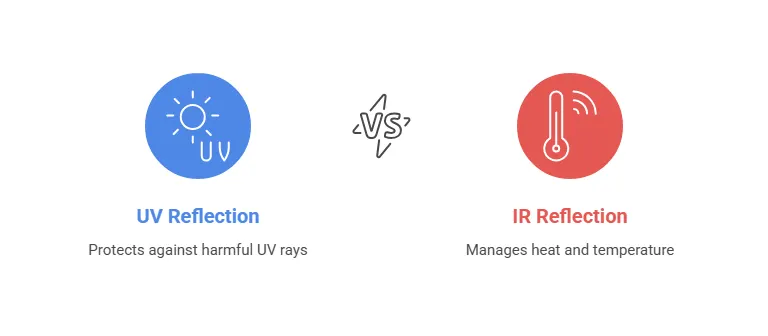
UV and IR radiation are both components of solar radiation, but they represent different regions of the electromagnetic spectrum and have different effects on exposed surfaces.
Ultraviolet (UV) radiation has shorter wavelengths and is mainly associated with long-term solar exposure that can contribute to weathering, fading, and degradation of certain coating materials and substrates.
Infrared (IR) radiation has longer wavelengths and is strongly associated with the thermal energy delivered by sunlight. When a roof absorbs infrared energy, it can contribute to an increase in surface temperature and solar heat gain.
Therefore, UV reflection is primarily relevant to managing UV exposure, while IR reflection is particularly important for controlling solar heat absorption.
Difference in Thermal Effects
The thermal effects of UV and IR radiation are not identical. Infrared radiation plays a more direct role in solar heating because absorbed IR energy contributes to the thermal energy of the exposed surface.
UV radiation, while carrying energy, is more commonly considered in relation to the long-term effects of solar exposure on coatings and materials. Prolonged UV exposure can contribute to colour fading, surface degradation, and weathering depending on the material and coating formulation.
For heat reflective paint, IR-reflective properties are therefore particularly relevant to reducing solar heat gain, while UV-resistant properties can support the durability and appearance of the coating during outdoor exposure.
How Both Work Together
UV and IR reflection can complement each other in a heat reflective coating system. The coating can be designed to reflect portions of incoming solar radiation while also providing resistance to prolonged outdoor UV exposure.
IR reflection helps reduce the amount of solar energy absorbed by the roof, which can help control surface heating. UV resistance and reflection can help the coating withstand the effects of continued sunlight exposure and support longer-term surface performance.
Together, these properties can provide a more comprehensive approach to managing solar exposure—combining heat management with surface protection.
Why Combined UV and IR Reflection Matters
A roof is exposed to the full spectrum of sunlight rather than to a single type of radiation. For this reason, evaluating a heat reflective paint based on only one performance characteristic may not provide a complete picture of its suitability for outdoor use.
A coating with suitable UV resistance and effective solar/IR reflective properties can help address two important concerns: solar heat gain and long-term weathering. This can be valuable for industrial sheds, warehouses, factories, commercial buildings, RCC roofs, metal roofs, and other continuously exposed surfaces.
However, UV and IR reflection are only part of overall coating performance. Solar reflectance, thermal emittance, adhesion, weather resistance, coating thickness, surface preparation, and application quality should also be considered when selecting a heat reflective coating.
In practical terms, IR reflection is more closely connected with controlling solar heat, while UV resistance and reflection are important for managing the effects of prolonged solar exposure. Combining these properties can help create a more durable and thermally efficient exterior coating system.
Benefits of UV & IR Reflective Heat Reflective Paint
Lower Roof Surface Temperatures
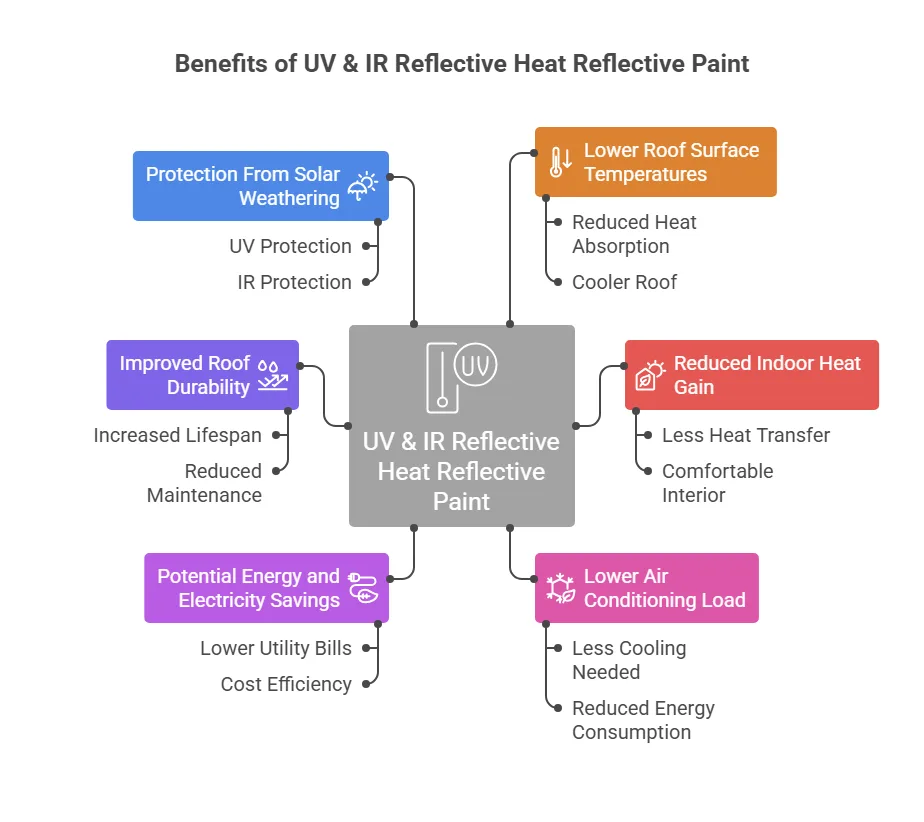
One of the primary benefits of solar-reflective paint is its ability to reduce the amount of solar energy absorbed by an exposed roof. By reflecting a portion of incoming solar radiation, including relevant infrared wavelengths, the coating can help limit excessive heating of the roof surface.
A cooler roof can be particularly beneficial for large exposed areas such as industrial sheds, warehouses, factories, commercial buildings, and RCC terraces. The actual reduction in surface temperature depends on factors such as coating formulation, solar reflectance, roof material, colour, weather conditions, and application quality.
Reduced Indoor Heat Gain
Heat absorbed by a roof can gradually transfer through the roofing system and contribute to indoor heat gain. This can make interior spaces warmer, especially when the building has a large exposed roof area or limited thermal insulation.
By reducing solar heat absorption at the exterior surface, UV and IR reflective heat reflective paint can help limit the amount of heat transferred into the building. This can support more stable indoor temperatures and improve thermal comfort during hot and sunny conditions.
Lower Air Conditioning Load
When less heat enters a building through the roof, the cooling system may have less heat to remove. As a result, a heat reflective coating can help reduce the cooling load under suitable building and climate conditions.
This can be useful for offices, warehouses, factories, commercial facilities, and other buildings that rely on air conditioning during periods of high outdoor temperatures. The actual reduction in HVAC demand will vary according to building insulation, occupancy, ventilation, equipment efficiency, roof construction, and local weather conditions.
Potential Energy and Electricity Savings
Reduced cooling demand can translate into potential energy savings because air-conditioning systems may not need to operate as intensively to maintain the desired indoor temperature.
However, energy savings are not determined by the coating alone. Building size, roof area, insulation, HVAC efficiency, operating hours, climate, indoor temperature settings, and the condition of the existing roof all influence the final result.
For this reason, UV and IR reflective paint should be considered as one component of a broader building energy-efficiency strategy rather than as a guaranteed source of a fixed percentage of electricity savings.
Improved Roof Durability
A roof coating must withstand more than solar heat. Outdoor surfaces are continuously exposed to UV radiation, temperature fluctuations, moisture, dust, rain, and other environmental stresses.
A properly formulated heat reflective coating with suitable UV resistance can help protect the underlying surface and maintain coating performance under prolonged outdoor exposure. Reducing excessive surface heating may also help limit repeated thermal expansion and contraction of exposed roofing materials.
The long-term durability of the system ultimately depends on coating formulation, substrate condition, surface preparation, application thickness, adhesion, environmental exposure, and maintenance.
Protection From Solar Weathering
Continuous sunlight can gradually affect exposed coatings and building materials. UV exposure may contribute to fading, chalking, and degradation depending on the material and coating system.
UV-resistant reflective coatings are designed to better withstand these outdoor conditions while helping manage solar heat. This combination of solar reflection and weather resistance can support the long-term appearance and protective performance of the coated surface.
For industrial and commercial roofs that remain exposed to sunlight throughout the year, selecting a coating with appropriate UV resistance, solar reflectance, weather resistance, and durability can therefore be an important part of long-term roof protection.
UV & IR Reflection for Different Roof Types
RCC and Concrete Roofs
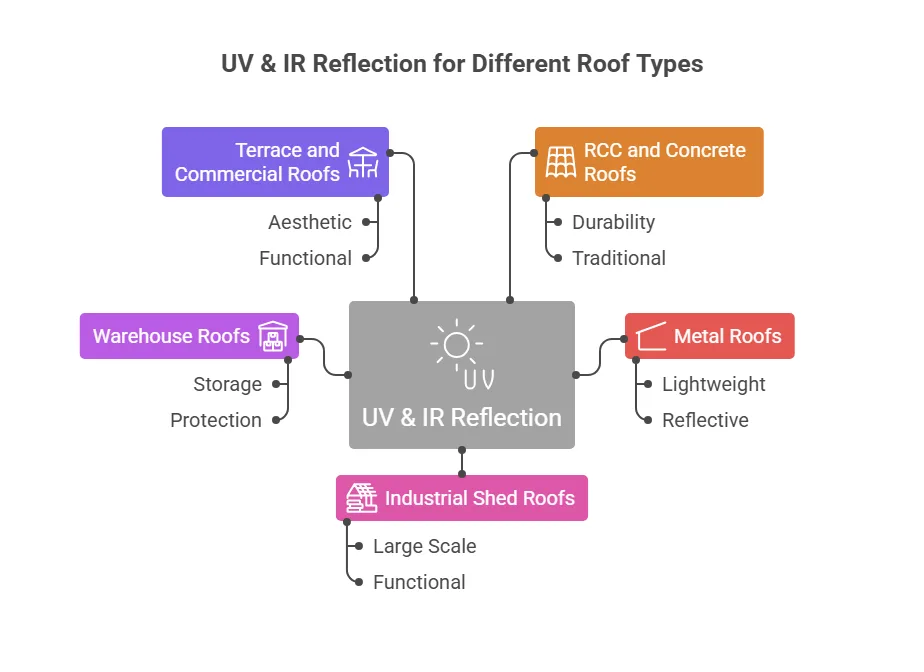
RCC and concrete roofs can absorb substantial solar energy when exposed to direct sunlight for long periods. As the surface heats up, some of this heat can transfer into the building below, increasing indoor heat gain.
UV and IR reflective heat reflective paint can help manage this exposure by reflecting a portion of incoming solar radiation and reducing solar heat absorption at the roof surface. On terraces and exposed RCC roofs, a suitable coating can therefore support cooler surface temperatures and improved thermal performance.
Before application, the concrete surface should be properly cleaned and prepared. Cracks, damaged areas, moisture-related issues, and other surface defects should be addressed according to the coating system requirements.
Metal Roofs
Metal roofs can heat rapidly under direct sunlight because of their high thermal conductivity. Large metal roofing panels used in factories, warehouses, and industrial buildings can therefore become significant sources of solar heat gain.
An appropriate UV and IR reflective coating can help reflect solar radiation and reduce the amount of heat absorbed by the metal surface. This can help limit roof temperature and reduce heat transfer into the building.
For metal roofs, surface preparation and adhesion are especially important. Rust, mill scale, oil, grease, loose coatings, and other contaminants should be removed as required by the selected coating system. The coating should also be compatible with the specific metal substrate and existing paint system.
Industrial Shed Roofs
Industrial shed roofs typically cover large areas and may remain exposed to intense sunlight throughout the working day. As a result, solar heat absorbed by the roof can contribute significantly to indoor heat gain within production and working areas.
UV and IR reflective heat reflective paint can be used as part of a roof-cooling approach by reflecting solar radiation and reducing heat absorption. Lower roof surface temperatures can help improve indoor thermal conditions and may reduce cooling requirements where mechanical cooling is used.
For industrial applications, coating selection should consider the roof material, existing coating, operating environment, surface preparation requirements, weather exposure, and expected maintenance conditions.
Warehouse Roofs
Warehouses often have extensive roof areas with relatively large internal spaces. When the roof absorbs significant solar heat, the resulting heat transfer can affect storage areas, workspaces, and temperature-sensitive operations.
Applying a suitable UV and IR reflective coating to the roof can help reduce solar heat absorption and support a cooler roof surface. This can contribute to improved indoor thermal comfort and potentially reduce the demand for cooling systems.
For warehouses, durability is also important because roofs may be exposed to dust, rain, UV radiation, temperature changes, and regular maintenance activity. A coating system should therefore be selected based on both reflective performance and long-term outdoor durability.
Terrace and Commercial Roofs
Terraces and commercial roofs are commonly exposed to direct sunlight and can contribute to heat gain in offices, shops, apartments, and other occupied spaces. This can become particularly noticeable during hot weather when roof surfaces remain heated for extended periods.
UV and IR reflective heat reflective paint can help reduce solar heat absorption and maintain a comparatively cooler roof surface. This may help reduce heat entering occupied areas and support better indoor thermal comfort.
For commercial and terrace applications, the coating should be selected according to the existing roof surface, exposure conditions, drainage requirements, foot traffic, and maintenance needs. Proper surface preparation and application are essential for achieving consistent coating performance.
Across all roof types, UV and IR reflection should be considered alongside other coating properties such as solar reflectance, thermal emittance, adhesion, weather resistance, durability, and substrate compatibility. The expected thermal benefit will also depend on climate, roof construction, insulation, sunlight exposure, and the quality of application.
Industrial Applications of UV & IR Reflective Coatings
Factories and Manufacturing Plants
Factories and manufacturing plants often have large roof areas made from metal sheets, RCC, or other industrial roofing materials. These surfaces can absorb significant solar heat during the day, increasing the temperature inside production and working areas.
UV and IR reflective coatings can help reduce solar heat absorption by reflecting a portion of incoming solar radiation away from the roof surface. This can support lower roof temperatures and reduce heat transfer into the building.
In facilities where cooling or ventilation systems are used, reducing roof-level heat gain may also help improve the overall thermal environment and potentially reduce cooling requirements.
Warehouses and Storage Facilities
Warehouses and storage facilities typically have large, uninterrupted roof surfaces that are exposed to sunlight for several hours each day. Heat absorbed through these roofs can increase indoor temperatures and create challenging conditions for workers and stored materials.
Applying a suitable UV and IR reflective coating can help manage solar heat at the roof surface. By reducing heat absorption, the coating can contribute to a cooler internal environment and potentially reduce the cooling load.
For warehouses storing temperature-sensitive products, the coating should be considered as part of a broader temperature-control strategy that may include insulation, ventilation, HVAC systems, and appropriate building design.
Industrial Sheds
Industrial sheds commonly use metal roofing with extensive exposure to direct sunlight. Because these structures can have large roof areas and relatively limited thermal insulation, solar heat can quickly affect the internal environment.
UV and IR reflective coatings can help reflect solar radiation and reduce the amount of heat absorbed by the roof. This can support improved working conditions and help manage indoor heat during hot and sunny periods.
Before application, the roof should be assessed for rust, existing coatings, dirt, oil, loose material, joints, and other surface conditions. Proper preparation and application are essential for achieving reliable coating performance.
Utility and Process Buildings
Utility and process buildings may contain electrical systems, pumps, control equipment, compressors, boilers, or other industrial services. Many of these structures have exposed roofs and walls that can experience significant solar heating.
A UV and IR reflective coating can help reduce solar heat absorption on suitable exterior surfaces. Lower surface temperatures can contribute to better thermal conditions around the building and help reduce the amount of heat entering enclosed equipment or working areas.
For process-related facilities, coating selection should also account for the surrounding industrial environment, chemical exposure, moisture, operating temperature, maintenance requirements, and compatibility with the existing substrate.
Outdoor Tanks and Industrial Equipment
Outdoor tanks, vessels, pipelines, and other industrial equipment can remain exposed to direct sunlight throughout their operating life. Solar radiation can increase the surface temperature of these assets and contribute to heat gain within or around the equipment.
Where the coating system is suitable for the substrate and operating conditions, UV and IR reflective coatings can help reflect solar radiation and reduce surface heating. This can be useful for selected storage tanks, process equipment, pipelines, and other outdoor assets where controlling solar exposure is important.
However, these applications require careful technical evaluation. The coating should be compatible with the substrate, operating temperature, existing protective system, and surrounding environment. Surface preparation, coating thickness, adhesion, and maintenance should follow the requirements of the selected coating system.
Overall, UV and IR reflective coatings can be applied across a wide range of industrial environments to help manage solar heat and protect exposed surfaces. Their effectiveness depends on the coating formulation, substrate, climate, solar exposure, application quality, and the specific operating conditions of the facility.
How UV & IR Reflection Supports Energy Efficiency
Reducing Solar Heat Gain
Solar heat gain occurs when sunlight is absorbed by a building’s roof and exterior surfaces and converted into heat. Large exposed roofs can absorb substantial solar energy during periods of strong sunlight, increasing surface temperatures and contributing to heat transfer into the building.
UV and IR reflective coatings can help reduce this effect by reflecting a portion of incoming solar radiation away from the coated surface. In particular, effective solar and IR reflection can reduce the amount of radiation converted into heat at the roof surface.
Lower solar heat absorption can help reduce the thermal load placed on the building, making reflective coatings a useful component of a broader heat-management strategy.
Lowering Cooling Requirements
As less solar heat is transferred through the roof, the indoor space may experience lower heat gain. This can reduce the amount of heat that air-conditioning or other cooling systems need to remove.
For factories, warehouses, offices, commercial buildings, and other occupied spaces, reducing roof-related heat gain can help maintain more comfortable indoor conditions during hot weather. Depending on the building and operating conditions, this may reduce the duration or intensity of mechanical cooling required.
The actual reduction in cooling demand will depend on factors such as roof area, insulation, building orientation, ventilation, occupancy, climate, HVAC operation, and coating performance.
Improving HVAC Efficiency
HVAC systems operate by removing heat from indoor spaces to maintain a selected temperature. When the building receives less heat through its roof, the cooling system may have a lower thermal load to handle.
UV and IR reflective coatings can therefore support HVAC performance indirectly by reducing solar heat entering the building. A lower cooling load can allow HVAC equipment to operate under less demanding conditions, depending on system design and operating controls.
However, reflective roof coatings do not replace properly sized HVAC systems, insulation, ventilation, or regular equipment maintenance. They work most effectively as part of an integrated building thermal-management approach.
Supporting Sustainable Building Performance
Improving the thermal performance of a building can contribute to more efficient use of energy over its operating life. By reducing solar heat absorption and potentially lowering cooling requirements, UV and IR reflective coatings can support efforts to manage building energy consumption.
This can be particularly relevant for large industrial and commercial facilities where extensive roof areas are exposed to sunlight every day. Lower cooling demand can also support broader energy-efficiency and sustainability objectives.
The overall environmental and energy benefit depends on the coating’s reflective performance, building characteristics, local climate, HVAC system, operating schedule, and maintenance. Therefore, UV and IR reflection should be viewed as one part of a complete energy-efficiency strategy rather than a standalone solution.
Factors That Affect UV & IR Reflection Performance
Reflective Pigment Technology
The type and quality of reflective pigments used in a heat reflective coating have a major influence on its ability to manage solar radiation. Specialized pigments can be formulated to reflect selected portions of the solar spectrum rather than absorbing a large amount of incoming energy.
Different pigment technologies can provide different levels of solar reflectance and infrared reflection. The coating formulation also needs to balance reflective performance with properties such as colour stability, adhesion, weather resistance, and durability.
For this reason, the performance of two coatings that appear visually similar may differ depending on their underlying pigment and binder technology.
Solar Reflectance and Thermal Emittance
Solar reflectance and thermal emittance are important properties when evaluating the thermal performance of a reflective coating.
Solar reflectance describes how much incoming solar radiation is reflected away from a surface. A higher solar reflectance generally means less solar energy is absorbed by the coated surface.
Thermal emittance describes how effectively a surface releases absorbed thermal energy as infrared radiation. A coating with appropriate thermal emittance can help a heated surface release thermal energy rather than retaining it.
Considering both properties provides a more complete understanding of how a roof coating can manage solar heat. Focusing only on visible appearance or colour may not accurately indicate the coating’s overall solar-reflective performance.
Coating Thickness and Application Quality
Even a technically advanced reflective coating may not perform as expected if it is applied incorrectly. Coating thickness, uniformity, dilution, application method, drying conditions, and the number of coats can all influence final performance.
Insufficient or uneven coating coverage may leave areas more exposed to solar radiation and can affect the consistency of the protective layer. Excessive or improperly applied material can also create application and curing issues.
Following the manufacturer’s recommended application procedure, including surface preparation, mixing, application thickness, drying time, and curing requirements, is therefore essential for achieving consistent results.
Roof Material and Surface Condition
The underlying roof material can influence how a reflective coating performs. RCC, concrete, galvanized sheets, steel, aluminium, and other roofing materials have different surface characteristics and thermal behaviour.
Existing paint, rust, dust, grease, moisture, cracks, loose material, and surface contamination can affect adhesion and coating uniformity. Proper surface preparation is therefore an important part of achieving reliable reflective performance.
The coating should also be selected for compatibility with the specific substrate and any existing coating system. A technically suitable product for one roof material may require a different preparation or primer system on another.
Climate and Solar Exposure
Local climate and solar exposure also influence the practical performance of UV and IR reflective coatings. A roof exposed to intense sunlight for long periods will experience a different thermal load from a roof that receives limited direct sunlight.
Ambient temperature, humidity, rainfall, seasonal changes, dust, UV intensity, and the duration of daily solar exposure can all affect coating performance and service life.
For industrial and commercial buildings, the roof’s orientation, surrounding structures, shading, operating environment, and maintenance conditions should also be considered. Selecting a reflective coating based on the actual exposure conditions helps ensure that its solar-reflective and protective properties are appropriate for the application.
How to Choose Heat Reflective Paint With UV & IR Protection
Check Solar Reflectance Performance
Solar reflectance is one of the key properties to consider when selecting heat reflective paint. It indicates how effectively a coating reflects incoming solar radiation rather than absorbing it and converting it into heat.
A coating with suitable solar-reflective performance can help reduce roof surface heating and limit solar heat gain. When comparing products, review available technical data rather than judging performance only by colour or appearance.
For large industrial roofs, warehouses, factories, and commercial buildings, solar reflectance should be considered alongside the roof material, local climate, level of sunlight exposure, and intended application.
Consider Thermal Emittance
Thermal emittance describes how effectively a surface releases absorbed thermal energy as infrared radiation. It is an important property to consider alongside solar reflectance when evaluating the thermal performance of a roof coating.
A coating with suitable solar reflectance and thermal emittance can provide a more complete approach to managing heat at the roof surface. Reviewing technical data for both properties can help in comparing different reflective coating systems.
For applications where roof cooling and energy efficiency are important objectives, these properties should be evaluated according to the manufacturer’s technical documentation and the specific requirements of the building.
Evaluate UV and Weather Resistance
Outdoor roofs are continuously exposed to sunlight, UV radiation, rain, humidity, dust, and temperature changes. A heat reflective coating therefore needs to withstand environmental exposure while maintaining its protective and reflective properties.
Look for information regarding UV resistance, weather resistance, colour stability, adhesion, and expected outdoor durability. These properties are particularly important for industrial sheds, warehouses, RCC terraces, metal roofs, and other continuously exposed surfaces.
A coating designed for outdoor use should be selected according to the actual environmental conditions rather than based only on its initial reflective performance.
Select the Coating According to Roof Material
The same heat reflective paint may not be suitable for every roofing substrate. RCC, concrete, galvanized steel, aluminium, mild steel, and other surfaces can have different preparation and coating requirements.
Before selecting a product, identify the roof material and assess its current condition. Rust, old coatings, cracks, dust, grease, moisture, loose particles, and other surface defects may affect adhesion and final performance.
The selected coating should be compatible with the substrate and, where applicable, with the existing primer or coating system. Following the recommended surface preparation procedure is essential for achieving a durable result.
Consider Long-Term Durability and Maintenance
Reflective performance is important, but long-term durability should also be considered when choosing a roof coating. A coating exposed to strong sunlight and changing weather conditions must maintain adequate adhesion, weather resistance, and surface integrity throughout its service period.
Consider the expected maintenance requirements, cleaning needs, recoating requirements, resistance to environmental exposure, and compatibility with the roof’s operating conditions.
For large industrial and commercial roofs, a coating that combines suitable solar reflectance, UV resistance, weather durability, substrate compatibility, and practical maintenance requirements can provide a more balanced long-term solution.
Ultimately, the right heat reflective paint should be selected based on solar reflectance, thermal emittance, UV and weather resistance, roof material, application requirements, and expected service conditions rather than relying on a single performance characteristic.
Application and Maintenance of UV & IR Reflective Coatings
Surface Cleaning and Preparation
Proper surface preparation is one of the most important steps in achieving reliable performance from a UV and IR reflective coating. Dirt, dust, grease, oil, loose particles, rust, moisture, and old deteriorated coatings can interfere with adhesion and lead to premature coating failure.
The roof or exterior surface should first be inspected and cleaned using a method appropriate for the substrate and existing condition. Loose material should be removed, and the surface should be allowed to become sufficiently dry before coating application.
For metal roofs, particular attention should be given to rust, corrosion, oil contamination, and loose existing paint. RCC and concrete surfaces should be checked for dust, laitance, moisture, cracks, and other conditions that may affect coating adhesion.
Repairing Cracks and Surface Defects
Cracks, joints, holes, damaged areas, and other surface defects should be identified and repaired before applying the reflective coating. Applying paint over an unstable or damaged substrate can compromise adhesion and reduce the service life of the coating system.
The appropriate repair material should be selected according to the roof material and the nature of the defect. Any repaired areas should be properly cured or prepared before the reflective coating is applied.
Particular attention should also be given to roof joints, edges, penetrations, drainage areas, and other locations where water accumulation or movement may occur.
Correct Coating Application
Once the surface is properly prepared, the coating should be applied according to the manufacturer’s recommended application procedure. This includes following the specified mixing instructions, application method, number of coats, coverage requirements, drying time, and recommended coating thickness.
The coating should be applied evenly to avoid thin spots, missed areas, excessive buildup, or inconsistent coverage. Proper application is important because the final solar-reflective and protective performance depends not only on the formulation but also on the quality and uniformity of the applied coating.
Weather conditions should also be considered during application. Excessive moisture, rain, unsuitable temperatures, or other unfavourable conditions can affect drying, curing, and adhesion.
Regular Inspection and Cleaning
Regular inspection helps identify early signs of coating deterioration before they develop into larger maintenance problems. The roof should be checked periodically for peeling, cracking, blistering, chalking, mechanical damage, contamination, or areas where the coating has become thin or worn.
Dust, dirt, leaves, industrial deposits, and other contaminants can accumulate on exposed roof surfaces and may affect the cleanliness and appearance of the reflective coating. Appropriate cleaning can help maintain the surface condition.
Inspection frequency should be based on the roof’s exposure, climate, industrial environment, traffic, and overall operating conditions.
Recoating When Required
Over time, exposure to sunlight, weather, temperature changes, moisture, and mechanical activity can gradually reduce the condition of an exterior coating. Recoating may therefore become necessary when the existing layer shows significant deterioration or when its protective and reflective performance is no longer adequate.
Before recoating, the existing surface should be inspected and properly prepared. Areas with peeling, loose coating, corrosion, cracks, or other defects should be repaired before the new layer is applied.
The recoating interval should not be assumed to be the same for every project. It depends on the coating formulation, application quality, substrate, climate, solar exposure, industrial environment, and maintenance history. Following the coating manufacturer’s maintenance and recoating recommendations is the best way to support long-term performance.
Frequently Asked Questions
What Is UV Reflection in Heat Reflective Paint?
UV reflection refers to the ability of a coating to reflect a portion of incoming ultraviolet radiation from sunlight. In heat reflective paint, suitable UV-resistant and reflective properties can help reduce the effects of prolonged solar exposure and support the durability and appearance of outdoor surfaces.
What Is IR Reflection in Heat Reflective Paint?
IR reflection is the ability of a coating to reflect a portion of incoming infrared radiation rather than allowing it to be absorbed by the roof or exterior surface. By reducing solar energy absorption, IR-reflective coatings can help limit surface heating and solar heat gain.
Does IR Reflection Reduce Roof Temperature?
Yes, IR reflection can help reduce roof surface heating by reflecting a portion of incoming infrared solar energy away from the surface. However, the actual temperature reduction depends on factors such as solar reflectance, coating formulation, roof material, climate, sunlight exposure, coating thickness, and application quality.
Does UV Reflection Protect the Roof?
UV reflection and UV resistance can help protect exposed coating systems from prolonged ultraviolet exposure. They can support resistance to effects such as fading and weather-related degradation. However, overall roof protection also depends on coating formulation, substrate condition, weather resistance, application quality, and maintenance.
Can UV and IR Reflective Paint Reduce Electricity Consumption?
UV and IR reflective paint can potentially reduce electricity consumption indirectly by reducing solar heat gain and the cooling load of a building. If less heat enters the building, air-conditioning systems may require less energy to maintain indoor temperatures. Actual savings vary according to roof area, insulation, HVAC efficiency, climate, occupancy, operating hours, and coating performance.
Is UV & IR Reflective Paint Suitable for Metal Roofs?
Yes, suitable UV and IR reflective coatings can be applied to many metal roofing systems, including industrial and warehouse roofs. However, the coating must be compatible with the specific metal substrate and existing coating system. Proper cleaning, rust removal, surface preparation, and application are essential for reliable adhesion and long-term performance.
How Long Does UV & IR Reflective Paint Last?
There is no single service-life period that applies to every UV and IR reflective coating. Durability depends on the coating formulation, roof material, surface preparation, application quality, UV exposure, weather conditions, industrial environment, and maintenance.
Regular inspection and timely maintenance can help extend coating performance. For an accurate expected service life, refer to the specific manufacturer’s technical data and recommended maintenance schedule.
Conclusion – Why UV & IR Reflection Matters in Heat Reflective Paint
Understanding the Role of UV and IR Reflection
UV and IR reflection are important properties to consider when evaluating heat reflective paint for exposed roofs and exterior surfaces. IR reflection primarily helps manage solar heat absorption, while UV reflection and UV resistance can help the coating withstand prolonged exposure to sunlight.
By reflecting a portion of incoming solar radiation, a suitable reflective coating can help reduce surface heating and limit the amount of solar heat transferred into the building. The actual performance depends on the coating formulation, solar reflectance, thermal emittance, roof material, climate, and application quality.
Combining Solar Reflection With Roof Protection
A high-performance roof coating should do more than reflect sunlight. It should also provide suitable adhesion, weather resistance, UV resistance, and durability for the intended environment.
Combining solar-reflective properties with protection against prolonged outdoor exposure can help maintain the condition of the coated surface over time. Proper surface preparation, correct application, regular inspection, and timely maintenance are equally important for achieving reliable long-term performance.
Long-Term Benefits for Energy-Efficient Buildings
For factories, warehouses, industrial sheds, commercial buildings, and other structures with large exposed roof areas, UV and IR reflective coatings can form part of an overall strategy for managing solar heat.
By reducing solar heat absorption, these coatings can help lower roof surface temperatures and potentially reduce indoor heat gain and cooling requirements. In suitable buildings, this may contribute to improved thermal comfort and more efficient use of cooling energy.
Ultimately, the value of UV and IR reflective heat reflective paint comes from combining solar heat management, outdoor surface protection, and long-term coating durability. When the coating is correctly selected, properly applied, and maintained according to the roof and operating conditions, it can be a useful component of a broader energy-efficient building and industrial roof protection strategy.