

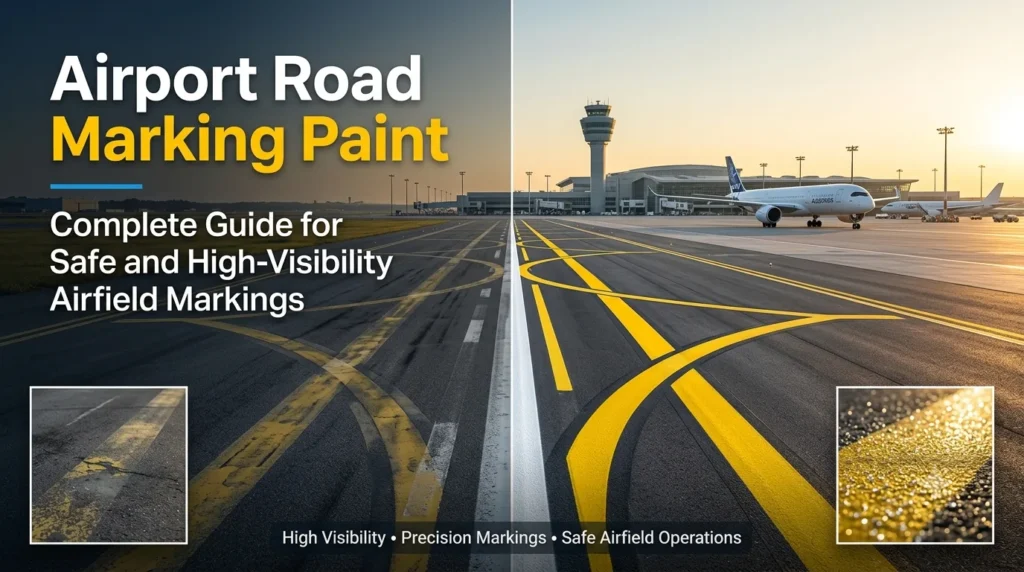
Airport road marking paint is a specialized coating designed to create highly visible and durable markings on runways, taxiways, aprons, service roads, and other airfield pavements. These markings play a vital role in guiding pilots, airport ground vehicles, and maintenance personnel, ensuring safe and efficient aircraft movement. Unlike conventional road marking paints, airport marking coatings are engineered to withstand heavy aircraft loads, jet fuel exposure, extreme weather conditions, and continuous operational traffic.
Clear and accurate airport pavement markings are essential for maintaining smooth airport operations. They help pilots identify runway centerlines, taxiway routes, holding positions, parking bays, and safety zones during both day and night. High-performance airport road marking paint also enhances visibility in low-light conditions, rain, and fog, reducing the risk of runway incursions and navigation errors.
Modern airport road marking systems are manufactured with advanced technologies that provide excellent adhesion, abrasion resistance, UV stability, and long-lasting reflectivity. Depending on operational requirements, airports may use water-based, epoxy, thermoplastic, or reflective marking systems to achieve optimal performance and compliance with aviation standards.
Whether for international airports, domestic terminals, military airbases, or private airfields, choosing the right airport road marking paint is essential for improving aviation safety, minimizing maintenance, and ensuring uninterrupted ground operations. In this guide, we’ll explore the types, features, applications, benefits, and best practices for selecting high-quality airport road marking paint for safe and efficient airfield infrastructure.
Introduction to Airport Road Marking Paint
What Is Airport Road Marking Paint?
Airport road marking paint is a specially formulated coating used to create highly visible and durable markings on runways, taxiways, aprons, service roads, and other airfield surfaces. These markings guide aircraft, airport vehicles, and ground personnel, ensuring safe and efficient movement throughout the airport. Unlike conventional road marking paints, airport marking coatings are designed to withstand heavy aircraft loads, jet fuel spills, UV exposure, and harsh weather conditions while maintaining excellent visibility.
Available in water-based, epoxy, thermoplastic, and other high-performance formulations, airport road marking paint offers strong adhesion to asphalt and concrete surfaces, fast drying times, and long-lasting performance. It is an essential component of modern airport infrastructure, supporting safe and uninterrupted airfield operations.
Importance of Airport Pavement Markings
Airport pavement markings are critical for maintaining order and safety on the airfield. They provide clear visual guidance for pilots during takeoff, landing, and taxiing, while also directing airport vehicles and maintenance crews. Runway centerlines, threshold markings, taxiway centerlines, holding position markings, and parking bay markings help ensure smooth aircraft movement and minimize operational errors.
Well-maintained airport markings improve visibility in both daytime and nighttime conditions, helping pilots navigate accurately even during rain, fog, or low-light environments. They also reduce confusion on busy airfields, supporting efficient aircraft movement and minimizing delays.
Role in Aviation Safety and Ground Operations
Airport road marking paint plays a vital role in aviation safety by providing standardized visual guidance across all operational areas. Clear and durable markings help prevent runway incursions, guide aircraft along designated taxi routes, and identify restricted areas, holding positions, and emergency access routes.
In addition to supporting pilots, airport markings improve the efficiency of ground operations by organizing the movement of service vehicles, baggage handling equipment, fuel trucks, and maintenance personnel. High-quality airport road marking systems contribute to smoother airport operations, reduced accident risks, regulatory compliance, and enhanced safety for passengers, aircraft, and airport staff.
Why Airport Road Marking Paint Is Essential
Enhances Aircraft and Vehicle Guidance
Airport road marking paint provides clear visual guidance for both aircraft and airport ground vehicles. Markings such as runway centerlines, taxiway lines, holding positions, and service road markings help pilots and drivers navigate safely and accurately across the airfield. Well-defined markings reduce confusion, improve operational efficiency, and ensure smooth movement in busy airport environments.
Improves Runway and Taxiway Safety
Runways and taxiways are among the busiest areas of an airport, requiring precise markings for safe aircraft movement. High-quality airport road marking paint creates bright, durable, and highly visible markings that remain clear under heavy aircraft traffic and varying weather conditions. These markings help pilots identify designated routes, runway thresholds, and taxiway intersections, reducing the chances of navigation errors.
Supports Efficient Airport Ground Operations
Efficient airport operations depend on well-organized ground movement. Airport road markings clearly define service roads, aircraft parking stands, loading zones, maintenance areas, and restricted zones. This allows baggage vehicles, fuel trucks, emergency vehicles, and maintenance equipment to move safely and efficiently without disrupting aircraft operations, improving overall airport productivity.
Reduces the Risk of Runway Incursions
Runway incursions occur when an aircraft, vehicle, or person enters a protected runway area without authorization. Clear and durable airport road markings help prevent these incidents by identifying holding positions, runway entry points, restricted areas, and mandatory stop locations. Combined with proper airport procedures, high-visibility pavement markings significantly improve situational awareness and contribute to safer airfield operations for pilots, ground personnel, and airport authorities.
Types of Airport Road Marking Paint
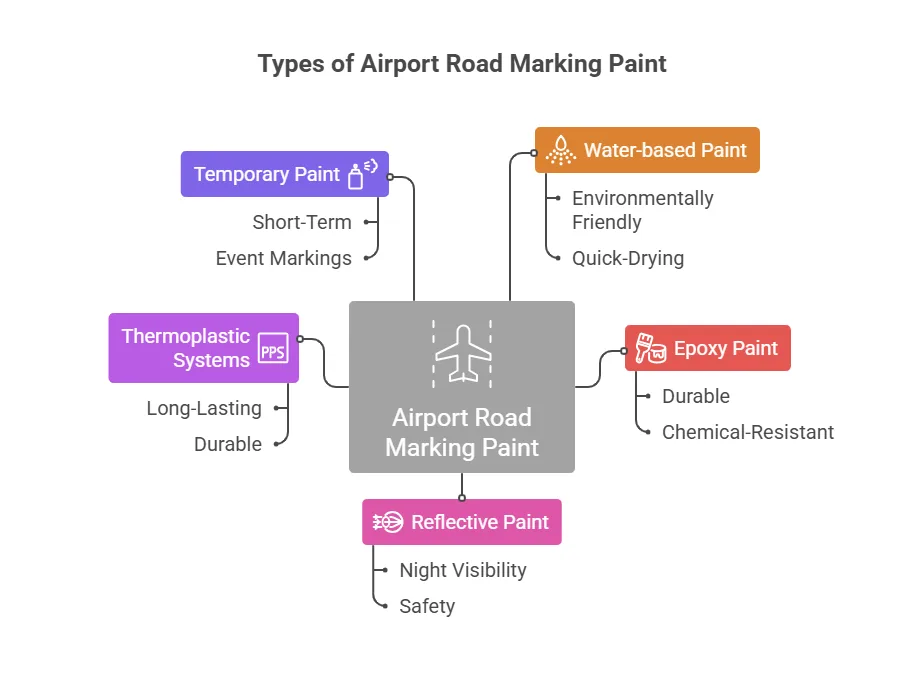
Water-Based Airport Marking Paint
Water-based airport marking paint is an environmentally friendly coating that uses water as its primary solvent. It offers low VOC emissions, fast drying, and easy application, making it suitable for airport service roads, parking areas, and low-traffic airfield zones. It provides good visibility and is often selected for projects that prioritize sustainability and quick turnaround times.
Epoxy Airport Marking Paint
Epoxy airport marking paint is a high-performance, two-component coating known for its exceptional durability and strong adhesion. It resists abrasion, chemicals, aviation fuel, and heavy aircraft traffic, making it ideal for runways, taxiways, aprons, and aircraft parking areas. Its long service life helps reduce maintenance requirements and operational downtime.
Reflective Airport Marking Paint
Reflective airport marking paint is designed to improve visibility during nighttime and low-light conditions. It incorporates reflective glass beads that return light from aircraft landing lights and airport vehicles back toward the operator. This enhanced visibility helps pilots and ground crews identify runways, taxiways, holding positions, and guidance markings more easily, improving overall airfield safety.
Thermoplastic Airport Marking Systems
Thermoplastic airport marking systems are applied in a heated molten state and quickly harden to form thick, highly durable pavement markings. These systems provide excellent wear resistance, strong adhesion, and long-lasting visibility under continuous aircraft and vehicle traffic. They are commonly used for permanent airport markings where durability and high performance are essential.
Temporary Airport Marking Paint
Temporary airport marking paint is used during runway maintenance, construction projects, or operational changes. It provides clear but removable markings that guide aircraft and ground vehicles safely until permanent markings are installed. Temporary markings are designed for easy application and removal while maintaining adequate visibility throughout the project period.
Key Features of Airport Road Marking Paint
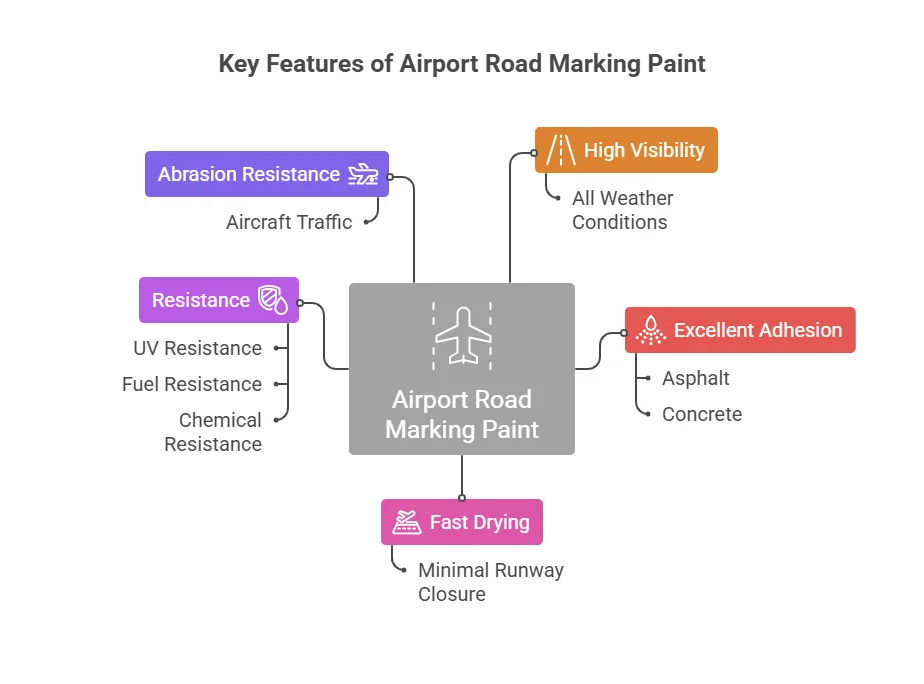
High Visibility in All Weather Conditions
Airport road marking paint is formulated to provide exceptional visibility in a wide range of weather conditions, including bright sunlight, heavy rain, fog, and low-light environments. Clear and highly visible markings help pilots, ground vehicle operators, and airport personnel easily identify runways, taxiways, holding positions, and service roads. This consistent visibility enhances operational safety and ensures smooth aircraft movement throughout the airfield.
Excellent Adhesion to Asphalt and Concrete
Airport pavements are primarily constructed using asphalt or concrete, requiring marking paints with superior bonding strength. High-quality airport road marking paint adheres firmly to these surfaces, preventing peeling, cracking, and premature wear. Strong adhesion ensures that markings remain intact despite continuous aircraft movement, heavy service vehicle traffic, and changing environmental conditions.
Fast Drying for Minimal Runway Closure
Airports operate around the clock, making it essential to minimize downtime during maintenance. Fast-drying airport road marking paint allows runways, taxiways, and aprons to reopen quickly after application. This reduces operational disruptions, improves maintenance efficiency, and helps airports maintain scheduled flight operations while ensuring high-quality pavement markings.
UV, Fuel, and Chemical Resistance
Airport markings are exposed to intense sunlight, aviation fuel, hydraulic fluids, de-icing chemicals, and other harsh substances. Premium airport road marking paint is designed to resist UV radiation, fuel spills, chemicals, and weathering without fading or deteriorating. This resistance helps maintain bright, durable markings that continue to perform reliably in demanding airport environments.
High Abrasion Resistance Under Aircraft Traffic
Aircraft wheels, ground support equipment, baggage vehicles, and maintenance machinery place significant stress on pavement markings every day. Airport road marking paint is engineered with excellent abrasion resistance to withstand continuous heavy traffic while maintaining its visibility and structural integrity. Its long-lasting performance reduces the need for frequent repainting, lowers maintenance costs, and supports safe, efficient airfield operations.
Airport Marking Colors and Their Meanings
White Runway Markings
White markings are used exclusively on runways to provide essential guidance for pilots during takeoff, landing, and runway operations. They include runway centerlines, threshold markings, touchdown zone markings, aiming points, and runway edge markings. These highly visible white markings help pilots maintain proper alignment and safely navigate the runway under both day and night conditions.
Yellow Taxiway Markings
Yellow markings identify taxiways and guide aircraft safely between runways, terminals, aprons, and parking stands. Common yellow markings include taxiway centerlines, edge lines, holding position markings, and directional signs painted on the pavement. Their bright color clearly distinguishes taxiways from runways, helping prevent navigation errors and ensuring smooth aircraft movement on the ground.
Red Mandatory Instruction Markings
Red mandatory instruction markings highlight critical locations where pilots must stop or obtain clearance before proceeding. Typically found at runway holding positions and restricted areas, these markings feature a red background with white lettering or symbols. They improve situational awareness and help reduce the risk of runway incursions by clearly indicating areas that require special authorization.
Black Background Markings
Black background markings are used to improve the visibility of yellow pavement markings, especially on light-colored concrete surfaces. By creating a strong contrast, the black border makes taxiway centerlines, holding position markings, and directional symbols easier to identify in bright sunlight, rain, fog, and other challenging conditions. This enhanced contrast supports safer aircraft navigation across the airfield.
Enhanced Runway Safety Markings
Enhanced runway safety markings are designed to increase pilot awareness when approaching active runways and other critical operational areas. These markings include enhanced taxiway centerlines, surface-painted holding position signs, and other specialized guidance markings that improve recognition of runway entry points. Their high visibility helps pilots make timely decisions, minimizes navigation errors, and contributes to safer airport ground operations.
Application Process of Airport Road Marking Paint
Surface Preparation
Proper surface preparation is the foundation of durable airport pavement markings. The runway, taxiway, apron, or service road must be thoroughly cleaned to remove dust, dirt, rubber deposits, oil, grease, moisture, and loose materials. Any damaged pavement should be repaired before painting to ensure strong adhesion and long-lasting performance. A clean and dry surface allows the marking paint to bond effectively with both asphalt and concrete.
Layout Planning and Measurements
Before painting begins, a detailed marking plan is prepared according to airport design specifications and aviation standards. Accurate measurements are taken to position runway centerlines, taxiway markings, holding positions, arrows, parking bay markings, and safety zones. Surveying equipment, measuring tools, and layout guides are used to ensure every marking is correctly aligned for safe aircraft navigation.
Machine Application Techniques
Airport road marking paint is typically applied using specialized airfield marking machines that deliver precise line widths, uniform coating thickness, and consistent paint distribution. Depending on the project requirements, spray machines or self-propelled marking equipment are used to create high-quality pavement markings. Reflective glass beads may also be applied simultaneously to improve nighttime visibility and enhance pilot guidance.
Drying, Curing, and Quality Inspection
After application, the markings must be allowed to dry and cure according to the paint manufacturer’s recommendations. Fast-drying formulations help minimize runway or taxiway closures, reducing operational disruptions. Once curing is complete, quality inspections are carried out to verify line dimensions, color accuracy, adhesion, thickness, and reflectivity. Final inspections ensure the airport markings meet aviation safety requirements and are ready for safe airfield operations.
Applications of Airport Road Marking Paint
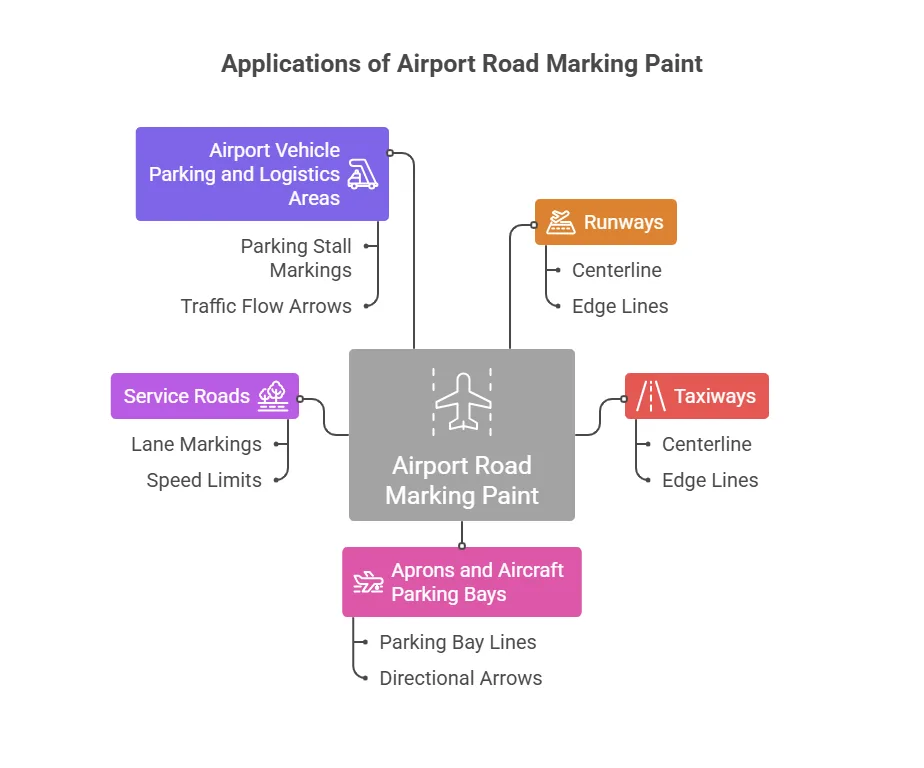
Runways
Runways are the most critical areas of an airport, requiring precise and highly visible pavement markings. Airport road marking paint is used to create runway centerlines, threshold markings, aiming points, touchdown zone markings, edge lines, and runway designation numbers. These markings provide essential visual guidance for pilots during takeoff, landing, and runway operations, ensuring safe aircraft movement in all weather and lighting conditions.
Taxiways
Taxiways connect runways with terminals, aprons, and maintenance areas, making clear markings essential for efficient aircraft movement. Airport road marking paint is used for taxiway centerlines, edge markings, holding position lines, and directional guidance. These markings help pilots safely navigate the airport while preventing confusion and reducing the risk of runway incursions.
Aprons and Aircraft Parking Bays
Aprons and aircraft parking bays require accurate pavement markings to guide aircraft during parking, loading, unloading, refueling, and maintenance operations. Airport marking paint is used to define aircraft stand positions, lead-in lines, safety zones, equipment staging areas, and clearance boundaries. Durable markings improve ground handling efficiency while maintaining safe distances between aircraft and airport equipment.
Service Roads
Service roads within airports are used by baggage vehicles, fuel trucks, catering vehicles, maintenance equipment, emergency response units, and airport staff. Road marking paint creates clear traffic lanes, directional arrows, pedestrian crossings, speed control markings, and stop lines to ensure the safe movement of airport vehicles while minimizing interference with aircraft operations.
Airport Vehicle Parking and Logistics Areas
Airport road marking paint is widely used in vehicle parking zones, cargo terminals, logistics centers, and equipment storage areas. It defines parking bays, loading and unloading zones, forklift routes, pedestrian walkways, restricted areas, and emergency access lanes. Well-planned markings improve traffic organization, enhance workplace safety, and support efficient airport logistics and ground operations.
Benefits of Airport Road Marking Paint
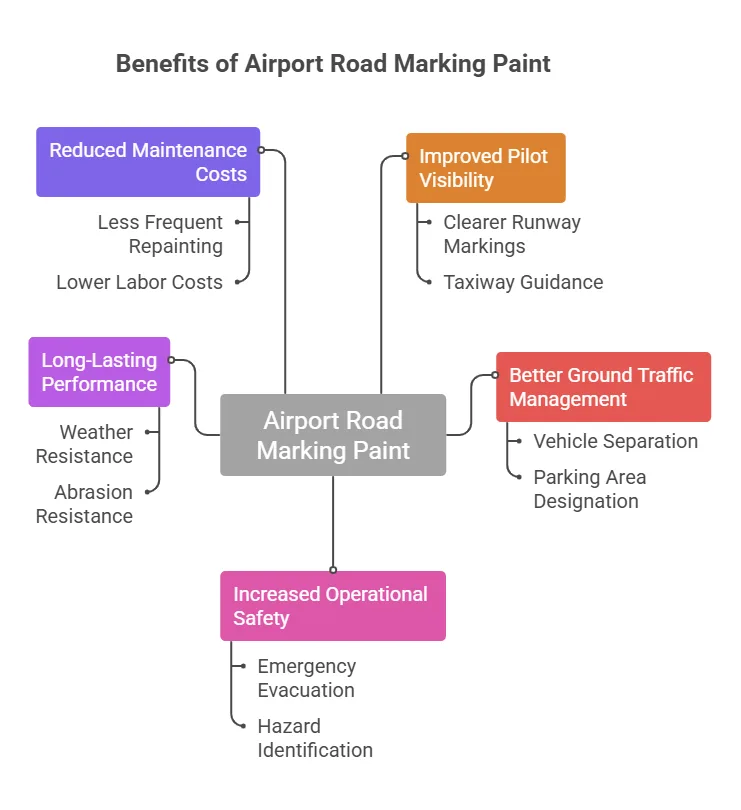
Improved Pilot Visibility
Airport road marking paint is designed to deliver exceptional visibility under both daytime and nighttime conditions. Bright, clearly defined runway, taxiway, and apron markings help pilots accurately identify navigation routes, holding positions, and aircraft parking bays. High-visibility markings improve situational awareness during takeoff, landing, and taxiing, reducing the likelihood of navigation errors and enhancing overall flight safety.
Better Ground Traffic Management
Airports handle the continuous movement of aircraft, service vehicles, baggage carts, fuel trucks, and maintenance equipment. Clearly marked service roads, vehicle lanes, pedestrian crossings, and restricted areas help organize ground traffic and minimize congestion. Well-planned airport pavement markings ensure smooth coordination between aircraft and ground support vehicles, improving operational efficiency across the airfield.
Increased Operational Safety
Airport road marking paint plays a vital role in maintaining a safe operating environment. Clearly visible markings identify runway centerlines, taxiway edges, holding positions, safety zones, emergency access routes, and no-entry areas. These visual cues help prevent runway incursions, reduce the risk of accidents, and support safe movement for pilots, ground crews, passengers, and airport vehicles.
Long-Lasting Performance
High-quality airport road marking paint is engineered to withstand heavy aircraft loads, continuous vehicle traffic, UV exposure, aviation fuel, hydraulic fluids, and harsh weather conditions. Its superior durability ensures that markings remain bright, intact, and highly visible for extended periods, even in demanding airport environments. This long service life reduces the frequency of repainting while maintaining reliable airfield guidance.
Reduced Maintenance Costs
Durable airport marking systems require fewer repairs and less frequent repainting than conventional coatings. Their resistance to wear, chemicals, and environmental conditions lowers maintenance expenses while minimizing runway and taxiway closures during maintenance activities. Investing in premium airport road marking paint helps airports achieve lower lifecycle costs, improved operational efficiency, and uninterrupted airfield operations.
Choosing the Right Airport Road Marking Paint
Compliance with Aviation Standards
The first consideration when selecting airport road marking paint is compliance with national and international aviation standards. Airport pavement markings must meet the specifications established by aviation authorities to ensure uniformity, visibility, and operational safety. Using certified marking systems helps airports maintain regulatory compliance while providing pilots and ground personnel with standardized visual guidance for runways, taxiways, aprons, and service roads.
Surface Compatibility
Airport pavements are typically constructed using asphalt or concrete, and the marking paint must be compatible with the surface to achieve maximum adhesion and durability. Selecting a coating specifically formulated for the pavement type helps prevent peeling, cracking, and premature wear. Proper surface preparation and compatible paint systems also improve the longevity and performance of airport markings under continuous operational use.
Traffic Intensity and Aircraft Type
Different airport areas experience varying levels of traffic and loading. Runways and taxiways handling large commercial aircraft require highly durable coatings capable of withstanding heavy wheel loads, jet blast, and continuous aircraft movement. Aprons, service roads, and vehicle parking areas may require coatings with excellent abrasion and chemical resistance. Choosing airport road marking paint based on traffic intensity and aircraft type ensures long-lasting performance and reduced maintenance.
Weather and Environmental Conditions
Airport markings are exposed to intense sunlight, heavy rainfall, temperature fluctuations, wind, aviation fuel, hydraulic fluids, and de-icing chemicals. Selecting paint with superior UV resistance, weather durability, and chemical resistance helps maintain bright, highly visible markings throughout the year. In regions with frequent rain or fog, reflective airport road marking paint can further improve visibility and operational safety.
Durability and Lifecycle Cost
While the initial cost of airport road marking paint is an important factor, evaluating its overall lifecycle cost provides better long-term value. High-performance coatings such as epoxy and thermoplastic systems may require a greater upfront investment but offer longer service life, lower maintenance requirements, and fewer repainting cycles. Investing in durable airport marking solutions reduces operational downtime, minimizes maintenance expenses, and ensures reliable airfield performance for years to come.
Maintenance of Airport Pavement Markings
Routine Inspections
Routine inspections are essential to ensure airport pavement markings remain clear, accurate, and compliant with aviation safety standards. Airport authorities should regularly inspect runways, taxiways, aprons, and service roads for signs of fading, peeling, cracking, or surface wear. Early identification of damaged markings allows timely maintenance, helping maintain safe aircraft navigation and uninterrupted airport operations.
Reflectivity and Visibility Testing
High visibility is critical for airport pavement markings, especially during nighttime operations and adverse weather conditions. Regular reflectivity and visibility testing helps evaluate whether runway, taxiway, and apron markings continue to provide adequate visual guidance for pilots and ground personnel. Measuring brightness, color consistency, and retroreflective performance ensures that airport markings continue to meet operational and regulatory requirements.
Scheduled Repainting
Even the most durable airport road marking paint gradually experiences wear due to continuous aircraft movement, ground vehicle traffic, UV exposure, and environmental conditions. Establishing a planned repainting schedule helps restore the visibility and performance of runway centerlines, taxiway markings, holding positions, aircraft parking bays, and safety zones before they fall below acceptable standards. Scheduled maintenance minimizes unexpected repairs and supports continuous airport safety.
Surface Cleaning and Repairs
Airport pavement markings can become less visible due to the buildup of rubber deposits, dust, dirt, oil, fuel residues, and other contaminants. Regular cleaning helps maintain the brightness and reflectivity of the markings, ensuring clear guidance for pilots and airport vehicles. Damaged pavement surfaces should also be repaired promptly before reapplying markings, allowing the paint to achieve strong adhesion and long-lasting performance. Consistent cleaning and timely repairs extend the service life of airport pavement markings while reducing long-term maintenance costs.
Future Trends in Airport Marking Technology
Sustainable Low-VOC Coatings
Environmental sustainability is becoming a key priority in airport infrastructure development. Manufacturers are increasingly developing low-VOC (Volatile Organic Compound) airport marking paints that reduce harmful emissions while maintaining high durability and performance. Water-based and environmentally friendly coating systems help airports comply with environmental regulations, improve workplace safety, and support sustainable aviation initiatives without compromising marking quality or visibility.
Advanced Reflective Technologies
Modern airport marking systems are incorporating advanced reflective technologies to improve visibility during nighttime operations and adverse weather conditions. High-performance glass beads, ceramic reflective particles, and enhanced retroreflective materials provide brighter and longer-lasting pavement markings. These innovations help pilots and ground vehicle operators identify runways, taxiways, holding positions, and safety zones more accurately, contributing to improved airfield safety and operational efficiency.
Smart Airport Guidance Systems
As airports embrace digital transformation, smart airport guidance systems are becoming an integral part of future airfield operations. Intelligent pavement markings integrated with sensors, LED lighting, GPS-based navigation, and airport management systems can provide real-time guidance for aircraft and ground vehicles. These technologies improve situational awareness, reduce navigation errors, enhance traffic management, and support the growing adoption of automated and connected airport operations.
High-Performance Durable Marking Materials
Continuous advancements in coating technology are leading to the development of stronger and more durable airport marking materials. New-generation epoxy, polyurethane, thermoplastic, and hybrid coating systems offer superior adhesion, abrasion resistance, UV stability, and resistance to aviation fuel and chemicals. These high-performance materials deliver extended service life, lower maintenance requirements, and improved lifecycle value, making them ideal for modern airports with increasing aircraft traffic and demanding operational conditions.
Conclusion – Choosing the Right Airport Road Marking Paint for Safe Airfield Operations
Airport road marking paint is an essential component of modern aviation infrastructure, providing the clear visual guidance needed for safe and efficient aircraft movement. From runways and taxiways to aprons, service roads, and vehicle parking areas, high-quality pavement markings help pilots, ground crews, and airport vehicles navigate the airfield with confidence. Selecting the right airport road marking paint improves visibility, supports regulatory compliance, and contributes to the smooth operation of airports of all sizes.
Importance of Durable Airport Markings
Durable airport pavement markings are designed to withstand heavy aircraft traffic, ground support vehicles, harsh weather conditions, aviation fuel exposure, and continuous operational demands. Their excellent adhesion, abrasion resistance, and long-lasting visibility help maintain clear guidance while reducing the need for frequent repainting. Well-maintained airport markings are critical for preventing navigation errors, improving situational awareness, and ensuring safe airfield operations.
Long-Term Safety and Operational Efficiency
Investing in high-performance airport marking systems delivers long-term benefits beyond improved visibility. Durable markings reduce maintenance interruptions, minimize runway and taxiway closures, lower lifecycle costs, and support efficient airport traffic management. Consistent, highly visible markings help reduce runway incursions, improve aircraft routing, and enhance the overall safety and efficiency of airport ground operations.
Investing in High-Performance Airport Marking Solutions
As airports continue to expand and modernize, the demand for reliable and long-lasting pavement marking systems will continue to grow. Choosing premium airport road marking paint with superior durability, weather resistance, chemical resistance, and reflective performance ensures long-term operational reliability and regulatory compliance. By investing in advanced airport marking solutions and following proper application and maintenance practices, airport operators can create safer airfields, improve operational efficiency, and support the future of sustainable and high-performance aviation infrastructure.