

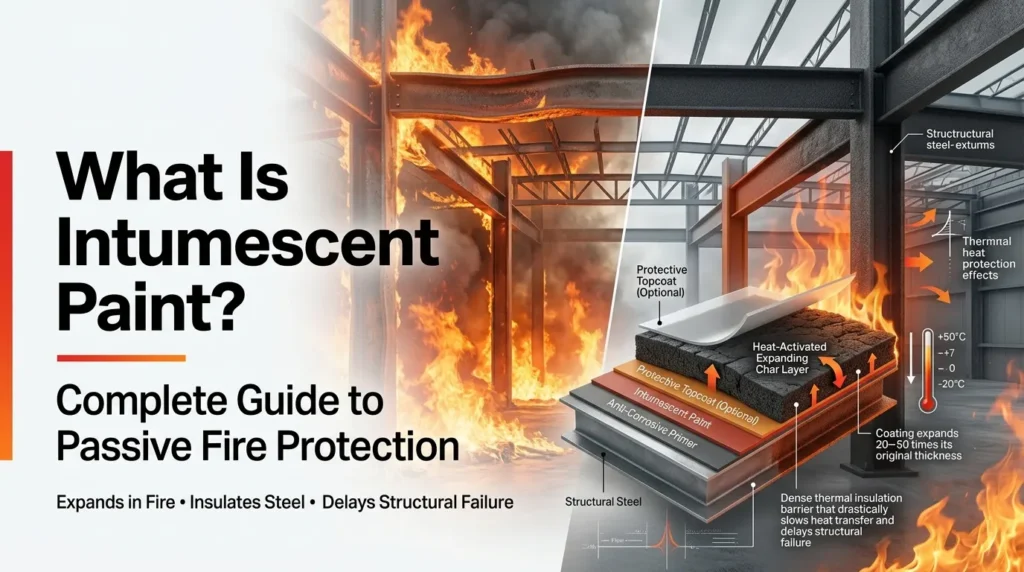
Intumescent paint is a specialized passive fire protection coating that expands when exposed to high temperatures, forming a thick insulating char layer that protects structural materials from the effects of fire. Unlike conventional decorative paints, intumescent coatings are engineered to delay heat transfer, helping structural steel and other building components maintain their strength for a specified fire-resistance period.
In modern construction and industrial facilities, fire safety is more than a regulatory requirement—it’s a critical part of protecting lives, assets, and business continuity. Structural steel, although non-combustible, can rapidly lose its load-bearing capacity when exposed to temperatures above approximately 550°C. Without adequate fire protection, steel beams and columns may deform or fail, increasing the risk of structural collapse during a fire.
Intumescent paint addresses this challenge by reacting chemically when exposed to fire. As temperatures rise, the coating expands many times its original thickness to create a durable, carbon-rich insulating barrier. This protective char significantly slows the rate at which heat reaches the substrate, providing valuable time for building occupants to evacuate safely and for emergency responders to control the fire.
Today, intumescent paint is widely specified for commercial buildings, industrial plants, warehouses, manufacturing facilities, airports, hospitals, power stations, oil and gas installations, and public infrastructure. It combines high-performance fire protection with an attractive architectural finish, making it a preferred solution for exposed structural steel where both safety and aesthetics are important.
Available in water-based, solvent-based, and epoxy systems, intumescent coatings can be selected based on environmental exposure, project requirements, and required fire ratings ranging from 30 minutes to 180 minutes or more, depending on the tested coating system and design specifications.
This comprehensive guide explains what intumescent paint is, how it works, its types, benefits, applications, fire ratings, application methods, and key selection factors, helping engineers, architects, contractors, facility managers, and building owners choose the right passive fire protection solution for their projects.
Introduction to Intumescent Paint
Fire safety is a fundamental consideration in modern construction and industrial facilities. While active fire protection systems such as sprinklers and alarms help detect and control fires, passive fire protection is equally important because it helps maintain the structural stability of a building during a fire. One of the most effective passive fire protection solutions is intumescent paint, a specialized coating designed to protect structural steel and other building materials from extreme heat.
Unlike conventional paints that serve decorative or corrosion-resistant purposes, intumescent paint is formulated to react when exposed to high temperatures. During a fire, it expands into a thick insulating char layer that significantly slows heat transfer to the underlying substrate. This additional protection helps delay structural failure, allowing more time for occupants to evacuate safely and emergency responders to carry out rescue operations.
Today, intumescent paint is widely used in commercial buildings, industrial plants, warehouses, airports, hospitals, power stations, and infrastructure projects where fire safety regulations require certified passive fire protection systems. Understanding how this coating works and where it should be used is essential for architects, engineers, contractors, and facility owners planning fire-safe structures.
What Is Intumescent Paint?
Intumescent paint is a passive fire protection coating that expands when exposed to high temperatures, creating a thick carbon-rich insulating char layer. This expanded barrier slows the transfer of heat to the protected surface, helping structural elements maintain their strength for a specified fire-resistance period.
Unlike ordinary decorative paints, intumescent coatings are engineered specifically for fire protection. Under normal operating conditions, they appear as a thin coating with a smooth finish. However, when temperatures typically exceed 200–250°C, the coating undergoes a chemical reaction that causes it to expand many times its original thickness. The resulting char acts as thermal insulation, reducing the rate at which heat reaches the substrate.
Intumescent paint is commonly applied to structural steel, steel columns, beams, and other load-bearing components because steel can rapidly lose its strength when exposed to high temperatures. Depending on the approved coating system, it can provide fire resistance for 30, 60, 90, 120, or even 180 minutes, helping buildings comply with fire safety regulations and performance requirements.
Why Passive Fire Protection Is Important
Passive fire protection is designed to limit the effects of fire by protecting the building’s structural elements without requiring activation. Unlike fire alarms or sprinkler systems, passive protection remains in place at all times and automatically performs its function when exposed to fire.
Structural steel begins to lose significant strength as its temperature increases during a fire. Without adequate protection, steel beams and columns may deform or fail, increasing the risk of structural collapse. Intumescent paint helps delay this temperature rise by forming an insulating barrier around the steel, allowing it to maintain its load-bearing capacity for a longer period.
The benefits of passive fire protection include:
- Protecting structural stability during a fire
- Providing additional evacuation time for occupants
- Supporting firefighting operations
- Reducing property damage
- Improving compliance with fire safety regulations
- Enhancing overall building safety
For these reasons, passive fire protection has become an essential component of modern commercial, industrial, and infrastructure projects.
Where Intumescent Paint Is Used
Intumescent paint is used wherever structural fire protection is required while maintaining an attractive architectural appearance. It is particularly suitable for exposed steel structures because it provides certified fire resistance without significantly increasing the size or weight of the structural members.
Common applications include:
- Commercial office buildings
- High-rise buildings
- Industrial manufacturing plants
- Warehouses and logistics centers
- Shopping malls
- Airports and railway stations
- Hospitals and healthcare facilities
- Educational institutions
- Power generation plants
- Oil and gas facilities
- Pharmaceutical manufacturing plants
- Infrastructure projects such as bridges and transport terminals
Depending on the project requirements, intumescent coatings are available in water-based, solvent-based, and epoxy systems, allowing designers to select the most suitable solution for indoor, semi-exposed, or harsh industrial environments.
How Intumescent Paint Works
Intumescent paint is engineered to provide passive fire protection by reacting automatically when exposed to high temperatures. Unlike conventional coatings, it remains stable under normal conditions but undergoes a controlled chemical transformation during a fire. This reaction causes the coating to expand dramatically, forming a thick insulating char layer that slows heat transfer to the underlying substrate.
The primary purpose of this process is to protect structural materials—especially steel—from reaching critical temperatures where they begin to lose their mechanical strength. By delaying the rise in temperature, intumescent paint helps maintain the structural integrity of buildings, providing valuable time for evacuation and firefighting operations.
The effectiveness of an intumescent coating depends on factors such as the coating formulation, dry film thickness (DFT), fire rating requirements, and compliance with tested fire protection systems.
The Science Behind Intumescent Coatings
The term “intumescent” refers to the ability of a material to swell or expand when exposed to heat. Intumescent paint contains specially formulated chemical ingredients that remain inactive under normal temperatures but react rapidly during a fire.
As the temperature rises to approximately 200°C–250°C, the coating begins a chemical reaction involving three primary components:
- Acid Source – Initiates the chemical reaction by promoting carbon formation.
- Carbon Source (Char Former) – Produces a carbon-rich protective layer.
- Blowing Agent – Releases non-flammable gases that expand the coating into a thick foam-like char.
These components work together to create an insulating barrier that significantly reduces heat transfer. The resulting char has low thermal conductivity, allowing the protected structure to remain cooler for a longer period.
Modern intumescent coatings are available in water-based, solvent-based, and epoxy formulations, each designed for specific environmental conditions and fire protection requirements.
Expansion and Char Formation
The defining feature of intumescent paint is its ability to expand many times its original thickness during a fire. While the applied coating may initially be only a few millimeters thick, exposure to intense heat causes it to expand into a thick, carbon-rich char.
The expansion process generally follows these stages:
- The surrounding temperature rises during a fire.
- The coating activates at its designed temperature.
- Chemical reactions generate expanding gases.
- The coating swells into a thick insulating foam.
- A stable carbon-rich char forms around the protected surface.
- The char acts as a thermal barrier, slowing heat penetration.
This expanded char layer is essential because it absorbs heat and reduces the rate at which temperatures rise within the structural element. The effectiveness of the insulation depends on the approved coating system and the required fire-resistance rating.
How It Protects Structural Steel During Fire
Structural steel is widely used because of its high strength and design flexibility. However, during a fire, steel can lose a significant portion of its load-bearing capacity as temperatures increase. Without protection, prolonged exposure to high temperatures may lead to deformation or structural instability.
Intumescent paint helps protect structural steel by creating an insulating char layer that delays heat reaching the steel surface. This slows the temperature rise, allowing steel beams, columns, and other structural members to retain their strength for the required fire-resistance period.
The level of protection provided depends on several factors, including:
- Required fire rating (30, 60, 90, 120, or 180 minutes)
- Steel section factor
- Dry Film Thickness (DFT)
- Coating formulation
- Primer and topcoat compatibility
- Correct application and curing
- Compliance with tested fire protection systems
Because of these advantages, intumescent paint is widely specified for commercial buildings, industrial facilities, warehouses, airports, hospitals, power plants, oil and gas installations, and other structures where maintaining structural stability during a fire is essential.
Key Components of Intumescent Paint
The exceptional fire-protection performance of intumescent paint comes from a carefully balanced combination of chemical ingredients that work together when exposed to high temperatures. Under normal conditions, these components remain stable and form a durable protective coating. During a fire, however, they undergo a controlled chemical reaction that produces an expanded insulating char layer.
A typical intumescent coating consists of four primary components: an acid source, a carbon source, a blowing agent, and a binder with performance-enhancing additives. Each component has a specific function, and together they determine the coating’s fire resistance, expansion characteristics, durability, and long-term performance.
Understanding these key components helps engineers, architects, contractors, and facility owners appreciate how intumescent paint provides reliable passive fire protection.
Acid Source
The acid source is one of the most important ingredients in an intumescent coating because it initiates the chemical reaction when exposed to fire.
As temperatures increase, the acid source decomposes and releases acidic compounds that promote the formation of a stable carbon layer. This reaction prepares the coating for expansion and helps create the protective char that insulates the substrate from extreme heat.
The acid source plays a vital role in:
- Initiating the intumescent reaction
- Promoting char formation
- Improving fire resistance
- Supporting thermal insulation
- Enhancing overall coating performance
Without an effective acid source, the coating would not form the strong insulating barrier required for passive fire protection.
Carbon Source
The carbon source, also known as the char former, provides the material needed to build the expanded protective layer during a fire.
When activated by the acid source, the carbon source converts into a rigid carbon-rich structure that forms the backbone of the insulating char. This expanded layer significantly reduces heat transfer and protects the underlying structural material from rapid temperature increases.
The carbon source contributes to:
- Formation of the insulating char
- Improved thermal resistance
- Structural stability of the expanded coating
- Extended fire protection
- Reduced heat penetration
The quality of the carbon source directly influences the strength and durability of the protective char.
Blowing Agent
The blowing agent is responsible for the dramatic expansion that gives intumescent paint its unique fire-protection properties.
When exposed to high temperatures, the blowing agent releases non-flammable gases that cause the softened coating to expand many times its original thickness. This expansion creates a lightweight foam-like char filled with microscopic air pockets, which greatly improve thermal insulation.
The blowing agent helps to:
- Expand the coating during a fire
- Produce an insulating foam structure
- Increase the thickness of the protective barrier
- Slow heat transfer
- Improve overall fire performance
Without the blowing agent, the coating would not expand sufficiently to provide effective thermal insulation.
Binder and Additives
The binder holds all the coating ingredients together and ensures strong adhesion to the substrate under normal service conditions. It also provides durability, flexibility, and resistance to environmental exposure before a fire occurs.
In addition to the binder, manufacturers incorporate specialized additives to enhance application properties and long-term performance. These additives may improve flow, leveling, weather resistance, corrosion resistance, moisture resistance, curing characteristics, and coating stability.
The binder and additives provide several important benefits:
- Strong adhesion to the substrate
- Improved coating durability
- Better resistance to moisture and weather
- Enhanced application properties
- Increased flexibility and crack resistance
- Long-term coating stability
- Compatibility with primers and topcoats
Together, the binder and additives ensure that the intumescent coating remains effective throughout its service life while maintaining its fire-protection performance when required.
Types of Intumescent Paint
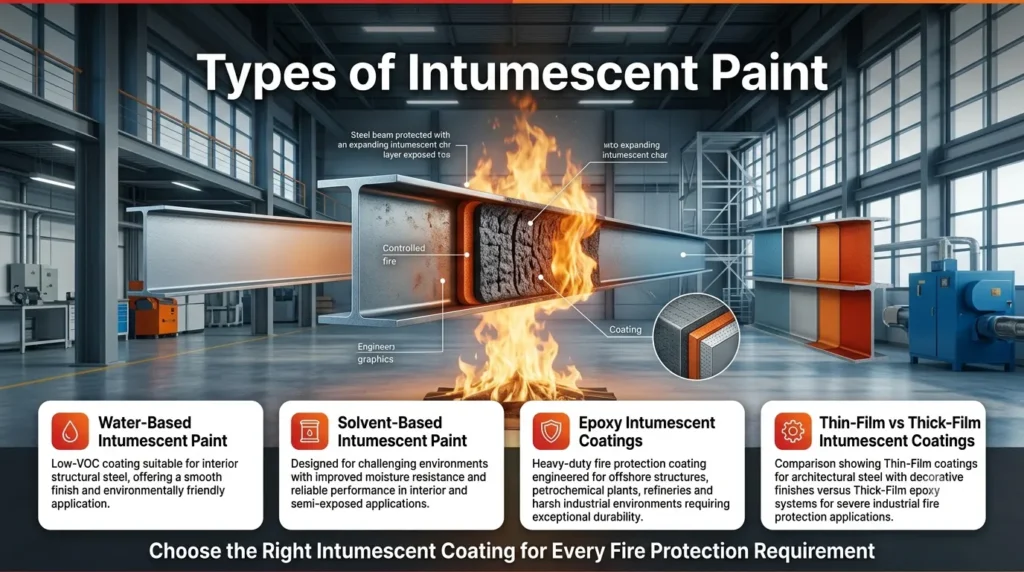
Intumescent paint is available in several formulations to meet different fire protection requirements, environmental conditions, and project specifications. The choice of coating depends on factors such as the type of structure, exposure conditions, required fire rating, and long-term durability. The three most common types are water-based, solvent-based, and epoxy intumescent coatings. In addition, intumescent systems are classified as thin-film or thick-film coatings based on their composition and intended application.
Selecting the appropriate type of intumescent paint helps ensure reliable fire protection while meeting both performance and maintenance requirements.
Water-Based Intumescent Paint
Water-based intumescent paint is one of the most commonly used fire protection coatings for interior structural steel. It contains water as the primary carrier, making it a low-VOC and environmentally friendly option for commercial and residential buildings.
These coatings provide a smooth architectural finish while delivering certified fire resistance for exposed steel structures. They are suitable for dry indoor environments where exposure to moisture and harsh weather conditions is limited.
Key Benefits
- Low VOC and low odor
- Easy application and cleanup
- Smooth decorative finish
- Suitable for interior steel structures
- Environmentally friendly formulation
Common Applications
- Office buildings
- Shopping malls
- Hospitals
- Schools and universities
- Hotels
- Residential developments
Solvent-Based Intumescent Paint
Solvent-based intumescent paint is designed for environments where faster drying, improved humidity resistance, or limited external exposure is required. These coatings generally offer better performance in challenging weather conditions compared to water-based systems.
They are commonly specified for semi-exposed steel structures and industrial projects where greater environmental resistance is necessary.
Key Benefits
- Faster drying and curing
- Better humidity resistance
- Improved durability
- Suitable for semi-exposed environments
- Compatible with various protective topcoats
Common Applications
- Industrial buildings
- Warehouses
- Manufacturing plants
- Parking structures
- Steel fabrication projects
- Exterior steel with approved topcoat systems
Epoxy Intumescent Coatings
Epoxy intumescent coatings are heavy-duty fire protection systems developed for harsh industrial and offshore environments. In addition to providing passive fire protection, they offer excellent resistance to corrosion, chemicals, moisture, and mechanical damage.
These coatings are widely used in industries where structures may be exposed to severe operating conditions and hydrocarbon fire risks.
Key Benefits
- High mechanical strength
- Excellent corrosion resistance
- Superior chemical resistance
- Outstanding durability
- Suitable for aggressive environments
- Long service life
Common Applications
- Oil and gas facilities
- Petrochemical plants
- Offshore platforms
- Refineries
- LNG terminals
- Power generation facilities
- Marine structures
Thin-Film vs Thick-Film Intumescent Coatings
Intumescent coatings are also classified according to the thickness of the protective system and the type of fire exposure they are designed to withstand.
Thin-Film Intumescent Coatings
Thin-film coatings are lightweight systems that provide fire protection while maintaining a smooth architectural appearance. They are primarily used for structural steel in commercial and residential buildings where aesthetics are important.
Advantages
- Smooth finish
- Lightweight coating system
- Ideal for exposed architectural steel
- Easy application
- Suitable for cellulosic fire protection
Typical Applications
- Offices
- Shopping malls
- Airports
- Hotels
- Commercial buildings
Thick-Film Intumescent Coatings
Thick-film intumescent coatings are high-build systems designed for demanding industrial environments. They provide enhanced durability and are often specified where hydrocarbon fire protection or extreme environmental resistance is required.
Advantages
- High-build protective system
- Excellent impact resistance
- Superior durability
- Suitable for harsh industrial environments
- Long-term protection
Typical Applications
- Offshore platforms
- Refineries
- Petrochemical facilities
- Oil and gas plants
- Heavy industrial structures
Benefits of Intumescent Paint
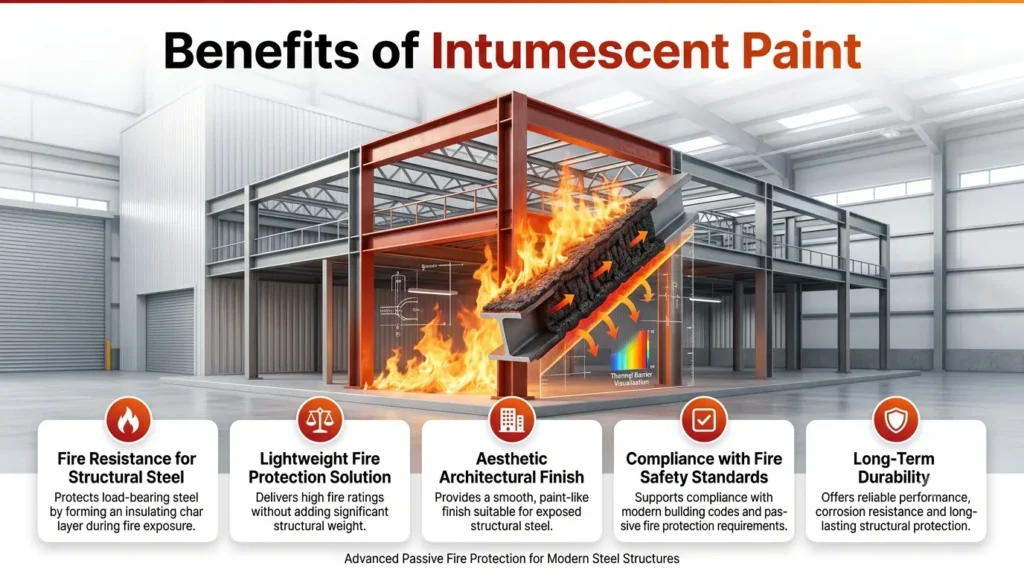
Intumescent paint offers a highly effective passive fire protection solution for modern commercial, industrial, and infrastructure projects. Unlike conventional coatings, it provides more than just surface protection—it helps preserve the structural integrity of buildings during a fire by delaying heat transfer to critical structural elements. In addition to enhancing fire safety, intumescent paint provides architectural flexibility, long-term durability, and compliance with building fire regulations.
Whether used in high-rise buildings, warehouses, manufacturing plants, hospitals, or power facilities, intumescent coatings deliver reliable fire performance while maintaining the appearance of exposed structural steel. Below are the key benefits of using intumescent paint.
Fire Resistance for Structural Steel
One of the primary advantages of intumescent paint is its ability to protect structural steel from extreme temperatures during a fire. Although steel is non-combustible, it begins to lose significant strength when exposed to high temperatures. Intumescent paint expands into a thick insulating char layer that slows heat transfer, helping steel retain its load-bearing capacity for a specified fire-resistance period.
Key Advantages
- Delays heat transfer to structural steel
- Helps maintain structural stability
- Supports safe building evacuation
- Reduces the risk of structural collapse
- Available for fire ratings from 30 to 180 minutes, depending on the approved system
Lightweight Fire Protection Solution
Compared with traditional fireproofing materials such as concrete encasement or cementitious coatings, intumescent paint provides effective fire protection with minimal additional weight. The coating is applied in relatively thin layers under normal conditions and expands only when exposed to fire.
Its lightweight design makes it suitable for projects where maintaining structural efficiency and architectural flexibility is important.
Key Advantages
- Minimal increase in structural weight
- Suitable for exposed steel sections
- Preserves original structural dimensions
- Reduces installation complexity
- Ideal for renovation and retrofit projects
Aesthetic Architectural Finish
Unlike bulky fireproofing systems, intumescent paint provides a smooth, clean finish that allows structural steel to remain visible. This makes it a preferred choice for modern architectural designs where exposed steel is an important design feature.
The coating can also be finished with compatible topcoats in various colors and gloss levels to meet both aesthetic and environmental requirements.
Key Advantages
- Smooth decorative finish
- Maintains the appearance of exposed steel
- Compatible with architectural topcoats
- Suitable for commercial and public buildings
- Combines fire protection with design flexibility
Compliance with Fire Safety Standards
Intumescent paint helps buildings meet fire safety requirements when specified and applied as part of a tested and approved coating system. Fire-resistance performance is verified through recognized testing standards, making these coatings suitable for projects that require certified passive fire protection.
Selecting the appropriate coating system based on the required fire rating and project specifications supports compliance with applicable building codes and fire safety regulations.
Key Advantages
- Supports compliance with fire regulations
- Available with certified fire-resistance systems
- Suitable for commercial and industrial projects
- Helps meet project fire protection requirements
- Designed for use in tested coating systems
Long-Term Durability
Modern intumescent coatings are formulated to provide reliable performance throughout the service life of a structure. When combined with compatible primers and protective topcoats, they offer excellent resistance to environmental exposure, moisture, corrosion, and general wear, depending on the selected system.
Regular inspection and maintenance help ensure continued performance and long-term protection.
Key Advantages
- Long service life
- Strong adhesion to approved substrates
- Good environmental resistance
- Compatible with protective topcoat systems
- Reduced maintenance requirements over time
Applications of Intumescent Paint
Intumescent paint is widely used across commercial, industrial, and public infrastructure projects where passive fire protection is essential. Its ability to expand into an insulating char layer during a fire helps protect structural steel and other load-bearing elements, allowing buildings to maintain structural stability for a specified fire-resistance period.
Because it combines certified fire protection with a smooth architectural finish, intumescent paint is commonly specified for exposed steel structures in modern construction. The choice of coating system depends on factors such as the building type, environmental conditions, required fire rating, and applicable fire safety regulations.
Commercial Buildings
Commercial buildings often feature exposed structural steel as part of their architectural design. Intumescent paint provides the required fire protection while preserving the clean appearance of steel beams and columns.
By delaying the rise in steel temperature during a fire, the coating helps maintain the structural integrity of office complexes, shopping malls, hotels, and other commercial properties, supporting safe evacuation and emergency response.
Common Applications
- Office buildings
- Shopping malls
- Hotels
- Convention centers
- Mixed-use developments
- High-rise commercial towers
Key Benefits
- Protects exposed structural steel
- Maintains architectural aesthetics
- Supports compliance with fire safety requirements
- Available in various fire ratings
- Compatible with decorative topcoats
Industrial Plants and Warehouses
Manufacturing facilities and warehouses often contain valuable equipment, production lines, and storage areas where fire protection is critical. Intumescent paint helps protect steel structures from rapid temperature increases, reducing the risk of structural failure during a fire.
It is widely used in factories, logistics centers, distribution warehouses, and processing plants where operational continuity and worker safety are priorities.
Common Applications
- Manufacturing plants
- Warehouses
- Distribution centers
- Logistics facilities
- Food processing plants
- Pharmaceutical manufacturing units
Key Benefits
- Protects steel frameworks
- Suitable for large industrial structures
- Supports business continuity
- Helps reduce fire-related structural damage
- Long-lasting fire protection
Oil & Gas Facilities
The oil and gas industry operates in environments with elevated fire risks, making passive fire protection a critical part of facility design. Intumescent coatings, particularly epoxy systems, are commonly used to protect structural steel exposed to harsh environmental conditions.
These coatings provide fire resistance while also offering excellent durability and resistance to corrosion, chemicals, and moisture.
Common Applications
- Refineries
- Petrochemical plants
- Offshore platforms
- LNG terminals
- Storage terminals
- Processing facilities
Key Benefits
- Designed for demanding industrial environments
- High durability and corrosion resistance
- Suitable for aggressive operating conditions
- Helps protect critical structural assets
- Compatible with heavy-duty protective coating systems
Power Plants
Power generation facilities contain boilers, turbines, transformers, and steel support structures that require dependable passive fire protection. Intumescent paint helps maintain the stability of structural steel during fire incidents, supporting the protection of critical infrastructure.
These coatings are used in conventional, renewable, and industrial power generation facilities where maintaining structural integrity is essential.
Common Applications
- Thermal power plants
- Gas-fired power stations
- Biomass plants
- Renewable energy facilities
- Turbine buildings
- Utility structures
Key Benefits
- Protects structural steel
- Supports operational safety
- Suitable for complex industrial facilities
- Long-term coating performance
- Helps meet project fire protection requirements
Hospitals, Airports, and Public Infrastructure
Public buildings and transportation facilities require reliable passive fire protection because they accommodate large numbers of people every day. Intumescent paint helps protect structural steel while maintaining an attractive architectural finish, making it well suited for these high-occupancy environments.
It is commonly specified in healthcare facilities, transportation hubs, educational institutions, sports arenas, and other public infrastructure projects.
Common Applications
- Hospitals
- Airports
- Railway stations
- Schools and universities
- Sports stadiums
- Government buildings
- Museums and exhibition centers
Key Benefits
- Enhances life safety
- Protects critical structural elements
- Suitable for high-occupancy buildings
- Preserves architectural appearance
- Supports compliance with building fire safety requirements
Intumescent Paint vs Fire Retardant Paint
Although intumescent paint and fire retardant paint are both used to improve fire safety, they are designed for different purposes and applications. The two coatings are often confused because both help reduce the impact of fire, but they work in different ways.
Intumescent paint is primarily used for passive fire protection of structural steel and load-bearing elements. When exposed to high temperatures, it expands into a thick insulating char layer that slows heat transfer and helps maintain structural stability during a fire.
Fire retardant paint, on the other hand, is formulated to reduce flame spread and slow surface ignition on various substrates such as wood, gypsum boards, cables, and certain metal applications. It helps limit fire propagation but does not typically expand to form the thick insulating barrier associated with intumescent coatings.
Understanding these differences is essential when selecting the right fire protection system for commercial buildings, industrial facilities, or infrastructure projects.
Key Differences
Although both coatings contribute to fire safety, they differ in their working mechanism, applications, and performance objectives.
| Feature | Intumescent Paint | Fire Retardant Paint |
| Primary Purpose | Passive fire protection | Reduces flame spread |
| Reaction to Fire | Expands to form insulating char | Slows ignition and flame propagation |
| Heat Insulation | Excellent | Limited |
| Structural Steel Protection | Yes | Limited |
| Typical Applications | Structural steel, columns, beams | Wood, gypsum board, cables, walls, interior surfaces |
| Fire Resistance | 30–180 minutes (depending on the tested system) | Varies by product and application |
| Appearance | Smooth architectural finish | Decorative or protective finish |
Advantages of Intumescent Paint
- Expands during fire
- Protects structural steel
- Delays heat transfer
- Suitable for passive fire protection
- Available in certified fire-rated systems
Advantages of Fire Retardant Paint
- Helps reduce flame spread
- Suitable for multiple substrates
- Easy to apply
- Supports fire safety strategies
- Available for residential, commercial, and industrial applications
Which Coating Is Right for Your Project?
Choosing the correct coating depends on the substrate, fire protection objectives, environmental conditions, and project specifications.
Choose Intumescent Paint When:
- Structural steel requires fire protection.
- Building codes specify certified fire ratings.
- Exposed steel needs an architectural finish.
- Passive fire protection is required.
- Commercial, industrial, or infrastructure projects require structural stability during fire.
Choose Fire Retardant Paint When:
- The objective is to reduce flame spread.
- Wood, gypsum board, or cables require additional fire protection.
- Interior wall or ceiling systems need improved fire performance.
- Decorative surfaces require fire-retardant properties.
- The project does not require structural steel fire resistance.
For many projects, both coatings may be used together on different building components. For example, intumescent paint may be specified for structural steel, while fire retardant paint is applied to wood, gypsum board, or cable systems to provide comprehensive passive fire protection.
Common Misconceptions
There are several misconceptions about fire protection coatings that can lead to incorrect product selection.
Myth 1: Intumescent paint and fire retardant paint are the same.
Fact: They serve different purposes. Intumescent paint expands to provide thermal insulation, while fire retardant paint primarily reduces flame spread.
Myth 2: Fire retardant paint can replace intumescent paint on structural steel.
Fact: Fire retardant paint is generally not intended to provide the same level of structural fire protection as an approved intumescent coating system.
Myth 3: Thicker coatings always provide better fire protection.
Fact: Fire performance depends on the tested coating system, required fire rating, substrate, and specified Dry Film Thickness (DFT), not simply on applying more paint.
Myth 4: Intumescent paint only protects steel.
Fact: While it is most commonly used on structural steel, some intumescent coating systems are formulated for other substrates, depending on the manufacturer’s specifications.
Myth 5: Fire protection coatings eliminate the risk of fire.
Fact: Fire protection coatings do not prevent fires from occurring. They are designed to improve fire performance, delay heat transfer, and enhance building safety during a fire.
Application Process
Proper application is essential to achieve the intended fire-resistance performance of an intumescent coating. Even the highest-quality intumescent paint may not provide the required level of protection if the surface is not properly prepared or if the coating system is applied incorrectly. A complete intumescent system typically consists of surface preparation, primer, intumescent coating, protective topcoat (where required), and final inspection.
Following the manufacturer’s recommendations and the approved fire-tested coating system helps ensure reliable performance, long-term durability, and compliance with project specifications.
Surface Preparation
Surface preparation is the foundation of every successful intumescent coating system. The substrate must be clean, dry, and free from contaminants that could reduce coating adhesion or performance.
For structural steel, surface preparation generally includes removing rust, mill scale, oil, grease, dust, and loose coatings using appropriate cleaning methods. The required level of preparation depends on the project specification and the selected coating system.
Best Practices
- Remove rust and mill scale
- Eliminate oil, grease, and dust
- Ensure the surface is dry before coating
- Repair damaged or defective steel surfaces
- Follow the specified surface preparation standard
Proper surface preparation improves adhesion, coating durability, and long-term fire protection performance.
Primer Selection
The primer forms the first protective layer between the steel surface and the intumescent coating. It improves adhesion, provides corrosion protection, and ensures compatibility within the complete fire protection system.
Only approved primers recommended by the coating manufacturer should be used. Selecting an incompatible primer may reduce the effectiveness of the intumescent coating and affect the tested fire-resistance performance.
Factors to Consider
- Primer compatibility with the intumescent coating
- Corrosion protection requirements
- Environmental exposure
- Project specifications
- Manufacturer-approved coating systems
Using the correct primer helps maximize coating life and supports reliable passive fire protection.
Applying the Intumescent Coating
Once the primer has fully cured, the intumescent coating is applied according to the manufacturer’s recommendations. Depending on the product and project requirements, application may be carried out using airless spray equipment, rollers, or brushes.
The coating is normally applied in multiple coats until the specified Dry Film Thickness (DFT) required for the approved fire rating is achieved. Adequate drying time should be allowed between coats to ensure proper curing and coating performance.
Application Methods
- Airless spray application
- Roller application
- Brush application
- Multiple-coat application
- Controlled drying and curing
Correct application helps ensure uniform coverage, proper expansion during fire, and consistent fire-resistance performance.
Topcoat Application
In many projects, particularly those exposed to humidity, weather, or industrial environments, a compatible protective topcoat is applied over the intumescent coating. The topcoat protects the fire protection system from environmental damage while maintaining its appearance.
Topcoats may also provide additional resistance to moisture, ultraviolet (UV) exposure, chemicals, abrasion, and corrosion, depending on the service environment.
Benefits of Topcoats
- Moisture protection
- Weather resistance
- UV resistance
- Improved durability
- Decorative finish
- Easier maintenance and cleaning
The selected topcoat must always be compatible with the approved intumescent coating system.
Inspection and Dry Film Thickness (DFT)
Final inspection is an essential step in verifying that the intumescent coating system has been applied correctly. The coating should be visually inspected for uniformity, adhesion, and surface defects, while the Dry Film Thickness (DFT) should be measured using appropriate inspection equipment.
The required DFT depends on several factors, including the fire rating, steel section factor, and the manufacturer’s tested coating system. Applying too little coating may reduce fire protection, while excessive thickness can affect curing and coating performance.
Inspection Checklist
- Verify surface preparation
- Confirm primer compatibility
- Measure Dry Film Thickness (DFT)
- Inspect coating uniformity
- Check for defects or damage
- Verify complete curing before service
- Ensure compliance with project specifications
Regular inspections and maintenance throughout the service life of the coating help maintain long-term passive fire protection performance.
Factors to Consider Before Choosing Intumescent Paint
Selecting the right intumescent paint is essential for achieving effective passive fire protection and long-term coating performance. Every project has unique requirements based on the type of structure, environmental exposure, fire safety regulations, and desired fire-resistance period. Choosing the wrong coating system can affect fire performance, durability, and compliance with building standards.
Before specifying an intumescent coating, engineers, architects, contractors, and building owners should evaluate factors such as the required fire rating, steel section factor, exposure conditions, environmental influences, and long-term maintenance needs. Considering these factors helps ensure the coating system delivers reliable protection throughout its service life.
Required Fire Rating
The first step in selecting an intumescent paint is determining the required fire rating for the project. Fire ratings indicate how long a structural element can maintain its integrity during a fire under approved test conditions.
Depending on building regulations and project specifications, intumescent coatings are available with fire-resistance ratings such as 30, 60, 90, 120, and 180 minutes. The required rating is determined by factors including the building type, occupancy, structural design, and applicable fire safety codes.
Considerations
- Required fire-resistance period
- Building occupancy and usage
- Local fire safety regulations
- Project specifications
- Approved fire-tested coating systems
Selecting the correct fire rating ensures that the coating provides the level of protection required for the structure.
Steel Section Factor
The steel section factor is one of the most important technical considerations when specifying an intumescent coating for structural steel. It represents the relationship between the exposed surface area of a steel member and its cross-sectional area.
Steel sections with higher section factors heat up more quickly during a fire and generally require a greater Dry Film Thickness (DFT) to achieve the desired fire rating. Conversely, heavier steel sections may require less coating thickness.
Why It Matters
- Determines required coating thickness
- Influences fire performance
- Affects material consumption
- Helps achieve certified fire ratings
- Ensures compliance with tested coating systems
Accurate calculation of the steel section factor is essential for selecting the appropriate intumescent coating specification.
Indoor vs Outdoor Exposure
The service environment plays a major role in selecting the appropriate intumescent paint system. Different formulations are designed for interior, semi-exposed, or exterior applications.
Water-based intumescent coatings are commonly used for dry indoor environments, while solvent-based or epoxy systems are better suited for areas exposed to humidity, weather, or harsh industrial conditions. In outdoor applications, a compatible protective topcoat is typically required to improve resistance to moisture and ultraviolet (UV) exposure.
Selection Factors
- Interior or exterior installation
- Exposure to rain and humidity
- UV resistance requirements
- Temperature variations
- Protective topcoat compatibility
Choosing the correct system for the exposure conditions helps maximize coating durability and long-term fire protection.
Environmental Conditions
Environmental conditions can significantly influence the performance and lifespan of an intumescent coating. Factors such as moisture, corrosive chemicals, salt spray, industrial pollution, and temperature fluctuations should be evaluated during the specification process.
Projects located in coastal areas, chemical plants, offshore platforms, or heavy industrial facilities often require more durable coating systems, such as epoxy intumescent coatings, combined with appropriate primers and protective topcoats.
Environmental Factors
- Humidity levels
- Corrosive atmosphere
- Chemical exposure
- Coastal or marine environments
- Temperature fluctuations
- Industrial pollution
- Moisture resistance requirements
Selecting a coating system suitable for the operating environment helps maintain long-term fire protection performance.
Maintenance Requirements
Regular inspection and maintenance are essential for ensuring the continued effectiveness of an intumescent coating system throughout its service life. Although these coatings are designed for long-term durability, periodic assessments help identify mechanical damage, coating deterioration, or environmental wear that could affect fire protection performance.
Maintenance requirements vary depending on the service environment, coating system, and exposure conditions.
Maintenance Best Practices
- Conduct routine visual inspections
- Repair damaged coating areas promptly
- Check coating adhesion and integrity
- Maintain protective topcoats
- Follow manufacturer maintenance recommendations
- Document inspection and maintenance activities
A well-maintained intumescent coating system helps preserve both structural fire protection and long-term asset performance.
Common Mistakes to Avoid
The performance of an intumescent coating depends not only on the quality of the product but also on correct specification, application, and maintenance. Even a certified intumescent paint may fail to deliver its intended fire resistance if it is applied incorrectly or outside the manufacturer’s approved system.
Many fire protection issues result from avoidable mistakes, such as applying the wrong coating thickness, inadequate surface preparation, using incompatible coating components, or failing to follow the manufacturer’s instructions. Understanding these common errors helps ensure reliable passive fire protection, long-term durability, and compliance with project specifications.
Incorrect Dry Film Thickness (DFT)
Dry Film Thickness (DFT) is one of the most critical factors affecting the fire performance of an intumescent coating. Every approved coating system specifies a required DFT based on the steel section factor and the desired fire rating.
Applying less than the required thickness may reduce the coating’s ability to protect structural steel during a fire. Conversely, applying excessive thickness can lead to issues such as cracking, poor curing, or reduced coating performance.
Best Practices
- Measure DFT after each application stage.
- Follow the manufacturer’s approved thickness requirements.
- Use calibrated DFT gauges for inspection.
- Apply multiple coats where necessary.
- Verify the final DFT before project completion.
Poor Surface Preparation
Surface preparation is essential for achieving strong adhesion and long-term performance. Applying intumescent paint over dirty, oily, rusty, or contaminated surfaces can result in coating failure, poor adhesion, and reduced fire protection.
Before application, the substrate should be properly cleaned and prepared according to the specified surface preparation standard and coating manufacturer’s recommendations.
Best Practices
- Remove rust, mill scale, dust, and contaminants.
- Eliminate oil and grease before coating.
- Ensure the surface is dry and clean.
- Repair damaged steel before application.
- Follow the specified surface preparation requirements.
Using Incompatible Primers or Topcoats
An intumescent coating system consists of compatible layers, including the primer, intumescent coating, and, where required, the protective topcoat. Using primers or topcoats that have not been approved for the coating system may affect adhesion, curing, durability, or fire performance.
Always use products that are compatible with the tested and approved intumescent coating system.
Best Practices
- Select manufacturer-approved primers.
- Use compatible protective topcoats.
- Follow recommended curing times between coats.
- Avoid mixing products from unapproved systems.
- Confirm compatibility before application.
Ignoring Manufacturer Specifications
Every intumescent coating is supplied with detailed technical documentation covering surface preparation, application methods, environmental conditions, curing times, and inspection requirements. Ignoring these recommendations can reduce coating performance and affect the certified fire-resistance rating.
Following the manufacturer’s specifications helps ensure the coating system performs as tested and intended throughout its service life.
Best Practices
- Read the Technical Data Sheet (TDS) before application.
- Follow the recommended application procedures.
- Apply the coating within the specified temperature and humidity limits.
- Allow sufficient drying and curing time.
- Perform final inspection according to project requirements.
Frequently Asked Questions (FAQs)
What is the difference between intumescent paint and fire retardant paint?
Intumescent paint and fire retardant paint both improve fire safety, but they serve different purposes. Intumescent paint expands when exposed to high temperatures, forming a thick insulating char layer that protects structural steel and other load-bearing elements by slowing heat transfer. Fire retardant paint, on the other hand, is designed to reduce flame spread and delay surface ignition on materials such as wood, gypsum board, and cables. It does not typically provide the same level of thermal insulation or structural fire protection as an approved intumescent coating system.
How long does intumescent paint last?
The service life of intumescent paint depends on the coating formulation, application quality, environmental conditions, and maintenance practices. When applied as part of an approved coating system with compatible primers and topcoats, intumescent coatings can provide long-term fire protection for many years. Regular inspections and timely maintenance help preserve the coating’s performance and durability throughout its service life.
Can intumescent paint be used outdoors?
Yes, intumescent paint can be used outdoors, but the coating system must be suitable for exterior exposure. Water-based coatings are generally recommended for interior applications, while solvent-based or epoxy intumescent coatings are more suitable for outdoor and harsh industrial environments. Exterior applications typically require a compatible protective topcoat to improve resistance to moisture, ultraviolet (UV) radiation, and weathering.
What fire ratings are available?
Intumescent paint systems are available with a range of certified fire-resistance ratings, depending on the product, coating thickness, steel section factor, and approved test system. Common fire ratings include:
- 30 Minutes
- 60 Minutes
- 90 Minutes
- 120 Minutes
- 180 Minutes
The required fire rating should be selected based on the building type, project specifications, applicable fire safety regulations, and the manufacturer’s tested coating system.
Does intumescent paint prevent fire?
No. Intumescent paint does not prevent a fire from starting or extinguish flames. Its primary purpose is to provide passive fire protection by delaying heat transfer to structural elements during a fire. When exposed to high temperatures, the coating expands into an insulating char layer that helps maintain the structural stability of the building, providing valuable time for safe evacuation and emergency response.
Conclusion
Intumescent paint is one of the most effective passive fire protection solutions for safeguarding structural steel and other critical building components during a fire. By expanding into a thick insulating char layer when exposed to high temperatures, it slows heat transfer and helps maintain the structural integrity of buildings for a specified fire-resistance period. This additional protection provides valuable time for safe evacuation, emergency response, and fire control, making intumescent coatings an essential part of modern fire safety strategies.
Whether used in commercial buildings, industrial facilities, warehouses, hospitals, airports, or power plants, intumescent paint combines certified fire protection with a durable and aesthetically pleasing finish. However, achieving the expected fire performance depends on selecting the correct coating system, applying it according to manufacturer recommendations, and maintaining it throughout its service life.
By understanding how intumescent paint works, its different types, application methods, and selection criteria, architects, engineers, contractors, and facility owners can make informed decisions that improve both fire safety and long-term building performance.
Why Intumescent Paint Is Essential for Passive Fire Protection
Intumescent paint plays a critical role in passive fire protection by delaying the temperature rise of structural steel during a fire. Unlike active fire protection systems that require activation, intumescent coatings respond automatically to heat, forming an insulating barrier that helps preserve the load-bearing capacity of structural elements. This protection enhances life safety, reduces the risk of structural collapse, and supports compliance with fire safety requirements.
Selecting the Right Intumescent Coating System
Choosing the appropriate intumescent coating system requires careful consideration of the project’s fire rating, steel section factor, environmental exposure, substrate type, and maintenance requirements. Water-based, solvent-based, and epoxy formulations are each designed for specific applications and service conditions. Using a tested and approved coating system, along with compatible primers and topcoats, helps ensure reliable long-term fire protection.
Improving Building Safety with Certified Fire Protection Coatings
Certified intumescent coating systems contribute to safer buildings by protecting structural components during fire emergencies and supporting compliance with recognized fire safety standards. Proper specification, professional application, regular inspection, and ongoing maintenance help ensure the coating continues to perform as intended throughout its service life. Investing in a certified passive fire protection system not only safeguards property and infrastructure but also helps protect the lives of building occupants and emergency responders.