

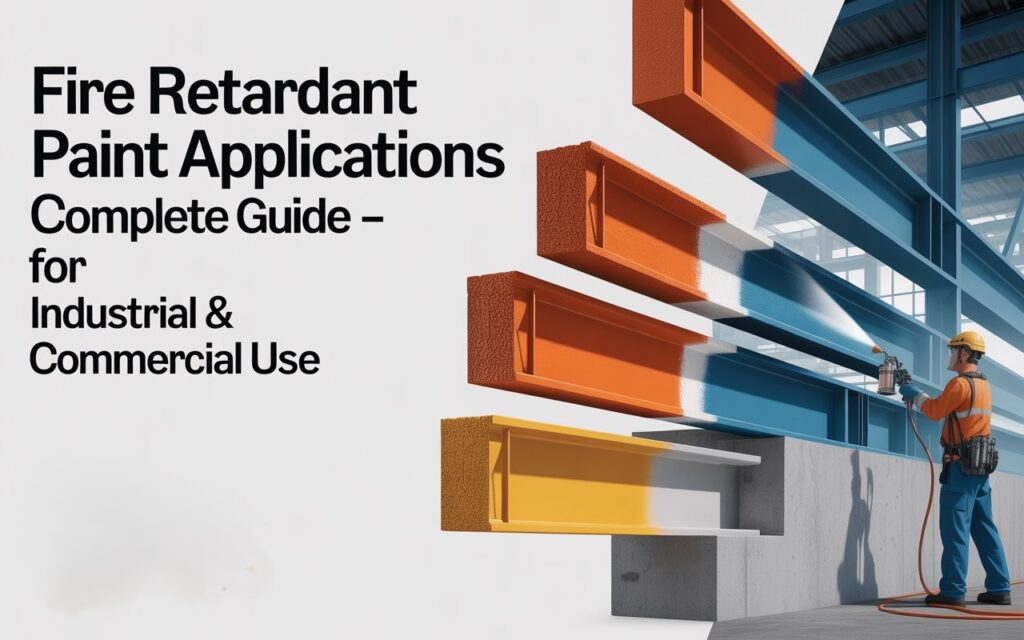
Fire safety is a critical requirement in today’s industrial and commercial environments. From factories and warehouses to offices and public infrastructure, protecting structures against fire hazards is essential for both safety and regulatory compliance. This is where fire retardant paint applications play an important role.
Fire retardant paint is specially designed to slow down flame spread, reduce heat transfer, and improve structural fire resistance during emergencies. Unlike ordinary coatings, these advanced fire protection systems react under high temperatures to form an insulating barrier that helps protect steel, wood, cables, and other surfaces.
Modern fire retardant coatings are widely used across industries because they provide effective passive fire protection without affecting structural design or appearance. Whether applied in industrial plants, commercial buildings, data centers, or residential spaces, these coatings help enhance occupant safety, reduce property damage, and support long-term fire safety compliance.
In this complete guide, we will explore the most common fire retardant paint applications, their benefits, and how to choose the right fire protection coating system for different environments.
Introduction to Fire Retardant Paint Applications
Fire hazards can cause severe damage to buildings, machinery, and human life within minutes. As industries and commercial structures become more advanced, the need for reliable fire protection systems continues to grow. Fire retardant paint applications have become an essential part of modern passive fire protection strategies, helping reduce fire risks while improving structural safety.
What is Fire Retardant Paint?
Fire retardant paint is a specially formulated protective coating designed to slow down the spread of flames and reduce heat transfer during a fire. Unlike conventional paint, it reacts to high temperatures by forming an insulating char layer that shields the underlying surface.
These coatings are commonly applied to steel, wood, cables, and concrete surfaces to improve fire resistance and delay structural failure during emergencies.
Why Fire Protection Coatings Matter
Fire protection coatings play a critical role in preventing rapid fire escalation. By slowing flame spread and minimizing heat penetration, they provide valuable extra time for evacuation and firefighting operations.
In industrial and commercial environments, fire retardant coatings also help reduce property damage, limit operational downtime, and support compliance with fire safety regulations and building codes.
Growing Use in Modern Construction
Modern construction projects increasingly incorporate fire retardant paint as part of overall safety planning. High-rise buildings, warehouses, shopping malls, airports, hospitals, and manufacturing facilities all require enhanced fire resistance measures.
With stricter fire safety standards and rising awareness of passive fire protection, fire retardant paint applications are becoming a standard requirement in both new construction and renovation projects.
How Fire Retardant Paint Works
Fire retardant paint is more than just a protective surface coating — it is an advanced fire safety system engineered to react under extreme heat conditions. These coatings are designed to delay fire spread, reduce heat transfer, and protect structural materials during emergencies. Understanding how the technology works helps explain why it is widely used in industrial and commercial fire protection applications.
Intumescent Coating Technology
Most modern fire retardant paints use intumescent coating technology. When exposed to high temperatures, the coating undergoes a chemical reaction and rapidly expands many times its original thickness.
This expansion creates a thick foam-like insulating layer known as char. The char acts as a thermal barrier between the fire and the substrate, helping protect materials such as steel, wood, and cables from direct heat exposure.
Heat Resistance & Char Formation
The key function of fire retardant paint is to resist heat transfer. During a fire, the coating activates at a specific temperature and begins forming a carbon-rich char layer.
This protective layer:
- Slows temperature rise
- Reduces heat penetration
- Protects structural integrity
- Delays material failure
For steel structures, this is especially important because steel can lose significant strength when exposed to high temperatures. The insulating char helps maintain stability for a longer period.
Flame Spread Reduction Process
Fire retardant paint also helps control how quickly flames spread across a surface. By reducing oxygen access and limiting combustible reactions, the coating slows fire progression and minimizes smoke generation.
This controlled reaction provides valuable extra time for evacuation, emergency response, and fire suppression efforts. As a result, fire retardant coatings play a critical role in passive fire protection systems used in industrial plants, warehouses, commercial buildings, and public infrastructure.
Applications of Fire Retardant Paint in Steel Structures
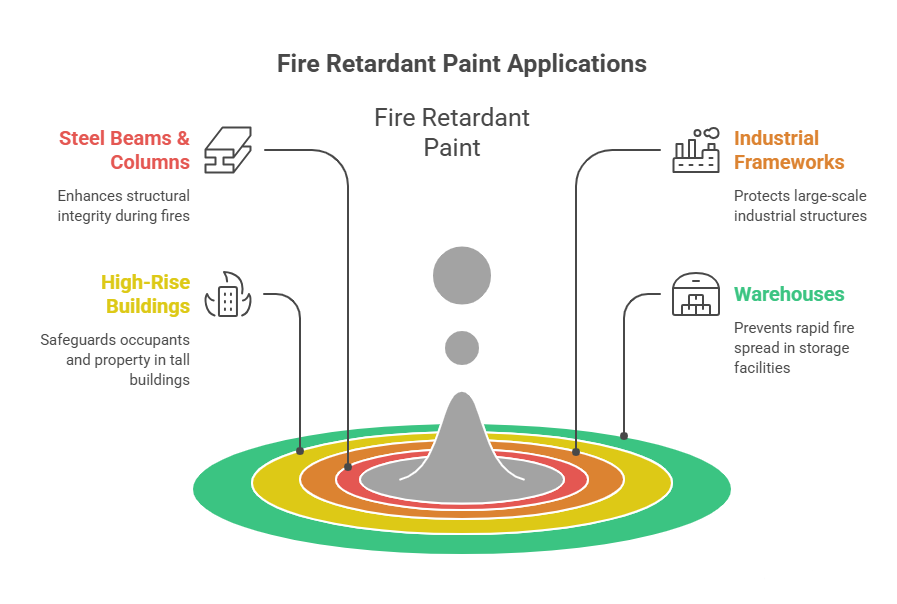
Steel is one of the most widely used construction materials due to its strength and durability. However, during a fire, steel can rapidly lose its load-bearing capacity when exposed to extreme temperatures. Fire retardant paint applications in steel structures help delay heat transfer and maintain structural stability during critical situations. These coatings are an essential part of passive fire protection systems in industrial and commercial construction.
Steel Beams & Columns
Steel beams and columns form the core structural framework of many buildings. When exposed to fire, unprotected steel can weaken quickly and increase the risk of collapse.
Fire retardant paint creates an insulating char layer that slows temperature rise and protects the steel surface. This added protection helps maintain structural integrity for a specified fire resistance period, such as 60, 90, or 120 minutes.
Industrial Structural Frameworks
Factories, manufacturing units, and processing plants often rely on heavy steel frameworks to support machinery and operations. Fire retardant coatings applied to these structures help reduce fire-related damage and improve workplace safety.
In high-risk industrial environments, these coatings provide critical protection against heat exposure while supporting compliance with industrial fire safety standards.
High-Rise Building Protection
Modern high-rise buildings use extensive steel construction for strength and flexibility. During a fire emergency, maintaining the stability of structural steel is essential for safe evacuation and emergency response.
Fire retardant paint applications in high-rise buildings help slow structural weakening, giving occupants and firefighters more time to react. These coatings are commonly used in commercial towers, residential complexes, and mixed-use developments.
Fire Resistance for Warehouses
Warehouses often contain combustible goods, storage racks, and large open steel structures. Fire retardant paint helps protect warehouse frameworks from rapid heat buildup and structural collapse during fire incidents.
By improving fire resistance, these coatings help reduce property damage, support insurance compliance, and improve overall operational safety in storage and logistics facilities.
Fire Retardant Paint Applications for Wood Surfaces
Wood is widely used in construction and interior design because of its natural appearance and versatility. However, it is also a combustible material that can contribute to rapid fire spread if left unprotected. Fire retardant paint applications for wood surfaces help improve fire resistance, reduce flame spread, and enhance overall safety in residential, commercial, and public spaces.
Wooden Doors & Panels
Wooden doors and wall panels are common in offices, hotels, schools, and residential buildings. Applying fire retardant paint helps slow ignition and reduces the speed at which flames spread across wooden surfaces.
This added protection is especially important for emergency exit routes, corridors, and high-occupancy areas where fire safety compliance is critical.
Interior Decorative Wood
Decorative wooden finishes such as wall cladding, ceiling panels, and architectural features enhance aesthetics but can increase fire risk if untreated. Fire retardant coatings help preserve the appearance of decorative wood while adding an extra layer of fire protection.
These coatings are commonly used in commercial interiors, auditoriums, restaurants, and luxury residential spaces.
Furniture & Partitions
Wooden furniture and partitions are frequently used in offices, conference rooms, educational institutions, and hospitality environments. Fire retardant paint helps reduce the combustibility of these surfaces, limiting flame spread during fire incidents.
This application supports safer interior environments and helps meet fire safety standards for public occupancy spaces.
Fire Safety for Public Spaces
Public spaces such as theaters, schools, hospitals, shopping malls, and airports require strict fire safety measures. Since wood is often used for interiors and furnishings in these locations, fire retardant paint applications are essential for minimizing fire hazards.
By slowing combustion and reducing smoke generation, these coatings help improve occupant safety and provide valuable time for evacuation during emergencies.
Electrical & Cable Protection Applications
Electrical systems are one of the most common sources of fire in industrial and commercial facilities. Overheating, short circuits, and cable failures can quickly lead to dangerous fire incidents if proper protection measures are not in place. Fire retardant paint applications for electrical systems help reduce flame spread, limit smoke generation, and improve overall fire safety in critical infrastructure.
Cable Trays & Conduits
Cable trays and conduits carry large volumes of electrical wiring throughout buildings and industrial facilities. During a fire, unprotected cables can accelerate flame spread across multiple areas.
Applying fire retardant coating to cable trays and conduits helps slow combustion and reduces the risk of fire propagation through electrical networks. This protection is especially important in factories, commercial complexes, and utility facilities.
Electrical Control Panels
Electrical control panels contain sensitive components that manage machinery, automation systems, and power distribution. Fire retardant paint applications help protect panel surfaces and surrounding structures from heat exposure and fire damage.
These coatings also contribute to safer operation environments by reducing the possibility of fire spreading from electrical faults or overheating equipment.
Data Centers & Server Rooms
Data centers and server rooms require advanced fire protection because they contain critical digital infrastructure and high-density electrical systems. Fire retardant coatings help protect cable systems, support structures, and electrical pathways while minimizing smoke generation that could damage sensitive equipment.
Passive fire protection is essential in these environments to reduce downtime and maintain operational continuity.
Power Plant Electrical Systems
Power plants operate under high electrical loads and extreme operating conditions, increasing fire risk in cable networks and electrical systems. Fire retardant paint applications provide additional protection for cable trays, switchgear areas, and electrical enclosures.
By slowing flame spread and protecting critical systems, these coatings improve safety, reduce operational risks, and support compliance with industrial fire safety standards.
Industrial Applications of Fire Retardant Coating
Industrial environments often involve high temperatures, flammable materials, and complex machinery, making fire protection a critical safety requirement. Fire retardant coating applications help reduce fire risks, protect valuable infrastructure, and improve compliance with industrial safety regulations. These coatings are widely used across multiple industries where fire hazards can lead to severe operational and financial losses.
Oil & Gas Facilities
Oil and gas facilities handle highly flammable substances under demanding operating conditions. Fire retardant coatings are applied to structural steel, pipelines, storage tanks, and processing units to slow heat transfer and reduce fire spread during emergencies.
These coatings provide essential passive fire protection that helps maintain structural stability and supports safer evacuation and emergency response procedures.
Chemical Manufacturing Plants
Chemical plants often store and process combustible or reactive materials that increase fire risk. Fire retardant coatings help protect production areas, support structures, storage facilities, and processing equipment from extreme heat exposure.
By reducing flame spread and delaying structural failure, these coatings contribute to safer plant operations and improved risk management.
Boiler & Furnace Areas
Boiler rooms and furnace zones operate at high temperatures and are exposed to continuous thermal stress. Fire retardant coatings applied in these areas help improve heat resistance and reduce the impact of accidental fire incidents.
These coatings also protect nearby structural components from excessive heat exposure, improving long-term durability and operational safety.
Heavy Equipment Protection
Industrial machinery and heavy equipment represent significant investments in manufacturing and processing facilities. Fire retardant coatings help protect equipment support structures, metal surfaces, and operational zones from heat-related damage.
In addition to improving safety, these coatings help reduce downtime, maintenance costs, and potential production losses caused by fire-related incidents.
Commercial Building Fire Protection Applications
Commercial buildings accommodate large numbers of people every day, making fire safety a top priority. Fire retardant paint applications help improve structural fire resistance, slow flame spread, and support safer evacuation during emergencies. These coatings are widely used in modern commercial construction to meet fire safety regulations and protect valuable infrastructure.
Shopping Malls & Offices
Shopping malls and office buildings contain extensive electrical systems, interior furnishings, and high occupant density, increasing fire risk. Fire retardant coatings are applied to steel structures, ceilings, walls, and service areas to reduce flame spread and maintain structural stability during a fire.
These applications help protect occupants, minimize property damage, and support compliance with building safety standards.
Hospitals & Educational Institutions
Hospitals, schools, colleges, and universities require strict fire safety measures because they serve vulnerable and high-occupancy populations. Fire retardant paint applications help create safer environments by protecting corridors, staircases, structural elements, and interior surfaces.
By delaying fire progression, these coatings provide additional time for safe evacuation and emergency response.
Hotels & Hospitality Spaces
Hotels, resorts, banquet halls, and hospitality venues often use decorative interiors, wooden finishes, and large public gathering areas. Fire retardant coatings help reduce the combustibility of these surfaces while preserving aesthetic appeal.
These coatings improve guest safety and help hospitality businesses meet fire protection requirements and insurance standards.
Airports & Public Infrastructure
Airports, railway stations, metro systems, and other public infrastructure projects require advanced fire protection due to heavy public usage and complex operational systems. Fire retardant paint is used on structural steel, cable systems, and interior components to improve fire resistance and reduce operational risks.
These applications play a vital role in maintaining public safety and ensuring compliance with national and international fire safety regulations.
Fire Retardant Paint for Residential Applications
Fire safety is equally important in residential spaces, where electrical faults, kitchen accidents, and combustible materials can quickly lead to dangerous situations. Fire retardant paint applications in homes help reduce flame spread, improve structural protection, and create a safer living environment for occupants. These coatings are increasingly used in modern residential construction and renovation projects.
Kitchen & Utility Areas
Kitchens and utility rooms are among the highest fire-risk areas in a home due to cooking equipment, gas connections, and electrical appliances. Applying fire retardant paint to walls, ceilings, and nearby structural surfaces helps reduce flame spread during accidental fires.
This added protection can help contain fire damage and provide more time for emergency response.
Wooden Roof Structures
Wooden roof frames, attic structures, and ceiling components can contribute to rapid fire spread if left untreated. Fire retardant coatings help improve the fire resistance of wooden structures by slowing ignition and reducing combustion rates.
These applications are especially valuable in villas, cottages, and homes with exposed timber architecture.
Electrical Distribution Zones
Residential electrical panels, wiring routes, and distribution zones are common sources of electrical fires. Fire retardant paint applications around these areas help reduce flame propagation and improve overall electrical fire safety.
Protecting cable pathways and electrical enclosures is particularly important in modern homes with high power consumption and multiple electrical systems.
Interior Wall Protection
Interior walls and partitions can act as pathways for fire spread during emergencies. Fire retardant coatings applied to walls and decorative surfaces help slow down combustion and improve passive fire protection inside the home.
In addition to enhancing safety, these coatings can support compliance with modern residential fire safety standards and building regulations.
Benefits of Fire Retardant Paint Applications
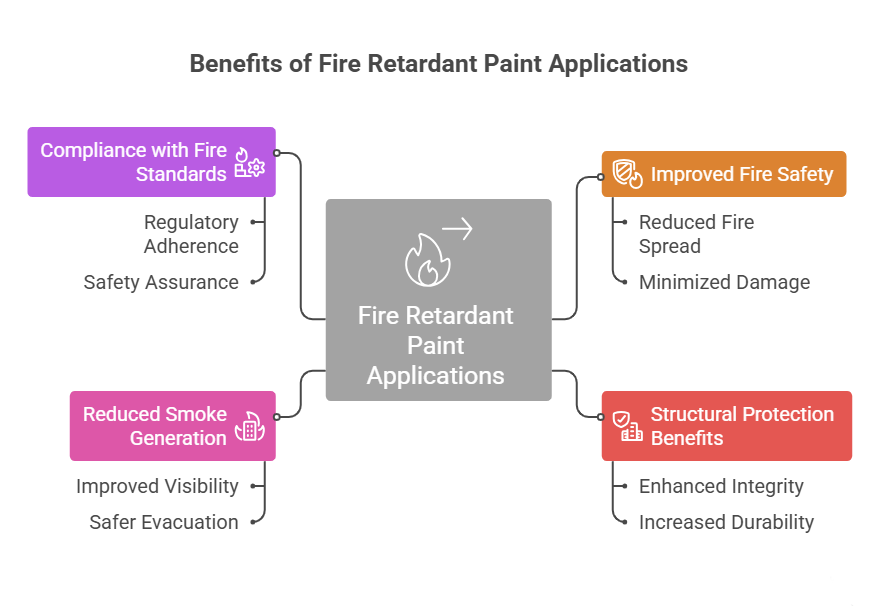
Fire retardant paint applications offer more than just surface protection — they play a major role in improving overall fire safety and reducing the impact of fire-related incidents. From industrial facilities to residential buildings, these coatings provide valuable protection that supports safety, durability, and regulatory compliance.
Improved Fire Safety
One of the primary benefits of fire retardant paint is enhanced fire safety. These coatings slow down flame spread and reduce heat transfer during a fire, helping contain the situation for a longer period.
This additional response time is critical for safe evacuation, firefighting operations, and minimizing injury risks in occupied buildings and industrial facilities.
Structural Protection Benefits
High temperatures can weaken structural materials such as steel and wood, increasing the risk of collapse during a fire. Fire retardant coatings create an insulating char layer that helps protect structural components from rapid heat exposure.
By maintaining structural integrity for a longer duration, these coatings improve building stability and reduce the extent of fire damage.
Reduced Smoke Generation
Smoke and toxic fumes are often more dangerous than flames during a fire emergency. Fire retardant paint applications help reduce smoke generation by slowing combustion and limiting flame spread.
Lower smoke levels improve visibility during evacuation and create safer conditions for emergency responders and building occupants.
Compliance with Fire Standards
Modern building regulations require strict fire protection measures for commercial, industrial, and public structures. Fire retardant paint helps buildings meet required fire resistance ratings and safety standards such as ASTM, BS, and IS codes.
Using certified fire protection coatings supports regulatory compliance, simplifies inspections, and improves long-term safety assurance.
Choosing the Right Fire Retardant Paint
Selecting the right fire retardant paint is essential for achieving reliable fire protection and long-term performance. Different environments and substrates require different coating systems, and choosing the wrong product can reduce effectiveness and durability. Understanding key selection factors helps ensure better safety, compliance, and structural protection.
Understanding Fire Ratings
Fire ratings indicate how long a coating can protect a surface during fire exposure. Common ratings include 30, 60, 90, and 120 minutes.
The required rating depends on factors such as:
- Building type and occupancy
- Structural design
- Fire risk assessment
- Local safety regulations
Higher fire ratings usually require thicker coating applications and certified testing to ensure performance under extreme heat conditions.
Indoor vs Outdoor Applications
Environmental conditions play a major role in product selection. Indoor fire retardant paints are generally designed for controlled environments with limited moisture and UV exposure.
Outdoor applications require coatings with additional resistance to:
- Rain and humidity
- UV radiation
- Temperature fluctuations
- Industrial pollutants
Using an exterior-grade fire retardant coating ensures better durability and long-term protection in exposed environments.
Surface Compatibility
Fire retardant paints are formulated for specific substrates such as steel, wood, concrete, or electrical cables. Choosing a coating compatible with the intended surface improves adhesion, performance, and lifespan.
It is also important to verify compatibility with primers and existing coatings to avoid cracking, peeling, or reduced fire resistance.
Certified Fire Protection Systems
Always choose coatings tested and certified according to recognized fire safety standards such as ASTM, BS, or IS codes. Certified systems provide verified fire resistance ratings and greater confidence in safety performance.
Using approved fire protection systems also helps ensure compliance with building regulations, insurance requirements, and industrial safety standards.
Application & Maintenance Best Practices
Proper application and regular maintenance are essential for ensuring that fire retardant paint performs effectively throughout its service life. Even high-quality coatings may fail to provide certified fire protection if they are applied incorrectly or not maintained properly. Following best practices helps maximize durability, safety, and long-term fire resistance performance.
Surface Preparation Guidelines
Surface preparation is one of the most important steps before applying fire retardant paint. All surfaces should be clean, dry, and free from dust, grease, rust, oil, or loose particles.
For steel structures, abrasive blasting or mechanical cleaning may be required to achieve proper adhesion. Wooden and interior surfaces should be smooth and moisture-controlled before coating application. Proper preparation improves bonding strength and coating reliability.
Correct Application Thickness
Fire retardant paint must be applied at the recommended dry film thickness (DFT) to achieve the required fire resistance rating. Under-application may reduce protection time, while excessive thickness can lead to cracking or adhesion problems.
Using professional spray equipment and measuring tools helps maintain uniform coating thickness across the surface. Always follow manufacturer technical specifications for best results.
Inspection & Recoating
Regular inspections help identify coating damage before it affects fire protection performance. During inspection, check for:
- Cracking or peeling
- Mechanical damage
- Moisture exposure
- Rust formation
- Surface discoloration
Damaged areas should be repaired and recoated promptly using compatible materials to restore certified fire resistance performance.
Long-Term Performance Maintenance
Long-term maintenance ensures the coating continues to provide reliable fire protection over time. Environmental exposure, industrial pollutants, and physical wear can gradually affect coating condition.
A scheduled maintenance program that includes cleaning, periodic inspection, and timely recoating helps extend service life and maintain compliance with fire safety standards. Proper maintenance also reduces future repair costs and improves overall structural safety.
Frequently Asked Questions
Below are answers to some of the most common questions about fire retardant paint applications and fire protection coatings.
Where is fire retardant paint commonly used?
Fire retardant paint is commonly used in industrial plants, warehouses, commercial buildings, hospitals, schools, shopping malls, data centers, and residential properties. It is applied to steel structures, wooden surfaces, electrical cables, ceilings, walls, and structural frameworks to improve fire resistance and reduce flame spread.
Can fire retardant paint be applied outdoors?
Yes, certain fire retardant paints are specially formulated for outdoor applications. These coatings include weather-resistant and UV-stable properties that help withstand rain, humidity, sunlight, and temperature changes. It is important to select an exterior-grade coating designed specifically for outdoor environments.
Is fire retardant paint suitable for wood and steel?
Yes, fire retardant paint is widely used on both wood and steel surfaces. For steel structures, it helps slow heat transfer and maintain structural stability during a fire. On wooden surfaces, it reduces combustibility and delays flame spread. However, different formulations may be required depending on the substrate type and application conditions.
How long does fire retardant coating last?
The lifespan of a fire retardant coating depends on factors such as product quality, environmental exposure, application thickness, and maintenance practices. When properly applied and maintained, many fire retardant coatings can provide effective protection for several years. Regular inspection and timely recoating help maintain long-term performance and fire resistance.
Conclusion – Importance of Fire Retardant Paint Applications
Fire safety has become an essential requirement in modern industrial, commercial, and residential construction. Fire retardant paint applications provide an effective passive fire protection solution that helps slow flame spread, reduce heat transfer, and protect critical structures during emergencies. Investing in the right fire protection coating system can significantly improve safety and reduce fire-related risks.
Enhancing Structural Fire Safety
Fire retardant coatings play a major role in maintaining structural integrity during fire exposure. By forming an insulating barrier under high temperatures, these coatings help protect steel, wood, and other construction materials from rapid failure. This added protection provides valuable time for evacuation and emergency response operations.
Long-Term Industrial Protection
In industrial environments, fire retardant paint helps protect machinery, storage areas, structural frameworks, and electrical systems from heat-related damage. Properly maintained coatings improve durability, reduce operational risks, and minimize potential downtime caused by fire incidents.
Long-term fire protection also supports safer working conditions and improved asset reliability.
Importance of Certified Fire Coatings
Using certified fire retardant coatings is critical for achieving reliable and tested fire protection performance. Products tested according to recognized standards such as ASTM, BS, or IS codes provide verified fire resistance ratings and better compliance with safety regulations.
Certified systems offer greater confidence for contractors, engineers, facility managers, and property owners.
Final Safety Recommendations
Choosing the right fire retardant paint involves evaluating fire ratings, surface compatibility, environmental conditions, and certification standards. Proper surface preparation, correct application thickness, and routine maintenance are equally important for long-term performance.
For the best results, always consult fire protection experts and use high-quality certified coatings to ensure maximum safety, durability, and compliance in every project.