

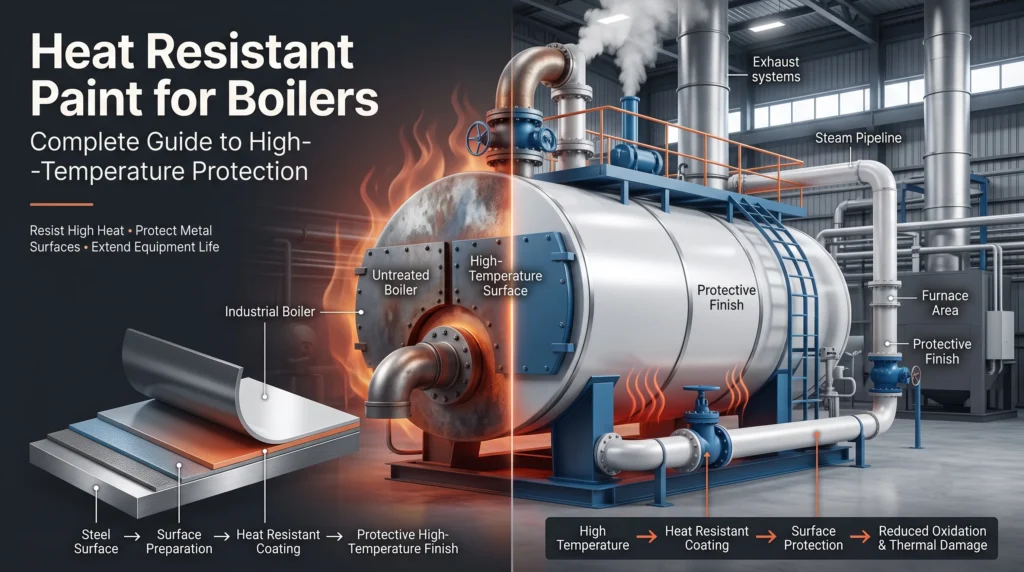
Boilers operate under demanding conditions where surfaces are exposed to continuous heat, moisture, steam, and industrial environments. Over time, these conditions can contribute to oxidation, corrosion, surface deterioration, and damage to conventional paint coatings. This is where heat resistant paint for boilers can play an important role in protecting suitable boiler surfaces and maintaining their appearance and durability.
Unlike ordinary industrial paints, heat resistant coatings are formulated to withstand elevated temperatures without quickly losing adhesion or deteriorating under heat exposure. The right coating can provide an additional protective layer against temperature-related surface degradation while supporting the long-term condition of boiler components.
However, selecting a boiler coating is not simply a matter of choosing the highest temperature rating. The actual operating temperature, substrate material, exposure conditions, surface preparation, coating thickness, and application method all need to be considered before a product is selected.
In this complete guide, we will explore heat resistant paint for boilers, including where it can be used, how to select the right coating, surface preparation, application methods, common coating problems, maintenance requirements, and the factors that influence long-term performance.
Why Do Boilers Need Heat Resistant Paint?
Boilers are continuously exposed to elevated temperatures during operation, making their external and associated metal surfaces more demanding than ordinary industrial equipment. A conventional paint system may not be designed for prolonged heat exposure and can gradually lose its appearance, adhesion, or protective properties. Heat resistant paint for boilers is therefore used where the coating system needs to tolerate the expected operating temperature while protecting suitable surfaces from heat-related deterioration.
The coating should be selected according to the actual service conditions rather than temperature rating alone. Factors such as the substrate, continuous or intermittent heating, moisture, steam, chemicals, and thermal cycling can all affect coating performance.
What Happens to Boiler Surfaces Under Continuous Heat
Continuous heat places ongoing stress on painted boiler surfaces. As temperatures remain elevated, an unsuitable coating can gradually become brittle, discoloured, chalky, or lose adhesion to the substrate. Repeated heating and cooling can add further stress because the metal and coating respond differently to temperature changes.
Over time, this can leave the underlying surface more exposed to the surrounding industrial environment. For steel components, prolonged exposure to heat and atmospheric conditions can contribute to oxidation and corrosion, particularly where the coating has already been damaged or has poor adhesion.
Using a coating designed for the expected temperature range helps create a more suitable protective barrier around the boiler surface.
Common Surface Problems in Boiler Systems
Boiler systems can experience several surface-related problems depending on their design and operating environment. Common issues include rust, oxidation, coating peeling, cracking, blistering, discoloration, and loss of adhesion. Moisture, steam, condensation, industrial fumes, and contaminants can make these problems more difficult to control.
Thermal cycling is another important factor. A boiler that repeatedly moves between heating and cooling conditions can place mechanical stress on the coating film. If the coating system is not compatible with these conditions, cracks or adhesion failures may develop over time.
These problems do not always appear immediately. Regular inspection can help identify early coating deterioration before larger areas of the surface become exposed.
How Protective Coatings Help Extend Boiler Service Life
A properly selected and applied heat resistant coating provides a protective layer between the boiler surface and its surrounding environment. Depending on the coating system and application, it can help protect suitable surfaces from heat-related deterioration, oxidation, and environmental exposure.
However, coating performance depends heavily on proper surface preparation and application. Rust, oil, scale, dust, and other contaminants should be removed before coating, and the specified film thickness and curing procedure should be followed.
For this reason, heat resistant paint should be viewed as part of a complete boiler surface-protection system—not simply as a paint chosen because it has a high temperature rating. The right combination of coating selection, surface preparation, application, curing, and maintenance can contribute to better long-term protection of boiler surfaces.
What Is Heat Resistant Paint for Boilers?
Heat resistant paint for boilers is a specialized industrial coating designed for surfaces that operate at elevated temperatures. Unlike ordinary paints, these coatings are formulated to maintain their protective properties when exposed to the heat generated by boilers and related equipment.
The purpose is not simply to make a boiler surface look finished. A suitable high-temperature coating can help protect the substrate from heat-related deterioration, oxidation, and environmental exposure. The coating must be selected according to the actual operating conditions, including temperature, substrate type, moisture, steam, and other surrounding contaminants.
Understanding High-Temperature Coatings
High-temperature coatings are developed for applications where standard industrial paints may not provide adequate performance. They are formulated with binders and heat-resistant components that allow the coating film to remain stable within its specified service-temperature range.
For boiler applications, the appropriate coating depends on where it is being applied and how much heat that particular surface experiences. External boiler surfaces, hot pipelines, exhaust areas, and other components may have different temperature and environmental requirements.
This is why a heat resistant paint should always be selected based on the actual surface temperature and operating conditions rather than choosing a product only because it has a high temperature rating.
How Boiler Coatings Withstand Heat
When a boiler is operating, the coated surface can experience prolonged heating and, in some applications, repeated heating and cooling cycles. A properly formulated high-temperature coating is designed to tolerate these conditions without rapidly losing adhesion or breaking down within its specified temperature range.
The coating system also needs to work properly with the underlying substrate. Proper surface preparation, recommended coating thickness, drying, and curing are important because even a high-temperature product can perform poorly if it is applied over rust, oil, scale, dust, or an unsuitable existing coating.
For this reason, the temperature capability of the paint is only one part of the overall performance. Coating formulation, surface preparation, application method, film thickness, curing, and actual operating conditions all influence how well the coating performs on a boiler.
Heat Resistant Paint vs Conventional Industrial Paint
The main difference between heat resistant paint and conventional industrial paint is the environment they are designed to handle. Conventional industrial coatings are generally selected for normal atmospheric conditions and may not be suitable for prolonged exposure to elevated temperatures.
A heat resistant coating, on the other hand, is specifically formulated for high-temperature service within its stated limits. It is intended to maintain coating integrity and adhesion under heat exposure where an ordinary paint system could deteriorate more quickly.
This does not mean that every heat resistant paint is suitable for every boiler. The correct product must match the boiler’s actual temperature, substrate, exposure conditions, and application requirements. Choosing the coating as part of a complete protection system helps achieve more reliable and long-lasting boiler surface protection.
Key Benefits of Heat Resistant Paint on Boilers
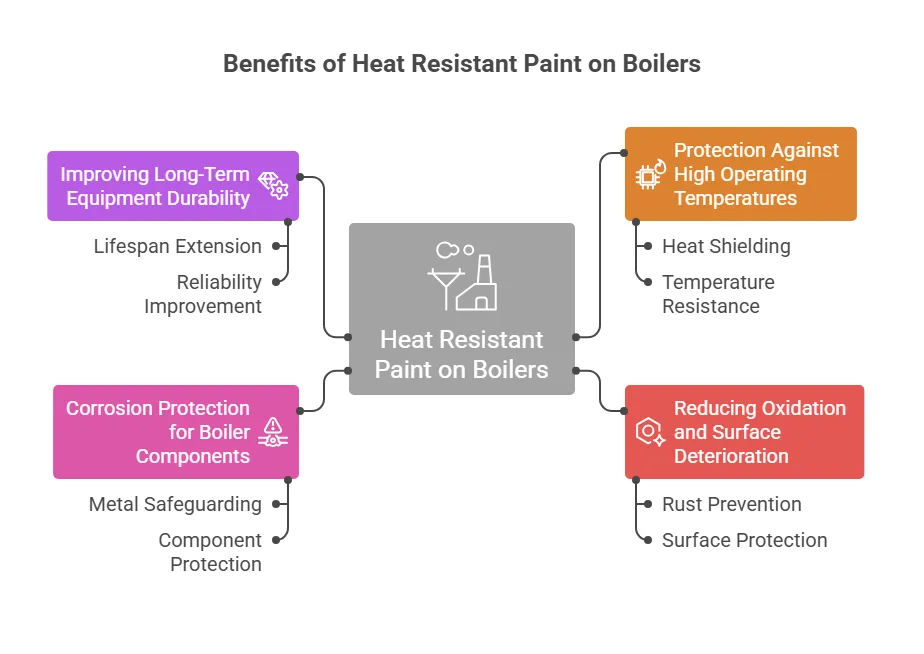
Boiler surfaces are exposed to demanding operating conditions, so the coating used on them needs to be selected with the actual service environment in mind. Heat resistant paint for boilers can provide a protective barrier on suitable surfaces and help the coating system remain functional under elevated temperatures within its specified limits.
The benefits are not limited to temperature resistance. A properly selected and applied coating can also help reduce surface deterioration, support corrosion protection, and maintain the condition of boiler components over time.
Protection Against High Operating Temperatures
The primary benefit of heat resistant paint is its ability to withstand elevated temperatures within its specified operating range. Boiler surfaces can remain hot for extended periods, and conventional paint may not be designed for such conditions.
A suitable high-temperature coating is formulated to maintain its coating integrity under the expected heat exposure. This helps reduce problems such as premature coating breakdown, loss of adhesion, or surface exposure that can occur when an unsuitable paint is used.
The coating should always be selected according to the actual operating temperature of the surface, rather than simply the maximum temperature of the boiler system.
Reducing Oxidation and Surface Deterioration
Prolonged heat exposure can contribute to oxidation and gradual deterioration of exposed metal surfaces. Once the protective coating becomes damaged or breaks down, the underlying substrate can become increasingly exposed to heat and atmospheric conditions.
A suitable heat resistant coating creates an additional protective layer over the substrate. By maintaining this barrier within its intended service conditions, the coating can help reduce direct environmental exposure and slow surface deterioration.
Proper preparation is particularly important because rust, scale, oil, and other contaminants underneath the coating can reduce adhesion and affect long-term performance.
Corrosion Protection for Boiler Components
Boiler environments may involve moisture, condensation, steam, industrial fumes, and other conditions that can contribute to corrosion. Heat alone is not the only consideration when selecting a protective coating.
A suitable coating system can help isolate the substrate from environmental exposure and provide a barrier against conditions that contribute to corrosion. However, the level of corrosion protection depends on the coating formulation, substrate condition, exposure environment, and complete coating system.
For this reason, boiler coating selection should consider both temperature resistance and corrosion requirements, especially when equipment operates in humid or chemically aggressive industrial environments.
Improving Long-Term Equipment Durability
Regular exposure to heat and industrial conditions can gradually affect the appearance and condition of boiler surfaces. Maintaining an appropriate protective coating can help keep these surfaces in better condition and reduce the frequency of coating-related repairs.
Long-term performance depends on more than the paint itself. Correct surface preparation, compatible primers where required, proper application thickness, curing, operating temperature, and periodic inspection all contribute to coating durability.
In practical terms, a well-planned heat resistant paint system for boilers can support ongoing surface protection and help maintain the condition of suitable boiler components throughout their service life.
Where Can Heat Resistant Paint Be Used on Boilers?
Heat resistant paint can be used on various boiler-related surfaces where the coating is exposed to elevated temperatures. However, not every part of a boiler operates at the same temperature or experiences the same environmental conditions. The coating should therefore be selected according to the surface temperature, substrate, operating conditions, and exposure environment of each component.
In many industrial applications, heat resistant coatings are used on external metal surfaces and associated hot equipment rather than being treated as a single coating solution for the entire boiler system.
Boiler Shells and External Surfaces
Boiler shells and other external metal surfaces can become hot during normal operation. A suitable heat resistant paint for boilers can provide a protective coating layer over these surfaces and help maintain coating performance under the expected temperature conditions.
The selected product should be compatible with the boiler substrate and actual surface temperature. Before application, the surface should be properly cleaned and prepared to remove rust, oil, dust, scale, and other contaminants that could interfere with adhesion.
For previously painted boiler surfaces, the existing coating should also be checked for compatibility and condition before applying a new heat resistant coating.
Steam and Hot Water Pipelines
Steam and hot water pipelines can operate at elevated temperatures and may experience repeated heating and cooling during operation. These conditions can place additional stress on conventional coating systems.
Heat resistant paint may be considered for suitable external pipeline surfaces when the coating’s temperature capability matches the actual pipe surface temperature. Proper preparation and application are important to ensure that the coating remains securely bonded to the substrate during service.
Pipeline coating selection may also need to consider moisture, condensation, outdoor exposure, and the surrounding industrial atmosphere.
Boiler Headers and Associated Components
Headers and associated boiler components can experience significant heat exposure depending on their location and operating conditions. Applying an appropriate high-temperature coating to suitable external surfaces can help provide an additional protective barrier against heat and surrounding environmental exposure.
Because temperatures can vary between different components, it is important to evaluate each surface individually rather than selecting a coating solely according to the boiler’s overall operating temperature.
The coating system should also be compatible with the material of the component and any existing primer or coating. Correct film thickness and curing should be maintained according to the product’s application requirements.
Exhaust and Flue Gas Areas
Exhaust and flue gas areas can be exposed to elevated temperatures as well as fumes, gases, condensation, and other industrial conditions. These surfaces can therefore require a coating system capable of handling both the expected heat and the surrounding environment.
A suitable heat resistant coating can be applied to compatible external surfaces when its temperature and chemical-resistance characteristics meet the service requirements. Surface preparation becomes especially important in these areas because deposits, soot, corrosion products, or contaminants can affect coating adhesion.
Before selecting a product for exhaust or flue gas equipment, the actual surface temperature and exposure conditions should be evaluated. This helps ensure that the coating is appropriate for the specific boiler component rather than relying only on a general temperature rating.
Choosing Heat Resistant Paint for Boiler Applications
Choosing the right heat resistant paint for boilers requires more than looking at the highest temperature mentioned on a product label. Boiler components can experience different temperatures, heating cycles, moisture levels, and chemical exposure. The coating should therefore be selected according to the actual conditions of the surface where it will be applied.
Matching the Coating to Operating Temperature
The first step is to determine the actual operating temperature of the surface, not just the boiler’s rated temperature. Different components may operate at different temperatures, so one coating may not necessarily be suitable for every area.
A coating should have a suitable temperature range for the expected service conditions, with consideration given to whether the heat is continuous or occasional. Selecting a product without checking the actual surface temperature can result in premature coating deterioration.
Continuous vs Intermittent Heat Exposure
The way a boiler operates can have a significant effect on coating performance. Some equipment remains hot for long operating periods, while other systems experience repeated heating and cooling during start-up, shutdown, or changes in production.
Continuous heat requires a coating designed for sustained exposure within its specified temperature range. Intermittent heating introduces thermal cycling, which can place additional stress on the coating and substrate as they expand and contract.
Understanding the operating cycle helps in selecting a coating system that is appropriate for the real working conditions rather than relying only on a maximum temperature figure.
Considering Moisture, Steam, and Chemical Exposure
Temperature is only one part of the boiler environment. Moisture, steam, condensation, industrial fumes, and chemicals may also affect the coating, particularly around pipelines, exhaust areas, and other associated equipment.
If a surface experiences both heat and moisture, the coating should be evaluated for its suitability under those combined conditions. In corrosive industrial environments, additional corrosion-protection requirements may also need to be considered.
This is why the complete exposure environment should be reviewed before selecting heat resistant paint rather than treating temperature resistance as the only selection criterion.
Selecting the Right Coating System for the Substrate
The substrate also plays an important role in coating selection. Steel, stainless steel, and other materials can have different surface characteristics and preparation requirements. Existing primers or old coatings may also affect compatibility with a new heat resistant coating.
Before application, the surface should be properly prepared by removing contaminants such as rust, oil, dust, loose scale, and deteriorated existing paint. The selected coating system should then be applied according to its specified preparation, thickness, drying, and curing requirements.
Ultimately, the right boiler heat resistant coating system is one that brings together the operating temperature, heating cycle, environmental exposure, substrate condition, and application requirements. This approach provides a more practical basis for long-term coating performance than selecting a product based on temperature rating alone.
Surface Preparation Before Boiler Coating
Proper surface preparation is one of the most important steps when applying heat resistant paint for boilers. Even a high-performance coating can have poor adhesion if it is applied over rust, oil, loose scale, dust, or a deteriorated old coating.
Before starting the coating work, the boiler surface should be inspected and prepared according to the condition of the substrate and the requirements of the selected coating system. Good preparation provides a cleaner and more stable surface for the coating to bond with.
Removing Rust, Oil, Scale, and Contaminants
Boiler surfaces can accumulate rust, oil, grease, dust, mill scale, deposits, and other contaminants during manufacturing, operation, or maintenance. These materials can create a barrier between the coating and the metal surface.
Rust and loose scale should be removed using an appropriate mechanical or abrasive cleaning method, depending on the substrate and project requirements. Oil and grease should also be removed using a suitable cleaning procedure before coating.
The goal is to leave the surface sufficiently clean and sound for the selected high-temperature coating to adhere properly.
Preparing Previously Painted Boiler Surfaces
Boilers that have already been painted require additional inspection before recoating. The existing coating should be checked for peeling, cracking, blistering, poor adhesion, or other signs of deterioration.
Loose or damaged paint should be removed rather than simply covering it with a new layer. Areas with sound existing coating may require appropriate cleaning and surface preparation to ensure compatibility with the new coating system.
If the existing coating is unknown or incompatible, it may be necessary to remove it or conduct suitable compatibility checks before applying the new heat resistant paint.
Checking Surface Cleanliness Before Application
Once cleaning and preparation are complete, the surface should be inspected before the coating is applied. Dust, moisture, oil residue, loose particles, and remaining surface contamination can affect coating adhesion and finish.
The prepared surface should also be checked for visible rust or areas requiring additional preparation. Environmental conditions during application may also need to be monitored, particularly when moisture or condensation could affect the prepared substrate.
A final inspection before painting helps ensure that the surface is ready for the specified coating system.
Why Surface Preparation Affects Coating Life
Surface preparation directly influences how effectively the coating bonds to the substrate. When contaminants or loose corrosion products remain underneath the coating, they can create weak points that may eventually contribute to peeling, blistering, cracking, or premature coating failure.
Proper preparation gives the heat resistant coating a more stable foundation and allows the specified coating thickness and application procedure to work as intended. It also helps identify substrate problems before they are hidden beneath a new coating layer.
For boiler applications, surface preparation, coating selection, application, drying, and curing should be treated as one complete system. Paying attention to the preparation stage can significantly improve the reliability and service performance of the finished coating.
How to Apply Heat Resistant Paint on Boilers
Applying heat resistant paint on boilers requires careful attention to surface preparation, coating compatibility, application thickness, and curing. A high-temperature coating will only perform as intended when it is applied according to the manufacturer’s specified application procedure and the actual conditions of the boiler surface.
Before painting, make sure the equipment is safely shut down and the surface has cooled to an appropriate application temperature. The prepared surface should be clean, dry, and free from rust, oil, dust, loose scale, and other contaminants.
Primer Requirements
Whether a primer is required depends on the selected heat resistant coating system, substrate, and service conditions. Some high-temperature coatings are designed for direct application on properly prepared metal, while other systems may require a compatible high-temperature primer.
A conventional primer should not be used simply because it is normally suitable for industrial steel. Its temperature capability and compatibility with the finish coating need to be considered.
If a primer is specified, it should be applied at the recommended thickness and allowed to dry or cure according to the product instructions before the heat resistant topcoat is applied.
Brush, Roller, and Spray Application
Heat resistant paint can be applied using methods such as brush, roller, or spray, depending on the product specification, surface geometry, and project requirements.
Brush application can be useful for smaller areas, edges, corners, touch-ups, and difficult-to-reach sections. Rollers may be suitable for accessible, relatively uniform surfaces. Spray application is often considered when larger boiler surfaces need a more consistent coating application.
The selected method should follow the coating manufacturer’s recommendations. Equipment cleanliness, correct thinning where permitted, and consistent application technique are important for achieving a uniform coating film.
Controlling Coating Thickness
Coating thickness is an important part of boiler coating application. Applying too little material may provide inadequate protection, while excessive thickness can create its own problems, including uneven drying or curing and potential coating defects.
The required dry film thickness (DFT) should therefore be based on the product’s technical data and the intended service conditions. Where necessary, wet film thickness can be monitored during application and dry film thickness can be checked after curing.
Maintaining a consistent coating thickness across the boiler surface helps provide more uniform protection and makes quality inspection easier.
Drying and Heat Curing Requirements
Drying and curing requirements vary between heat resistant coating formulations. Some products may require air drying before the equipment is returned to service, while others require a controlled heat-curing procedure.
The boiler should not simply be brought immediately to full operating temperature after painting unless the coating manufacturer’s instructions specifically allow it. Where heat curing is required, the temperature should normally be increased according to the specified procedure.
Following the recommended drying time, curing schedule, and temperature limits helps the coating develop its intended properties. Always refer to the product’s technical data sheet for the exact application and curing requirements, because these can differ significantly between heat resistant coating systems.
Boiler Operating Conditions That Affect Coating Performance
The performance of heat resistant paint for boilers depends not only on the coating itself but also on the conditions under which the boiler operates. Temperature, heating and cooling cycles, moisture, steam, and the surrounding industrial atmosphere can all influence how a coating behaves over time.
Understanding these conditions helps in selecting and applying a coating system that is appropriate for the actual boiler environment.
Continuous High-Temperature Operation
Boilers that operate continuously at elevated temperatures place sustained thermal stress on their coating systems. If the actual surface temperature exceeds the coating’s specified service range, the coating may gradually lose its protective properties or develop defects.
For this reason, the coating should be selected according to the actual surface temperature and duration of heat exposure. Continuous service can also require different considerations from occasional or short-term exposure.
Regular inspection of high-temperature areas can help identify early signs of coating deterioration.
Thermal Expansion and Contraction
Boiler surfaces can expand when heated and contract as they cool. Repeated heating and cooling cycles can therefore place mechanical stress on the coating film and the underlying substrate.
If the coating system is not suitable for these operating cycles, repeated thermal movement may contribute to cracking, loss of adhesion, or other coating defects. This is particularly relevant for equipment that undergoes frequent start-up and shutdown cycles.
Considering the boiler’s operating pattern when selecting the coating can help reduce problems associated with repeated thermal cycling.
Steam and Condensation Exposure
Steam and condensation can create additional challenges for boiler coatings. Moisture may be present around pipelines, fittings, headers, and other associated components, particularly during shutdowns or changes in operating conditions.
A coating exposed to moisture should be suitable for the expected combination of heat and humidity. Condensation can also become a concern if moisture reaches damaged areas or gaps in the coating, potentially contributing to corrosion of the underlying substrate.
Proper surface preparation and maintaining coating integrity are therefore important in areas where steam and condensation are present.
Chemical and Industrial Atmospheres
Boilers are commonly installed in industrial environments where surfaces may be exposed to fumes, gases, dust, chemicals, or other airborne contaminants. Depending on the facility and process, these conditions can affect coating performance alongside temperature exposure.
A heat resistant coating should therefore be evaluated not only for its temperature capability but also for compatibility with the surrounding industrial environment. Where chemical exposure is significant, the coating system should be selected based on the specific substances and conditions involved.
In practice, temperature, thermal cycling, moisture, steam, and atmospheric exposure should all be considered together when evaluating coating requirements for a boiler. This provides a more realistic basis for selecting and maintaining a high-temperature coating system.
Common Boiler Coating Problems
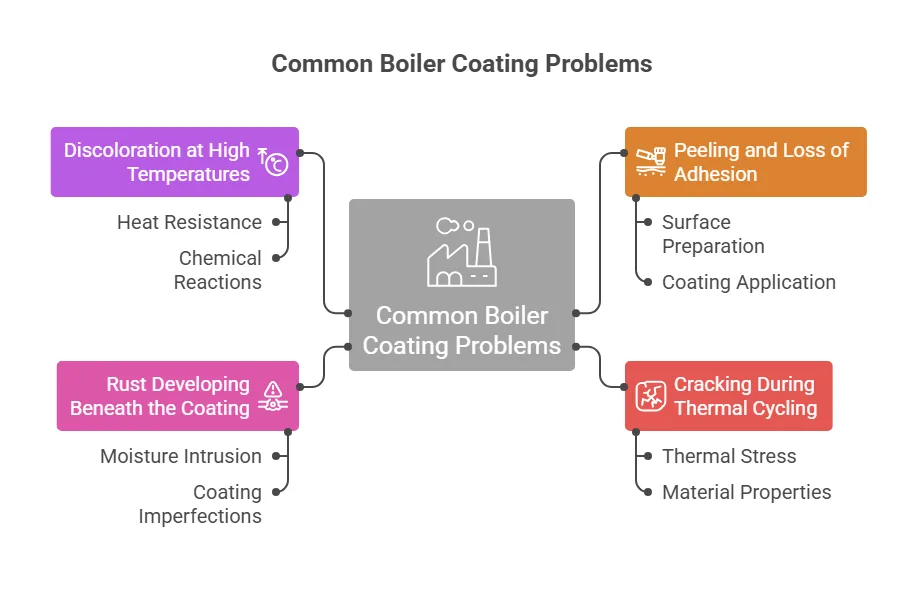
Even when a suitable heat resistant paint for boilers is selected, coating problems can develop if the surface is poorly prepared, the coating is incompatible with the substrate, application requirements are not followed, or the boiler operates outside the coating’s intended conditions. Identifying these problems early can help prevent further coating deterioration and unnecessary maintenance.
Peeling and Loss of Adhesion
Peeling is one of the most visible signs that a boiler coating is no longer properly bonded to the surface. It can occur when the substrate was not adequately cleaned before painting, or when rust, oil, dust, scale, moisture, or loose existing paint remains beneath the new coating.
Incompatible coating systems and excessive thermal stress can also contribute to adhesion problems. Once peeling begins, simply applying another coat over the damaged area usually does not address the underlying cause.
The affected area should be inspected, loose coating removed, and the surface properly prepared before repair or recoating.
Cracking During Thermal Cycling
Boilers may repeatedly heat up and cool down during normal operation, maintenance, or shutdown periods. This thermal movement can place stress on the coating film as the metal substrate expands and contracts.
If the coating system is unsuitable for these repeated temperature changes, fine cracks or larger coating failures may develop over time. Cracking can expose the underlying metal to heat, moisture, and the surrounding industrial environment.
Selecting a coating appropriate for the expected thermal cycle and following the recommended application thickness can help reduce the risk of premature cracking.
Rust Developing Beneath the Coating
Rust appearing beneath a coating often indicates that moisture or contaminants have reached the metal surface. Poor surface preparation, existing corrosion, coating damage, or inadequate coating coverage can create conditions where corrosion continues underneath the paint film.
This problem can be difficult to notice during the early stages because the coating may initially appear intact. Blistering, staining, bubbling, or localized peeling can later reveal corrosion underneath.
When rust is discovered, the affected coating should be assessed and the damaged area properly prepared before applying a new boiler heat resistant coating.
Discoloration at High Temperatures
Discoloration can occur when a coating is exposed to elevated temperatures, particularly when the surface approaches or exceeds the coating’s specified service conditions. Changes in colour do not always mean that the coating has completely failed, but they can indicate that the coating is experiencing significant thermal exposure.
The original colour and gloss may also change as a result of prolonged heating, even when the coating continues to provide some level of surface protection.
For this reason, colour should not be the only measure used to evaluate coating performance. The surface should also be inspected for cracking, peeling, blistering, loss of adhesion, or substrate exposure. Regular inspection helps determine whether maintenance or recoating is required.
Maintenance of Heat Resistant Boiler Coatings
Regular maintenance helps keep heat resistant boiler coatings in good condition and allows coating problems to be identified before they become more extensive. Boiler surfaces should be inspected as part of routine maintenance, particularly in areas exposed to higher temperatures, moisture, steam, or industrial contaminants.
Maintenance should focus not only on the appearance of the paint but also on the condition of the coating and the substrate underneath it.
Routine Visual Inspection
A visual inspection is a simple way to monitor the condition of a boiler coating. Look for visible changes such as peeling, cracking, blistering, bubbling, rust stains, exposed metal, or significant colour changes.
High-temperature areas and locations around joints, pipelines, fittings, and other associated components may deserve particular attention because operating conditions can vary across the boiler system.
Keeping records of inspection findings can also make it easier to track whether coating deterioration is stable or progressing over time.
Identifying Early Coating Damage
Small coating defects can become more significant if they are left unattended. Fine cracks, localized peeling, minor blistering, scratches, and small areas of exposed metal should therefore be assessed when they are first noticed.
The cause of the damage should also be considered. For example, recurring damage may indicate excessive temperature, thermal cycling, moisture exposure, poor adhesion, or an underlying corrosion problem rather than simply a surface defect.
Finding the cause before repairing the coating can help prevent the same problem from returning.
Touch-Up of Damaged Areas
Localized coating damage does not always mean that the entire boiler needs to be recoated. Where the remaining coating is sound, a suitable touch-up repair may be possible after properly preparing the affected area.
Damaged or loose coating should be removed, and any rust or contamination should be cleaned before applying the compatible heat resistant coating. The repair should follow the product’s specified preparation, application thickness, drying, and curing requirements.
The repair material should also be compatible with the existing coating system. Applying an unsuitable paint over a high-temperature coating can create adhesion or performance problems.
When Boiler Recoating May Be Required
Recoating may become necessary when deterioration is widespread or when the existing coating can no longer provide an effective protective layer. Extensive peeling, cracking, corrosion, repeated coating failure, or large areas of exposed substrate are signs that a more comprehensive assessment may be required.
Before recoating, the condition of the existing coating and underlying substrate should be evaluated. The surface may require substantial preparation or removal of the existing coating before a new system is applied.
The decision to recoat should therefore be based on actual coating condition, operating temperature, environmental exposure, and substrate condition, rather than on a fixed time period alone. A planned maintenance approach can help keep boiler coating systems reliable and reduce unexpected coating-related repairs.
How Long Does Heat Resistant Paint Last on Boilers?
There is no single fixed lifespan for heat resistant paint on boilers because coating durability depends on the actual operating and environmental conditions. A coating exposed to moderate heat and a controlled environment may behave very differently from one exposed to continuous high temperatures, thermal cycling, moisture, or corrosive industrial conditions.
Instead of relying on a specific number of years, it is more useful to evaluate the coating based on its condition, service environment, and maintenance history.
Effect of Operating Temperature
Operating temperature is one of the most important factors affecting coating durability. When a heat resistant coating remains within its specified temperature range, it can maintain its intended properties more effectively.
Continuous exposure near the upper temperature limit can place greater stress on the coating than lower-temperature service. Repeated heating and cooling can also contribute to gradual deterioration.
For this reason, the actual surface temperature should be considered when selecting and monitoring boiler heat resistant paint.
Impact of Surface Preparation and Application
The service life of a coating begins with proper surface preparation. Rust, oil, dust, scale, moisture, or loose existing paint can prevent good adhesion and may lead to premature peeling or coating failure.
Application quality is equally important. Incorrect coating thickness, unsuitable application methods, insufficient drying, or failure to follow the recommended curing procedure can affect the finished coating.
A properly prepared surface and correctly applied coating system provide a stronger foundation for long-term performance.
Effect of Moisture and Corrosive Exposure
Boiler coatings may be exposed to steam, condensation, humidity, chemicals, fumes, and other industrial contaminants. These conditions can accelerate coating deterioration, particularly when the coating has cracks, scratches, or areas of exposed substrate.
Moisture reaching the underlying metal can also contribute to corrosion. In aggressive environments, the coating should therefore be selected for both its temperature resistance and environmental resistance.
Importance of Regular Maintenance
Regular inspection can help extend the useful service life of a boiler coating by identifying minor defects before they develop into larger coating failures. Peeling, cracking, blistering, rust staining, and exposed metal should be assessed during maintenance inspections.
Small damaged areas may be suitable for localized repair when the surrounding coating remains sound. If deterioration becomes widespread, a more comprehensive recoating may be necessary.
Ultimately, the durability of heat resistant paint for boilers depends on the combination of coating selection, operating temperature, surface preparation, application quality, environmental exposure, and ongoing maintenance.
Frequently Asked Questions About Boiler Heat Resistant Paint
What Temperature Can Boiler Heat Resistant Paint Withstand?
The temperature resistance of boiler paint depends on the specific product and coating system. Different boiler components can also operate at different surface temperatures. Therefore, the coating should be selected according to the actual surface temperature and exposure conditions, rather than assuming one temperature rating applies to the entire boiler.
Always check the manufacturer’s technical data sheet for the specified service-temperature range before application.
Can Heat Resistant Paint Be Applied to an Existing Boiler?
Yes, heat resistant paint can be applied to an existing boiler when the substrate and existing coating are suitable for recoating. The surface must first be inspected and properly prepared.
Rust, loose paint, scale, oil, dust, and other contaminants should be removed. If the existing coating is damaged or incompatible with the new system, additional preparation or complete removal may be necessary.
Is Primer Required for Boiler Coating?
A primer is not automatically required for every boiler coating system. Some heat resistant paints are designed for direct application on properly prepared metal, while others may require a compatible high-temperature primer.
The requirement depends on the product, substrate, service conditions, and manufacturer’s specifications. A conventional primer should not be used unless it is confirmed to be compatible with the expected temperature and finish coating.
Can Heat Resistant Paint Protect Boilers From Rust?
Heat resistant paint can help protect suitable boiler surfaces from environmental exposure that contributes to corrosion, provided the coating system is appropriate for the service conditions.
However, paint cannot compensate for heavy existing corrosion or poor surface preparation. Rust, scale, oil, and other contaminants should be properly removed before coating. Where corrosion exposure is significant, the complete coating system should be selected with both heat resistance and corrosion protection in mind.
How Many Coats Are Required on Boiler Surfaces?
The required number of coats depends on the specific heat resistant coating, required dry film thickness, substrate condition, application method, and service requirements. There is no universal number of coats that applies to every boiler application.
Following the manufacturer’s recommended coating thickness, number of coats, drying time, and curing procedure is the appropriate approach. Applying additional coats beyond the specified system does not necessarily provide better performance and can create application or curing problems.
Conclusion – Protecting Boilers With the Right Heat Resistant Paint
Choosing the right heat resistant paint for boilers is an important part of maintaining suitable boiler surfaces exposed to elevated temperatures and demanding industrial conditions. The coating should be selected based on the actual surface temperature, heating cycle, substrate, moisture exposure, and surrounding environment rather than temperature rating alone.
Matching the Coating to Boiler Operating Conditions
Every boiler application can have different operating conditions. Boiler shells, pipelines, headers, exhaust areas, and other components may experience different levels of heat and environmental exposure.
Selecting a coating that matches the actual surface temperature and service environment helps ensure that the paint is being used within its intended performance range. Where moisture, steam, chemicals, or thermal cycling are present, these factors should also be considered during coating selection.
Importance of Proper Application and Maintenance
Even a suitable high-temperature coating can perform poorly when surface preparation and application are neglected. Removing rust, oil, scale, dust, and loose existing coatings provides a better foundation for adhesion.
The recommended coating thickness, application method, drying time, and curing procedure should also be followed according to the product’s technical requirements. After application, regular visual inspections can help identify peeling, cracking, blistering, corrosion, or other early signs of deterioration.
Improving Long-Term Boiler Surface Protection
Long-term coating performance comes from treating the coating as part of a complete maintenance system. Correct product selection, proper surface preparation, controlled application, suitable curing, routine inspection, and timely repairs all contribute to maintaining the protective coating.
Rather than choosing a heat resistant paint simply because it offers a high temperature rating, consider the complete operating environment of the boiler. A coating system that is properly matched to the application and maintained throughout its service life can provide dependable surface protection and support the long-term condition of suitable boiler components.