

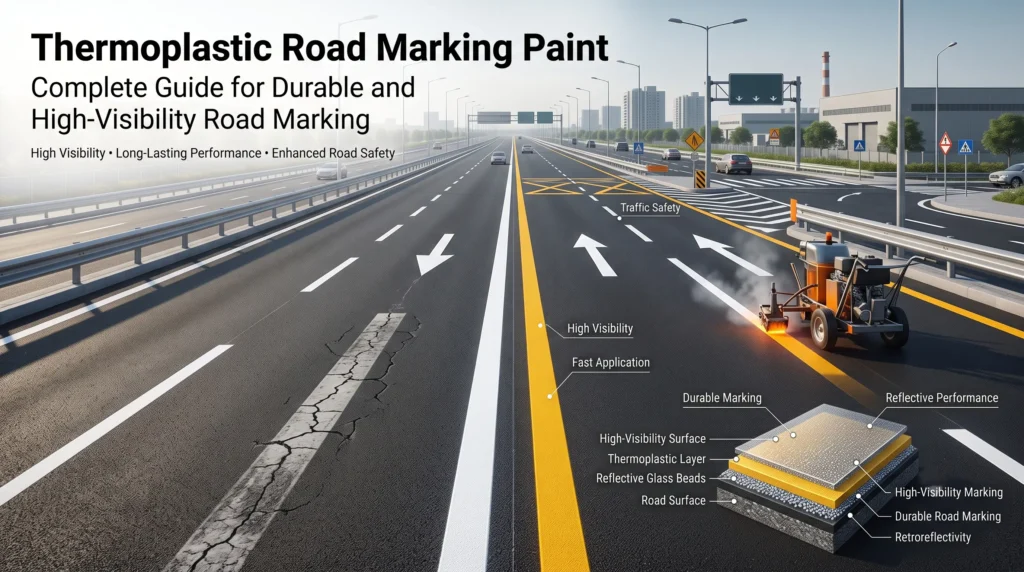
Clear road markings are essential for safe and organized movement on highways, city roads, parking areas, and industrial premises. They help drivers understand lanes, directions, crossings, and restricted areas while improving overall traffic management.
Thermoplastic road marking paint is a popular choice for applications where durability, visibility, and resistance to regular traffic are important. Unlike conventional liquid road paints, thermoplastic material is heated before application and forms a tough marking layer as it cools.
In this guide, we will explore how thermoplastic road marking works, its key features, applications, benefits, application process, and the important factors to consider when selecting a suitable road marking paint for long-lasting performance.
Introduction to Thermoplastic Road Marking Paint
What Is Thermoplastic Road Marking Paint?
Thermoplastic road marking paint is a durable road marking material that is heated before application. Once heated, it becomes workable and can be applied to roads using specialized marking equipment. As it cools, it forms a hard and visible layer that provides clear guidance for drivers and pedestrians.
Thermoplastic markings can be used for lane lines, road edges, arrows, pedestrian crossings, parking lines, and other traffic markings. Reflective glass beads may also be used to improve nighttime visibility.
Why Is Thermoplastic Road Marking Important?
Road markings need to remain visible even under continuous traffic and changing weather conditions. Faded or damaged markings can make lanes, crossings, and traffic directions difficult to identify.
Thermoplastic road marking is valued for its durability, abrasion resistance, strong visibility, and reliable performance in demanding areas. Its ability to set through cooling can also help reduce disruption when roads need to be reopened after marking work.
For high-traffic roads, industrial premises, and parking areas, choosing a suitable road marking system can improve traffic organization while reducing the need for frequent maintenance.
Where Is Thermoplastic Road Marking Paint Commonly Used?
Thermoplastic road marking paint is suitable for a wide range of applications where clear and durable markings are required. Common areas include:
- Highways and expressways – lane lines, edge lines, arrows, and traffic symbols.
- Urban roads and intersections – lane separation, stop lines, crossings, and directional markings.
- Parking areas – parking bays, directional arrows, pedestrian paths, and restricted zones.
- Industrial facilities and warehouses – internal roads, vehicle routes, loading zones, and safety pathways.
- Commercial and institutional areas – organized vehicle and pedestrian movement.
- Logistics and service areas – clear routes for vehicles and operational traffic.
The right thermoplastic road marking solution depends on traffic volume, road surface, environmental conditions, required visibility, and expected service life.
How Thermoplastic Road Marking Paint Works
Thermoplastic Material Composition
Thermoplastic road marking paint is made from a carefully formulated combination of resins, pigments, fillers, and performance additives. These components help provide the required colour, durability, adhesion, and resistance to regular road traffic.
The material is solid under normal conditions but becomes workable when heated. This property allows it to be applied efficiently to prepared road surfaces and then form a durable marking layer after cooling.
Heating and Melting Process
Before application, the thermoplastic material is heated in specialized equipment until it reaches the required working condition. Proper heating is important because the material needs to flow consistently through the application equipment.
Controlled heating helps achieve an even marking thickness and a smooth finish. Overheating or inadequate heating can affect application quality, so temperature control is an important part of the process.
Application and Rapid Cooling
Once heated, the material is applied to the prepared road surface using a suitable thermoplastic road marking machine. The equipment helps create consistent lines, symbols, arrows, crossings, and other markings.
After application, the material begins to cool and harden. This cooling process creates a strong, durable marking on the surface. Because thermoplastic solidifies through cooling rather than conventional air drying, suitable road sections can often be returned to traffic relatively quickly.
Role of Glass Beads in Reflectivity
Glass beads are an important part of many reflective road marking systems. They are used to improve the visibility of road markings when illuminated by vehicle headlights at night.
When properly embedded or applied to the marking surface, the glass beads help reflect light back toward approaching drivers. This improves the visibility of lane lines, crossings, arrows, and other markings in low-light conditions.
For highways and other high-traffic roads, combining durable thermoplastic material with an appropriate reflective system can provide better daytime definition and nighttime visibility.
Key Features of Thermoplastic Road Marking Paint
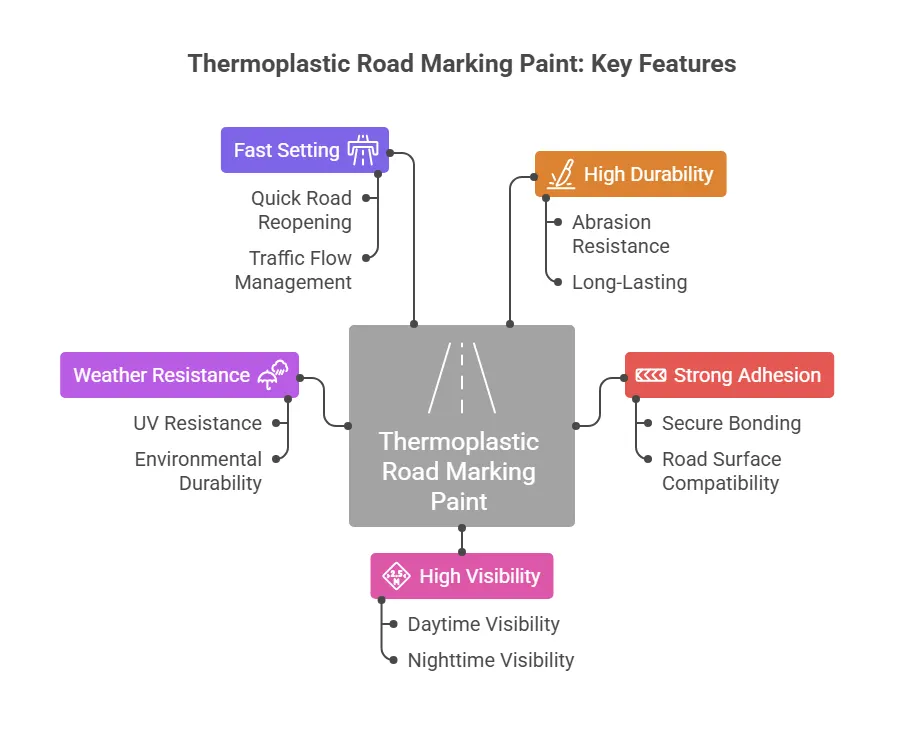
High Durability and Abrasion Resistance
Thermoplastic road marking paint forms a hard and durable layer after cooling, making it suitable for roads exposed to continuous vehicle movement. Its abrasion resistance helps markings withstand tyre friction, heavy traffic, and regular surface wear for longer periods.
Strong Adhesion to Road Surfaces
Properly applied thermoplastic markings can provide strong adhesion to suitable asphalt and concrete surfaces. Good surface preparation is important to ensure the marking bonds effectively and remains intact under traffic and environmental conditions.
High Visibility During Day and Night
Thermoplastic road markings provide clear and noticeable lines during daytime. When combined with reflective glass beads, they can also improve nighttime visibility by reflecting vehicle headlights back toward drivers. This helps make lane lines, arrows, crossings, and other traffic markings easier to identify.
Weather and UV Resistance
Road markings are exposed to sunlight, rain, temperature changes, dust, and other environmental conditions. Thermoplastic systems are designed to provide good resistance to weathering and UV exposure, helping maintain their appearance and performance in outdoor applications.
Fast Setting and Road Reopening
One of the key advantages of thermoplastic road marking is its rapid setting through cooling. Once the heated material is applied, it quickly hardens as it cools. This can reduce the time required before the marked road section is ready for traffic, helping minimize disruption during road marking work.
Types of Thermoplastic Road Marking Systems
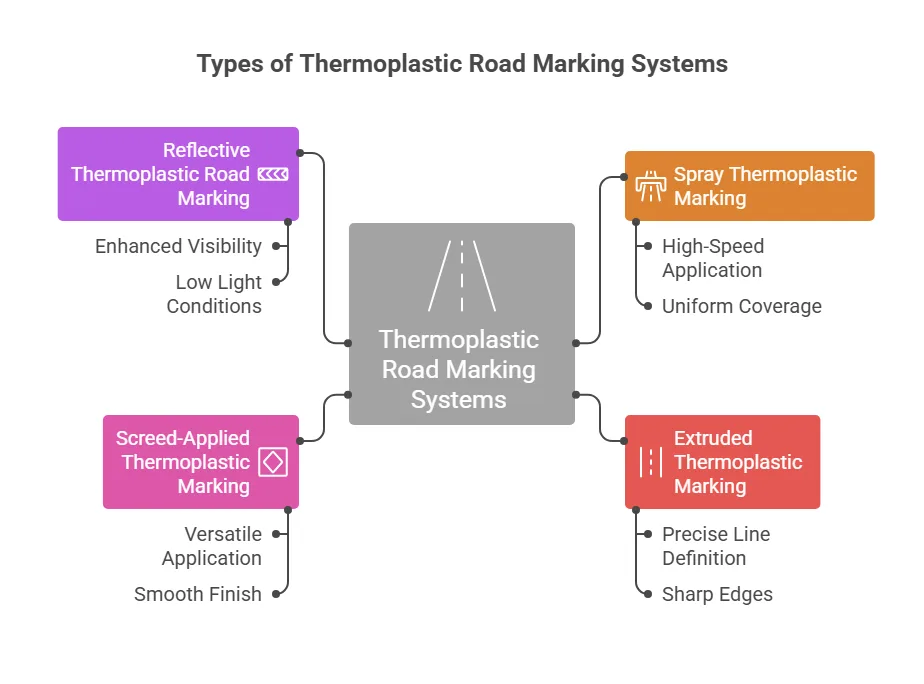
Thermoplastic road marking systems can be applied using different methods depending on the road surface, marking design, traffic conditions, and required thickness. The main application systems include spray, extrusion, screed, and reflective thermoplastic markings.
Spray Thermoplastic Marking
Spray thermoplastic is applied in a thinner and more uniform layer using specialized spraying equipment. It is suitable for applications where smooth, consistent, and efficient coverage is required across larger road sections. This method can be used for lane lines, edge lines, and other standard road markings.
Extruded Thermoplastic Marking
Extruded thermoplastic is applied through a machine that forms the heated material into a controlled line or profile. It generally provides a thicker and durable marking layer, making it suitable for roads exposed to heavy traffic and regular abrasion. It is commonly used for lane lines, arrows, symbols, and other permanent markings.
Screed-Applied Thermoplastic Marking
In the screed application method, heated thermoplastic material is spread over the prepared surface using a screed or similar application system. This allows the applicator to achieve a controlled and consistent thickness. Screed application is useful for durable road markings where a thicker coating profile is required.
Reflective Thermoplastic Road Marking
Reflective thermoplastic road marking combines thermoplastic material with glass beads or other reflective elements to improve visibility, particularly at night. Vehicle headlights illuminate the glass beads, helping reflect light toward approaching drivers. This system is widely useful for highways, intersections, lane markings, pedestrian crossings, and other areas where nighttime visibility is important.
Applications of Thermoplastic Road Marking Paint
Thermoplastic road marking paint is widely used where durability, clear visibility, and resistance to regular traffic are important. Its ability to form a strong marking layer after cooling makes it suitable for roads, public areas, and industrial environments.
Highways and Expressways
Highways and expressways experience continuous vehicle movement and high traffic loads. Thermoplastic markings are used for lane lines, edge lines, arrows, road symbols, and other traffic markings where long-lasting visibility is required.
Urban Roads and Intersections
In cities, clear road markings help organize traffic and guide drivers and pedestrians. Thermoplastic road marking paint can be used for lane separation, stop lines, pedestrian crossings, turning arrows, and intersection markings.
Parking Lots and Commercial Areas
Parking areas require clear markings to organize vehicle movement and maximize available space. Thermoplastic markings can be used for parking bays, directional arrows, pedestrian pathways, loading zones, and traffic lanes in commercial and public parking areas.
Industrial Facilities and Warehouses
Industrial facilities and warehouses use floor and traffic markings to improve movement and workplace organization. Thermoplastic or suitable thermoplastic marking systems can be used for vehicle routes, pedestrian pathways, loading areas, parking zones, and safety markings, depending on the surface and application conditions.
Airports and Logistics Areas
Airports and logistics facilities require clearly defined movement routes for vehicles and ground operations. Thermoplastic road marking systems can be considered for service roads, parking areas, access routes, and selected traffic-control markings, subject to the specific surface, operational requirements, and applicable marking standards.
Benefits of Thermoplastic Road Marking Paint
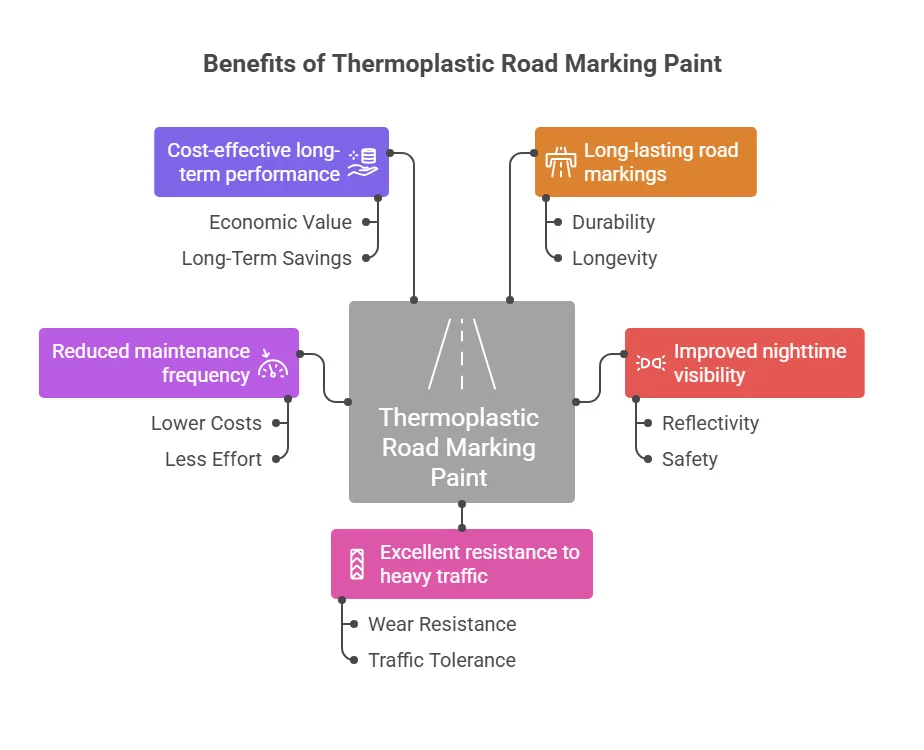
Thermoplastic road marking paint offers several advantages for roads and high-traffic areas where durability, visibility, and reliable performance are important. Its strong marking layer and compatibility with reflective glass beads make it a practical choice for long-term road marking applications.
Long-Lasting Road Markings
Thermoplastic markings form a durable layer that can withstand regular vehicle movement and surface abrasion. This helps road lines, symbols, arrows, and other markings remain visible for longer compared with less durable marking systems.
Improved Nighttime Visibility
When used with reflective glass beads, thermoplastic road markings can provide better nighttime visibility. The beads reflect vehicle headlights toward drivers, helping them identify lane lines, crossings, arrows, and other important road markings in low-light conditions.
Excellent Resistance to Heavy Traffic
Roads with frequent vehicle movement require markings that can withstand continuous wear. Thermoplastic road marking paint provides good abrasion and traffic resistance, making it suitable for highways, intersections, commercial areas, and other high-use locations.
Reduced Maintenance Frequency
Because thermoplastic markings are designed for durability, they can help reduce the need for frequent re-marking and maintenance. Longer-lasting markings can also help minimize traffic disruption caused by repeated road marking work.
Cost-Effective Long-Term Performance
Although the initial application cost can vary depending on the system and project requirements, durable thermoplastic markings can provide good long-term value through extended service life, reduced maintenance needs, and consistent visibility. This makes them a cost-effective option for many road marking projects.
Application Process of Thermoplastic Road Marking Paint
Proper application is essential for achieving durable, uniform, and highly visible thermoplastic road markings. The process generally involves preparing the surface, setting out the marking design, heating the material, applying it with suitable equipment, adding reflective glass beads, and carrying out a final inspection.
Surface Preparation
The road surface should be clean, dry, and free from dust, loose particles, oil, grease, and other contaminants. Proper surface preparation helps the thermoplastic material achieve good adhesion and reduces the risk of premature peeling or damage.
Road Marking Layout and Measurement
Before application, the required marking pattern is measured and clearly laid out. Lane lines, edge lines, arrows, symbols, pedestrian crossings, and other markings should be positioned according to the project requirements. Accurate measurement helps maintain consistent line width, spacing, and alignment.
Heating Thermoplastic Material
The thermoplastic material is heated in suitable equipment until it reaches the required working condition. Controlled and uniform heating is important because the material must flow properly during application. Excessive or inadequate heating can affect the quality and consistency of the finished marking.
Machine Application
The heated thermoplastic material is transferred to a suitable road marking machine and applied according to the planned layout. The equipment controls the line width, thickness, and application pattern, helping produce consistent markings across the road surface.
Glass Bead Application
For reflective road markings, glass beads are applied to the thermoplastic surface during or immediately after application, depending on the marking system. Proper bead placement and embedment help provide retroreflectivity and improve nighttime visibility.
Cooling and Quality Inspection
After application, the thermoplastic material cools and solidifies to form the finished marking. The completed work should then be inspected for line consistency, adhesion, thickness, alignment, surface finish, and overall visibility. Any required corrections should be completed before the marked area is opened for normal use.
Thermoplastic Road Marking Paint vs Conventional Road Paint
Thermoplastic road marking paint and conventional road paints are both used for traffic and safety markings, but they differ in application method, durability, setting time, maintenance needs, and long-term performance. The right choice depends on traffic conditions, road surface, project requirements, and expected service life.
Durability Comparison
Thermoplastic road marking generally forms a thicker and more wear-resistant layer after cooling. This makes it suitable for highways and areas exposed to frequent vehicle movement. Conventional road paints can also provide effective markings, but their durability depends strongly on the paint type, surface condition, traffic load, and environmental exposure.
Visibility and Reflectivity Comparison
Both systems can provide clear daytime markings when properly applied. Thermoplastic markings are commonly combined with reflective glass beads, which can improve nighttime visibility by reflecting vehicle headlights. Conventional road paint can also be designed for reflective applications, depending on the selected formulation and marking system.
Application and Drying Time
Thermoplastic material is heated before application and sets as it cools. This allows the marked area to become usable relatively quickly after the material has solidified. Conventional road paints normally require drying or curing time, which can vary depending on the formulation, weather, humidity, and application conditions.
Maintenance Requirements
The longer-lasting nature of thermoplastic markings can help reduce the frequency of re-marking and maintenance in high-traffic areas. Conventional road markings may require more frequent renewal in locations experiencing heavy traffic or significant environmental exposure, although actual maintenance intervals depend on the specific paint system and site conditions.
Cost and Service Life
Thermoplastic road marking may have a higher initial application cost than some conventional road paints. However, its durability, reduced maintenance frequency, and potential for longer service life can make it cost-effective over the full operating period. The best option should therefore be selected based on total lifecycle requirements rather than initial material cost alone.
Factors to Consider When Choosing Thermoplastic Road Marking Paint
Selecting the right thermoplastic road marking paint depends on the road environment, traffic conditions, surface type, visibility requirements, and expected service life. Considering these factors before application helps achieve better marking performance and reduce maintenance requirements.
Traffic Volume and Road Conditions
Traffic volume has a direct impact on marking wear. Highways, intersections, and busy urban roads may require a more durable thermoplastic system than low-traffic areas. Existing road condition, surface wear, and the expected level of abrasion should also be considered before selecting the marking system.
Asphalt or Concrete Surface Compatibility
Thermoplastic markings should be selected according to the type and condition of the road surface. Asphalt and concrete can have different surface characteristics, so proper preparation and compatibility assessment are important for achieving strong adhesion and consistent performance.
Climate and Environmental Exposure
Local environmental conditions can affect road marking performance. Consider exposure to sunlight, UV radiation, rain, temperature variations, moisture, dust, and other weather conditions when selecting a suitable thermoplastic system.
Required Visibility and Reflectivity
For roads operating during nighttime or low-light conditions, visibility should be an important selection factor. A thermoplastic system combined with properly applied reflective glass beads can improve nighttime visibility. The required colour, marking design, and level of reflectivity should be determined according to the project’s requirements.
Durability and Maintenance Requirements
Consider how long the markings are expected to remain functional and how frequently maintenance can be performed. Roads with heavy traffic or limited maintenance windows may benefit from a durable thermoplastic system that can help reduce the frequency of re-marking and associated traffic disruption.
Maintenance of Thermoplastic Road Markings
Although thermoplastic road markings are designed for durability, regular inspection and timely maintenance help preserve their visibility, adhesion, and overall performance. A simple maintenance program can also identify worn or damaged markings before they become a safety concern.
Routine Inspection
Road markings should be inspected periodically for wear, cracking, peeling, fading, or physical damage. High-traffic areas, intersections, crossings, and locations exposed to heavy vehicle movement may require more frequent inspection.
Cleaning and Surface Upkeep
Dirt, dust, mud, oil, and other surface contaminants can reduce the visibility of road markings. Regular cleaning helps maintain a clear and recognizable marking surface, particularly in parking areas, industrial facilities, and busy roads.
Reflectivity Monitoring
Reflective thermoplastic markings should be checked periodically to ensure adequate nighttime visibility. Loss of glass beads, surface wear, or contamination can reduce reflectivity. Where required, markings should be evaluated and maintained according to the project’s performance requirements.
Repair and Re-Marking Strategies
Damaged or significantly worn markings should be repaired or re-marked when necessary. Minor damaged areas may require localized repair, while heavily worn sections may need complete re-marking. Proper surface preparation before reapplication helps achieve better adhesion and long-term performance.
Conclusion – Choosing Thermoplastic Road Marking Paint for Long-Lasting Road Safety
Thermoplastic road marking paint is a practical solution for road and traffic marking applications where durability, visibility, and reliable performance are important. Its strong marking layer, rapid setting, and compatibility with reflective glass beads make it suitable for highways, urban roads, parking areas, industrial facilities, and other high-traffic locations.
Importance of Durable Thermoplastic Markings
Durable road markings help maintain clear lane guidance, traffic organization, and pedestrian safety over time. Thermoplastic systems can withstand regular traffic wear and environmental exposure, helping markings remain functional for longer periods when properly selected and applied.
Long-Term Safety and Cost Benefits
Clear and visible markings support safer movement for drivers, pedestrians, and industrial vehicle operators. The durability of thermoplastic markings can also reduce the frequency of re-marking and maintenance, potentially lowering long-term maintenance costs and minimizing disruption to traffic.
Selecting the Right Thermoplastic Road Marking Solution
The right system should be selected based on traffic volume, road surface, climate, required visibility, application conditions, and maintenance expectations. Proper surface preparation, controlled application, and quality inspection are equally important for achieving reliable results.
For highways, industrial areas, parking facilities, and other demanding applications, choosing a suitable thermoplastic road marking system can provide a strong combination of long-lasting performance, visibility, safety, and value.