

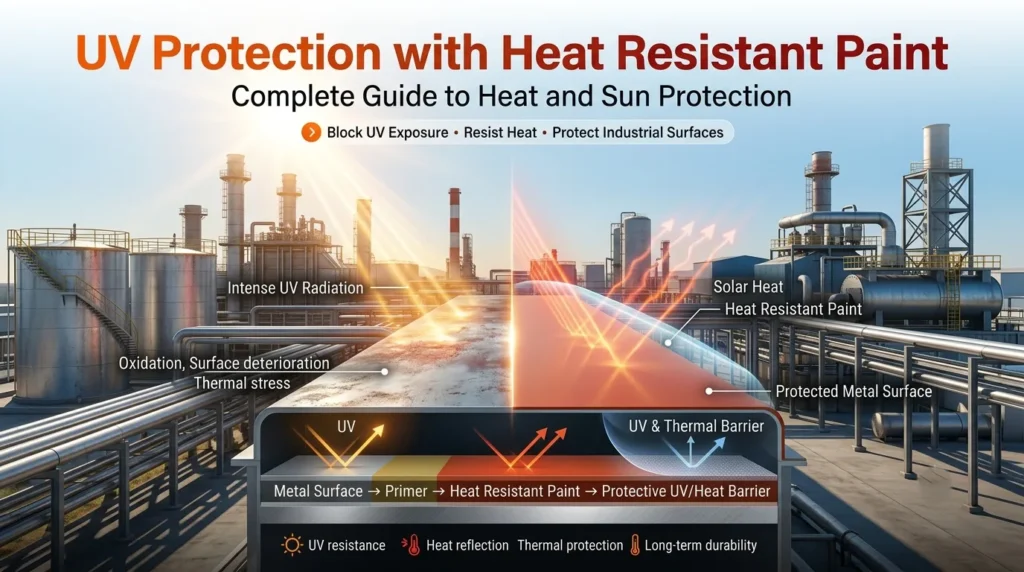
Industrial surfaces exposed to high temperatures and direct sunlight face two different but connected challenges: thermal stress and ultraviolet (UV) radiation. Boilers, pipelines, chimneys, furnaces, exhaust systems, storage tanks, and outdoor equipment can experience continuous temperature fluctuations while also being exposed to sunlight, moisture, and weather conditions.
A suitable heat resistant paint can help protect surfaces designed for high-temperature service, while appropriate UV-resistant properties can help maintain coating performance under outdoor exposure. Selecting the right coating therefore requires consideration of operating temperature, UV exposure, surface type, environmental conditions, and application requirements.
What Is Heat Resistant Paint?
Definition of Heat Resistant Paint
Heat resistant paint is a specialized coating designed to protect surfaces exposed to elevated temperatures. Unlike conventional paints, it is formulated to maintain its protective properties under specified thermal conditions. It is commonly used on industrial equipment and structures such as boilers, furnaces, ovens, pipelines, chimneys, steam lines, and other heat-exposed surfaces.
The required coating should always be selected according to the operating temperature, substrate, environmental conditions, and manufacturer’s technical specifications.
How Heat Resistant Paint Protects Industrial Surfaces
Heat resistant paint forms a protective coating over the substrate and is designed to withstand the temperature range specified for the product. This helps reduce premature coating deterioration caused by continuous or intermittent heat exposure.
For industrial applications, the coating can also help maintain the surface’s protective barrier against environmental exposure. When the equipment is installed outdoors, factors such as UV radiation, moisture, weathering, and temperature fluctuations should also be considered when selecting the complete coating system.
Heat Resistant Paint vs Conventional Paint
The primary difference between heat resistant paint and conventional paint is their intended operating environment.
Conventional paints are generally designed for normal-temperature applications and may lose performance when subjected to excessive heat. Heat resistant paints are specifically formulated for elevated-temperature service and are available in different temperature grades.
| Feature | Heat Resistant Paint | Conventional Paint |
| Temperature resistance | Designed for elevated temperatures | Generally intended for normal conditions |
| Industrial heat exposure | Suitable for specified applications | Usually limited |
| Typical applications | Boilers, furnaces, pipelines, chimneys | General structures and equipment |
| Temperature grades | Available in different grades | Usually not classified for high-temperature service |
| Selection criteria | Temperature, substrate and environment | Surface and general environmental conditions |
Understanding Heat Resistance Ratings
Heat resistant paint is available in different temperature ratings, and selecting the correct grade is one of the most important parts of a coating system.
For example, ALTIC’s heat resistant range includes products designed for progressively higher temperature applications, from lower-temperature industrial surfaces through extreme-temperature applications. The appropriate product should be selected according to the actual operating temperature rather than simply choosing the highest available rating.
Before application, consider:
- Maximum operating temperature
- Normal operating temperature
- Duration of heat exposure
- Type of substrate
- Indoor or outdoor exposure
- UV and weather conditions
- Surface preparation requirements
- Primer and thinner compatibility
For outdoor industrial applications, temperature resistance alone should not be the only selection criterion. The coating system should also be evaluated for the expected UV, weather, chemical, and mechanical exposure.
What Is UV Protection in Industrial Coatings?
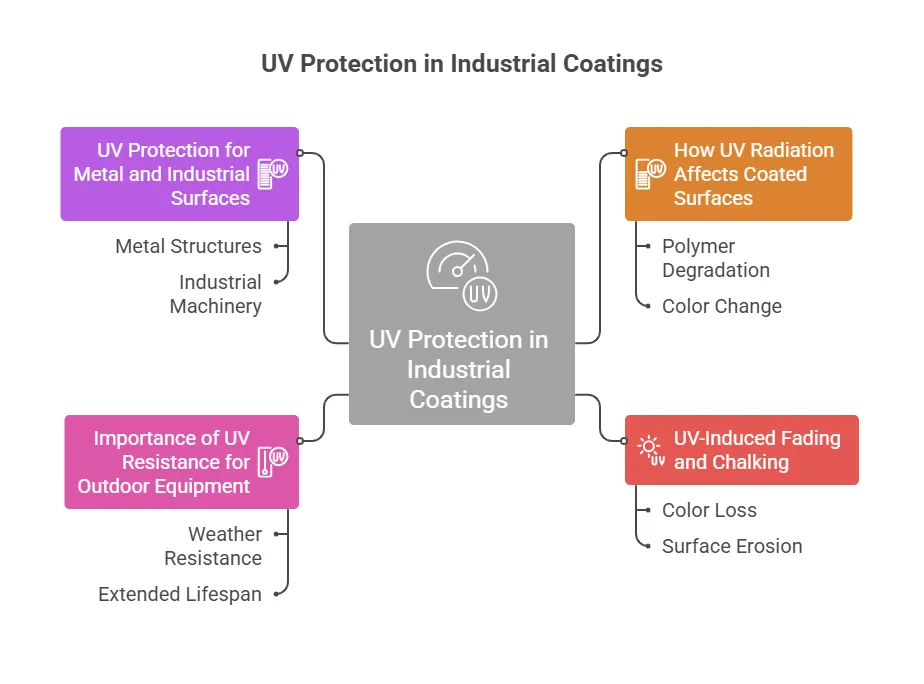
UV protection in industrial coatings refers to the ability of a coating system to withstand prolonged exposure to ultraviolet radiation from sunlight. Industrial surfaces installed outdoors can experience continuous sunlight along with heat, moisture, rain, and changing weather conditions. Over time, these exposures can affect the appearance and performance of a coating.
For heat-exposed outdoor equipment, UV resistance can be an important consideration alongside the required temperature resistance. The coating should therefore be selected according to the complete operating and environmental conditions.
How UV Radiation Affects Coated Surfaces
Ultraviolet radiation can gradually contribute to the degradation of exposed coating surfaces. Prolonged sunlight may cause changes in the coating’s appearance and, depending on the coating formulation and exposure conditions, can contribute to surface deterioration.
Outdoor industrial equipment should therefore be evaluated for its expected level of sunlight exposure when selecting a protective coating system.
UV-Induced Fading and Chalking
Fading occurs when prolonged UV exposure causes a coating’s color or appearance to change. Chalking refers to the development of a powdery surface as the coating weathers.
The degree of fading or chalking depends on factors such as coating formulation, UV intensity, exposure duration, temperature, and environmental conditions. Using a coating system appropriate for outdoor exposure can help manage these effects.
Importance of UV Resistance for Outdoor Equipment
Equipment installed outdoors may remain exposed to sunlight for extended periods. This includes pipelines, storage tanks, chimneys, industrial structures, outdoor machinery, and other metal surfaces.
UV resistance becomes particularly relevant where maintaining coating appearance and long-term surface protection is important. For heat-exposed equipment, the coating should provide the required thermal performance while also being suitable for the expected outdoor environment.
UV Protection for Metal and Industrial Surfaces
Metal and industrial surfaces exposed to sunlight require careful coating selection. In addition to UV exposure, factors such as operating temperature, moisture, corrosion risk, chemicals, and mechanical conditions should be considered.
For outdoor applications, selecting a coating system based on the complete exposure environment can help support longer-lasting surface protection. Heat resistance and UV resistance should be evaluated together when equipment operates at elevated temperatures while remaining exposed to direct sunlight.
Why UV Protection Matters for Heat-Exposed Surfaces
Industrial surfaces exposed to both high operating temperatures and direct sunlight face combined thermal and environmental stress. This is particularly important for outdoor pipelines, chimneys, tanks, furnaces, industrial equipment, and metal structures. Selecting a coating according to both the thermal and outdoor exposure conditions can help maintain coating performance over time.
Combined Effects of Heat and UV Exposure
Heat and UV radiation can affect a coating in different ways. Elevated temperatures place thermal stress on the coating, while prolonged sunlight can contribute to fading, chalking, and weathering.
When a heat-exposed surface is also located outdoors, both conditions should be considered during coating selection. A coating designed for the required temperature range and suitable for the expected outdoor environment can provide more appropriate protection than selecting a coating based on temperature alone.
Preventing Premature Coating Degradation
Continuous exposure to heat and sunlight can contribute to premature deterioration if the coating is not suitable for the service conditions. Selecting the correct heat resistance rating and considering UV and weather exposure can help reduce unnecessary coating failure and maintenance.
Proper surface preparation, application, coating thickness, and curing are also important for achieving the intended coating performance.
Maintaining Surface Appearance and Performance
UV exposure can cause changes in coating appearance, including fading and chalking, while excessive thermal exposure can affect coating performance.
For outdoor industrial equipment, maintaining both appearance and protective performance requires selecting a coating system appropriate for the operating temperature and environmental exposure. This is especially important for visible equipment and structures where long-term coating condition matters.
Supporting Long-Term Coating Durability
Long-term coating durability depends on more than temperature resistance. The complete exposure environment should be considered, including UV radiation, heat, moisture, weather conditions, chemicals, and mechanical stress.
For heat-exposed outdoor surfaces, choosing the appropriate coating system and following the manufacturer’s recommended preparation and application procedures can support consistent performance and help extend maintenance intervals.
How Heat Resistant Paint Helps Protect Against UV and Heat
Heat resistant paint is primarily designed to protect surfaces from elevated operating temperatures. When such surfaces are installed outdoors, they may also experience prolonged exposure to sunlight, UV radiation, moisture, and changing weather conditions. For these applications, coating selection should consider both thermal requirements and outdoor exposure.
Thermal Protection
Heat resistant paint is formulated to maintain its coating properties within a specified temperature range. This makes it suitable for heat-exposed industrial surfaces such as boilers, furnaces, ovens, pipelines, chimneys, steam lines, and industrial equipment.
Selecting the correct temperature grade is essential. The coating should be capable of handling the surface’s actual operating temperature, including expected temperature fluctuations.
UV and Weather Exposure
Heat resistance and UV resistance are related but different coating properties. A heat resistant coating is not automatically UV-resistant simply because it can withstand high temperatures.
For outdoor applications, the coating system should be evaluated for sunlight, UV radiation, moisture, rain, humidity, and weathering in addition to operating temperature. Where UV resistance is required, select a product whose technical specifications specifically support the intended outdoor exposure.
Resistance to Surface Degradation
A properly selected coating system can help reduce premature deterioration caused by the conditions for which it is designed. Heat-resistant performance helps address thermal exposure, while suitable UV and weather-resistant properties can help manage degradation associated with prolonged outdoor exposure.
Proper surface preparation, application thickness, primer compatibility, and curing are equally important for achieving the intended coating performance.
Long-Term Coating Performance
Long-term performance depends on matching the coating to the complete service environment. For heat-exposed outdoor equipment, consider:
- Maximum and continuous operating temperature
- UV and sunlight exposure
- Moisture and weather conditions
- Surface material and condition
- Chemical exposure
- Required coating thickness
- Application and curing requirements
Therefore, the best approach is not simply to choose the highest-temperature paint, but to select a heat resistant coating system that is appropriate for the actual thermal and environmental conditions. This helps support reliable surface protection and can reduce premature maintenance when the coating is correctly specified and applied.
Applications of Heat Resistant Paint with UV Protection
Heat resistant paint with suitable UV and weather resistance can be considered for industrial surfaces that experience elevated temperatures and outdoor sunlight exposure. The correct coating should always be selected according to the surface temperature, substrate, environmental conditions, and manufacturer’s technical specifications.
Industrial Pipelines
Industrial pipelines may carry hot fluids, steam, gases, or other process materials that raise the external surface temperature. When pipelines are installed outdoors, they can also receive prolonged sunlight and UV exposure.
A suitable heat resistant coating can help maintain coating performance under the specified operating temperature, while appropriate UV and weather-resistant properties can provide additional protection for outdoor exposure.
Boilers and Steam Lines
Boilers and steam lines operate under elevated temperatures and require coatings designed for their specific thermal conditions. Heat resistant paint can be used on suitable external surfaces to help the coating withstand the required operating temperature.
For outdoor steam lines or boiler components, sunlight, moisture, and weather exposure should also be considered when selecting the coating system.
Chimneys and Exhaust Systems
Chimneys and exhaust systems can experience continuous exposure to hot gases and elevated surface temperatures. Conventional coatings may not be suitable for these conditions.
Heat resistant paint designed for the required temperature range can provide a protective coating for suitable chimney and exhaust surfaces. If the equipment is outdoors, UV and weather exposure should also be evaluated.
Furnaces and Ovens
Furnaces and industrial ovens operate at elevated temperatures and can expose their external surfaces to significant thermal stress.
A suitable high-temperature coating can help maintain coating performance within its specified temperature range. Product selection should be based on the actual surface temperature rather than the internal operating temperature alone.
Storage Tanks
Storage tanks may be exposed to both process-related heat and outdoor environmental conditions. Tanks installed outside can experience sunlight, UV radiation, rain, humidity, and temperature fluctuations.
Where elevated temperatures are involved, a heat resistant coating suitable for the tank’s operating conditions can be considered. UV and weather resistance should be evaluated separately when required.
Outdoor Industrial Equipment
Outdoor industrial equipment can experience a combination of heat, sunlight, UV radiation, moisture, dust, and changing weather conditions.
For such equipment, selecting a coating based on the complete exposure environment can help support long-term performance. The required temperature rating and outdoor durability should both be considered before application.
Metal Structures Exposed to Sunlight
Metal structures exposed to direct sunlight can experience surface heating in addition to normal environmental exposure. If the structure also operates at elevated temperatures, a suitable heat resistant coating may be required.
For these applications, coating selection should consider operating temperature, UV exposure, corrosion conditions, surface preparation, and environmental durability to achieve the intended protection.
Benefits of UV-Protected Heat Resistant Paint
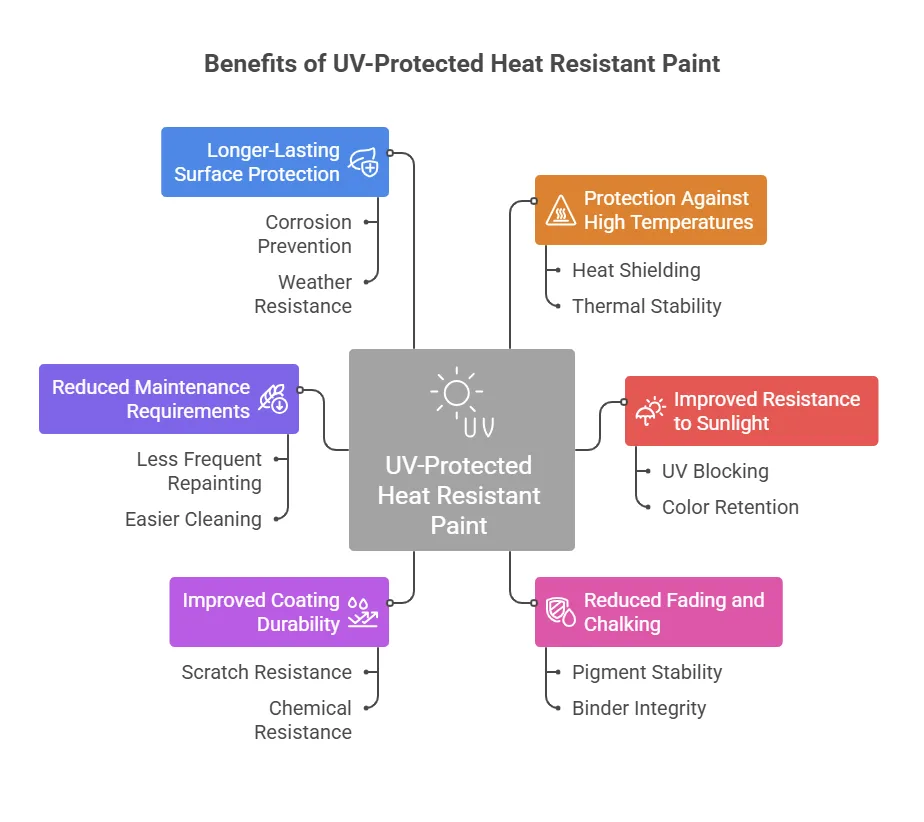
UV-protected heat resistant paint can be useful for industrial surfaces that experience both elevated temperatures and outdoor sunlight. By considering thermal resistance together with UV and weather exposure, industries can select a coating system better suited to their operating environment.
Protection Against High Temperatures
The primary benefit of heat resistant paint is its ability to withstand elevated temperatures within its specified rating. This makes it suitable for heat-exposed applications such as pipelines, boilers, furnaces, chimneys, ovens, and industrial equipment.
Selecting the correct temperature grade helps the coating maintain its intended performance during service.
Improved Resistance to Sunlight
Outdoor equipment can remain exposed to direct sunlight for long periods. UV-resistant coating properties can help the coating withstand prolonged exposure to ultraviolet radiation and weathering.
This is particularly important when heat-generating equipment is installed outdoors and experiences both operating heat and solar exposure.
Reduced Fading and Chalking
Prolonged UV exposure can contribute to color fading and surface chalking. A coating system selected for appropriate outdoor exposure can help reduce these effects and maintain a more consistent surface appearance.
The actual level of UV resistance depends on the specific coating formulation and its technical specifications.
Improved Coating Durability
A coating matched to its intended temperature and environmental conditions can provide more reliable long-term performance. For outdoor heat-exposed surfaces, considering temperature, UV radiation, moisture, weathering, and chemical exposure during product selection can help improve overall coating durability.
Reduced Maintenance Requirements
Premature coating deterioration can lead to additional inspection, recoating, and maintenance work. Using a coating system appropriate for the operating environment can help reduce unnecessary maintenance caused by unsuitable coating selection.
However, maintenance requirements also depend on surface preparation, application quality, coating thickness, operating conditions, and exposure severity.
Longer-Lasting Surface Protection
When the coating is correctly specified and applied, combining the required heat resistance with suitable UV and weather protection can support longer-lasting surface protection.
For industrial applications, the objective should be to select a coating based on the complete exposure environment rather than choosing a product based only on its maximum temperature rating.
How to Choose Heat Resistant Paint for Outdoor Applications
Choosing heat resistant paint for outdoor industrial applications requires more than checking the maximum temperature rating. The coating should be matched to the operating temperature, UV exposure, substrate, weather conditions, chemicals, expected service life, and application requirements.
Operating Temperature
The first consideration is the actual surface operating temperature. Heat resistant paints are available in different temperature grades, so the selected coating should be suitable for the maximum temperature the surface is expected to reach.
For example, equipment such as pipelines, boilers, furnaces, chimneys, and ovens may require different temperature-resistant coating systems.
It is important to consider both the normal operating temperature and possible temperature fluctuations rather than selecting a product based only on average conditions.
UV Exposure Level
Outdoor surfaces can receive prolonged exposure to ultraviolet radiation from sunlight. UV exposure can contribute to fading, chalking, and coating weathering.
If the application is continuously exposed to sunlight, check whether the selected coating system is specifically suitable for the expected UV and outdoor exposure. Heat resistance should not automatically be assumed to mean UV resistance.
Surface Material
The substrate also influences coating selection. The coating system should be compatible with the surface material, such as carbon steel, stainless steel, metal equipment, pipelines, tanks, or other industrial substrates.
Before application, the condition of the surface should be assessed and appropriate preparation should be carried out according to the coating manufacturer’s recommendations.
Indoor or Outdoor Environment
The exposure environment is an important selection factor. Indoor heat-exposed equipment may primarily require thermal resistance, while outdoor equipment can experience a combination of heat, sunlight, UV radiation, rain, humidity, dust, and temperature changes.
For outdoor applications, the complete coating system should therefore be evaluated for both thermal and environmental exposure.
Chemical and Weather Exposure
Industrial surfaces may encounter chemicals, process vapors, moisture, rain, humidity, and other environmental contaminants. These conditions can affect coating performance.
If the equipment is exposed to chemicals or severe weather, select a coating system whose technical specifications are appropriate for those conditions.
Required Service Life
Consider how long the coating is expected to perform before maintenance or recoating. A coating system selected according to the actual operating and environmental conditions can help support the required service life.
The expected service life also depends on surface preparation, coating thickness, application quality, curing, operating conditions, and maintenance practices.
Application and Curing Requirements
Even a technically suitable heat resistant coating may not perform as intended if it is incorrectly applied. Follow the manufacturer’s requirements for surface preparation, primer compatibility, application method, coating thickness, drying, curing, and service conditions.
For outdoor industrial applications, proper application combined with the correct temperature and environmental resistance can help achieve more consistent and durable coating performance.
Heat Resistant Paint Temperature Ratings
Heat resistant paints are available in different temperature ranges to suit different industrial operating conditions. The correct rating should be selected based on the actual surface temperature, duration of heat exposure, substrate, and environmental conditions.
For outdoor applications, UV exposure and weather conditions should also be considered along with temperature resistance.
Low-Temperature Heat Resistant Paint
Low-temperature heat resistant paints are suitable for surfaces exposed to moderately elevated temperatures where conventional coatings may not provide adequate performance.
Typical applications can include certain pipelines, industrial equipment, hot surfaces, and process components. The exact temperature limit should always be checked against the manufacturer’s technical specifications.
Medium-Temperature Heat Resistant Paint
Medium-temperature coatings are designed for applications where surfaces experience higher and more continuous thermal exposure.
They can be considered for suitable industrial pipelines, boilers, steam lines, ovens, and process equipment, depending on the actual operating temperature and product specification.
High-Temperature Heat Resistant Paint
High-temperature heat resistant paints are intended for surfaces exposed to significantly elevated temperatures. They are commonly considered for demanding industrial applications such as furnaces, chimneys, exhaust systems, high-temperature pipelines, and industrial heating equipment.
The selected product must have a temperature rating appropriate for the maximum surface temperature during operation.
Extreme-Temperature Heat Resistant Paint
Extreme-temperature coatings are designed for applications involving exceptionally high surface temperatures where standard heat resistant paints may not be suitable.
They may be considered for specialized industrial equipment and high-temperature process environments. In these applications, temperature rating, substrate compatibility, surface preparation, coating thickness, and curing requirements become especially important.
The temperature range should always be verified using the manufacturer’s current technical data before specifying or applying the coating.
Surface Preparation Before Applying Heat Resistant Paint
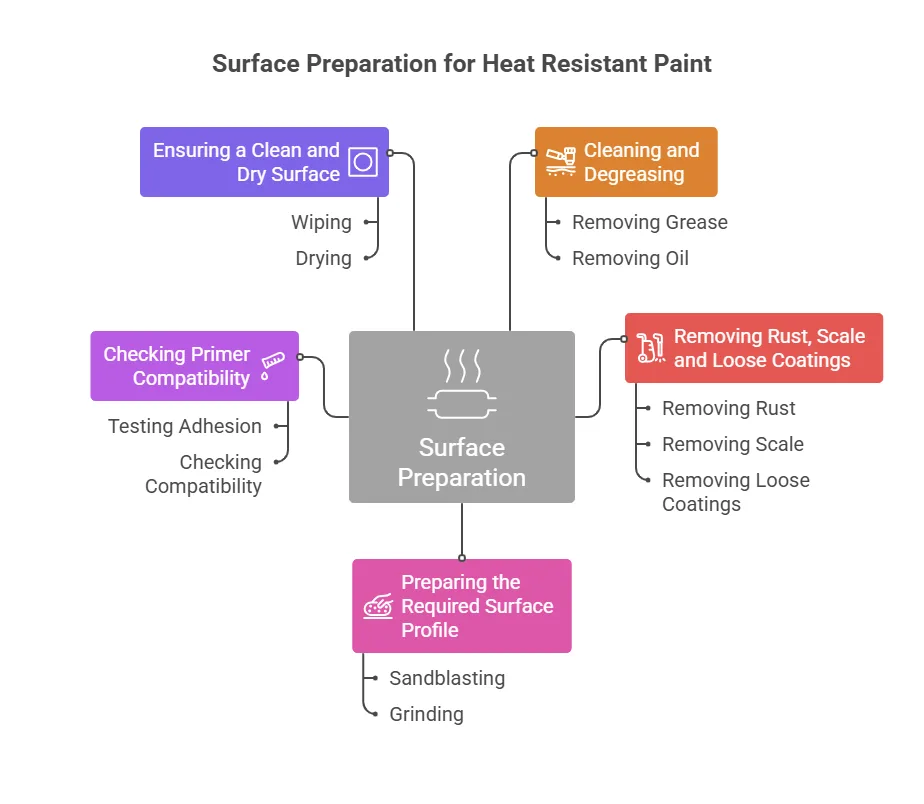
Proper surface preparation is one of the most important steps when applying heat resistant paint. A coating can only perform effectively when it is applied to a suitably prepared substrate. Before painting, the surface should be cleaned, free from contaminants, and prepared according to the coating manufacturer’s recommended application procedure.
Cleaning and Degreasing
The surface should first be cleaned to remove oil, grease, dirt, dust, salts, and other contaminants. Degreasing is particularly important on industrial equipment because oily or contaminated surfaces can interfere with coating adhesion.
A clean substrate provides a better foundation for the heat resistant coating and helps achieve a more uniform application.
Removing Rust, Scale and Loose Coatings
Rust, mill scale, loose paint, and other poorly adhered materials should be removed before applying the new coating.
Depending on the substrate and coating system, suitable mechanical or abrasive surface preparation methods may be used. The required preparation level should follow the coating manufacturer’s recommendations.
Preparing the Required Surface Profile
Some heat resistant coating systems require a specific surface profile to achieve adequate adhesion. Surface preparation should therefore provide the appropriate texture and cleanliness for the selected coating system.
The required preparation method can vary according to the substrate, existing coating condition, and coating specification.
Checking Primer Compatibility
If a primer is required, it should be compatible with both the substrate and the selected heat resistant topcoat. Not every conventional primer is suitable for elevated-temperature service.
Before application, verify the recommended primer, coating system, thinner, and application procedure using the manufacturer’s technical documentation.
Ensuring a Clean and Dry Surface
After preparation, the surface should be free from dust, moisture, oil, and other contaminants before coating application.
For outdoor applications, weather conditions should also be considered. Avoid applying the coating when moisture, condensation, rain, or other environmental conditions could compromise the coating process.
A properly prepared and clean substrate helps provide better adhesion and supports the intended heat resistance, UV/weather performance, and long-term durability of the coating system.
Heat Resistant Paint Application Process
Applying heat resistant paint correctly is essential for achieving the intended temperature resistance, adhesion, durability, and protective performance. The application process should follow the product’s technical data sheet and the manufacturer’s recommended surface preparation, application, drying, and curing requirements.
Surface Preparation
Before applying heat resistant paint, the substrate should be properly prepared. Remove oil, grease, dirt, dust, rust, scale, moisture, and loose or poorly adhered coatings.
The preparation method should be selected according to the substrate and coating system. A properly prepared surface provides a clean and suitable base for the coating and helps improve adhesion.
Primer Application
Where the specified coating system requires a primer, use a compatible high-temperature primer recommended for the application.
The primer should be applied according to the manufacturer’s requirements for application method, film thickness, drying time, and recoat interval. Avoid using a conventional primer unless its compatibility and temperature resistance have been confirmed.
Heat Resistant Paint Application
After the surface or primer is ready for recoating, apply the heat resistant paint using the recommended application method, such as brush, roller, or spray, depending on the product specification and project requirements.
Maintain the recommended coating thickness and ensure uniform coverage across the surface. Excessive or insufficient coating thickness can affect the intended performance, so the manufacturer’s technical data should be followed carefully.
Drying and Curing
The coating should be allowed to dry and cure according to the manufacturer’s specified conditions. Drying time, curing requirements, temperature, humidity, ventilation, and recoating intervals can affect final coating performance.
For high-temperature coatings, some products may require specific curing conditions before the equipment is returned to service. Always follow the product-specific technical documentation.
Final Coating Inspection
After application and curing, inspect the coating for uniform coverage, adhesion, visible defects, coating thickness, and surface condition.
Any defects, missed areas, runs, or damaged sections should be corrected according to the coating manufacturer’s recommended procedure.
A properly prepared substrate, compatible coating system, controlled application thickness, and correct curing process are essential for achieving reliable heat resistant coating performance.
Heat Resistant Paint vs Conventional Paint for UV-Exposed Areas
When selecting a coating for an outdoor industrial surface, it is important to distinguish between heat resistance, UV resistance, and general weather resistance. Heat resistant paint is designed primarily for elevated-temperature service, while conventional paint is generally intended for normal-temperature applications.
For surfaces exposed to both heat and sunlight, the coating should be selected according to the manufacturer’s technical specifications and the complete exposure environment.
Temperature Resistance
Heat resistant paint is specifically formulated for surfaces operating within a defined elevated-temperature range. It is suitable for applications where conventional coatings may not provide the required thermal performance.
Conventional paint is generally intended for normal service temperatures and may not be appropriate for continuously heat-exposed industrial equipment.
UV Resistance
UV resistance is a separate coating property from temperature resistance. A heat resistant paint should not automatically be assumed to provide UV protection unless the product specifications confirm suitability for UV or outdoor exposure.
For outdoor applications, select a coating system that addresses both the required temperature range and the expected sunlight exposure.
Weather Resistance
Outdoor surfaces may encounter sunlight, rain, moisture, humidity, dust, and temperature fluctuations. These conditions can affect coating performance over time.
Conventional paint may be suitable for general outdoor applications depending on its formulation, but heat-exposed outdoor equipment requires a coating system specifically matched to its thermal and environmental conditions.
Durability and Maintenance
The durability of any coating depends on factors such as surface preparation, coating thickness, application quality, curing, operating temperature, UV exposure, and environmental conditions.
Using a coating appropriate for the actual service environment can help reduce premature deterioration and unnecessary maintenance. A coating should therefore be selected based on the complete exposure conditions rather than temperature rating alone.
Application Suitability
Heat resistant paint is generally more appropriate for boilers, pipelines, furnaces, chimneys, ovens, steam lines, exhaust systems, and other heat-exposed industrial surfaces, provided the product’s specifications match the application.
Conventional paint may be appropriate for surfaces that do not experience elevated operating temperatures. For outdoor equipment exposed to both heat and sunlight, verify that the selected heat resistant coating system is also suitable for the required UV and weather exposure.
Common Mistakes When Using Heat Resistant Paint
Using heat resistant paint correctly requires more than selecting a high-temperature product. The coating must be matched to the operating environment and applied according to the manufacturer’s technical requirements. Avoiding common application mistakes can help improve adhesion, durability, and long-term coating performance.
Selecting the Wrong Temperature Rating
One of the most common mistakes is selecting a coating based on an assumed temperature rather than the actual surface operating temperature.
A coating rated below the required service temperature may deteriorate prematurely. On the other hand, selecting a product with an unnecessarily high rating may not provide any practical advantage for the application.
Always check the maximum surface temperature and select a compatible heat resistant coating grade.
Ignoring UV Exposure
Heat resistance does not automatically mean UV resistance. Outdoor equipment can experience continuous sunlight in addition to operating heat.
For outdoor applications, consider UV radiation, sunlight, moisture, and weathering when selecting the coating system. Check the product’s technical specifications to confirm its suitability for the intended outdoor exposure.
Poor Surface Preparation
Applying heat resistant paint over rust, oil, grease, dust, moisture, loose paint, or scale can reduce coating adhesion and affect long-term performance.
Proper cleaning, degreasing, rust removal, and surface preparation should be completed before coating application. The required preparation standard should follow the manufacturer’s recommendations.
Incorrect Coating Thickness
Applying too much or too little coating can affect the intended performance of a heat resistant coating system.
An insufficient film may provide inadequate protection, while excessive thickness can create application and curing problems depending on the product.
Follow the manufacturer’s recommended dry film thickness (DFT), wet film thickness where specified, number of coats, and recoat interval.
Using Incompatible Primer or Thinner
Not every primer or thinner is suitable for high-temperature coating systems. Using incompatible materials can affect adhesion, drying, curing, and temperature performance.
Only use the recommended primer and thinner specified for the particular heat resistant paint system. Product-specific technical documentation should be checked before application.
Inadequate Drying or Curing
Returning coated equipment to service before the coating has properly dried or cured can compromise its performance.
Drying and curing requirements can vary according to the coating formulation, temperature, humidity, ventilation, film thickness, and application conditions. Follow the manufacturer’s specified drying time, recoat interval, curing procedure, and service-start conditions.
Proper product selection, surface preparation, application, and curing are essential for achieving the expected performance of heat resistant paint, particularly when the coated surface is exposed to both high temperatures and outdoor UV conditions.
Frequently Asked Questions About UV Protection and Heat Resistant Paint
Does Heat Resistant Paint Provide UV Protection?
Not necessarily. Heat resistance and UV resistance are different coating properties. A heat resistant paint is primarily formulated to withstand elevated temperatures within its specified rating. For outdoor applications, check the product’s technical specifications to confirm whether it is suitable for prolonged UV and sunlight exposure.
Can Heat Resistant Paint Be Used Outdoors?
Yes, heat resistant paint can be used for outdoor applications when the selected product is specifically suitable for the operating temperature and outdoor environmental conditions. Outdoor surfaces may experience sunlight, UV radiation, moisture, rain, humidity, and temperature fluctuations, so these factors should be considered during coating selection.
Does UV Exposure Affect Heat Resistant Paint?
Prolonged UV exposure can affect coatings through fading, chalking, and weathering, depending on the coating formulation and exposure conditions. Heat resistant paint should therefore not be assumed to be UV-resistant unless the manufacturer’s technical information confirms its suitability for outdoor UV exposure.
What Temperature Can Heat Resistant Paint Withstand?
The temperature resistance depends on the specific product and its technical specification. Heat resistant paints are available in different temperature grades, ranging from lower-temperature applications to extremely high-temperature industrial applications.
The coating should be selected according to the actual surface temperature and not simply the temperature of the process or equipment. Always verify the manufacturer’s stated service-temperature limit before application.
How Long Does Outdoor Heat Resistant Paint Last?
There is no single service-life figure that applies to every outdoor heat resistant paint application. Durability depends on factors such as temperature, UV exposure, weather conditions, substrate, surface preparation, coating thickness, application quality, curing, and maintenance.
A properly selected and correctly applied coating system can provide reliable protection for its intended service environment, but the expected service life should be based on the specific product and project conditions.
Can Heat Resistant Paint Be Applied to Metal Surfaces?
Yes. Heat resistant paints are commonly used on suitable metal and industrial surfaces, including pipelines, boilers, chimneys, furnaces, exhaust systems, tanks, and other heat-exposed equipment.
Before application, the metal surface should be properly prepared by removing contaminants, rust, scale, and loose coatings. Primer compatibility, surface preparation requirements, coating thickness, and curing conditions should be confirmed from the manufacturer’s technical documentation.
Conclusion – Choosing Heat Resistant Paint for UV Protection
Choosing the right heat resistant paint for UV-exposed industrial surfaces requires consideration of both thermal and environmental conditions. A coating should not be selected only by its maximum temperature rating. The operating temperature, UV exposure, substrate, weather conditions, and application requirements should all be evaluated before selecting the coating system.
Matching Heat Resistance with UV Exposure
Outdoor industrial surfaces can experience high operating temperatures while also being exposed to direct sunlight and UV radiation. Heat resistance and UV resistance are separate properties, so the selected coating should be confirmed as suitable for the complete exposure environment.
Selecting the Right Coating for the Application
The appropriate coating depends on the surface temperature, substrate, outdoor conditions, chemical exposure, and required service life. Pipelines, boilers, chimneys, furnaces, tanks, and outdoor industrial equipment may require different coating specifications.
Always refer to the manufacturer’s technical data to confirm temperature limits, application conditions, and environmental suitability.
Following Proper Surface Preparation and Application
Good coating performance starts with proper surface preparation. Rust, oil, grease, dust, moisture, scale, and loose coatings should be removed before application.
The recommended primer, coating thickness, application method, drying time, and curing procedure should be followed according to the product’s technical documentation.
Supporting Long-Term Industrial Surface Protection
A correctly selected and properly applied heat resistant coating can help support reliable protection of industrial surfaces exposed to elevated temperatures and outdoor conditions. By considering heat resistance, UV exposure, weathering, surface preparation, and application quality together, industries can select a coating system better suited to long-term service.
For applications requiring specific temperature or UV performance, always verify the current product technical specifications before coating selection and application.