

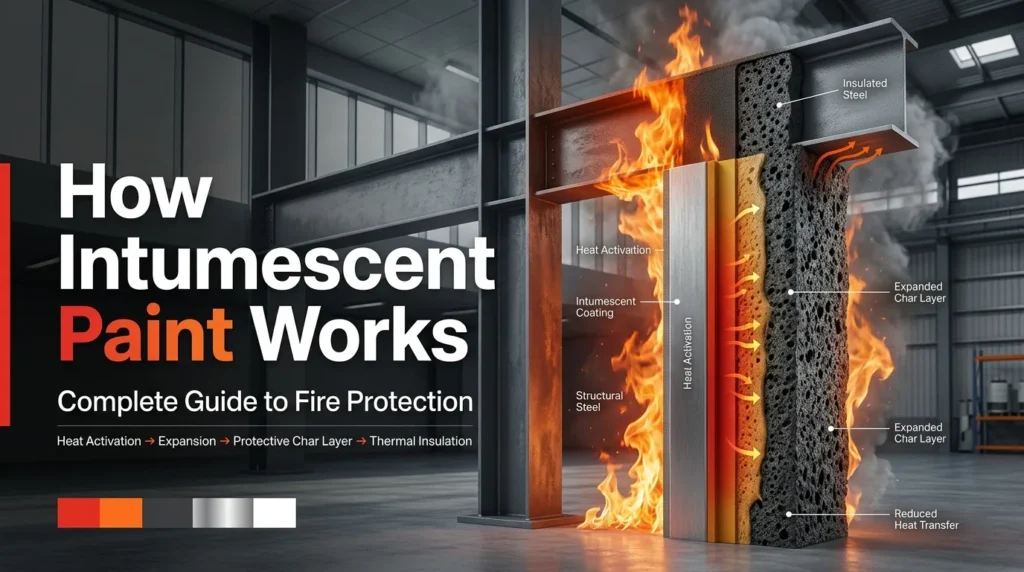
Intumescent paint works by reacting to high temperatures and expanding to form an insulating char layer that slows heat transfer to the protected surface. This heat-activated process is the foundation of its role in passive fire protection, particularly for structural steel. Under normal conditions, the coating remains relatively thin, but during a fire, its reactive components undergo a controlled chemical process that causes the coating to swell and create a protective barrier.
The resulting char layer acts as thermal insulation, helping delay the temperature rise of structural steel and maintain its load-bearing performance for the specified fire-resistance period. The effectiveness of an intumescent coating depends on factors such as the required fire rating, steel section factor, Dry Film Thickness (DFT), surface preparation, application quality, environmental exposure, and compatibility of the complete coating system.
Intumescent paint is commonly used for structural steel beams and columns in commercial buildings, industrial plants, warehouses, power facilities, oil and gas installations, and other infrastructure projects. When correctly selected and applied as part of an approved coating system, it provides a lightweight, space-efficient approach to passive fire protection while allowing structural steel to retain a relatively smooth architectural finish.
Introduction to How Intumescent Paint Works
Intumescent paint is a passive fire protection coating designed to protect surfaces and structural elements when exposed to high temperatures. Its key feature is its ability to react to heat, expand, and form an insulating char layer. This process slows heat transfer and helps protect the underlying material for the specified fire-resistance period.
What Is Intumescent Paint?
Intumescent paint is a specialized fire protection coating that remains relatively thin under normal conditions but expands when exposed to high temperatures. During a fire, the coating undergoes a heat-activated chemical reaction and forms a thick, carbon-rich char layer.
This insulating layer acts as a thermal barrier between the fire and the protected surface. For structural steel, the process helps delay the rise in steel temperature and can help maintain its load-bearing performance for the required fire-resistance period.
Why Is Intumescent Paint Used for Fire Protection?
Intumescent paint is used because it provides passive fire protection without requiring activation or mechanical operation. When exposed to fire, the coating automatically reacts to heat and creates an insulating barrier.
For structural steel, controlling the rate of temperature increase is particularly important because steel can lose strength as temperatures rise. An appropriate intumescent coating system helps delay this temperature increase, providing additional time for evacuation, emergency response, and fire control.
Other advantages include its relatively thin application, lightweight nature, space efficiency, and ability to provide a smooth finish where structural steel remains architecturally visible.
Where Is Intumescent Paint Used?
Intumescent paint is commonly used wherever structural fire protection is required. Typical applications include structural steel beams and columns, commercial buildings, industrial plants, warehouses, high-rise buildings, power facilities, oil and gas installations, hospitals, airports, and public infrastructure.
The correct coating system depends on the application environment, required fire rating, steel section factor, substrate condition, and specified Dry Film Thickness (DFT). For reliable performance, the complete system should be selected and applied according to the manufacturer’s approved technical requirements.
How Intumescent Paint Works During a Fire
Intumescent paint is designed to respond automatically when exposed to the elevated temperatures generated by a fire. The coating undergoes a sequence of heat-activated reactions that transform the relatively thin dry coating into an expanded insulating char. This char layer acts as a thermal barrier, slowing the transfer of heat to the protected substrate and helping maintain the performance of structural elements for the specified fire-resistance period.
Heat Activation of the Coating
When a fire causes the temperature of the protected surface to rise, the intumescent coating reaches its activation temperature. At this stage, the reactive components within the coating begin to undergo chemical changes.
The coating starts to soften and prepare for expansion. This heat-activated response allows the intumescent system to react directly to the fire without requiring external activation or mechanical equipment.
Chemical Reaction and Expansion
After activation, the components of the coating undergo a controlled chemical reaction that produces gases and promotes expansion. The coating begins to swell, increasing substantially in thickness compared with its original dry-film thickness.
This expansion is an important part of the fire protection mechanism because it creates a thicker, low-density protective layer between the fire and the underlying substrate.
Formation of the Protective Char Layer
As the coating expands, it develops into a carbon-rich insulating char layer. This layer is considerably thicker than the original coating and provides the primary thermal protection during fire exposure.
The quality and stability of the char are important to the performance of the intumescent system. A properly specified and applied coating forms a protective barrier that remains around the substrate while the fire continues.
How the Char Layer Slows Heat Transfer
The expanded char layer acts as a thermal insulation barrier, slowing the rate at which heat reaches the protected material. For structural steel, this helps delay the increase in steel temperature and can help the member retain its load-bearing performance for the specified fire-resistance period.
The effectiveness of this protection depends on the approved coating system, required fire rating, steel section factor, Dry Film Thickness (DFT), application quality, and environmental conditions. Therefore, intumescent paint should be applied according to the manufacturer’s specified system and technical requirements.
The Science Behind Intumescent Paint
Intumescent paint works through a coordinated chemical reaction involving several key components. When the coating is exposed to high temperatures, these components work together to produce gases, promote carbon formation, and create an expanded insulating char layer. The resulting char reduces heat transfer to the protected substrate and forms the primary barrier responsible for the coating’s passive fire protection performance.
Role of the Acid Source
The acid source plays an important role in initiating the intumescent reaction. When heated, it produces an acidic species that promotes the chemical reactions needed for char formation.
This reaction helps convert the carbon source into a stable, carbon-rich protective structure. The acid source therefore contributes to the development and stability of the insulating char layer during fire exposure.
Role of the Carbon Source
The carbon source provides the material needed to form the carbon-rich char. When activated by the acid source under elevated temperatures, it participates in a dehydration and carbonization process that produces the protective char structure.
A stable and sufficiently developed char layer is essential because it acts as the main thermal barrier between the fire and the protected substrate.
Role of the Blowing Agent
The blowing agent is responsible for generating gases when the coating is exposed to heat. These gases become trapped within the developing char and cause the coating to expand.
This expansion transforms the relatively thin coating into a much thicker, low-density insulating layer. The resulting expanded structure helps reduce the rate of heat transfer through the coating.
Role of Binder and Additives
The binder holds the coating components together and helps provide adhesion to the prepared substrate. It also influences the coating’s physical properties, application characteristics, and behavior during heating.
Additional additives may be included to improve properties such as stability, application, adhesion, durability, flow, and overall coating performance. The exact formulation varies between intumescent coating technologies and manufacturers.
Together, the acid source, carbon source, blowing agent, binder, and additives create the coordinated reaction that allows an intumescent coating to expand and form its protective char during fire exposure.
How Intumescent Paint Protects Structural Steel
Structural steel can lose strength as its temperature increases during a fire. Intumescent paint provides passive fire protection by reacting to heat and forming an insulating char layer around the steel. This protective layer slows heat transfer and helps delay the temperature rise of the structural member for the specified fire-resistance period.
How Steel Responds to Fire
Steel is a non-combustible construction material, but its mechanical properties change significantly at elevated temperatures. As steel becomes hotter, its strength and stiffness can decrease, which may lead to deformation of beams, columns, and other load-bearing members during a severe fire.
Unprotected structural steel can therefore require fire protection where the design requires the structure to maintain its load-bearing performance for a specified period.
Delaying the Rise in Steel Temperature
The primary function of intumescent paint is to delay the temperature increase of the protected steel. When exposed to fire, the coating expands and forms a low-density insulating char layer.
This char acts as a thermal barrier, reducing the rate at which heat reaches the steel. The effectiveness of this protection depends on the coating system, required fire rating, steel section factor, and specified Dry Film Thickness (DFT).
Maintaining Structural Stability
By slowing the heating of structural steel, an appropriate intumescent coating system can help structural members retain their load-bearing performance for the required fire-resistance period.
The coating does not make steel immune to fire or prevent the fire itself. Instead, it provides valuable thermal protection that can delay the loss of structural performance. Correct specification, application, and inspection are essential to achieve the intended protection.
Providing Additional Time for Evacuation
Passive fire protection can provide valuable additional time during a fire emergency. By delaying the heating of structural steel, an intumescent coating can help maintain structural stability for the specified period, supporting safe evacuation and allowing emergency responders additional time to control the incident.
For this reason, intumescent paint can form an important part of a broader building fire safety and passive fire protection strategy.
Stages of Intumescent Paint Activation
Intumescent paint undergoes a series of heat-activated changes when exposed to fire. The coating moves from its normal solid state through chemical activation and expansion before developing a protective char layer. Each stage contributes to the coating’s ability to slow heat transfer and protect the underlying structural material.
Initial Heat Exposure
When a fire develops, the temperature of the coated surface begins to rise. The intumescent coating absorbs heat until it reaches the temperature at which its reactive components become active.
At this stage, the coating remains relatively close to its original thickness, but the increasing temperature initiates the chemical processes responsible for intumescence.
Coating Softening and Chemical Activation
As the activation temperature is reached, the coating begins to soften and its reactive components undergo chemical changes. The acid source, carbon source, and blowing agent begin working together to initiate the formation of the protective structure.
This stage is important because it prepares the coating for controlled expansion and char development as the fire continues.
Coating Expansion
Following chemical activation, gases generated within the coating cause it to expand significantly beyond its original thickness. The coating swells and develops a cellular, low-density structure that provides thermal insulation.
The amount of expansion and the resulting protective thickness depend on the formulation of the coating and the specified application system.
Protective Char Formation
The final stage is the development of a stable insulating char layer. This expanded char forms a barrier between the fire and the protected substrate, reducing the rate of heat transfer.
For structural steel, this helps delay the rise in steel temperature and supports the required fire-resistance performance of the approved coating system. The effectiveness of the char layer depends on factors such as coating thickness, fire exposure, formulation, and correct application.
Factors Affecting Intumescent Paint Performance
The performance of intumescent paint depends on several technical and application factors. Fire rating, steel section factor, Dry Film Thickness (DFT), application quality, and environmental conditions all influence how effectively the coating performs during fire exposure. Correct specification and application are therefore essential for achieving the intended passive fire protection performance.
Required Fire Rating
The required fire rating determines how long the protected structural element must maintain its required performance during fire exposure. Common project requirements may include 30, 60, 90, 120, or 180 minutes.
A higher fire-resistance requirement may require a greater coating thickness or a specific tested coating system. The required thickness should always be determined from the manufacturer’s approved specifications rather than estimated independently.
Steel Section Factor
The steel section factor describes the relationship between the exposed surface area of a steel member and its cross-sectional area. It is an important factor in determining how quickly the steel heats during fire exposure.
Steel members with higher section factors generally heat more rapidly and may require greater intumescent coating thickness to achieve the specified fire rating. Accurate section-factor calculations are therefore important during coating specification.
Dry Film Thickness (DFT)
Dry Film Thickness (DFT) is one of the most important controls in an intumescent coating system. The required DFT depends on factors such as the fire rating, steel section factor, coating formulation, and approved fire-test system.
If the coating is applied below the specified thickness, the intended fire protection may not be achieved. Excessive or uneven application can also create coating defects. DFT should therefore be checked using appropriate calibrated measuring equipment.
Application Quality
Correct application is essential for achieving consistent fire protection. Poor surface preparation, incorrect mixing, unsuitable application conditions, inadequate curing, or uneven coating thickness can negatively affect coating performance.
The application process should follow the manufacturer’s technical requirements, including:
- Surface preparation
- Primer application
- Mixing and application method
- Recoat intervals
- Environmental conditions
- Required DFT
- Curing requirements
- Final inspection
Environmental Conditions
Environmental conditions can influence both application quality and long-term coating durability. Temperature, humidity, moisture, UV exposure, chemicals, and weather conditions should be considered when selecting and applying an intumescent coating.
Interior dry environments may require a different coating system from exterior or aggressive industrial environments. Where required, a compatible protective topcoat can help protect the intumescent layer from environmental exposure.
Intumescent Paint Application Process
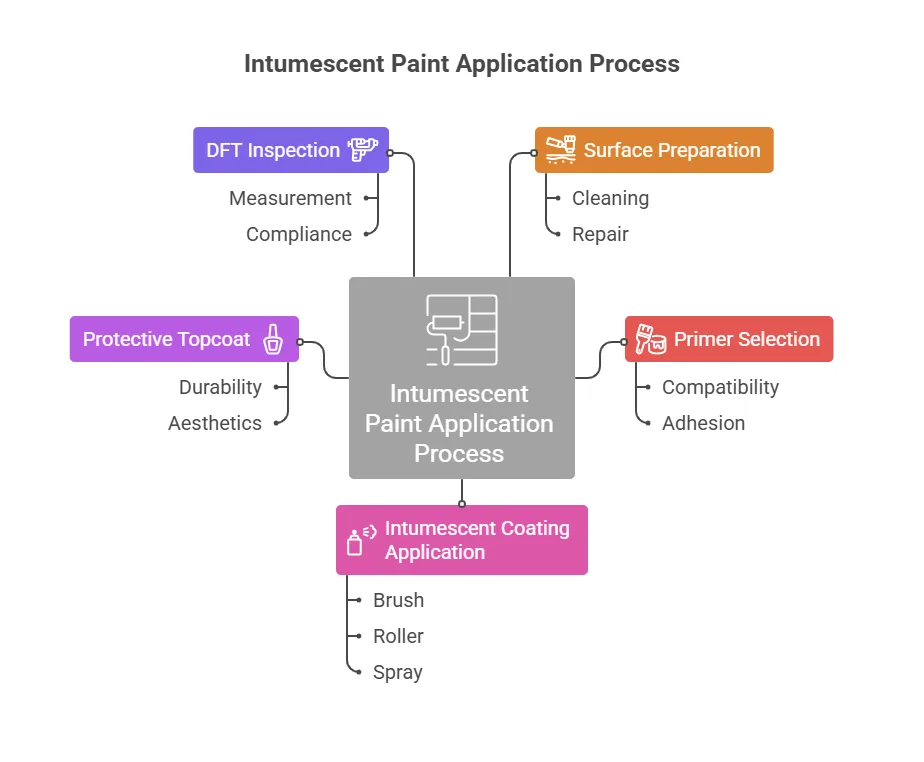
The application of intumescent paint requires a controlled coating system to achieve the intended fire-protection performance. Surface preparation, primer selection, application of the intumescent layer, protective topcoat, and DFT inspection all play an important role. Each stage should follow the product’s approved technical specifications and application requirements.
Surface Preparation
Proper surface preparation is the first step in an effective intumescent coating system. The substrate should be clean, dry, and free from contaminants such as rust, oil, grease, dust, loose material, and other substances that could affect coating adhesion.
The required preparation method depends on the substrate and coating specification. Any damaged or unsuitable areas should be corrected before the primer or intumescent coating is applied.
Good surface preparation helps improve adhesion and reduces the risk of peeling, blistering, cracking, or premature coating failure.
Primer Selection
The primer provides the foundation between the prepared steel substrate and the intumescent coating. It should be compatible with the selected intumescent system and suitable for the intended service environment.
An unsuitable or incompatible primer can affect adhesion, curing, durability, and fire performance. Therefore, the primer should be selected according to the manufacturer’s approved coating system.
Before application, verify:
- Primer compatibility
- Surface preparation requirements
- Required primer thickness
- Drying and curing time
- Environmental application conditions
Intumescent Coating Application
After the primer has been properly prepared and cured, the intumescent coating can be applied using the application method recommended for the product. Depending on the coating system, application may involve airless spray, brush, or roller application.
The coating should be applied evenly and within the specified environmental conditions. Multiple coats may be required to achieve the required DFT, with appropriate drying or recoat intervals between coats.
Careful control of application thickness is essential because the required DFT is related to the specified fire rating and steel section factor.
Protective Topcoat
A protective topcoat may be required when the intumescent system is exposed to moisture, UV radiation, weathering, chemicals, or other environmental conditions.
The topcoat must be compatible with the underlying intumescent coating and should be part of the approved coating system. It can provide additional environmental protection while also delivering the required final appearance.
For exterior or aggressive industrial environments, topcoat selection should be based on the expected exposure conditions and manufacturer’s recommendations.
DFT Inspection
Dry Film Thickness (DFT) inspection is an essential quality-control step. It verifies that the applied intumescent coating has reached the thickness required by the approved fire-protection system.
Measurements should be taken using suitable calibrated equipment and recorded as part of the coating inspection process. Areas with insufficient thickness should be corrected according to the manufacturer’s repair procedure.
Final inspection should confirm:
- Required DFT has been achieved
- Coating is uniform and properly cured
- No significant visible defects are present
- Primer and topcoat are compatible
- Application complies with the approved system
Benefits of Intumescent Paint
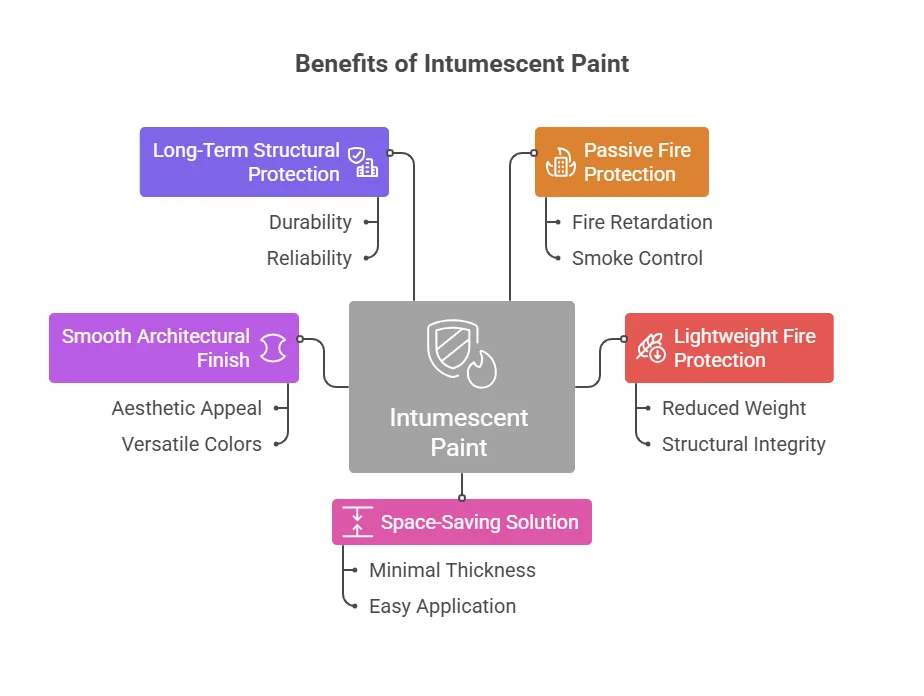
Intumescent paint offers several advantages as a passive fire protection coating, particularly for structural steel. When exposed to high temperatures, it expands and forms an insulating char layer that slows heat transfer to the protected substrate. Its relatively thin application, architectural flexibility, and ability to protect structural elements make it suitable for a wide range of commercial and industrial applications.
Passive Fire Protection
The primary benefit of intumescent paint is passive fire protection. Unlike active fire protection systems, it does not require activation, power, or mechanical operation. When exposed to fire, the coating automatically reacts to heat and forms an insulating char layer.
This protective layer slows the temperature increase of structural steel and helps the protected member maintain its required performance for the specified fire-resistance period.
Lightweight Fire Protection
Intumescent paint provides fire protection through a comparatively thin coating system, making it a lightweight solution for structural fire protection. It can protect steel without adding the substantial bulk associated with some traditional fireproofing methods.
This is particularly useful for projects where structural weight, clearances, and the original dimensions of steel members are important considerations.
Space-Saving Solution
Because intumescent coatings can provide protection with a relatively thin profile, they are suitable for applications where available space is limited. The coating can protect beams and columns without significantly increasing their overall dimensions.
This can be beneficial in commercial buildings, industrial facilities, and renovation projects where maintaining existing clearances and architectural details is important.
Smooth Architectural Finish
Intumescent paint can combine fire protection with a smooth and aesthetically acceptable finish. This allows exposed structural steel to remain visible rather than being enclosed within a bulky fireproofing system.
The coating can therefore be suitable for offices, hotels, commercial buildings, public spaces, and other projects where structural steel contributes to the architectural appearance.
Long-Term Structural Protection
When properly specified, applied, inspected, and maintained, an intumescent coating system can provide long-term protection for structural elements. Performance depends on factors such as surface preparation, coating thickness, environmental exposure, compatible primers and topcoats, and correct application.
Regular inspection and maintenance can help identify coating damage or deterioration and support continued fire-protection performance throughout the intended service life.
Intumescent Paint vs Other Fire Protection Methods
Different fire protection methods are designed for different substrates, environments, fire ratings, and project requirements. Intumescent paint is particularly useful where structural steel needs passive fire protection while maintaining a relatively thin profile and attractive finish. Cementitious fireproofing and fire retardant paints serve different protection purposes, so the coating should be selected according to the specific application.
Intumescent Paint vs Cementitious Fireproofing
Intumescent paint protects structural steel by reacting to high temperatures and expanding to form an insulating char layer. It provides a relatively thin coating system and can maintain the appearance of exposed steel.
Cementitious fireproofing generally provides protection through a thicker insulating layer applied around the structural element. It can be suitable for large industrial structures and applications where appearance and coating thickness are less critical.
| Feature | Intumescent Paint | Cementitious Fireproofing |
| Protection mechanism | Expands and forms insulating char | Provides thermal insulation |
| Profile | Relatively thin | Generally thicker |
| Weight | Relatively lightweight | Generally heavier |
| Appearance | Smooth finish possible | More textured/bulky |
| Architectural flexibility | High | More limited |
| Typical application | Commercial and industrial steel | Industrial and structural applications |
The final choice should be based on the required fire rating, substrate, project conditions, and approved fire-protection system.
Intumescent Paint vs Fire Retardant Paint
Intumescent paint and fire retardant paint are often confused, but they are not necessarily interchangeable. Intumescent paint is specifically designed to expand under high heat and form an insulating char layer. It is widely used for passive protection of structural steel.
Fire retardant paint is generally used to reduce flame spread or improve the fire performance of particular substrates such as wood, fabric, walls, gypsum boards, or other combustible materials, depending on the product formulation.
The correct product therefore depends on the substrate, fire-performance requirement, application environment, and tested product system. A fire retardant coating designed for a combustible surface should not automatically be considered a substitute for an approved structural-steel intumescent system.
Choosing the Right Fire Protection System
Selecting the right fire protection system requires evaluating several factors rather than choosing a coating based only on its name. Consider:
- Substrate: Steel, wood, gypsum, cable, or another material
- Required fire rating: The specified fire-resistance period
- Steel section factor: For structural steel applications
- Environmental exposure: Interior, exterior, humid, chemical, or industrial conditions
- Required coating thickness: Based on the approved system
- Architectural requirements: Whether exposed steel must retain a smooth finish
- Primer and topcoat compatibility: Especially for complete intumescent systems
- Application and maintenance: Surface preparation, DFT control, inspection, and repairs
For structural steel, an appropriately tested and approved intumescent coating system can provide passive fire protection while maintaining a relatively low-profile appearance. For other substrates, a suitable fire retardant or alternative fireproofing system may be more appropriate.
Common Mistakes to Avoid
The performance of an intumescent coating depends on correct specification, surface preparation, application, and inspection. Even a high-quality intumescent paint may not deliver its intended fire-protection performance if the coating is applied incorrectly or under unsuitable conditions. Avoiding common application mistakes helps maintain coating integrity and supports the required fire-resistance performance.
Incorrect DFT
Dry Film Thickness (DFT) is one of the most important factors in an intumescent coating system. The required thickness depends on the fire rating, steel section factor, and approved coating system.
Applying too little coating can reduce the intended fire protection, while excessive or uneven application can cause curing and coating defects. DFT should therefore be measured using suitable calibrated equipment and compared with the specified requirements.
Poor Surface Preparation
Poor surface preparation can lead to weak adhesion, peeling, blistering, corrosion, and premature coating failure. Before applying the coating system, the substrate should be properly cleaned and prepared.
Rust, oil, grease, dust, loose material, and other contaminants should be removed according to the specified preparation requirements. A clean and suitable substrate provides a better foundation for the primer and intumescent coating.
Incompatible Primer or Topcoat
An intumescent coating is normally part of a complete system that may include a primer and protective topcoat. Using an incompatible primer or topcoat can affect adhesion, curing, durability, and fire performance.
Only compatible or manufacturer-approved coating components should be used. Any substitution should be confirmed against the applicable technical requirements before application.
Incorrect Application Conditions
Environmental conditions during application can significantly affect coating quality. Temperature, humidity, moisture, ventilation, and surface condition should be within the limits specified for the coating system.
Applying the coating outside the recommended conditions can result in poor curing, uneven film formation, adhesion problems, or other defects. Applicators should monitor conditions throughout the application and curing process.
Ignoring Manufacturer Specifications
Every intumescent coating system has specific requirements for surface preparation, primer, application method, DFT, drying time, curing, environmental conditions, and topcoat compatibility.
Ignoring the manufacturer’s Technical Data Sheet (TDS) or approved application procedure can compromise the intended fire-protection performance. Following the specified system from preparation through final inspection is therefore essential.
Frequently Asked Questions (FAQs)
How Does Intumescent Paint Work?
Intumescent paint works by reacting to high temperatures, expanding, and forming an insulating char layer. This expanded layer slows heat transfer from the fire to the protected substrate. For structural steel, the process helps delay the increase in steel temperature and supports the required fire-resistance performance of the approved coating system.
What Happens to Intumescent Paint During a Fire?
During a fire, the coating first reaches its activation temperature. It then softens and undergoes a chemical reaction that generates gases and promotes char formation. The coating expands significantly and develops a thick, low-density protective char layer. This char acts as a thermal barrier while the fire continues.
How Much Does Intumescent Paint Expand?
The amount of expansion varies according to the formulation, coating system, application thickness, and manufacturer specifications. The coating can expand substantially from its original dry-film thickness when exposed to fire, producing a much thicker insulating char layer. The exact expansion ratio should be taken from the product’s tested technical data rather than assumed.
How Does Intumescent Paint Protect Steel?
Intumescent paint protects steel by forming an insulating char layer that slows the rate of heat transfer. This delays the rise in steel temperature and helps structural steel retain its required load-bearing performance for the specified fire-resistance period. Performance depends on factors such as the fire rating, steel section factor, DFT, and correct application.
Does Intumescent Paint Stop a Fire?
No. Intumescent paint does not stop or extinguish a fire. Its purpose is to provide passive fire protection by slowing heat transfer to the protected material. For structural steel, this can help delay loss of structural performance and provide additional time for evacuation and emergency response.
Conclusion
Understanding how intumescent paint reacts to fire helps explain why it is widely used as a passive fire protection solution for structural steel. The coating remains relatively thin under normal conditions but reacts to high temperatures, expands, and forms an insulating char layer. This char slows heat transfer and helps delay the rise in temperature of the protected steel.
Understanding the Intumescent Fire Protection Process
The intumescent fire protection process involves heat activation, chemical reaction, coating expansion, and protective char formation. As the temperature increases, the coating’s reactive components work together to create an expanded insulating layer.
This layer acts as a thermal barrier, helping reduce the rate at which heat reaches the structural steel. Understanding this process is important when evaluating the role of intumescent coatings within a building’s overall passive fire protection strategy.
Selecting the Right Intumescent Coating System
The correct intumescent coating should be selected according to the required fire rating, steel section factor, Dry Film Thickness (DFT), environmental exposure, application conditions, and compatibility of the primer and topcoat.
A complete approved coating system should be followed rather than selecting individual coating components independently. Proper surface preparation, application, curing, DFT inspection, and adherence to manufacturer specifications are essential for achieving the intended fire-protection performance.
Improving Structural Fire Safety
Intumescent paint can contribute to improved structural fire safety by delaying the heating of protected steel and helping structural members maintain their required performance during fire exposure. It does not extinguish or stop a fire, but provides valuable passive protection for the specified period.
With correct product selection, professional application, regular inspection, and appropriate maintenance, an intumescent coating system can form an important part of a comprehensive passive fire protection strategy for commercial, industrial, and infrastructure projects.