

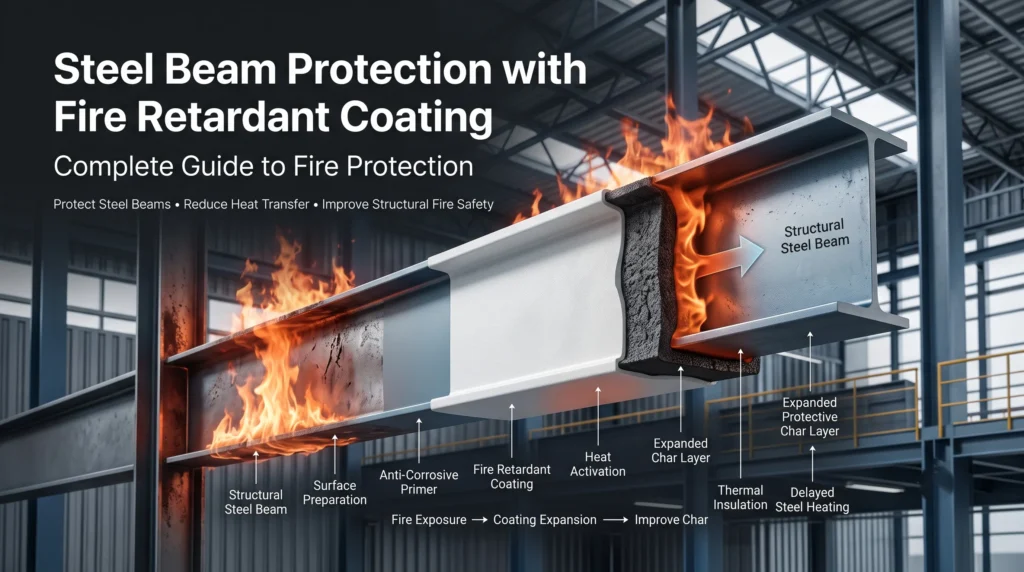
Steel beams are essential structural components in industrial buildings, warehouses, commercial facilities, and infrastructure projects. Although steel is non-combustible, its strength can reduce significantly when exposed to high temperatures during a fire. As the temperature of structural steel rises, it can lose its load-bearing capacity, leading to deformation and potentially structural failure.
Fire retardant coating provides a passive fire protection layer over steel beams. Depending on the coating system and tested fire rating, the coating can delay the transfer of heat to the steel and help maintain its structural stability for a specified period. Intumescent coatings are particularly useful because they react to high temperatures and form an expanded, insulating char layer around the steel surface.
Effective steel beam protection requires more than simply applying paint. The correct coating must be selected according to the required fire-resistance period, steel section, exposure conditions, surface preparation, primer compatibility, and specified dry film thickness (DFT). Proper application and inspection are equally important for achieving the intended fire protection performance.
This guide explains how fire retardant coatings protect steel beams, the major coating types, selection factors, application process, testing considerations, common mistakes, and maintenance practices for long-term structural fire protection.
Understanding Steel Beam Fire Protection
Steel beams are widely used in industrial structures because of their high strength, durability, and ability to carry heavy loads. However, during a fire, the temperature of steel can rise rapidly, reducing its mechanical strength and stiffness. Steel beam fire protection is therefore used to delay heat transfer and help maintain the structural performance of steel for the required fire-resistance period.
Why Steel Beams Need Fire Protection
Steel does not burn like wood or other combustible materials, but this does not mean it is unaffected by fire. As steel reaches elevated temperatures, its strength and load-bearing capacity decrease. Continued exposure can cause beams to deform, buckle, or lose their ability to safely support the structure.
Fire protection helps slow down the temperature increase of the steel beam and provides additional time for evacuation, firefighting, and emergency response. It is particularly important in industrial plants, warehouses, commercial buildings, manufacturing facilities, power plants, and other structures containing critical steel members.
The required protection depends on factors such as the structural design, fire-resistance rating, steel section, fire exposure, and applicable project requirements.
What is Fire Retardant Coating?
Fire retardant coating is a specially formulated protective coating applied to a surface to improve its resistance to fire and heat exposure. For steel beams, certain fire-protection coatings are designed to act as a thermal barrier and delay the heating of the underlying steel.
Intumescent fire retardant coatings are one important type. When exposed to high temperatures, the coating can expand and form an insulating char layer. This layer reduces the rate at which heat reaches the steel, helping maintain the steel at a lower temperature for a specified period under the relevant tested conditions.
The performance of a coating depends on its formulation, application system, required dry film thickness (DFT), substrate preparation, and tested fire-rating conditions. Therefore, coating thickness should be determined according to the approved system rather than applied simply by appearance.
How Fire Retardant Coating Protects Steel Beams
Fire retardant coating protects steel beams primarily by slowing the transfer of heat from the fire environment to the steel substrate. In an intumescent system, the coating reacts when exposed to high temperatures and develops an expanded insulating layer.
The protection process can be understood in three stages:
- Heat exposure: Fire raises the temperature of the coated steel beam.
- Coating activation: The fire-protection coating reacts to elevated temperature.
- Insulating barrier formation: The coating forms a protective layer that reduces the rate of heat transfer to the steel.
By delaying the temperature rise of the beam, the coating can help preserve the structural capacity of the steel for the specified fire-protection period. Achieving the intended performance requires the correct coating system, surface preparation, DFT, curing, and quality inspection.
How Fire Retardant Coating Works on Steel Beams
Fire retardant coating protects steel beams by slowing the rate at which heat reaches the steel during a fire. The coating acts as a thermal protection system, helping delay the rise in steel temperature and allowing the structural member to retain its strength for a specified period. The effectiveness depends on the coating system, applied thickness, substrate preparation, and tested fire-performance requirements.
Heat Exposure and Coating Activation
When a fire occurs, the temperature around an exposed steel beam rises rapidly. Heat begins transferring from the fire environment through the coating toward the steel substrate.
In an intumescent fire retardant coating, exposure to elevated temperature activates the coating’s reactive components. The coating begins to expand and undergo a controlled chemical reaction, transforming from a relatively thin film into a thicker protective layer.
The activation temperature and expansion behavior depend on the specific coating formulation. Therefore, the coating should be selected and applied according to its tested fire-protection system rather than assuming that every fire retardant coating performs in the same way.
Formation of the Protective Insulating Layer
After activation, an intumescent coating forms an expanded, carbon-rich insulating char layer over the steel surface. This layer is significantly thicker than the original coating film and acts as a thermal barrier.
The protective char reduces the rate of heat transfer from the fire to the steel. Its insulating effect helps slow down the temperature increase of the structural member during fire exposure.
The quality and thickness of the resulting protective layer depend on factors such as the coating formulation, specified dry film thickness (DFT), application quality, and fire exposure conditions.
Delaying Steel Temperature Rise
As the protective layer develops, it reduces the amount of heat reaching the steel beam over time. This delays the rise in steel temperature compared with an unprotected steel member exposed to the same fire conditions.
This delay is important because structural steel progressively loses strength and stiffness as its temperature increases. A properly designed and tested fire protection system can therefore provide additional time before the steel reaches the critical temperature considered in the structural fire design.
The required coating thickness is not necessarily the same for every beam. It can vary according to the required fire rating, steel section characteristics, section factor, exposure conditions, and approved coating system.
Maintaining Structural Stability During Fire
The primary objective of protecting a steel beam is to delay loss of structural capacity during fire exposure. By slowing the temperature increase, fire retardant coating helps the beam retain its load-bearing performance for the required fire-resistance period.
This additional protection can provide valuable time for building occupants to evacuate and for emergency services to respond. However, fire protection should be considered as part of an overall passive fire protection strategy rather than as a substitute for structural fire engineering, fire detection, suppression, or other safety measures.
For reliable performance, the complete coating system should be correctly specified, applied at the required DFT, properly cured, and inspected before the protected steel beam is placed into service.
Benefits of Fire Retardant Coating for Steel Beams
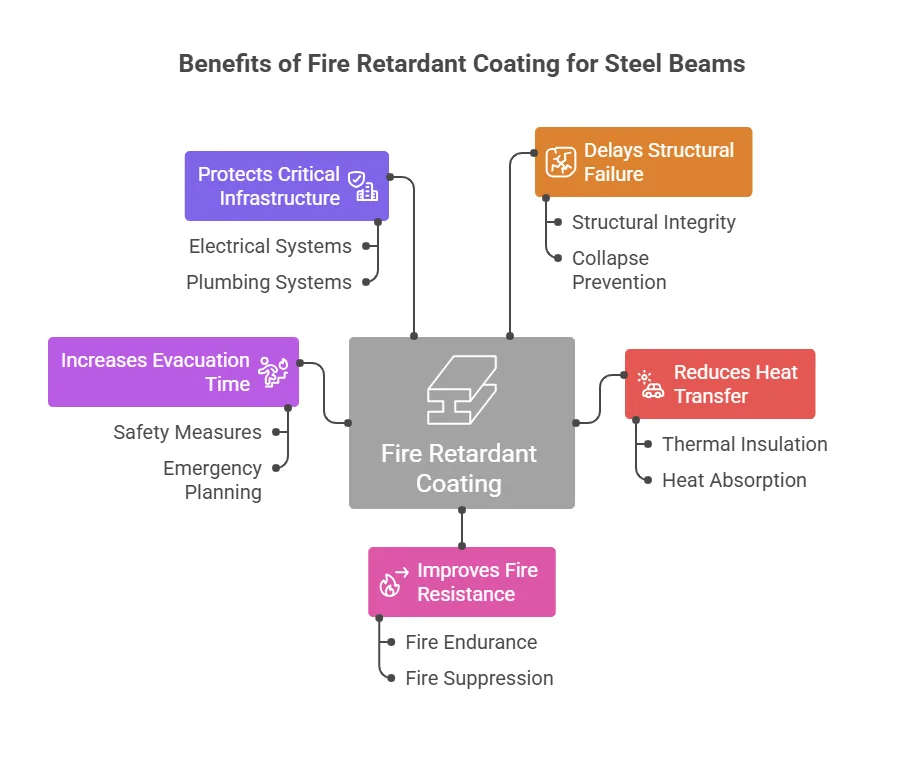
Fire retardant coating provides an important layer of passive fire protection for structural steel beams. By slowing the heating of steel during fire exposure, the coating can help preserve the performance of critical structural members and support the overall fire-safety strategy of a building.
Delays Structural Failure
High temperatures can reduce the strength and stiffness of structural steel, potentially causing excessive deformation or failure. Fire retardant coating helps delay the temperature rise of the steel beam, giving the structure additional time before it reaches temperatures that could significantly affect its load-bearing performance.
The protection period depends on the tested coating system, steel section, fire exposure, and required coating thickness.
Reduces Heat Transfer
A properly designed fire protection coating acts as a thermal barrier between the fire and the steel surface. In an intumescent system, heat causes the coating to expand and form an insulating char layer.
This protective layer reduces the rate of heat transfer into the steel beam, helping keep the steel temperature lower for longer during fire exposure.
Improves Fire Resistance
Fire retardant coating can improve the fire resistance of steel beams when the complete coating system has been appropriately tested and specified for the required fire-resistance period.
Performance depends on factors such as coating formulation, DFT, steel section factor, surface preparation, primer compatibility, and application quality. The coating should therefore be selected according to the project’s required fire rating rather than based only on nominal coating thickness.
Increases Evacuation and Emergency Response Time
By delaying the heating and loss of structural capacity of protected steel members, fire protection can provide additional time during a fire event. This can support safer evacuation and allow emergency responders more time to control the fire.
However, fire retardant coating is only one part of a complete fire-safety system and should work alongside fire detection, suppression, emergency planning, and appropriate structural design.
Protects Critical Building Infrastructure
Steel beams often form part of the primary structural framework supporting floors, roofs, equipment, and other building components. Protecting these members helps reduce the risk of premature structural deterioration during fire exposure.
Fire retardant coating is therefore valuable in industrial facilities, warehouses, manufacturing plants, commercial buildings, power facilities, and other structures where maintaining structural integrity during a fire is critical.
Types of Fire Protection Coatings for Steel Beams
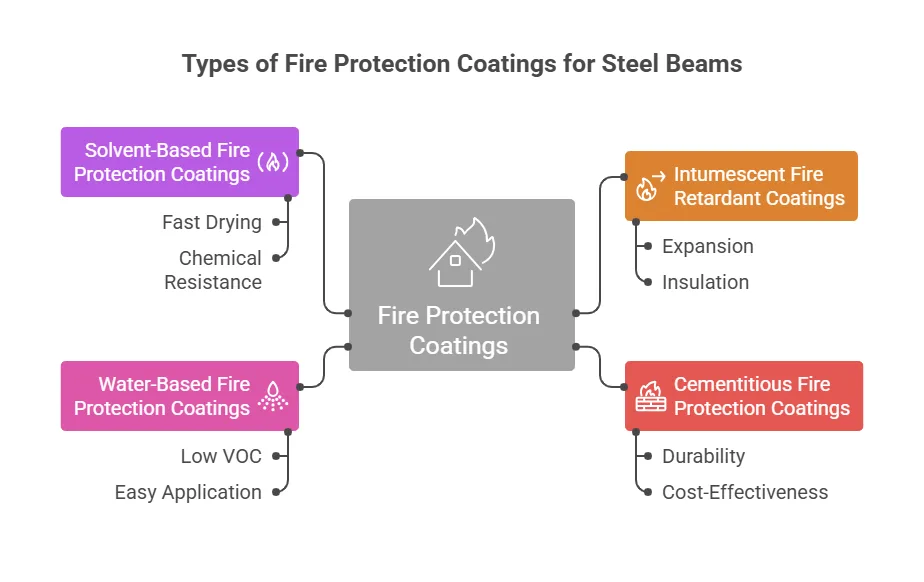
Fire protection systems for steel beams can be selected based on the required fire-resistance performance, project conditions, application requirements, and exposure environment. Different coating technologies provide protection through different mechanisms, so the complete system should be specified according to the structural and fire-protection requirements.
Intumescent Fire Retardant Coatings
Intumescent fire retardant coatings are widely used for protecting structural steel where a relatively thin coating system is preferred. When exposed to high temperatures, the coating expands and forms an insulating char layer over the steel surface.
This expanded layer slows heat transfer and delays the rise in steel temperature. The required coating thickness varies according to the steel section, required fire-resistance period, exposure conditions, and tested system.
Intumescent coatings are particularly useful where maintaining the visible appearance of steel is important, including commercial buildings, industrial facilities, warehouses, and architectural steelwork.
Cementitious Fire Protection Coatings
Cementitious fire protection coatings use a mineral or cement-based protective layer to provide thermal insulation around structural steel. Unlike intumescent coatings, they generally protect the steel by maintaining a thicker insulating barrier rather than expanding into an intumescent char.
These systems can be suitable for industrial and structural applications where robust thermal protection is required. Their selection should consider substrate condition, application thickness, mechanical exposure, environmental conditions, and the required fire rating.
Water-Based Fire Protection Coatings
Water-based fire protection coatings use water as the primary carrier and can provide a practical solution for suitable indoor or controlled application environments. Many water-based intumescent systems are designed to form an insulating protective layer when exposed to fire.
They can offer advantages such as relatively low solvent emissions and convenient application where environmental and workplace conditions are controlled. However, drying and curing can be influenced by temperature, humidity, ventilation, and coating thickness, so application conditions need to be properly managed.
Solvent-Based Fire Protection Coatings
Solvent-based fire protection coatings use organic solvents as the carrier and are formulated for applications where the coating system requires specific performance or environmental characteristics.
They can provide good film formation and may be selected for particular industrial or environmental conditions. However, solvent-based systems require appropriate ventilation, handling procedures, and control of application conditions because of solvent emissions and flammability considerations.
For steel beam protection, the most appropriate coating type should be selected based on the required fire rating, steel geometry, exposure environment, surface preparation, primer compatibility, application conditions, and verified fire-test performance.
Factors to Consider When Selecting Steel Beam Coating
Selecting the right fire retardant coating for a steel beam requires more than choosing a product based on its fire rating alone. The coating system should match the structural characteristics of the steel, environmental exposure, required protection period, and compatibility of the complete coating system.
Required Fire Resistance Rating
The required fire-resistance rating is one of the most important factors when selecting a steel beam coating. Projects may require different protection periods depending on building design, occupancy, structural requirements, and applicable regulations.
The coating thickness and system should be selected according to tested fire-performance data for the specific application. A coating that provides one fire-resistance period should not automatically be assumed to provide a higher rating without supporting test data.
Steel Section Size and Shape
The size and geometry of the steel beam directly influence its heating behavior during a fire. Different steel sections have different exposed surface areas relative to their mass, which affects how quickly they can heat up.
Therefore, the coating system and required DFT should be determined with consideration of the steel section size, shape, exposed surfaces, and section factor. Beams, columns, hollow sections, and other structural profiles may require different coating thicknesses under the same fire-resistance requirement.
Critical Steel Temperature
Critical steel temperature refers to the temperature at which the structural capacity of a steel member may become inadequate for the design conditions during fire exposure.
The required fire protection system should therefore be selected in conjunction with the project’s structural fire design. Coating performance, steel temperature limits, loading conditions, and required fire duration should be considered together rather than evaluating the coating independently.
Indoor vs Outdoor Exposure
The surrounding environment is important when choosing a protective coating system. Indoor steel beams may have relatively controlled exposure conditions, while outdoor or semi-exposed steel can experience moisture, UV radiation, temperature fluctuations, and other environmental stresses.
For exposed applications, the complete system may require suitable primers and protective topcoats that are compatible with the fire protection coating. Environmental conditions should also be considered during application and curing.
Primer and Topcoat Compatibility
Fire retardant coatings are normally part of a complete coating system rather than an isolated layer. The primer underneath and, where required, the topcoat above must be chemically and technically compatible with the fire protection coating.
An incompatible primer or topcoat can affect adhesion, drying, durability, or fire performance. The manufacturer-approved coating system should therefore be followed, including specified primer type, coating sequence, DFT, curing conditions, and topcoat requirements.
Fire Testing and Certification
Fire testing and certification provide important evidence that a coating system has been evaluated under defined fire-exposure conditions. When selecting a coating for steel beams, review the relevant fire-test reports, technical data, certification, application limitations, and tested coating thickness ranges.
Testing should relate to the intended substrate, coating system, fire-resistance period, and application conditions. Proper documentation helps engineers, contractors, and inspectors verify that the selected system is appropriate for the project’s fire-protection requirements.
Application Process for Steel Beam Fire Protection
Applying fire retardant coating to steel beams requires a controlled process to ensure proper adhesion, uniform coverage, and the required fire-protection performance. The complete application system should follow the coating manufacturer’s technical data, approved specifications, and project requirements.
Steel Surface Preparation
Proper surface preparation is the foundation of a reliable steel beam coating system. Before coating, the steel surface should be free from rust, mill scale, oil, grease, dust, moisture, and other contaminants that could affect coating adhesion.
The required preparation method depends on the existing condition of the steel and the specified coating system. After preparation, the surface should be inspected to ensure it is suitable for primer application.
Primer Application
Where the fire protection system requires a primer, the approved primer should be applied uniformly over the prepared steel surface. The primer provides corrosion protection and creates a suitable bonding surface for the fire retardant coating.
Primer selection is important because not every primer is compatible with every fire protection coating. The manufacturer’s approved system should be followed, including primer type, application thickness, drying time, and recoating interval.
Fire Retardant Coating Application
Once the primer has adequately dried, the fire retardant coating can be applied using the method specified for the particular product. Depending on the coating, application may involve spraying, brushing, or rolling.
The coating should be applied uniformly without excessive sagging, runs, pinholes, or other surface defects. Multiple coats may be required to achieve the specified protection thickness, with appropriate drying time between coats.
Achieving Required Dry Film Thickness (DFT)
Dry Film Thickness (DFT) is a critical quality parameter for fire protection coatings. The required DFT is determined by the approved fire-protection system and can vary according to the required fire rating and steel section characteristics.
Coating thickness should be measured using suitable thickness-gauging equipment at appropriate stages of application. Applying too little coating may result in inadequate protection, while excessive thickness can create drying, adhesion, or other coating-related problems.
Drying and Curing
Each coating layer should be allowed to dry or cure according to the manufacturer’s specified conditions. Temperature, humidity, ventilation, coating thickness, and substrate conditions can influence drying and curing.
The steel beam should not be subjected to subsequent coating operations or service conditions until the required curing stage has been achieved. The manufacturer’s specified recoat intervals and environmental limits should be followed throughout the process.
Final Inspection and Quality Control
After application and curing, the complete coating system should undergo a final inspection. This typically includes checking surface appearance, coating continuity, adhesion where specified, DFT, damage, and other application defects.
Any areas with insufficient thickness, mechanical damage, cracks, or other defects should be repaired according to the approved repair procedure. Proper documentation of surface preparation, environmental conditions, coating batches, application stages, and DFT measurements can help demonstrate that the steel beam fire protection system has been installed according to the specified requirements.
Common Applications of Protected Steel Beams
Fire-protected steel beams are used across industries where structural steel must maintain its performance during fire exposure. The appropriate fire protection system depends on the building type, required fire-resistance rating, steel section, environmental conditions, and project specifications.
Industrial Buildings and Manufacturing Plants
Manufacturing plants often contain large steel frames, beams, columns, platforms, and support structures. Fire retardant coatings can be applied to selected structural steel members to delay heat exposure and help maintain structural stability during a fire.
They are particularly relevant in facilities where manufacturing processes, equipment, electrical systems, or stored materials can contribute to fire risk.
Warehouses and Logistics Facilities
Warehouses and logistics centers commonly use steel-framed structures with large open areas and high storage capacities. A fire involving stored goods can expose structural steel to intense heat.
Protecting critical steel beams with an appropriate fire protection system can help delay temperature rise and support the structural integrity of the building for the required fire-resistance period.
Commercial Buildings and Offices
Commercial buildings and office complexes frequently incorporate structural steel beams as part of their floors, roofs, and framing systems. Fire protection coatings can be used where exposed or concealed steel members require passive fire protection.
In architectural applications, intumescent coatings can also provide fire protection while allowing the steelwork to maintain a relatively clean and finished appearance.
Power Plants and Infrastructure
Power plants and infrastructure facilities contain critical steel structures supporting equipment, platforms, roofs, pipelines, and other systems. Fire protection of selected structural members can help reduce the risk of premature structural deterioration during fire exposure.
Coating selection should account for the facility’s operating environment, required fire rating, temperature conditions, corrosion exposure, and compatibility with the complete protective coating system.
Oil & Gas and Petrochemical Facilities
Oil and gas and petrochemical facilities can present significant fire hazards because of the presence of combustible and flammable materials. Structural steel supporting process equipment, platforms, pipe racks, and buildings may therefore require specialized passive fire protection.
The coating system should be selected according to the specific fire scenario, required protection duration, environmental exposure, corrosion-protection requirements, and applicable project specifications. Proper surface preparation, application, DFT control, and inspection are essential for reliable performance.
Maintenance and Inspection of Fire-Protected Steel Beams
Regular maintenance and inspection help ensure that a fire-protected steel beam remains in suitable condition throughout its service life. The coating system should be monitored for physical damage, deterioration, corrosion, and other conditions that could affect its protective performance.
Routine Coating Inspection
Fire-protected steel beams should be inspected periodically to identify visible changes in the coating. Inspections can include checking for cracks, peeling, blistering, delamination, impact damage, surface contamination, and areas of coating loss.
The inspection frequency should be appropriate for the building’s environment, usage, exposure conditions, and maintenance requirements. Records of inspections can help track coating condition over time and identify areas requiring attention.
Identifying Damage and Corrosion
Mechanical impact, moisture exposure, corrosion, construction activity, vibration, or other environmental conditions can damage the protective coating system. Particular attention should be given to areas where the coating has been scraped, chipped, cracked, or separated from the substrate.
If exposed steel shows signs of rust or corrosion, the affected area should be assessed promptly. Corrosion beneath or around the coating can compromise the coating system and may require appropriate surface preparation before repair.
Repair and Touch-Up
Damaged areas should be repaired using the approved repair procedure for the specific fire protection system. Loose or damaged coating should be removed as required, and the exposed steel should be suitably prepared before applying compatible repair materials.
Touch-up work should restore the required coating thickness and continuity. The repair material, primer, fire retardant coating, and topcoat—where applicable—should be compatible with the original system.
Recoating Requirements
Recoating may be required when the existing coating has deteriorated significantly, when environmental exposure has affected its durability, or when inspection identifies widespread coating damage.
Before recoating, the existing system should be evaluated to determine its condition and compatibility with the proposed coating system. Surface preparation, primer requirements, DFT, curing conditions, and application procedures should follow the manufacturer’s recommendations and project specifications.
Regular inspection combined with timely repair and appropriate recoating helps maintain the continuity and intended performance of the fire protection system over the service life of the protected steel beam.
Fire Testing and Standards for Steel Beam Protection
Fire testing and applicable standards are important when selecting a fire protection coating for structural steel beams. They help determine how a coating system performs under defined fire exposure conditions and whether it can provide the required fire-resistance period. The relevant standard depends on the project location, building requirements, structural design, and specified fire-testing method.
ASTM Fire Testing Standards
ASTM standards provide established test methods for evaluating the fire performance of materials and protective systems. For steel beam protection, the relevant fire-test method should be appropriate for the intended structural application and fire exposure.
When evaluating an intumescent or other fire protection coating, project specifications should identify the applicable ASTM test method and the conditions under which the coating was tested. Test results should be reviewed together with the coating thickness, steel section characteristics, and required fire-resistance period.
BS and EN Fire Standards
BS and EN standards are widely used for assessing the fire performance of structural steel protection systems, particularly in projects following British or European specifications.
These standards can address factors such as fire exposure, structural steel behavior, coating performance, and determination of the required protection system. For a specific project, the applicable edition and testing requirements should be confirmed by the responsible fire-protection or structural engineering team.
Indian Standards (IS)
For projects in India, applicable Indian Standards (IS) should be considered alongside project specifications and relevant fire-safety requirements. The selected fire protection system should have supporting technical documentation and test evidence appropriate to the intended application.
For example, the user’s ALTIC fire-retardant product information includes IS 14856-2000 for certain fire-retardant applications. However, a standard applicable to one substrate or product should not automatically be treated as certification for every steel beam application.
Fire Resistance Certification
Fire resistance certification provides documented evidence of a coating system’s performance under specified test conditions. When reviewing certification, it is important to check that the documentation corresponds to the specific coating system, substrate, fire exposure, protection thickness, and required fire-resistance period.
A reliable evaluation should include the manufacturer’s technical data, relevant fire-test reports, certification documents, application requirements, and DFT specifications. Proper documentation helps engineers and project authorities determine whether the proposed fire protection system is suitable for the intended steel beam application.
Common Mistakes in Steel Beam Fire Protection
Proper steel beam fire protection depends on more than selecting a fire-retardant coating. Errors during surface preparation, application, thickness control, or maintenance can reduce the effectiveness and durability of the complete protection system.
Inadequate Surface Preparation
Poor surface preparation can lead to weak adhesion, premature peeling, blistering, or corrosion beneath the coating. Steel beams should be properly cleaned to remove rust, oil, grease, dust, moisture, mill scale, and other contaminants before the coating system is applied. The required preparation method should follow the coating manufacturer’s technical specification and the approved project system.
Incorrect Coating Thickness
Applying less coating than the specified dry film thickness (DFT) can result in insufficient fire protection. Excessive thickness can also create application, drying, adhesion, or cracking problems. Required DFT should therefore be determined from the approved fire-protection system and measured during application using suitable inspection equipment. Thickness should be recorded to confirm that the required protection level has been achieved.
Using Incompatible Coating Systems
A fire-retardant coating should be compatible with the primer, intermediate coating, and topcoat used on the steel beam. An incompatible system can affect adhesion, drying, durability, and potentially the fire-performance characteristics of the complete coating system. Only approved or manufacturer-recommended coating combinations should be used.
Ignoring Environmental Conditions
Temperature, humidity, moisture, ventilation, and exposure conditions can influence coating application and curing. High humidity or moisture on the steel surface may interfere with adhesion, while unsuitable temperature conditions can affect drying and film formation. Exterior or aggressive industrial environments may also require additional consideration for moisture, UV exposure, and corrosion protection.
Poor Inspection and Maintenance
Even a correctly applied fire protection system can deteriorate because of impact, mechanical damage, corrosion, construction activity, moisture, or environmental exposure. Regular inspection helps identify cracks, peeling, blistering, delamination, damaged areas, and coating loss. Any defective area should be assessed and repaired using a compatible, approved repair procedure so that the required protection system remains continuous.
Frequently Asked Questions About Steel Beam Fire Protection
Why do steel beams need fire retardant coating?
Steel beams can lose strength and stiffness when exposed to high temperatures during a fire. A suitable fire retardant coating slows the rate at which heat reaches the steel, helping delay the beam from reaching a critical temperature. This can provide additional time for evacuation, firefighting, and emergency response while supporting the structural fire-resistance strategy.
How does intumescent coating protect steel beams?
Intumescent coating reacts when exposed to high temperatures and expands to form a thick, insulating char layer. This layer reduces the rate of heat transfer from the fire to the steel and delays the rise in steel temperature. The required coating thickness depends on factors such as the fire-resistance period, steel section, exposure conditions, and tested coating system.
What fire rating can a steel beam coating provide?
The fire rating depends on the complete tested and approved coating system rather than the coating name alone. Required protection thickness can vary according to the steel section, section factor, fire exposure, and specified resistance period. Common project requirements may include 30, 60, 90, or 120 minutes, but the applicable rating should always be confirmed from the relevant test data and project specification.
How is fire retardant coating applied to steel beams?
Application normally involves surface preparation, primer application where required, application of the fire protection coating, DFT measurement, drying or curing, and final inspection. The steel surface must be clean and suitable for coating, while each layer should be applied according to the manufacturer’s technical requirements. Multiple coats may be required to achieve the specified DFT.
How long does fire protection coating last on steel?
The service life depends on the coating system, environmental exposure, surface preparation, application quality, mechanical damage, and maintenance. Fire protection coating should be inspected periodically for cracking, peeling, corrosion, impact damage, or coating loss. Damaged areas should be repaired using a compatible system to maintain continuous protection.
Can fire retardant coating be used for exterior steel beams?
Yes, some fire protection coating systems can be designed for exterior or semi-exposed steel applications, but the coating must be suitable for the environmental conditions. Exterior steel may experience rain, humidity, UV exposure, temperature changes, and corrosion risks. The complete system, including primer and protective topcoat where required, should therefore be selected according to the manufacturer’s specifications and the project’s exposure conditions.
Conclusion – Protecting Steel Beams with Fire Retardant Coating
Importance of Proper Steel Fire Protection
Steel beams are critical structural elements, and their performance can be affected significantly by high temperatures during a fire. A properly designed fire protection system can delay the heating of steel and help maintain structural stability for the required protection period. Fire retardant coating should therefore be considered as part of the overall passive fire protection strategy.
Selecting the Correct Coating System
The appropriate coating should be selected according to the required fire-resistance rating, steel section, exposure conditions, critical steel temperature, and project specifications. Test reports, technical data, approved coating systems, and required DFT should be reviewed before installation rather than selecting a coating based only on its stated fire rating.
Importance of Professional Application and Inspection
Fire protection performance depends heavily on correct surface preparation, primer compatibility, application technique, coating thickness, drying, and curing. Professional application and systematic inspection help ensure that the installed system matches the approved specification. DFT measurements and quality records can also provide valuable evidence of application quality.
Long-Term Structural Fire Safety
Long-term protection requires periodic inspection and timely repair of damaged or deteriorated areas. Cracking, peeling, corrosion, impact damage, and coating loss should be addressed before they compromise the continuity of the protection system. With the correct coating selection, controlled application, inspection, and maintenance, fire retardant coating can provide an important layer of passive fire protection for steel structures.