

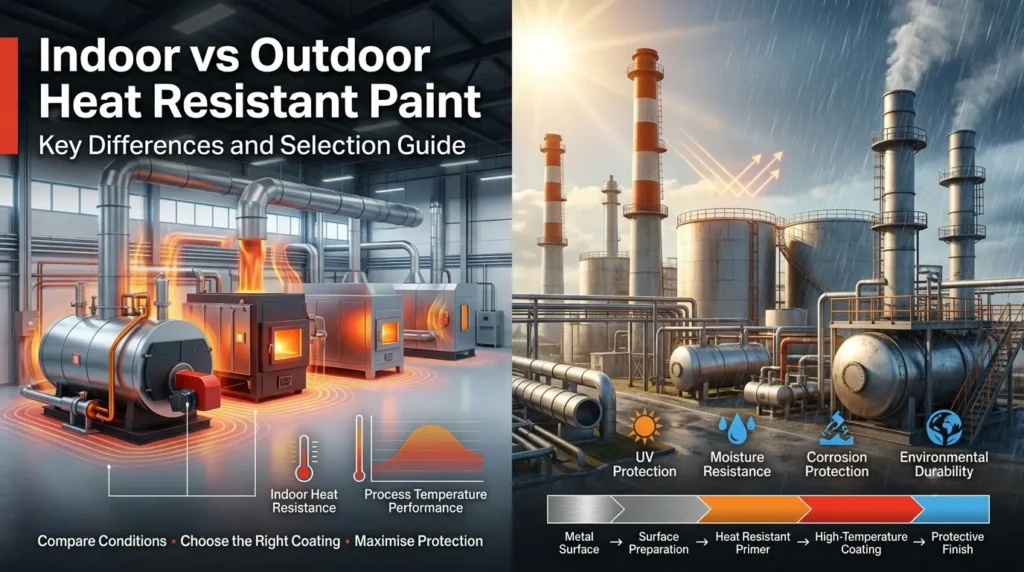
Heat resistant paint is designed to protect surfaces exposed to elevated temperatures, but the environment in which the coating is used can significantly affect its performance and service life. Indoor and outdoor applications may experience similar heat conditions, yet they face different exposure risks. Indoor equipment is often affected by process heat, smoke, fumes, chemicals, and limited ventilation, while outdoor structures must also withstand sunlight, UV radiation, rain, humidity, pollution, and changing weather conditions.
Choosing the right heat resistant paint requires more than checking the maximum temperature rating. The coating must also be compatible with the installation environment, surface material, operating conditions, and expected level of corrosion or weather exposure. A paint suitable for a protected indoor furnace may not provide adequate long-term protection on an outdoor chimney, exhaust stack, pipeline, or industrial structure.
For indoor applications, heat resistance, adhesion, thermal cycling performance, and resistance to industrial fumes are often the primary considerations. Outdoor applications generally require additional protection against UV degradation, moisture penetration, corrosion, weathering, and repeated temperature changes.
Understanding these differences helps industries select a coating system that provides reliable performance, reduces maintenance requirements, and extends the service life of high-temperature equipment. This guide explains the key differences between indoor and outdoor heat resistant paint, the environmental factors that influence coating selection, and how to choose the most suitable solution for long-term heat and surface protection.
Understanding Indoor and Outdoor Heat Exposure
Heat exposure can vary significantly depending on whether equipment or structures are located indoors or outdoors. Although both environments may involve high operating temperatures, the surrounding conditions affect how heat resistant paint performs over time. Indoor surfaces are generally exposed to more controlled conditions, while outdoor surfaces must withstand heat along with sunlight, moisture, weather changes, and environmental pollutants.
Understanding the type of heat exposure helps in selecting a coating that provides suitable thermal stability, surface protection, and long-term durability.
Controlled Indoor Heat Conditions
Indoor equipment is often exposed to controlled or predictable heat generated by industrial processes, machinery, boilers, furnaces, ovens, heaters, and exhaust systems. The operating temperature may remain relatively stable, allowing the coating to perform under consistent conditions.
However, indoor environments may still expose surfaces to smoke, hot vapours, chemical fumes, dust, condensation, and limited airflow. Therefore, indoor heat resistant paint should be selected based on the operating temperature, heat cycle, ventilation conditions, and possible exposure to industrial contaminants.
Changing Outdoor Temperature Conditions
Outdoor equipment is exposed to both process heat and changing environmental temperatures. During the day, surfaces may experience direct sunlight and high ambient temperatures, while cooler conditions at night can cause repeated expansion and contraction.
Rain, humidity, UV radiation, wind, dust, and seasonal weather changes can further affect coating performance. Outdoor heat resistant paint must therefore provide reliable thermal resistance along with strong weather, moisture, UV, and corrosion protection.
Why Location Affects Coating Performance
The location of the equipment directly influences the stresses placed on the coating. An indoor coating may mainly need to resist process heat and industrial exposure, whereas an outdoor coating must protect against multiple factors at the same time.
Using a coating that does not match the installation environment can result in premature fading, cracking, corrosion, loss of adhesion, or reduced service life. Selecting heat resistant paint according to the actual exposure conditions helps maintain coating integrity, improve durability, and reduce long-term maintenance requirements.
Indoor Heat Resistant Paint Requirements
Indoor heat resistant paint must be selected according to the operating temperature, type of industrial process, ventilation conditions, and exposure to smoke, fumes, vapours, or airborne contaminants. Unlike outdoor coatings, indoor heat resistant coatings may not require strong UV or weather resistance, but they must maintain thermal stability and adhesion under continuous or repeated heat exposure.
The right coating helps protect industrial equipment, reduce surface deterioration, and maintain reliable performance in enclosed or controlled environments.
Resistance to Continuous Process Heat
Many indoor industrial systems operate at elevated temperatures for long periods. Boilers, furnaces, ovens, heaters, exhaust ducts, and processing equipment may expose coated surfaces to continuous heat or frequent heating and cooling cycles.
The selected heat resistant paint should be rated for the equipment’s maximum operating temperature and capable of maintaining its protective properties during long-term thermal exposure. A coating with suitable thermal stability helps reduce cracking, peeling, discoloration, and premature coating failure.
Protection from Smoke, Fumes, and Vapours
Indoor industrial environments may contain smoke, hot gases, chemical fumes, oil vapours, and process emissions. These contaminants can settle on coated surfaces and gradually affect coating appearance, adhesion, or durability.
For such applications, the heat resistant coating should be compatible with the expected industrial exposure. Where chemical fumes or aggressive vapours are present, additional chemical or corrosion protection may be required as part of the overall coating system.
Performance in Enclosed Industrial Areas
Enclosed industrial areas may have limited airflow, higher ambient temperatures, and increased concentrations of heat and airborne contaminants. These conditions can influence coating drying, curing, and long-term performance.
The coating system should be suitable for the available ventilation and operating conditions. Proper ventilation during application and curing is also important for achieving consistent film formation and maintaining a safe working environment.
Low-Weather-Exposure Coating Needs
Indoor surfaces are generally protected from direct sunlight, rain, wind, and major seasonal weather changes. As a result, UV resistance and weather protection may be less critical than thermal stability, adhesion, and resistance to industrial exposure.
However, indoor equipment may still be affected by humidity, condensation, water leakage, or corrosive process conditions. The coating should therefore be selected according to the actual indoor environment rather than assuming that all indoor applications have low corrosion or moisture risks.
Outdoor Heat Resistant Paint Requirements
Outdoor heat resistant paint must protect surfaces from more than high operating temperatures. Industrial equipment and structures installed outdoors are exposed to direct sunlight, UV radiation, rain, humidity, dust, pollution, and seasonal temperature changes. These combined conditions can accelerate coating deterioration if the selected paint is not designed for outdoor service.
A suitable outdoor heat resistant coating should provide strong thermal stability along with weather resistance, moisture protection, corrosion resistance, and long-term adhesion. Selecting the coating according to the actual exposure conditions helps improve durability and reduce maintenance requirements.
Combined Heat and UV Exposure
Outdoor equipment may be exposed to both process heat and continuous sunlight. UV radiation can gradually affect certain coating binders and pigments, causing colour fading, chalking, loss of gloss, or surface deterioration.
For outdoor applications, the coating should be suitable for the expected temperature range and provide adequate UV and weather resistance. This is especially important for chimneys, exhaust stacks, pipelines, boilers, storage vessels, and exposed industrial structures.
Protection from Rain and Humidity
Rain, humidity, condensation, and moisture can increase the risk of corrosion and coating damage, particularly on steel and metal surfaces. Water may enter through cracks, pinholes, or damaged areas and cause corrosion beneath the coating.
Outdoor heat resistant paint should provide reliable moisture resistance and maintain strong adhesion under changing humidity conditions. In corrosive environments, a compatible primer and complete protective coating system may be required to improve long-term protection.
Resistance to Weathering and Pollution
Outdoor surfaces are exposed to dust, industrial pollution, airborne chemicals, salt, and other contaminants. Over time, these factors can reduce coating performance and contribute to surface degradation.
A durable outdoor coating should resist weathering, pollution, and environmental aging while maintaining its protective properties. In highly polluted or corrosive industrial areas, the coating system should be selected according to the specific exposure conditions.
Performance During Seasonal Changes
Outdoor surfaces experience repeated temperature changes throughout the day and across different seasons. Heating during the day and cooling at night can cause the substrate and coating to expand and contract.
The heat resistant coating should maintain flexibility and adhesion during these temperature cycles. A coating system designed for thermal movement and outdoor exposure helps reduce the risk of cracking, peeling, and premature coating failure, supporting reliable long-term performance.
Indoor vs Outdoor Coating Comparison
Indoor and outdoor heat resistant coatings are designed to withstand elevated temperatures, but their performance requirements differ because of the environments in which they operate. Indoor coatings mainly focus on thermal stability, adhesion, and resistance to process-related exposure. Outdoor coatings must manage these same demands while also providing protection against UV radiation, moisture, weathering, pollution, and changing temperatures.
Understanding these differences helps in selecting a coating system that matches the actual service environment and provides reliable long-term protection.
Thermal Resistance Requirements
Both indoor and outdoor heat resistant paints must be selected according to the maximum operating temperature of the equipment or surface. The coating should remain stable during continuous heat exposure and repeated heating and cooling cycles.
Indoor applications may experience more controlled process temperatures, while outdoor equipment can be affected by both operating heat and changes in ambient temperature. Outdoor coatings may therefore require greater resistance to thermal movement and temperature fluctuations.
UV Stability and Colour Retention
UV resistance is generally more important for outdoor heat resistant coatings. Continuous exposure to sunlight can cause fading, chalking, loss of gloss, or changes in surface appearance over time.
Indoor surfaces are usually protected from direct sunlight, so UV stability may not be a primary requirement. However, indoor coatings may still require colour stability when exposed to high operating temperatures or industrial conditions.
Moisture and Corrosion Protection
Outdoor surfaces are exposed to rain, humidity, condensation, and environmental moisture, which can increase the risk of corrosion. Outdoor heat resistant coating systems may require a compatible anti-corrosive primer and a durable topcoat to provide long-term protection.
Indoor applications may have lower exposure to weather-related moisture, but condensation, steam, water leaks, and process chemicals can still create corrosion risks. The coating should therefore be selected based on actual moisture and corrosion conditions rather than location alone.
Resistance to Environmental Aging
Environmental aging refers to the gradual deterioration of a coating caused by long-term exposure to heat, sunlight, moisture, pollution, temperature changes, and other environmental factors.
Outdoor heat resistant paints generally require stronger resistance to weathering and environmental aging because they are exposed to multiple conditions simultaneously. Indoor coatings may experience slower weather-related deterioration but can still be affected by continuous heat, industrial fumes, dust, and chemical exposure.
Selecting a coating with suitable environmental resistance helps maintain adhesion, appearance, and protective performance throughout its expected service life.
How Climate Affects Outdoor Heat Resistant Paint
Climate plays an important role in the long-term performance of outdoor heat resistant paint. Although the coating may be selected primarily based on its temperature rating, local environmental conditions can affect its adhesion, colour stability, corrosion resistance, and service life. High temperatures, humidity, rainfall, coastal exposure, and repeated temperature changes can place additional stress on the coating system.
Selecting an outdoor heat resistant paint according to the local climate helps improve durability, reduce maintenance requirements, and provide more reliable protection for industrial equipment and exposed structures.
Hot and Dry Regions
In hot and dry regions, outdoor surfaces may experience intense sunlight, high ambient temperatures, and prolonged UV exposure. Metal equipment can become significantly hotter due to direct solar radiation, adding to the heat generated during normal operation.
The coating should provide suitable thermal stability and resistance to UV-related deterioration. Good colour retention and resistance to chalking or surface degradation can help maintain the coating’s appearance and protective performance over time.
High-Humidity and Coastal Areas
High-humidity and coastal environments can increase the risk of moisture-related coating damage and corrosion. In coastal areas, airborne salt particles may settle on exposed surfaces and accelerate corrosion, particularly on steel structures, pipelines, chimneys, and industrial equipment.
A heat resistant coating system for these conditions should include appropriate moisture and corrosion protection. Proper surface preparation and a compatible anti-corrosive primer may be necessary to improve long-term coating performance.
Heavy Rainfall Locations
Areas with frequent or heavy rainfall expose outdoor coatings to continuous moisture, water runoff, and repeated wet-and-dry cycles. Water can enter through cracks, pinholes, damaged edges, or poorly protected areas, potentially leading to corrosion beneath the coating.
The selected coating system should maintain strong adhesion and moisture resistance during prolonged weather exposure. Effective drainage and timely repair of damaged coating areas can also help reduce water-related deterioration.
Areas with Extreme Temperature Changes
Regions with significant day-to-night or seasonal temperature variations can cause repeated expansion and contraction of the substrate and coating. Over time, this thermal movement may contribute to cracking, loss of adhesion, or coating fatigue.
Heat resistant paint used in these conditions should maintain suitable flexibility and adhesion throughout repeated temperature cycles. Selecting a coating designed for both high-temperature performance and thermal movement helps improve durability and reduce the risk of premature coating failure.
Selecting Paint Based on Exposure Conditions
Selecting heat resistant paint requires more than checking the maximum temperature rating. The coating must also be matched to the way heat is generated, the presence of moisture, the level of environmental exposure, and the risk of corrosion. A coating that performs well in a dry, protected indoor environment may not provide sufficient protection for outdoor equipment exposed to rain, humidity, chemicals, or corrosive pollutants.
Evaluating the actual service conditions helps ensure better coating performance, longer service life, and lower maintenance requirements.
Continuous Heat vs Intermittent Heat
Continuous heat exposure occurs when equipment operates at elevated temperatures for long periods, such as industrial furnaces, boilers, ovens, and process units. These applications require a coating with stable long-term thermal resistance and the ability to maintain adhesion during extended heat exposure.
Intermittent heat occurs when equipment repeatedly heats up and cools down. Exhaust systems, batch-processing equipment, and periodically operated machinery may experience frequent thermal cycles. In these conditions, the coating should tolerate repeated expansion and contraction without cracking, peeling, or losing adhesion.
Dry Heat vs Moist Heat
Dry heat environments mainly expose the coating to high temperatures with limited moisture. In these applications, thermal stability, oxidation resistance, and long-term heat performance are often the main selection criteria.
Moist heat environments may involve steam, condensation, high humidity, hot vapours, or water exposure. Moisture can increase the risk of corrosion and reduce coating adhesion if the coating system is not suitable. These applications may require enhanced moisture resistance, corrosion protection, and a compatible primer.
Protected vs Open Exposure
Protected equipment is installed indoors, under shelters, or in partially enclosed areas where direct exposure to sunlight, rain, and severe weather is limited. The coating selection may focus mainly on temperature resistance and process-related conditions.
Open exposure applies to equipment installed in fully exposed outdoor locations. Chimneys, exhaust stacks, pipelines, tanks, and industrial structures may face direct sunlight, UV radiation, rain, wind, dust, and pollution. These applications require a coating system that combines heat resistance with weather, UV, moisture, and corrosion protection.
Low-Corrosion vs Highly Corrosive Environments
Low-corrosion environments have limited exposure to moisture, chemicals, salt, or corrosive gases. A suitable heat resistant topcoat may provide adequate protection when applied to a properly prepared surface.
Highly corrosive environments may include chemical plants, refineries, coastal facilities, marine locations, and areas exposed to aggressive industrial emissions. These conditions often require a complete coating system with suitable surface preparation, a compatible anti-corrosive primer, and a heat resistant topcoat designed for the expected service environment.
Selecting the coating according to the corrosion level helps reduce under-film rusting, coating breakdown, and premature maintenance requirements.
When One Coating Cannot Meet All Requirements
In demanding industrial environments, a single heat resistant coating may not provide complete protection against every exposure condition. High operating temperatures, UV radiation, moisture, corrosion, chemicals, and weathering can place different demands on the coating system. A paint formulated primarily for high-temperature resistance may not automatically provide the same level of protection against outdoor weather or severe corrosion.
In such situations, a carefully designed multi-layer coating system may be required. Combining compatible primer, intermediate, and topcoat layers helps provide balanced protection and improves long-term coating performance.
Heat Resistance and Weather Resistance
Heat resistance and weather resistance are different coating properties. A coating may withstand high operating temperatures but have limited resistance to prolonged UV exposure, rainfall, humidity, or outdoor weathering.
For outdoor high-temperature equipment, the coating system should be evaluated for both thermal performance and environmental durability. The selected system should maintain adhesion and protective properties when exposed to heat, sunlight, moisture, and changing weather conditions.
Heat Protection and Corrosion Protection
Heat resistant paint helps protect surfaces from elevated temperatures, but it may not always provide sufficient corrosion resistance in highly humid, coastal, chemical, or industrial environments.
Steel equipment exposed to moisture, salt, corrosive gases, or chemicals may require additional anti-corrosive protection. A compatible primer can provide a protective barrier against corrosion, while the heat resistant topcoat delivers the required thermal performance.
The Need for a Multi-Layer Coating System
A multi-layer coating system is designed to provide different protective functions through separate coating layers. Depending on the application, the system may include:
- Heat resistant primer: Improves adhesion and provides initial corrosion protection.
- Intermediate coat: Adds barrier protection and helps achieve the required coating thickness.
- Heat resistant topcoat: Provides resistance to high temperatures and external exposure.
Each layer must be compatible with the others and suitable for the expected operating temperature. A properly designed system can provide stronger overall protection than relying on a single coating for multiple demanding conditions.
Evaluating Complete System Compatibility
All components of the coating system should be evaluated together rather than selected independently. The primer, intermediate coat, and topcoat must be chemically compatible and capable of performing under the same operating conditions.
Important factors include temperature limits, adhesion between layers, recommended film thickness, curing requirements, and resistance to moisture, chemicals, and weather exposure. Following the coating manufacturer’s system recommendations helps prevent problems such as intercoat adhesion failure, cracking, blistering, or premature coating breakdown.
A complete and compatible coating system provides more reliable long-term protection for equipment operating in complex indoor and outdoor environments.
Common Selection Errors
Choosing the wrong heat resistant paint can lead to premature coating failure, increased maintenance costs, and reduced protection of industrial equipment. Many selection errors occur when the coating is evaluated only by its temperature rating while other important conditions—such as UV exposure, moisture, weathering, and corrosion—are overlooked.
A successful coating selection should consider the complete operating environment, not only the maximum service temperature.
Choosing Only by Temperature Rating
The temperature rating is an important selection factor, but it does not provide a complete picture of coating performance. Two coatings may have similar heat resistance while offering different levels of protection against moisture, chemicals, UV radiation, or corrosion.
Before selecting a coating, evaluate the operating temperature, heat exposure pattern, substrate type, environmental conditions, and expected service life. The coating should be suitable for the complete application environment.
Ignoring UV and Weather Exposure
Outdoor equipment is exposed to direct sunlight, UV radiation, rain, humidity, wind, dust, and changing weather conditions. A coating designed mainly for high-temperature performance may not provide sufficient resistance to long-term outdoor exposure.
Ignoring UV and weather resistance can result in colour fading, chalking, surface degradation, cracking, or reduced coating durability. Outdoor applications should use a coating system designed for both heat resistance and environmental protection.
Using Indoor Coatings on Outdoor Equipment
Indoor heat resistant coatings are often selected for controlled environments where direct exposure to sunlight and rain is limited. Using the same coating on fully exposed outdoor equipment may lead to premature deterioration if the product is not designed for weather and UV exposure.
Before applying an indoor coating outdoors, verify its suitability through the manufacturer’s technical data sheet. Outdoor equipment may require a more durable coating system with additional UV, moisture, and corrosion protection.
Overlooking Moisture and Corrosion Risks
Moisture, condensation, humidity, salt exposure, and corrosive industrial gases can damage metal surfaces beneath the coating. If corrosion risks are not considered during coating selection, rust may develop under the paint and eventually cause blistering, peeling, or adhesion failure.
For humid, coastal, chemical, or highly corrosive environments, a complete protective system may be required. This can include proper surface preparation, a compatible anti-corrosive primer, and a heat resistant topcoat suitable for the operating temperature and exposure conditions.
Performance Expectations in Different Environments
The long-term performance of heat resistant paint depends on the environment in which it is used. Indoor coatings are generally exposed to more controlled conditions, while outdoor coatings must withstand additional stresses such as UV radiation, rain, humidity, pollution, and seasonal temperature changes. Understanding these differences helps set realistic expectations for coating durability and supports better maintenance planning.
Indoor Coating Service Life
Indoor heat resistant coatings may achieve a longer service life when applied in controlled environments with limited exposure to sunlight, rain, and severe weather. Their performance mainly depends on operating temperature, thermal cycling, ventilation, chemical exposure, and the condition of the coated surface.
Coatings used on indoor boilers, furnaces, ovens, exhaust ducts, and process equipment can remain effective for many years when the correct product is selected and the equipment operates within the coating’s specified temperature range. Regular inspection is still important because smoke, fumes, condensation, and industrial contaminants may gradually affect coating performance.
Outdoor Coating Service Life
Outdoor heat resistant coatings are exposed to multiple environmental conditions in addition to operating heat. Direct sunlight, UV radiation, rainfall, humidity, dust, pollution, and repeated temperature changes can increase the rate of coating aging.
The service life of an outdoor coating may vary depending on climate, corrosion exposure, coating quality, and the level of maintenance. A properly selected outdoor coating system with suitable UV, weather, moisture, and corrosion resistance can provide reliable long-term protection, but it may require more frequent inspection and maintenance than an equivalent indoor application.
Factors That Reduce Long-Term Performance
Several factors can reduce the durability and protective performance of heat resistant paint, including:
- Operating temperatures above the coating’s specified limit
- Frequent or severe thermal cycling
- Continuous UV exposure
- High humidity, rain, or condensation
- Salt, chemicals, and corrosive industrial pollutants
- Poor surface preparation or incorrect coating thickness
- Inadequate drying or curing
- Mechanical damage, abrasion, or impact
- Delayed repair of cracks, chips, or damaged areas
Identifying and controlling these factors can help extend coating life and reduce the risk of premature failure.
Evaluating Coating Condition Over Time
The condition of heat resistant paint should be evaluated through regular visual inspections and performance checks. Look for early signs of deterioration such as fading, chalking, cracking, blistering, peeling, rust formation, loss of adhesion, or changes in surface appearance.
Inspection frequency should be based on operating temperature, environmental exposure, and the importance of the equipment. Any damaged areas should be repaired promptly to prevent moisture, corrosion, or heat-related deterioration from spreading beneath the coating.
Regular evaluation helps determine whether the coating requires cleaning, localized touch-up, partial repair, or complete recoating. A proactive inspection program supports reliable equipment protection, reduces unexpected maintenance costs, and improves the long-term performance of the heat resistant coating system.
Practical Selection Guide
Selecting the right heat resistant paint requires a clear understanding of where the equipment is installed and the conditions it will face during operation. Indoor, outdoor, and semi-outdoor environments create different demands on the coating. The best choice should consider operating temperature, exposure to sunlight and moisture, corrosion risk, ventilation, and the expected service life.
A practical selection approach helps avoid using an unsuitable coating and supports long-term heat protection with lower maintenance requirements.
Best Choice for Indoor Equipment
Indoor equipment is generally protected from direct sunlight, rain, and severe weather. For boilers, furnaces, ovens, heaters, exhaust ducts, and process equipment, the primary selection factors are:
- Maximum continuous and peak operating temperature
- Frequency of heating and cooling cycles
- Exposure to smoke, fumes, vapours, or process chemicals
- Indoor humidity and condensation levels
- Surface material and existing coating condition
Choose a heat resistant coating that is rated for the actual operating temperature and compatible with the substrate. Where chemical fumes, steam, or corrosive conditions are present, additional protective properties or a compatible coating system may be required.
Best Choice for Outdoor Equipment
Outdoor equipment must withstand operating heat as well as direct sunlight, UV radiation, rain, humidity, pollution, and changing weather conditions. Chimneys, exhaust stacks, pipelines, tanks, and exposed industrial structures often require a more comprehensive protective system.
The selected coating should provide:
- Suitable high-temperature resistance
- UV and weather resistance
- Strong moisture protection
- Resistance to corrosion and environmental pollutants
- Good adhesion during thermal expansion and contraction
For severe outdoor or corrosive environments, a compatible anti-corrosive primer and heat resistant topcoat may provide better long-term protection than a single coating layer.
Best Choice for Semi-Outdoor Areas
Semi-outdoor areas include covered sheds, open-sided industrial buildings, partially enclosed process areas, and equipment installed under canopies. These locations may be protected from direct rainfall but can still experience humidity, wind-driven moisture, dust, temperature changes, and indirect sunlight.
The coating should be selected according to the actual exposure level rather than simply being classified as indoor or outdoor. Consider whether the surface receives direct sunlight, is exposed to condensation, or may be affected by rain during strong winds. A heat resistant coating with moderate weather and moisture resistance may be suitable, while more exposed equipment may require a complete outdoor-grade system.
Questions to Ask Before Selecting a Coating
Before choosing a heat resistant paint, evaluate the following questions:
- What is the maximum operating temperature of the equipment?
- Is the heat continuous, intermittent, or subject to frequent thermal cycling?
- Is the equipment installed indoors, outdoors, or in a semi-outdoor area?
- Will the surface be exposed to direct sunlight or UV radiation?
- Is there exposure to rain, humidity, condensation, or salt?
- Are chemicals, smoke, fumes, or corrosive gases present?
- What is the substrate—steel, other metal, concrete, or another material?
- Is corrosion protection required in addition to heat resistance?
- Is a primer or multi-layer coating system recommended?
- What service life and maintenance interval are expected?
Answering these questions before product selection helps ensure that the coating is matched to the actual operating environment and provides reliable, long-term protection.
Frequently Asked Questions
Can Indoor Heat Resistant Paint Be Used Outdoors?
Indoor heat resistant paint can be used outdoors only if the product is specifically designed and approved for outdoor exposure. A coating may provide excellent high-temperature resistance but may not offer adequate protection against UV radiation, rain, humidity, weathering, or environmental pollutants.
Before using an indoor coating outdoors, check the product’s Technical Data Sheet (TDS) for its UV resistance, weather resistance, moisture protection, and recommended application conditions. For fully exposed equipment, an outdoor-grade heat resistant coating system is generally the more suitable choice.
Does Outdoor Heat Resistant Paint Always Need UV Resistance?
UV resistance is strongly recommended when outdoor equipment is exposed to direct sunlight. Continuous UV exposure can cause some coatings to fade, chalk, lose gloss, or gradually deteriorate.
However, the level of UV protection required depends on the location and exposure conditions. Equipment installed under a permanent shelter may have lower UV exposure, while chimneys, exhaust stacks, pipelines, tanks, and open industrial structures may require higher UV and weather resistance.
Which Coating Is Better for Humid Environments?
For humid environments, the best choice is a heat resistant coating system that provides suitable moisture resistance, strong adhesion, and corrosion protection. High humidity, condensation, and moisture can increase the risk of rust formation and coating failure, especially on steel surfaces.
In highly humid, coastal, or corrosive industrial environments, a compatible anti-corrosive primer combined with a suitable heat resistant topcoat may provide better long-term protection. The coating should be selected based on both the operating temperature and the expected moisture exposure.
How Do I Select Paint for Semi-Open Industrial Areas?
Semi-open industrial areas may experience a combination of indoor and outdoor conditions. Equipment can be protected from direct rainfall but still exposed to humidity, wind-driven moisture, dust, indirect sunlight, and changing temperatures.
When selecting heat resistant paint for these areas, evaluate:
- Maximum operating temperature
- Direct or indirect UV exposure
- Humidity and condensation risk
- Exposure to rain during strong winds
- Industrial fumes, dust, and pollutants
- Corrosion risk and expected service life
If the equipment receives regular outdoor exposure, selecting an outdoor-grade heat resistant coating is generally a safer option. Always verify product suitability through the manufacturer’s Technical Data Sheet (TDS) and application recommendations.
Conclusion – Selecting Heat Resistant Paint by Environment
Selecting the right heat resistant paint requires a complete understanding of the operating environment. Temperature resistance is essential, but it should not be the only factor considered. Indoor, outdoor, and semi-open applications can expose coated surfaces to different combinations of heat, UV radiation, moisture, humidity, weathering, pollution, and corrosion.
A well-selected coating system helps maintain surface protection, improve equipment reliability, reduce maintenance requirements, and extend the service life of high-temperature assets. The most effective solution is one that matches the coating’s properties with the actual exposure conditions.
Matching Coating Properties to Exposure
The coating should be selected according to the equipment’s maximum operating temperature, heat cycle, surface material, and installation environment. Indoor equipment may primarily require thermal stability and resistance to process-related fumes, while outdoor equipment may also need UV, weather, moisture, and corrosion protection.
Semi-open areas should be evaluated based on their actual exposure rather than being treated only as indoor or outdoor locations. Understanding these conditions helps prevent incorrect product selection and premature coating failure.
Balancing Heat, Weather, and Corrosion Protection
High-temperature protection alone may not be sufficient for equipment exposed to rain, humidity, sunlight, salt, chemicals, or industrial pollutants. In demanding environments, a complete coating system may be required to provide balanced protection.
A compatible primer can improve adhesion and corrosion resistance, while the heat resistant topcoat provides the required thermal performance. Where necessary, additional coating layers can improve barrier protection and overall durability.
Improving Long-Term Coating Performance
Long-term performance depends on selecting the correct coating system and ensuring that it is suitable for the complete service environment. The coating should operate within its specified temperature range and provide the required resistance to environmental exposure.
Regular inspections can help identify early signs of fading, cracking, corrosion, peeling, or loss of adhesion. Timely repairs and appropriate maintenance help prevent localized damage from developing into larger coating failures.
By matching heat resistant paint to the actual indoor, outdoor, or semi-outdoor environment, industries can achieve dependable thermal protection, improved surface durability, and a longer coating service life.