

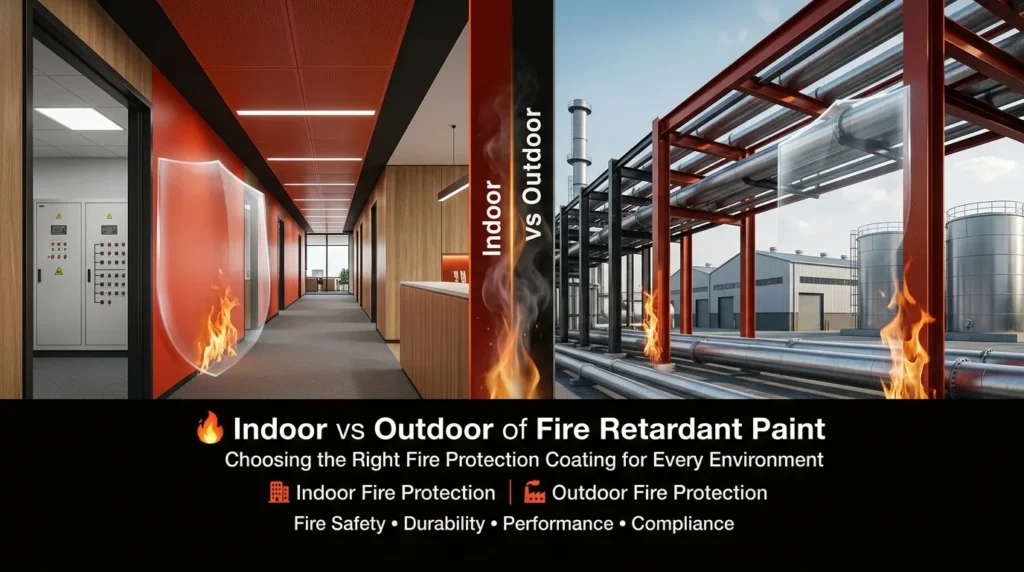
Fire safety requirements vary significantly depending on where a coating is applied. A fire retardant paint that performs well inside a climate-controlled building may not provide the same level of durability when exposed to rain, humidity, UV radiation, and temperature fluctuations outdoors. This is why selecting the right fire retardant paint for the intended environment is critical to achieving long-term fire protection and coating performance.
Fire retardant paint is widely used on structural steel, wood, walls, ceilings, fire doors, and industrial equipment to slow flame spread and reduce heat transfer during a fire. However, indoor and outdoor applications often require different coating systems, primers, and protective topcoats to ensure both fire resistance and environmental durability.
Indoor applications typically focus on protecting occupied spaces such as offices, hotels, hospitals, schools, and commercial buildings. In these environments, fire retardant paint helps improve occupant safety, supports fire compartmentation, and protects structural and decorative surfaces without affecting aesthetics.
Outdoor applications face additional challenges. Exposure to moisture, sunlight, pollution, and changing weather conditions can affect coating performance over time. As a result, exterior fire retardant paint systems are usually designed with enhanced weather resistance and protective topcoats to maintain both fire protection and durability.
Choosing the correct fire retardant paint depends on several factors, including:
- Surface type and substrate compatibility
- Indoor or outdoor exposure conditions
- Required fire resistance rating
- Moisture and humidity levels
- UV and weather exposure
- Maintenance requirements
- Building code and fire safety compliance
Common indoor applications include:
- Interior walls and ceilings
- Fire doors and wooden surfaces
- Structural steel in commercial buildings
- Electrical rooms and utility areas
- Decorative architectural finishes
Common outdoor applications include:
- Structural steel frameworks
- Warehouses and industrial facilities
- Exterior staircases and escape structures
- Utility infrastructure
- Oil & gas and power plant facilities
Understanding the differences between indoor and outdoor fire retardant paint helps architects, contractors, facility managers, and property owners select the most effective fire protection solution for their specific environment.
In this guide, we will explore the key differences between indoor and outdoor fire retardant paint, where each type is used, their benefits, performance requirements, and how to choose the right fire protection coating for long-term safety and durability.
Introduction to Indoor and Outdoor Fire Retardant Paint
Fire retardant paint plays a vital role in modern fire protection systems by helping to slow the spread of flames and reduce heat transfer during a fire. It is widely used on structural steel, wood, walls, ceilings, and industrial equipment to improve fire resistance and enhance overall building safety.
However, not all fire retardant paints are designed for the same environment. Indoor and outdoor applications face different conditions that can significantly affect coating performance, durability, and maintenance requirements. Understanding these differences is essential when selecting a fire protection system that will provide long-term safety and reliable performance.
Whether used in commercial buildings, industrial facilities, warehouses, or public infrastructure, choosing the right fire retardant paint ensures that the coating can withstand its environment while delivering effective fire protection when needed.
What is Fire Retardant Paint?
Fire retardant paint is a specialized coating designed to reduce the speed at which fire spreads across a surface. Unlike conventional paints, it contains fire-resistant additives and technologies that react to heat and help protect the substrate beneath.
When exposed to high temperatures, fire retardant paint may:
- Slow flame spread across the surface
- Reduce heat transfer to the substrate
- Delay ignition of combustible materials
- Improve fire resistance performance
- Help maintain structural integrity for longer
Many advanced fire retardant paints use intumescent technology, which expands when exposed to heat and forms an insulating char layer. This protective barrier helps shield the underlying material from direct flames and extreme temperatures.
Fire retardant paint is commonly applied to:
- Structural steel
- Fire doors
- Wood and timber surfaces
- Interior walls and ceilings
- Electrical panels and cable trays
- Industrial support structures
Its ability to provide passive fire protection makes it a valuable component of modern fire safety systems.
Why Environment Matters in Fire Protection
The environment in which fire retardant paint is applied has a major impact on its long-term performance and effectiveness.
Indoor environments are generally protected from harsh weather conditions and typically experience:
- Stable temperatures
- Lower moisture exposure
- Minimal UV radiation
- Controlled humidity levels
- Reduced environmental wear
Outdoor environments are far more demanding and may expose coatings to:
- Rain and moisture
- High humidity
- UV radiation from sunlight
- Temperature fluctuations
- Pollution and airborne contaminants
- Corrosive conditions
These environmental factors can affect:
- Coating adhesion
- Surface durability
- Appearance
- Fire protection performance
- Maintenance requirements
As a result, a coating system designed for indoor use may not provide adequate durability outdoors without additional protective layers. Selecting a system specifically engineered for the intended environment helps ensure long-term fire resistance and coating reliability.
Understanding Indoor vs Outdoor Fire Safety Requirements
Fire safety requirements differ between indoor and outdoor applications because the risks, exposure conditions, and performance expectations are not the same.
Indoor Fire Safety Requirements
Indoor fire retardant paint is commonly used to protect:
- Interior walls and ceilings
- Fire doors
- Structural steel within buildings
- Timber finishes and decorative wood
- Electrical rooms and service areas
Key objectives include:
- Slowing flame spread within occupied spaces
- Improving occupant safety
- Supporting fire compartmentation
- Maintaining aesthetic finishes
- Meeting interior fire safety regulations
Indoor coatings are typically selected based on fire performance, appearance, and compatibility with interior environments.
Outdoor Fire Safety Requirements
Outdoor fire retardant paint is commonly used on:
- Structural steel frameworks
- Industrial facilities
- Warehouses
- Exterior staircases
- Utility infrastructure
- Oil & gas installations
In addition to fire resistance, outdoor coatings must withstand:
- Weather exposure
- Moisture penetration
- UV degradation
- Corrosion risks
- Environmental wear
For this reason, exterior fire protection systems often include:
- Corrosion-resistant primers
- Fire retardant coating layers
- Weather-resistant protective topcoats
These additional components help preserve both the fire protection properties and the physical condition of the coating over time.
Understanding the differences between indoor and outdoor fire safety requirements allows project teams to select the most suitable fire retardant paint system, ensuring reliable protection, durability, and compliance throughout the service life of the structure.
How Fire Retardant Paint Works
Fire retardant paint is designed to improve the fire resistance of a surface by slowing flame spread, reducing heat transfer, and protecting the underlying material during a fire. Unlike conventional decorative paints, fire retardant coatings contain specialized ingredients that react when exposed to high temperatures, helping to delay fire growth and reduce structural damage.
These coatings form an important part of modern fire protection strategies because they provide continuous passive protection without requiring activation or human intervention. Whether applied indoors or outdoors, fire retardant paint helps enhance safety, protect assets, and improve the fire performance of buildings and industrial structures.
Fire Retardant Technology Explained
Fire retardant paint uses advanced chemical technologies that help reduce the combustibility of a surface when exposed to heat and flames.
Depending on the formulation, the coating may:
- Delay ignition of the substrate
- Reduce flame spread across the surface
- Lower heat transmission into the material
- Minimize fire growth during the early stages
- Improve the fire resistance rating of the structure
Many fire retardant paints incorporate intumescent technology, which reacts when exposed to high temperatures. Under normal conditions, the coating appears like conventional paint. However, during a fire, it undergoes a chemical transformation that helps protect the substrate beneath.
These coatings are commonly used on:
- Structural steel
- Wood and timber
- Fire doors
- Walls and ceilings
- Cable trays
- Industrial support structures
Their ability to react automatically during a fire makes them a highly effective passive fire protection solution.
Heat Resistance and Flame Spread Reduction
One of the primary functions of fire retardant paint is to reduce how quickly heat and flames spread across a surface.
When fire comes into contact with an unprotected material, heat rapidly penetrates the substrate, increasing the risk of ignition, structural weakening, and fire growth. Fire retardant paint helps slow this process by creating thermal resistance between the flames and the protected surface.
Key benefits include:
- Reduced flame propagation
- Slower heat transfer
- Delayed ignition of combustible materials
- Lower surface temperatures during fire exposure
- Improved fire containment within specific areas
This performance is especially important for:
- Timber wall panels
- Wooden ceilings
- Structural steel frameworks
- Electrical service areas
- Interior architectural finishes
By slowing the movement of heat and flames, the coating helps reduce fire damage and improve overall building safety.
Protective Barrier Formation During Fire
A defining feature of many fire retardant paints is their ability to create a protective barrier when exposed to extreme heat.
In intumescent systems, the coating expands dramatically as temperatures rise. This expansion produces a thick, carbon-rich char layer that acts as an insulating shield between the fire and the substrate.
The process typically involves:
- Exposure to high temperatures
- Activation of fire-reactive ingredients
- Expansion of the coating layer
- Formation of an insulating char barrier
- Reduction of heat transfer to the protected surface
The resulting char layer helps:
- Shield surfaces from direct flame contact
- Maintain lower substrate temperatures
- Delay structural weakening
- Extend fire resistance performance
- Reduce the likelihood of early failure
This protective barrier is particularly effective on structural steel, where preventing rapid temperature rise is critical for maintaining load-bearing capacity during a fire.
Role in Passive Fire Protection Systems
Fire retardant paint is classified as a passive fire protection system, meaning it provides protection automatically without requiring activation by occupants or emergency responders.
Passive fire protection systems are built directly into the structure and are designed to limit fire growth, protect critical building components, and improve evacuation safety.
Common passive fire protection measures include:
- Fire retardant paint
- Intumescent coatings
- Fire-rated walls
- Fire doors
- Firestopping systems
- Compartmentation barriers
These systems work alongside active fire protection systems, such as:
- Fire alarms
- Smoke detectors
- Sprinkler systems
- Fire extinguishers
- Suppression systems
The key advantage of passive fire protection is that it is always in place and ready to perform when a fire occurs.
Fire retardant paint contributes by:
- Slowing flame spread
- Protecting structural elements
- Delaying fire damage
- Supporting safe evacuation
- Providing additional response time for firefighters
- Helping maintain building stability during emergencies
When integrated into a comprehensive fire safety strategy, fire retardant paint plays a critical role in protecting people, property, and infrastructure in both indoor and outdoor environments.
Indoor Fire Retardant Paint Applications
Indoor fire retardant paint is widely used to improve fire safety within occupied buildings and enclosed environments. These coatings help slow flame spread, reduce heat transfer, and protect critical building components during a fire. Because indoor spaces often contain large numbers of occupants and valuable assets, fire retardant paint plays an important role in supporting evacuation, reducing damage, and meeting fire safety regulations.
Modern indoor fire retardant coatings are designed to provide effective fire protection while maintaining the appearance of walls, ceilings, wood finishes, and structural elements. They are commonly used across commercial, institutional, and public buildings where passive fire protection is a key requirement.
Interior Walls and Ceilings
Walls and ceilings are among the most common surfaces protected with indoor fire retardant paint. These large exposed areas can contribute to rapid flame spread if left unprotected, particularly in high-occupancy buildings.
Common applications include:
- Gypsum board walls
- Interior partitions
- Concrete walls
- Decorative wall panels
- Suspended ceilings
- Acoustic ceiling systems
- Corridor walls and ceilings
Benefits of applying fire retardant paint to walls and ceilings include:
- Reduced flame spread across interior surfaces
- Improved fire compartmentation
- Lower heat transfer between spaces
- Enhanced protection of escape routes
- Better compliance with fire safety regulations
These coatings help slow fire progression and improve overall building resilience during emergencies.
Fire Doors and Wooden Surfaces
Wood is widely used in interior construction and decorative architecture, but it is also a combustible material. Fire retardant paint helps improve the fire performance of wooden surfaces while preserving their appearance.
Typical applications include:
- Fire-rated doors
- Wooden door frames
- Timber wall panels
- Decorative wood cladding
- Wooden ceilings
- Interior joinery
- Architectural wood features
Key advantages include:
- Delayed ignition of timber surfaces
- Reduced flame spread
- Improved fire resistance ratings
- Preservation of natural wood aesthetics
- Enhanced occupant safety
Many interior wood applications use clear or decorative fire retardant coatings that maintain the visible grain and finish of the timber.
Commercial Offices and Corporate Buildings
Modern office buildings often contain open-plan workspaces, meeting rooms, utility areas, and decorative architectural finishes. Fire retardant paint is commonly specified to improve fire safety while supporting contemporary design requirements.
Applications in office environments include:
- Structural steel elements
- Interior walls and ceilings
- Fire doors
- Decorative timber finishes
- Utility rooms
- Service shafts
- Electrical infrastructure areas
Benefits for office buildings include:
- Improved occupant protection
- Increased evacuation time
- Protection of structural components
- Reduced fire-related property damage
- Support for fire code compliance
These coatings are particularly valuable in high-rise offices and large corporate facilities where fire safety is a critical design consideration.
Hotels, Hospitals, and Educational Facilities
Buildings with high occupancy levels or vulnerable occupants require enhanced fire protection measures. Fire retardant paint is widely used in hospitality, healthcare, and educational environments to improve safety and reduce fire risk.
Common applications include:
- Guest room corridors
- Hospital wards
- Waiting areas
- Classrooms
- Auditoriums
- Libraries
- Reception and lobby areas
- Fire-rated doors and partitions
Benefits include:
- Improved life safety during emergencies
- Better protection of evacuation routes
- Reduced fire spread between compartments
- Enhanced protection of vulnerable occupants
- Compliance with strict fire safety standards
These facilities often rely on passive fire protection systems to provide continuous safety throughout the building.
Electrical Rooms and Service Areas
Electrical rooms and service areas contain equipment that can present potential fire hazards due to electrical faults, overheating, or system failures. Fire retardant paint helps reduce fire spread and protect surrounding infrastructure.
Common applications include:
- Electrical panel rooms
- Switchgear rooms
- Control rooms
- Utility shafts
- Service corridors
- Cable management areas
- Mechanical service spaces
Benefits include:
- Reduced flame spread around electrical systems
- Improved compartmentation of high-risk areas
- Protection of critical building services
- Enhanced operational safety
- Reduced damage to infrastructure during fire incidents
By protecting these essential areas, fire retardant paint helps maintain building functionality and supports safer emergency response procedures.
Indoor fire retardant paint applications continue to expand across commercial, institutional, and public buildings because they provide effective passive fire protection while preserving aesthetics, supporting compliance, and improving overall building safety.
Benefits of Using Fire Retardant Paint Indoors
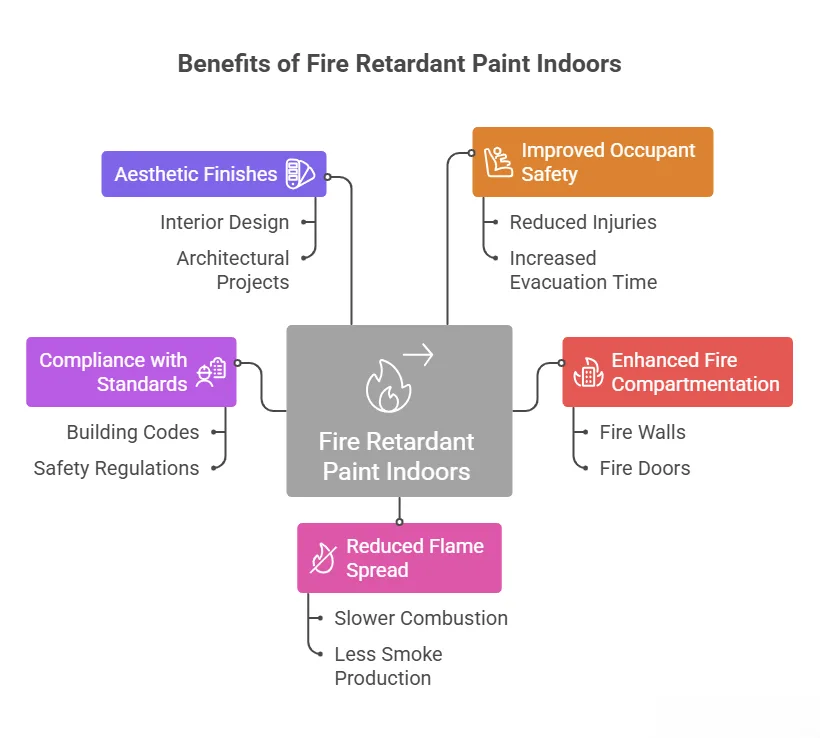
Indoor fire retardant paint provides much more than basic surface protection. It plays an important role in improving building safety, reducing fire-related risks, and helping structures meet modern fire protection requirements. From offices and hotels to hospitals, schools, and commercial facilities, indoor fire retardant coatings help create safer environments for occupants while protecting valuable property and infrastructure.
These coatings work continuously as part of a passive fire protection system, providing protection without requiring activation or human intervention. Their ability to combine fire performance with attractive finishes makes them a preferred solution for many interior applications.
Improved Occupant Safety
One of the most significant benefits of indoor fire retardant paint is its contribution to occupant safety during a fire emergency.
By slowing the spread of flames and reducing heat transfer, fire retardant coatings help create additional time for:
- Building evacuation
- Emergency response operations
- Fire suppression efforts
- Safe access to escape routes
This added time can be critical in high-occupancy buildings such as:
- Office complexes
- Shopping centers
- Hotels
- Hospitals
- Schools
- Public buildings
The coating helps reduce the speed at which fire develops, allowing occupants to move to safety before conditions become dangerous.
Key safety advantages include:
- Slower fire growth
- Reduced exposure to extreme heat
- Improved evacuation opportunities
- Better protection of occupied areas
- Enhanced emergency response conditions
Enhanced Fire Compartmentation
Fire compartmentation is a fundamental principle of building fire safety. It involves dividing a building into separate fire-resistant sections that help contain fire and prevent rapid spread.
Fire retardant paint supports compartmentation by helping protect:
- Walls and partitions
- Fire doors
- Structural steel
- Ceilings
- Service areas
- Escape corridors
Benefits include:
- Improved containment of fire within specific zones
- Reduced fire spread between rooms
- Better protection of evacuation routes
- Increased effectiveness of fire-rated assemblies
- Enhanced overall building resilience
When combined with fire doors and fire-rated construction systems, fire retardant paint helps strengthen the building’s passive fire protection strategy.
Reduced Flame Spread in Interior Spaces
Interior surfaces can significantly influence how quickly a fire spreads through a building. Fire retardant paint helps slow the movement of flames across walls, ceilings, wood surfaces, and other architectural elements.
This performance helps:
- Delay ignition of adjacent materials
- Reduce fire growth rates
- Limit heat release
- Improve fire containment
- Reduce overall fire damage
Common surfaces that benefit from fire retardant coatings include:
- Interior walls
- Ceiling systems
- Wooden paneling
- Decorative timber finishes
- Fire doors
- Architectural wood features
By reducing flame spread, these coatings help protect occupants and give emergency responders valuable additional time during a fire incident.
Compliance with Interior Fire Safety Standards
Many commercial and public buildings must comply with fire safety regulations that specify fire resistance and flame spread requirements for interior materials.
Fire retardant paint can help support compliance with:
- Building fire codes
- Fire resistance requirements
- Interior finish regulations
- Occupancy-specific fire safety standards
- Insurance and risk management requirements
Properly tested and certified fire retardant coating systems may assist project teams in meeting requirements established by organizations such as:
- ASTM International
- British Standards Institution
- Bureau of Indian Standards
Using certified fire retardant paint systems provides greater confidence in performance and helps simplify inspection and approval processes.
Aesthetic Finishes for Architectural Applications
Modern fire retardant paints are designed to provide effective fire protection without compromising architectural appearance. This makes them particularly valuable for projects where both safety and aesthetics are important.
Available finish options may include:
- Smooth decorative finishes
- Matte coatings
- Satin finishes
- Gloss finishes
- Clear fire retardant coatings
- Architectural topcoat systems
These coatings are commonly used on:
- Decorative wall panels
- Timber cladding
- Wooden ceilings
- Interior joinery
- Feature walls
- Reception areas
- Hospitality interiors
Benefits include:
- Preservation of architectural design intent
- Protection without altering visual appearance
- Compatibility with modern interior finishes
- Enhanced durability and surface protection
- Improved fire safety while maintaining aesthetics
This combination of fire protection and design flexibility makes indoor fire retardant paint a preferred choice for architects, designers, contractors, and building owners seeking safer and visually appealing interior spaces.
Outdoor Fire Retardant Paint Applications
Outdoor environments present unique fire protection challenges due to constant exposure to weather, moisture, UV radiation, temperature fluctuations, and industrial contaminants. Fire retardant paint used outdoors must not only provide effective fire resistance but also maintain its performance under harsh environmental conditions.
To achieve long-term durability, outdoor fire protection systems often include corrosion-resistant primers, fire retardant coatings, and weather-resistant topcoats. These systems help protect critical structures, industrial assets, and infrastructure from both fire and environmental degradation.
Outdoor fire retardant paint is commonly used in industrial facilities, commercial buildings, utility infrastructure, and high-risk environments where structural integrity and fire safety are essential.
Structural Steel Frameworks
Structural steel is one of the most common outdoor applications for fire retardant paint. Although steel is non-combustible, it can rapidly lose strength when exposed to high temperatures during a fire.
Common applications include:
- Steel columns and beams
- Building frameworks
- Roof support structures
- Exterior steel canopies
- Industrial platforms
- Steel bridges and support systems
Benefits of fire retardant paint on structural steel include:
- Delayed temperature rise in steel members
- Improved fire resistance ratings
- Reduced risk of structural collapse
- Extended evacuation and emergency response time
- Protection of critical load-bearing elements
Outdoor steel structures typically require weather-resistant coating systems to maintain fire protection performance throughout their service life.
Warehouses and Industrial Buildings
Warehouses and industrial facilities often contain large open spaces, valuable equipment, stored materials, and complex structural systems that require reliable fire protection.
Outdoor fire retardant coatings are commonly applied to:
- Structural steel frameworks
- Roof trusses
- Loading bay structures
- Exterior support columns
- Storage facility infrastructure
- Utility buildings
Key benefits include:
- Reduced fire spread across industrial structures
- Protection of critical structural components
- Improved facility safety
- Reduced repair and replacement costs
- Enhanced business continuity after fire incidents
These coatings help industrial buildings maintain structural integrity during fire exposure while resisting harsh environmental conditions.
Exterior Staircases and Escape Structures
Exterior escape routes are critical life-safety components that must remain functional during emergencies. Fire retardant paint helps protect these structures and supports safe evacuation procedures.
Common applications include:
- Emergency stair towers
- Fire escape staircases
- Exterior walkways
- Escape bridges
- Access platforms
- Structural supports for evacuation routes
Benefits include:
- Improved fire resistance of escape structures
- Protection against heat exposure during nearby fires
- Increased occupant safety during evacuation
- Long-term durability in outdoor environments
- Compliance with fire safety requirements
Because these structures are continuously exposed to weather, coating systems must provide both fire protection and environmental resistance.
Utility Infrastructure and Equipment Supports
Utility infrastructure often supports essential services such as power distribution, telecommunications, water systems, and industrial operations. Protecting these assets from fire helps maintain operational continuity and public safety.
Fire retardant paint is commonly used on:
- Utility support structures
- Cable support frames
- Electrical equipment supports
- Communication towers
- Service platforms
- Pipe rack structures
Advantages include:
- Reduced fire damage to critical infrastructure
- Protection of support systems during emergencies
- Improved operational reliability
- Enhanced asset protection
- Lower maintenance and replacement costs
These coatings are particularly important where infrastructure supports essential public or industrial services.
Oil & Gas and Power Plant Facilities
Oil & gas facilities and power generation sites are among the most demanding environments for fire protection systems. These locations often contain flammable materials, high-temperature processes, and critical operational infrastructure.
Outdoor fire retardant coatings are widely used on:
- Structural steel frameworks
- Pipe racks
- Equipment platforms
- Storage tank supports
- Processing units
- Turbine structures
- Utility support systems
- Access stairways and walkways
Benefits include:
- Enhanced protection against fire exposure
- Delayed structural failure during emergencies
- Improved safety for personnel and operations
- Protection of high-value industrial assets
- Support for regulatory compliance and risk management
In these environments, fire retardant coating systems are frequently combined with anti-corrosion protection to withstand aggressive industrial conditions while maintaining long-term fire resistance.
Outdoor fire retardant paint remains an essential solution for protecting exposed structures and infrastructure. By combining fire resistance with environmental durability, these coatings help safeguard industrial facilities, commercial properties, and critical infrastructure against both fire hazards and outdoor exposure conditions.
Benefits of Using Fire Retardant Paint Outdoors
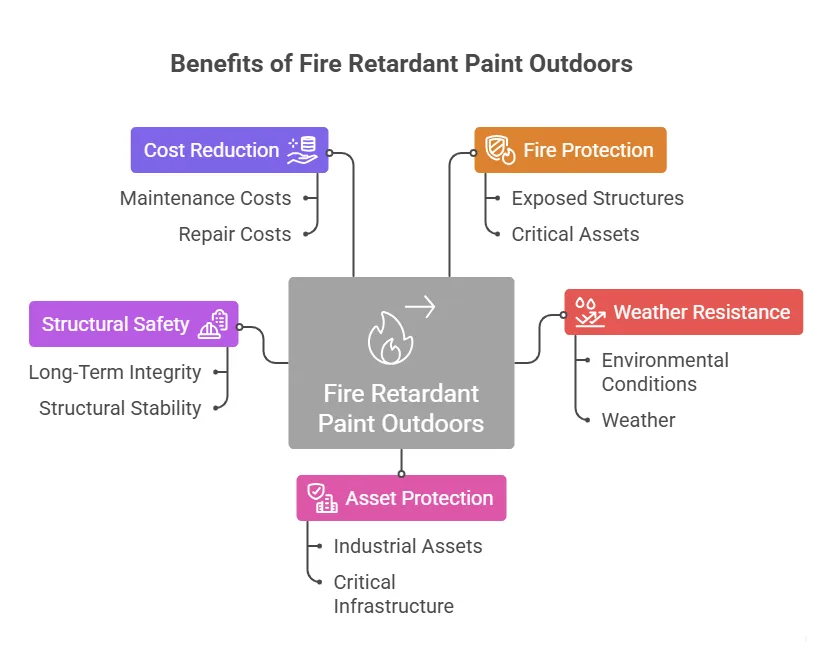
Outdoor structures face constant exposure to environmental conditions that can affect both their durability and fire safety performance. Fire retardant paint provides an effective solution by combining fire protection with long-term resistance to weather, moisture, and industrial exposure. These coatings help safeguard critical structures, infrastructure, and equipment while supporting compliance with fire safety requirements.
Whether used on structural steel, industrial facilities, utility infrastructure, or high-risk environments, outdoor fire retardant paint plays an important role in reducing fire-related risks and extending the service life of valuable assets.
Fire Protection for Exposed Structures
Outdoor structures are often vulnerable to fire hazards originating from electrical faults, industrial processes, combustible materials, vegetation fires, or nearby incidents. Fire retardant paint helps improve the fire resistance of these exposed surfaces and delays the effects of heat and flame.
Common protected structures include:
- Structural steel frameworks
- Exterior staircases
- Roof support systems
- Industrial platforms
- Pipe racks
- Utility support structures
- Equipment access walkways
Key benefits include:
- Reduced flame spread across exposed surfaces
- Delayed heat transfer to structural components
- Improved fire resistance ratings
- Enhanced protection of load-bearing structures
- Additional time for emergency response and evacuation
By slowing the impact of fire, these coatings help maintain structural integrity during critical emergency situations.
Resistance to Weather and Environmental Conditions
Unlike indoor coatings, outdoor fire retardant paint must withstand a wide range of environmental challenges while maintaining its fire protection performance.
Common environmental factors include:
- Rain and moisture
- High humidity
- UV radiation
- Temperature fluctuations
- Airborne pollutants
- Corrosive industrial atmospheres
High-quality exterior fire retardant coating systems are designed to resist:
- Moisture penetration
- UV degradation
- Surface cracking
- Premature coating failure
- Weather-related deterioration
These systems often include:
- Corrosion-resistant primers
- Fire retardant intermediate coatings
- Weather-resistant protective topcoats
This combination helps ensure long-term durability in demanding outdoor environments.
Protection of Critical Industrial Assets
Industrial facilities rely on valuable infrastructure and equipment that must remain operational and protected from fire-related damage.
Fire retardant paint is commonly used to protect:
- Production facilities
- Storage tanks
- Pipe support structures
- Equipment platforms
- Utility infrastructure
- Power distribution systems
- Material handling structures
Benefits include:
- Reduced risk of fire-related equipment damage
- Protection of operational assets
- Improved facility resilience
- Lower downtime after fire incidents
- Enhanced business continuity planning
Protecting these assets helps organizations reduce financial losses and maintain operational stability.
Long-Term Structural Safety
One of the most important benefits of outdoor fire retardant paint is its contribution to long-term structural safety. Structural steel and support systems can lose strength rapidly when exposed to extreme heat, increasing the risk of collapse during a fire.
Fire retardant coatings help:
- Delay temperature rise in structural members
- Maintain load-bearing capacity longer
- Reduce structural deformation
- Improve fire resistance performance
- Support safer evacuation and emergency operations
Applications include:
- Warehouses
- Industrial plants
- Commercial buildings
- Utility facilities
- Transportation infrastructure
- Oil & gas installations
By helping structures remain stable during fire exposure, these coatings contribute significantly to overall building and infrastructure safety.
Reduced Maintenance and Repair Costs
Investing in outdoor fire retardant paint can also provide substantial long-term economic benefits. Properly specified coating systems help reduce damage caused by both fire exposure and environmental deterioration.
Long-term advantages include:
- Lower maintenance requirements
- Reduced repair expenses
- Extended coating service life
- Improved protection against corrosion
- Reduced replacement costs for structural components
- Better lifecycle value for infrastructure assets
Routine inspections and preventative maintenance can further extend the lifespan of the coating system, ensuring continued fire protection and environmental resistance for many years.
By combining fire resistance, weather durability, and asset protection, outdoor fire retardant paint provides a cost-effective solution for safeguarding exposed structures and critical infrastructure while supporting long-term safety and operational reliability.
Key Differences Between Indoor and Outdoor Fire Retardant Paint
While both indoor and outdoor fire retardant paints are designed to improve fire resistance and reduce flame spread, they are formulated to perform under very different environmental conditions. Selecting the wrong coating system can lead to premature coating failure, reduced fire protection performance, and increased maintenance costs.
Understanding the differences between indoor and outdoor fire retardant paint helps architects, contractors, facility managers, and property owners choose the most effective solution for long-term fire safety and durability.
Environmental Exposure Conditions
The most significant difference between indoor and outdoor fire retardant paint is the environment in which the coating operates.
Indoor Applications
Indoor coatings are typically used in controlled environments where exposure to harsh weather conditions is minimal.
Common indoor conditions include:
- Stable temperatures
- Controlled humidity
- Minimal moisture exposure
- No direct sunlight
- Lower levels of contamination
Typical indoor applications include:
- Offices
- Hotels
- Hospitals
- Schools
- Shopping malls
- Residential buildings
Outdoor Applications
Outdoor coatings must withstand much harsher conditions throughout their service life.
Common outdoor exposures include:
- Rain and water penetration
- High humidity
- UV radiation
- Wind and dust
- Industrial pollution
- Temperature fluctuations
Typical outdoor applications include:
- Structural steel frameworks
- Industrial facilities
- Warehouses
- Utility infrastructure
- Oil & gas facilities
- Power plants
Because of these conditions, outdoor fire retardant paint systems require additional environmental protection measures.
Moisture and Humidity Resistance
Moisture resistance is a critical factor when selecting a fire retardant paint system.
Indoor Fire Retardant Paint
Indoor coatings generally experience:
- Lower moisture levels
- Limited water exposure
- Controlled indoor humidity
As a result, they can focus primarily on fire performance and aesthetics without requiring extensive moisture protection.
Outdoor Fire Retardant Paint
Outdoor coatings must resist:
- Rainwater
- Condensation
- High humidity
- Coastal moisture exposure
- Wet industrial environments
Without proper moisture resistance, coatings may experience:
- Blistering
- Peeling
- Delamination
- Reduced adhesion
- Premature failure
For this reason, exterior systems often include moisture-resistant primers and protective topcoats to maintain coating integrity.
UV Stability and Weather Durability
Sunlight exposure is another major difference between indoor and outdoor fire retardant paint.
Indoor Systems
Indoor coatings are rarely exposed to significant UV radiation and therefore do not require high levels of UV protection.
This allows manufacturers to focus on:
- Decorative appearance
- Smooth finishes
- Interior durability
- Fire performance
Outdoor Systems
Outdoor coatings must withstand continuous exposure to:
- UV radiation
- Sunlight
- Heat cycles
- Weathering
UV exposure can cause:
- Fading
- Chalk formation
- Surface degradation
- Reduced coating lifespan
To address these challenges, exterior fire retardant paint systems often include UV-resistant topcoats that help preserve both appearance and fire protection performance.
Coating System Requirements
The coating system used indoors is often simpler than the system required outdoors.
Typical Indoor System
Indoor fire protection systems may include:
- Surface preparation
- Primer (if required)
- Fire retardant paint
Because environmental exposure is limited, additional protective layers may not always be necessary.
Typical Outdoor System
Outdoor systems are generally more complex and may include:
- Surface preparation
- Anti-corrosion primer
- Fire retardant coating
- Weather-resistant topcoat
This multi-layer system helps provide:
- Fire resistance
- Corrosion protection
- UV resistance
- Moisture protection
- Long-term durability
Outdoor structures often require greater attention to coating thickness, environmental resistance, and maintenance planning.
Maintenance Expectations
Maintenance requirements also differ significantly between indoor and outdoor fire retardant paint systems.
Indoor Coatings
Indoor coatings generally benefit from:
- Longer service life
- Reduced environmental wear
- Lower maintenance frequency
- Easier inspection access
Typical maintenance activities include:
- Periodic visual inspections
- Repair of impact damage
- Touch-up of worn areas
- Verification of coating condition
Outdoor Coatings
Outdoor coatings experience greater environmental stress and usually require more frequent inspections.
Maintenance may include:
- Regular condition assessments
- Topcoat repairs
- Corrosion monitoring
- Moisture damage inspections
- Recoating when necessary
Factors that can affect outdoor coating lifespan include:
- Climate conditions
- UV exposure
- Industrial pollution
- Coastal environments
- Mechanical damage
A well-maintained outdoor fire retardant coating system can continue providing effective fire protection for many years while preserving the structural integrity of exposed assets.
By understanding these key differences, project teams can select the appropriate fire retardant paint system for their specific environment, ensuring reliable fire protection, long-term durability, regulatory compliance, and optimal lifecycle performance.
Choosing the Right Fire Retardant Paint for Your Project
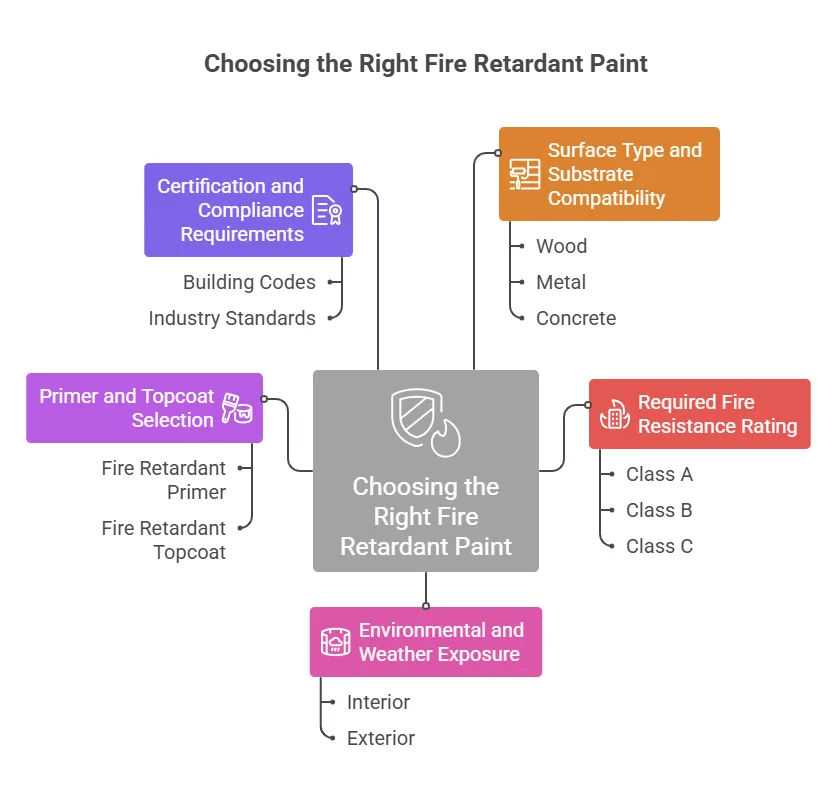
Selecting the right fire retardant paint is essential for achieving reliable fire protection, long-term durability, and compliance with fire safety requirements. Not all fire retardant coatings are suitable for every surface or environment. Factors such as substrate type, fire rating requirements, environmental exposure, and certification standards all play a role in determining the most effective coating system.
Whether the project involves structural steel, timber, commercial interiors, or industrial infrastructure, choosing the correct fire retardant paint helps ensure optimal performance throughout the service life of the structure.
Surface Type and Substrate Compatibility
The first step in selecting a fire retardant paint is identifying the material that requires protection. Different substrates react differently to heat and require specially formulated coating systems to achieve effective fire resistance.
Common substrates include:
- Structural steel
- Wood and timber
- Fire doors
- Concrete surfaces
- Gypsum board partitions
- Cable trays
- Utility structures
- Decorative architectural finishes
Important considerations include:
- Surface condition
- Porosity of the material
- Existing coatings or finishes
- Adhesion requirements
- Interior or exterior exposure
- Desired appearance
For example:
- Structural steel often requires anti-corrosion primers before fire retardant coating application.
- Timber surfaces may require clear or decorative fire-retardant finishes.
- Industrial infrastructure may require additional chemical and weather resistance.
Ensuring compatibility between the coating and substrate improves adhesion, durability, and long-term fire performance.
Required Fire Resistance Rating
Fire retardant coatings are designed to achieve specific fire resistance ratings based on building regulations and project requirements.
Common fire ratings include:
- 30 minutes
- 60 minutes
- 90 minutes
- 120 minutes
- Higher ratings for specialized applications
The required fire resistance rating depends on:
- Building occupancy type
- Structural design
- Fire risk assessment
- Local building regulations
- Insurance requirements
- Project specifications
Higher fire ratings typically require:
- Increased coating thickness
- Specialized intumescent systems
- Multi-layer coating applications
- Additional testing and certification
Selecting a coating with an appropriate tested fire rating ensures that the protected structure can maintain performance during fire exposure.
Environmental and Weather Exposure
The operating environment significantly affects coating performance and lifespan.
Indoor Environments
Indoor applications generally experience:
- Stable temperatures
- Lower humidity levels
- Minimal UV exposure
- Reduced weather-related wear
Typical indoor applications include:
- Offices
- Hotels
- Hospitals
- Schools
- Shopping centers
Outdoor Environments
Outdoor structures may be exposed to:
- Rain and moisture
- UV radiation
- Temperature fluctuations
- Industrial pollutants
- Coastal conditions
- Corrosive atmospheres
Common outdoor applications include:
- Structural steel frameworks
- Warehouses
- Industrial plants
- Utility infrastructure
- Oil & gas facilities
Choosing a coating system designed for the expected environmental conditions helps preserve both fire resistance and coating durability.
Primer and Topcoat Selection
A fire retardant coating system often consists of more than just the fire protection layer. Primers and topcoats play a critical role in protecting the coating and ensuring long-term performance.
Primers
Primers help:
- Improve adhesion
- Protect against corrosion
- Create a stable substrate
- Enhance coating system durability
Steel structures typically require corrosion-resistant primers before applying fire retardant coatings.
Topcoats
Topcoats may be required to provide:
- UV resistance
- Moisture protection
- Chemical resistance
- Improved aesthetics
- Easier maintenance
Outdoor fire protection systems commonly include:
- Surface preparation
- Protective primer
- Fire retardant coating
- Weather-resistant topcoat
Selecting compatible primers and topcoats helps maintain fire performance and extend coating lifespan.
Certification and Compliance Requirements
One of the most important factors when choosing fire retardant paint is verifying that the product has been properly tested and certified.
A quality fire retardant coating should be supported by:
- Fire test reports
- Technical data sheets
- Application guidelines
- Certification documentation
- Compliance records
Common fire testing and certification bodies include:
- ASTM International
- British Standards Institution
- Bureau of Indian Standards
- Underwriters Laboratories
Before specifying a coating, it is important to review:
- Approved fire resistance ratings
- Substrate-specific test results
- Environmental suitability
- Coating thickness requirements
- Maintenance recommendations
- Building code compliance documentation
Choosing a certified and tested fire retardant coating provides confidence that the system will deliver reliable fire protection while meeting regulatory and project requirements.
By carefully evaluating substrate compatibility, fire resistance needs, environmental exposure, coating system design, and certification requirements, project teams can select the most suitable fire retardant paint for safe, durable, and code-compliant fire protection.
Common Challenges in Indoor and Outdoor Applications
While fire retardant paint is an effective fire protection solution, its performance depends heavily on proper selection, application, and maintenance. Both indoor and outdoor environments present challenges that can affect coating durability, fire resistance, and long-term reliability.
Understanding these common issues helps building owners, contractors, and facility managers prevent premature coating failure and ensure continued fire protection throughout the life of the structure.
Moisture Damage and Coating Failure
Moisture is one of the most common causes of fire retardant coating deterioration, particularly in outdoor environments and high-humidity areas.
Sources of moisture exposure include:
- Rainwater
- Condensation
- High humidity
- Water leaks
- Washdown procedures
- Coastal environments
Excessive moisture can lead to:
- Blistering
- Peeling
- Delamination
- Loss of adhesion
- Surface cracking
- Reduced fire protection performance
Outdoor steel structures, utility facilities, and industrial plants are especially vulnerable if coatings are not properly sealed with weather-resistant topcoats.
Preventive measures include:
- Proper surface preparation
- Moisture-resistant primers
- Protective topcoat systems
- Routine inspections
- Prompt repair of damaged areas
Controlling moisture exposure helps maintain coating integrity and long-term fire resistance.
UV Degradation in Exterior Environments
Ultraviolet (UV) radiation from sunlight can gradually degrade exterior fire retardant coatings if they are not specifically designed for outdoor use.
Long-term UV exposure may cause:
- Color fading
- Surface chalking
- Reduced flexibility
- Cracking
- Premature weathering
- Decreased coating lifespan
Structures commonly affected include:
- Exterior steel frameworks
- Industrial buildings
- Storage facilities
- Utility infrastructure
- Outdoor stairways
To minimize UV-related damage, exterior fire protection systems often incorporate:
- UV-resistant topcoats
- Weatherproof finishing layers
- Regular maintenance inspections
Selecting a coating system rated for outdoor exposure is essential for preserving both appearance and fire protection performance.
Improper Surface Preparation
Even the highest-quality fire retardant paint can fail if applied to a poorly prepared surface.
Common preparation mistakes include:
- Dirt and dust contamination
- Oil or grease residue
- Rust on steel surfaces
- Loose existing coatings
- Moisture trapped beneath the coating
- Inadequate cleaning procedures
Poor preparation can result in:
- Weak adhesion
- Premature coating failure
- Uneven film formation
- Reduced fire resistance performance
- Increased maintenance requirements
Best practices typically include:
- Cleaning the substrate thoroughly
- Removing contaminants
- Repairing damaged surfaces
- Applying compatible primers
- Following manufacturer preparation guidelines
Proper preparation creates a stable foundation for long-term coating performance.
Incorrect Coating Thickness
Fire retardant coatings are designed to perform at specific dry film thickness (DFT) levels that have been tested and certified for particular fire ratings.
Applying too little coating may result in:
- Reduced fire resistance
- Failure to achieve required fire ratings
- Insufficient thermal insulation during fire exposure
Applying excessive thickness may lead to:
- Cracking
- Sagging
- Extended curing times
- Application defects
- Higher material costs
Factors affecting thickness requirements include:
- Surface type
- Fire resistance rating
- Environmental conditions
- Coating formulation
Quality control measures often include:
- Wet film thickness measurements
- Dry film thickness testing
- Inspection during application
- Verification against project specifications
Accurate thickness control is critical for achieving the intended fire protection performance.
Maintenance and Inspection Issues
Fire retardant coatings require periodic inspection to ensure they continue providing reliable protection over time.
Without regular maintenance, problems may go unnoticed until coating performance is compromised.
Common maintenance challenges include:
- Delayed inspections
- Unrepaired physical damage
- Corrosion beneath coatings
- Moisture intrusion
- Weather-related deterioration
- Mechanical impact damage
Areas that often require close monitoring include:
- Structural steel connections
- Exterior support structures
- Utility installations
- Fire doors
- High-traffic service areas
- Industrial equipment supports
A proactive maintenance program should include:
- Scheduled visual inspections
- Thickness verification when necessary
- Damage assessment
- Surface cleaning
- Repair of affected areas
- Recoating when required
Regular inspection and maintenance help extend coating lifespan, preserve fire resistance performance, and reduce long-term repair costs.
By understanding and addressing these common challenges, building owners and facility managers can maximize the effectiveness of fire retardant paint systems, ensuring dependable fire protection in both indoor and outdoor environments for years to come.
Fire Safety Standards for Indoor and Outdoor Fire Retardant Paint
Fire retardant paint must do more than simply claim fire resistance—it should be tested, certified, and applied in accordance with recognized fire safety standards. These standards help verify that a coating can perform as expected during fire exposure and provide the level of protection required for a specific application.
For both indoor and outdoor projects, compliance with recognized testing methods and building regulations is essential to ensure safety, regulatory approval, and long-term performance. Whether protecting structural steel, timber, walls, ceilings, or industrial infrastructure, selecting coatings that meet established standards helps provide confidence in fire protection performance.
ASTM Fire Testing Standards
ASTM International develops widely recognized fire testing standards used throughout the construction and industrial sectors.
ASTM standards help evaluate:
- Flame spread characteristics
- Fire resistance performance
- Heat transfer properties
- Surface burning behavior
- Structural fire protection effectiveness
Common ASTM fire tests used for fire retardant coatings include:
- Surface burning and flame spread evaluations
- Fire resistance testing of building elements
- Thermal performance assessments
- Material reaction-to-fire testing
These tests help determine how a coating performs under controlled fire conditions and whether it can meet specified fire resistance requirements.
Benefits of ASTM-compliant coatings include:
- Verified fire performance
- Greater project credibility
- Easier specification approval
- Enhanced safety assurance
- Support for regulatory compliance
Many architects, consultants, and project engineers rely on ASTM-tested systems when selecting fire protection coatings.
BS Fire Protection Requirements
The British Standards Institution publishes widely respected fire safety standards that are often referenced internationally.
BS fire protection requirements address:
- Fire resistance performance
- Building material testing
- Structural fire protection
- Fire compartmentation systems
- Passive fire protection measures
These standards are frequently used for:
- Commercial buildings
- Public infrastructure
- Educational facilities
- Healthcare buildings
- Industrial projects
BS-certified fire retardant coating systems are often selected because they provide documented evidence of performance under standardized fire testing conditions.
Key advantages include:
- Reliable fire resistance verification
- Support for international project specifications
- Improved quality assurance
- Consistent testing methodologies
- Enhanced building safety compliance
BS standards are particularly important for projects that require recognized international fire protection credentials.
IS Standards for Fire Protection Coatings
In India, fire protection products and systems may be evaluated according to standards developed by the Bureau of Indian Standards.
IS standards help establish requirements for:
- Fire resistance testing
- Building materials
- Structural safety
- Construction practices
- Fire protection systems
These standards support:
- Regulatory compliance
- Product quality verification
- Building safety requirements
- National construction guidelines
For projects within India, compliance with applicable IS standards can help ensure that fire retardant coatings meet local safety expectations and building code requirements.
Benefits of selecting coatings tested to relevant Indian standards include:
- Improved project approval processes
- Alignment with local regulations
- Enhanced safety assurance
- Greater confidence in product performance
- Support for government and commercial projects
Project teams should always review current applicable standards and fire testing requirements during specification and design stages.
Building Code Compliance and Certification
Building codes establish minimum fire safety requirements that must be met for different types of structures and occupancies. Fire retardant paint often forms part of a broader passive fire protection strategy designed to satisfy these requirements.
Building code considerations may include:
- Fire resistance ratings
- Structural fire protection
- Flame spread limitations
- Occupancy classifications
- Means of egress protection
- Fire compartmentation requirements
Common sectors requiring compliance include:
- Commercial buildings
- Industrial facilities
- Warehouses
- Hospitals
- Hotels
- Educational institutions
- Public buildings
When evaluating fire retardant paint, it is important to review:
- Fire test reports
- Product certifications
- Technical data sheets
- Approved application systems
- Required coating thicknesses
- Inspection and maintenance guidelines
Certified coating systems help provide:
- Verified fire performance
- Regulatory acceptance
- Improved project documentation
- Easier inspection approval
- Reduced compliance risks
Ultimately, adherence to ASTM, BS, IS, and relevant building code requirements helps ensure that indoor and outdoor fire retardant paint systems deliver reliable fire protection, support regulatory compliance, and contribute to safer buildings and industrial facilities.
Frequently Asked Questions About Indoor vs Outdoor Fire Retardant Paint
Choosing between indoor and outdoor fire retardant paint often raises questions about performance, durability, and application requirements. Below are answers to some of the most common questions asked by building owners, contractors, architects, and facility managers.
Can indoor fire retardant paint be used outdoors?
In most cases, indoor fire retardant paint should not be used outdoors unless the manufacturer specifically approves it for exterior exposure.
Indoor coatings are typically designed for controlled environments and may not withstand:
- Rain and moisture
- High humidity
- UV radiation
- Temperature fluctuations
- Environmental pollutants
If an indoor-only coating is used outside, it may experience:
- Peeling
- Cracking
- Blistering
- Loss of adhesion
- Reduced fire protection performance
For exterior applications, it is important to use a fire retardant coating system specifically designed and tested for outdoor conditions, often with a protective weather-resistant topcoat.
What makes outdoor fire retardant paint different?
Outdoor fire retardant paint is formulated to provide both fire protection and environmental durability.
Compared to indoor systems, exterior coatings are designed to resist:
- Moisture penetration
- UV degradation
- Corrosion
- Weathering
- Temperature extremes
- Industrial contaminants
Outdoor fire protection systems often include:
- Surface preparation
- Corrosion-resistant primer
- Fire retardant coating
- Weather-resistant topcoat
These additional layers help ensure the coating maintains its fire performance even after years of environmental exposure.
Common outdoor applications include:
- Structural steel frameworks
- Warehouses
- Industrial facilities
- Utility infrastructure
- Oil & gas installations
- Power plants
Does outdoor fire retardant paint require a topcoat?
In many cases, yes. Most outdoor fire retardant coating systems require a compatible protective topcoat.
A topcoat helps provide:
- UV resistance
- Moisture protection
- Improved durability
- Better appearance retention
- Enhanced resistance to dirt and pollutants
Without a suitable topcoat, the fire retardant layer may deteriorate more quickly when exposed to:
- Sunlight
- Rain
- Humidity
- Harsh industrial environments
The exact topcoat requirements depend on:
- The coating manufacturer
- Environmental exposure conditions
- Project specifications
- Required service life
Always follow the approved coating system recommended by the manufacturer.
How long does fire retardant paint last indoors and outdoors?
The lifespan of fire retardant paint varies depending on product quality, environmental conditions, maintenance practices, and application quality.
Indoor Applications
Indoor coatings generally last longer because they are protected from harsh environmental exposure.
Factors supporting longer service life include:
- Stable temperatures
- Limited moisture exposure
- Minimal UV exposure
- Reduced weather-related wear
Outdoor Applications
Outdoor coatings may experience greater stress from:
- Rain
- UV radiation
- Humidity
- Corrosion
- Pollution
- Temperature changes
As a result, exterior systems often require more frequent inspections and maintenance.
Factors affecting lifespan include:
- Surface preparation quality
- Coating thickness
- Environmental exposure
- Topcoat condition
- Maintenance frequency
Regular inspections and timely repairs can significantly extend the service life of both indoor and outdoor fire retardant coating systems.
Which fire retardant paint is best for steel structures?
The best fire retardant paint for steel structures is typically an intumescent fire protection coating that has been tested and certified for structural steel applications.
When exposed to high temperatures, intumescent coatings expand to form an insulating char layer that helps:
- Reduce heat transfer to steel
- Delay temperature rise
- Maintain load-bearing capacity
- Improve fire resistance ratings
- Extend structural stability during a fire
When selecting a coating for steel structures, consider:
- Required fire rating (30, 60, 90, or 120 minutes)
- Indoor or outdoor exposure
- Corrosion protection requirements
- Environmental conditions
- Certification and fire test documentation
- Compatibility with primers and topcoats
Common steel applications include:
- Structural columns
- Steel beams
- Roof trusses
- Industrial frameworks
- Warehouses
- Commercial buildings
- Utility infrastructure
A properly specified and certified intumescent coating system provides reliable fire protection while helping steel structures maintain their integrity during fire emergencies.
Conclusion – Selecting the Right Fire Retardant Paint for Indoor and Outdoor Protection
Fire retardant paint is an essential component of modern passive fire protection systems, helping to slow flame spread, reduce heat transfer, and protect critical building elements during a fire. However, achieving reliable long-term performance depends on selecting a coating system that is specifically designed for the environment in which it will be used.
Indoor and outdoor applications face different challenges, from moisture and UV exposure to structural requirements and maintenance demands. Understanding these differences allows project teams to choose the most effective fire protection solution while ensuring compliance, durability, and safety.
Whether protecting commercial interiors, structural steel frameworks, industrial facilities, or critical infrastructure, the right fire retardant paint system can significantly improve fire resilience and asset protection.
Importance of Environment-Specific Fire Protection
No single fire retardant coating is suitable for every application. Indoor and outdoor environments expose coatings to different conditions that directly affect performance and service life.
Indoor coatings are typically designed for:
- Controlled environments
- Lower moisture exposure
- Minimal UV radiation
- Enhanced aesthetic requirements
Outdoor coatings must withstand:
- Rain and humidity
- UV radiation
- Temperature fluctuations
- Corrosion risks
- Industrial pollutants
Selecting a coating system specifically engineered for the intended environment helps ensure that fire protection performance remains effective throughout the life of the structure.
Benefits of Proper Coating Selection
Choosing the correct fire retardant paint provides advantages that extend beyond basic fire resistance.
Key benefits include:
- Improved fire protection performance
- Reduced flame spread and heat transfer
- Enhanced structural stability during fire exposure
- Better compatibility with the protected substrate
- Increased coating durability
- Reduced risk of premature coating failure
- Improved compliance with fire safety regulations
- Lower long-term maintenance costs
A properly specified system ensures that both fire protection and environmental performance requirements are met.
Long-Term Safety and Durability Advantages
Fire retardant paint is a long-term investment in building and infrastructure safety. When applied correctly and maintained according to manufacturer recommendations, these coatings can provide years of reliable protection.
Long-term advantages include:
- Protection of structural steel and timber components
- Improved occupant safety and evacuation time
- Reduced fire-related property damage
- Extended service life of critical assets
- Lower repair and replacement costs
- Improved facility resilience
- Enhanced risk management and insurance confidence
Regular inspections and maintenance further help preserve coating integrity and ensure continued fire protection performance.
Final Recommendations for Buildings and Industrial Facilities
To achieve the best results from a fire retardant paint system, project teams should follow a structured selection and maintenance approach.
Recommended best practices include:
- Identify fire risks during project planning
- Select coatings compatible with the substrate
- Verify required fire resistance ratings
- Consider indoor or outdoor environmental exposure
- Use approved primers and topcoats where required
- Review fire test reports and certification documents
- Follow manufacturer application guidelines
- Conduct routine inspections and maintenance
For commercial buildings, industrial facilities, warehouses, utility infrastructure, and public spaces, the right fire retardant paint system provides an effective balance of fire protection, durability, and regulatory compliance.
By choosing environment-specific fire retardant coatings and maintaining them properly, building owners and facility managers can improve safety, protect valuable assets, and ensure long-term performance in both indoor and outdoor environments.