
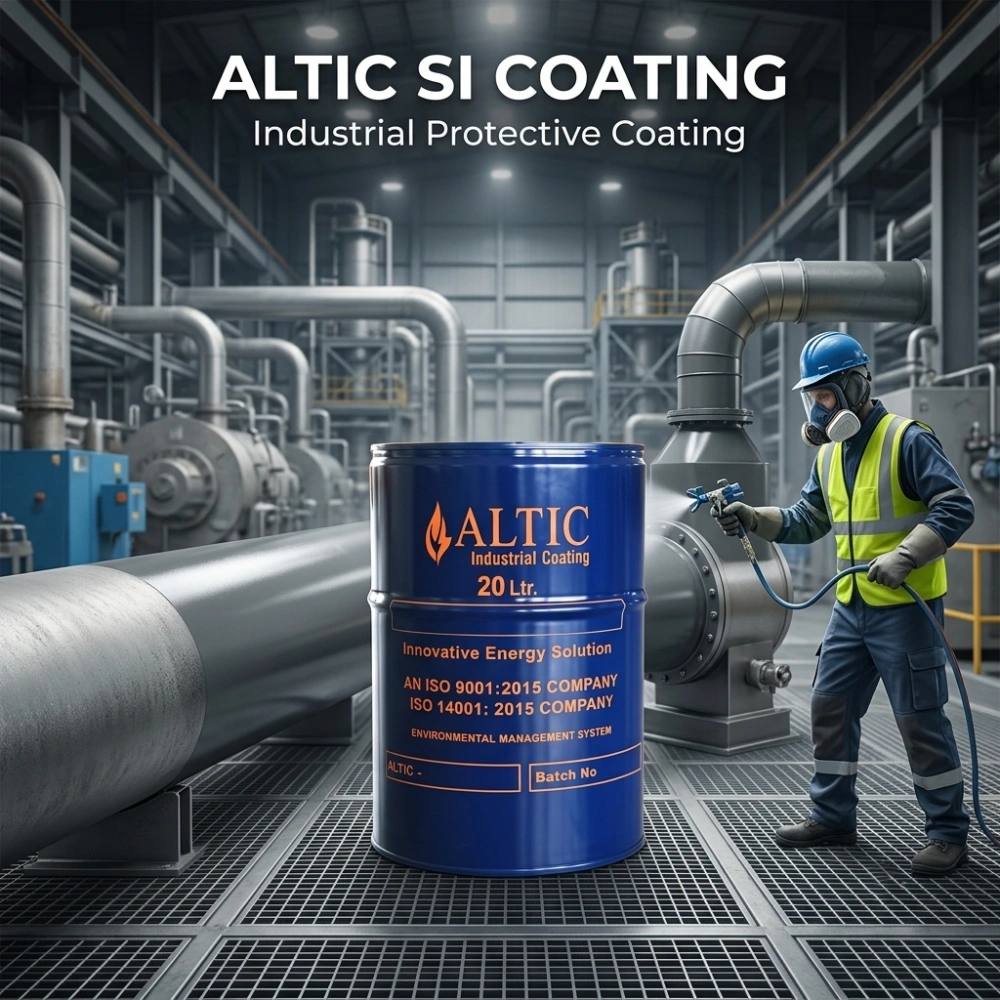
ALTIC SI COATING is a specialized thermal insulation and oxidation-protection coating system designed for suitable metal surfaces exposed to elevated temperatures. The system is formulated to help reduce heat transfer while providing protection against oxidation and environmental exposure.
The ALTIC SI system is a multi-layer coating solution consisting of:
- ALTIC SI PRIMER
- ALTIC SI BASECOAT
- ALTIC SI TOPCOAT
Each layer performs a specific function, creating an integrated system for thermal insulation, substrate protection and environmental durability.
ALTIC SI COATING can be considered for industrial applications such as hot pipelines, steam lines, ducts, process equipment, fire walls and other suitable metal surfaces.
Key Features & Benefits
- Thermal insulation coating system for industrial applications
- Designed to reduce heat transfer from hot metal surfaces
- Helps provide protection against surface oxidation
- Multi-layer system for enhanced coating performance
- Suitable for compatible carbon steel, stainless steel and alloy steel surfaces
- Water-based coating system
- Designed to control heat transfer through conduction, convection and radiation
- Suitable for selected online industrial coating applications
- Helps reduce the need for conventional fibrous insulation in suitable applications
- Designed for industrial thermal protection and maintenance
- Topcoat provides additional protection against weather and environmental exposure
- Suitable for new construction as well as maintenance applications
Three-Layer ALTIC SI System
ALTIC SI COATING works as a complete three-layer system.
1. ALTIC SI PRIMER
The primer forms the foundation of the system. It helps prepare the metal surface, seal suitable surface porosity and provide initial oxidation protection.
2. ALTIC SI BASECOAT
The basecoat is the primary thermal insulation layer. It is applied to the required thickness according to the operating temperature and desired temperature reduction.
3. ALTIC SI TOPCOAT
The topcoat provides the final protective layer and helps protect the thermal insulation coating from weather and environmental exposure.
System Structure
Metal Surface
↓
ALTIC SI PRIMER
↓
ALTIC SI BASECOAT
↓
ALTIC SI TOPCOAT
↓
Thermal Insulation + Oxidation Protection + Environmental Protection
Thermal Insulation Technology
ALTIC SI COATING is designed to help control heat transfer through the three primary heat-transfer mechanisms:
Conduction
The thermal insulation layer helps reduce the direct transfer of heat through the coated substrate.
Convection
The coating system can help reduce heat exchange between the hot surface and surrounding air.
Radiation
The system is designed to provide thermal-radiation control from hot industrial surfaces.
The actual thermal performance depends on the substrate temperature, coating thickness, equipment configuration, ambient conditions and application quality.
Typical Applications
ALTIC SI COATING may be considered for:
- Hot industrial pipelines
- Steam pipelines
- Process pipelines
- Industrial ducts
- Fire walls
- Process equipment
- Industrial vessels
- Carbon steel structures
- Stainless steel surfaces
- Low-alloy steel
- Industrial heating equipment
- Thermal insulation applications
- High-temperature industrial assets
The system should be selected according to the actual operating conditions and substrate requirements.
Surface Preparation
Proper surface preparation is essential for achieving long-term coating performance.
The substrate should be:
- Clean
- Dry
- Free from oil and grease
- Free from loose rust and scale
- Free from dirt and other contaminants
- Properly prepared for the selected primer
Existing loose or poorly adhered coatings should be removed.
For metal substrates, the required preparation standard should be selected according to the substrate condition and project specification.
Application Procedure
ALTIC SI COATING should be applied as a complete system according to the latest ALTIC technical instructions.
Step 1 – Surface Preparation
Clean and prepare the metal substrate according to the specified preparation procedure.
Step 2 – SI Primer
Apply the appropriate ALTIC SI Primer according to the operating-temperature requirement.
Allow the primer to cure for the specified period.
Step 3 – SI Basecoat
Apply ALTIC SI BASECOAT using the recommended application equipment.
Build the required thermal insulation thickness according to the desired temperature reduction.
Step 4 – SI Topcoat
After the basecoat has reached the required curing condition, apply ALTIC SI TOPCOAT to provide environmental and weather protection.
Step 5 – Final Curing
Allow the completed system to cure according to the specified application conditions before exposing it to the intended service conditions.
Online Application
A significant feature of the ALTIC SI system is its potential for online application on suitable operating equipment, which can reduce the need for complete shutdowns in certain industrial situations.
Online application must be evaluated according to:
- Actual surface temperature
- Equipment accessibility
- Application method
- Curing conditions
- Personnel safety
- Operating environment
The coating should only be applied online when the approved ALTIC procedure and site safety assessment permit it.
Operating Temperature
The ALTIC SI system is intended for elevated-temperature applications, but the complete system temperature limitation must be considered, rather than relying on the temperature resistance of an individual component.
The technical information for the ALTIC SI system indicates a maximum use temperature of approximately 250°C.
The SI Primer may have a higher temperature resistance than the complete system. Therefore, product selection should always be based on the complete coating-system specification and actual operating temperature.
For applications above the recommended system temperature, a different ALTIC high-temperature coating system may be required.
Coating Thickness
Thermal insulation coating thickness is determined according to the required thermal performance rather than by a single standard film thickness.
Factors affecting the required thickness include:
- Operating temperature
- Desired surface temperature
- Heat-transfer conditions
- Substrate material
- Equipment geometry
- Ambient temperature
- Environmental exposure
- Required energy/heat-loss reduction
For project-specific applications, the required thickness should be established using the applicable ALTIC technical guidance.
Suitable Substrates
ALTIC SI COATING may be considered for compatible:
- Carbon steel
- Stainless steel
- Low-alloy steel
- Industrial metal structures
- Metal pipelines
- Process equipment
The substrate must be compatible with the selected primer and complete SI coating system.
Maintenance & Inspection
Periodic inspection is recommended for coated industrial equipment, particularly where thermal cycling or outdoor exposure is present.
Inspect for:
- Cracking
- Peeling
- Delamination
- Mechanical damage
- Surface contamination
- Topcoat deterioration
- Exposed substrate
- Corrosion at damaged areas
Damaged sections should be repaired using the appropriate ALTIC SI system procedure.
Safety & Handling
Use appropriate PPE during surface preparation and coating application.
When working on operating hot equipment, follow all applicable industrial safety procedures and perform a site-specific risk assessment.
Ensure suitable ventilation and follow the latest Safety Data Sheet (SDS) for detailed handling, storage, first-aid and disposal information.
Storage
Store ALTIC SI coating components in their original sealed containers in a suitable cool and dry area. Protect the materials from contamination, extreme conditions and direct sunlight.
For exact storage conditions and shelf life, refer to the latest product-specific TDS/SDS.
Why Choose ALTIC SI COATING?
ALTIC SI COATING provides an integrated approach to industrial thermal protection by combining thermal insulation, oxidation protection and environmental protection within a multi-layer coating system.
Its three-stage design—SI Primer, SI Basecoat and SI Topcoat—allows the system to address the different requirements of the metal substrate, thermal insulation layer and external protective surface.
For optimum performance, select the system according to the actual operating temperature, substrate condition and required thermal reduction, and follow the recommended ALTIC application procedure.

Reviews
There are no reviews yet.