

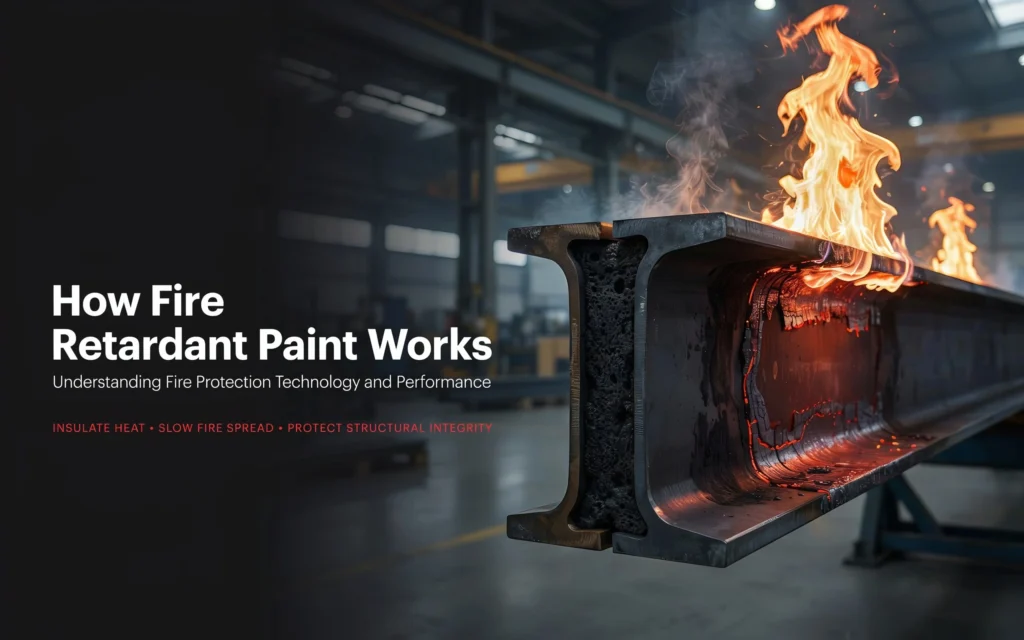
Fire safety is a critical consideration in modern construction, industrial facilities, and infrastructure projects. As buildings become larger and more complex, the need for effective passive fire protection systems continues to grow. One of the most widely used solutions for reducing fire risks is fire retardant paint, a specialized coating designed to slow flame spread and protect surfaces from the damaging effects of heat and fire.
Unlike conventional decorative paints, fire retardant paint is engineered to react when exposed to high temperatures. It helps delay the progression of fire, reduces heat transfer to the underlying material, and provides valuable additional time for evacuation and emergency response. These characteristics make fire retardant coatings an important component of comprehensive fire safety strategies in commercial, residential, and industrial environments.
Fire retardant paint is commonly used on:
- Structural steel frameworks
- Wooden doors and timber surfaces
- Interior walls and ceilings
- Electrical panels and cable trays
- Warehouses and industrial facilities
- Commercial buildings and public spaces
The effectiveness of these coatings lies in their advanced fire protection technology. When exposed to extreme heat, many fire retardant paints undergo a chemical reaction that creates an insulating barrier between the fire and the protected surface. This process helps maintain structural stability and slows the spread of flames throughout a building.
Key functions of fire retardant paint include:
- Slowing flame spread across surfaces
- Reducing heat transfer to structural components
- Delaying ignition of combustible materials
- Improving fire resistance performance
- Supporting building code compliance
- Enhancing occupant safety during emergencies
Modern fire retardant paints often use intumescent technology, which causes the coating to expand when exposed to heat. This expansion forms a thick protective char layer that acts as thermal insulation and shields the substrate from direct fire exposure.
The demand for fire retardant paint continues to increase across industries because it offers several advantages:
- Effective passive fire protection
- Minimal impact on architectural aesthetics
- Compatibility with various substrates
- Long-term durability
- Reduced fire-related damage
- Improved regulatory compliance
Whether protecting structural steel in a high-rise building, timber finishes in a commercial space, or critical equipment in an industrial facility, fire retardant paint provides a practical and reliable method of enhancing fire safety.
Introduction to Fire Retardant Paint
Fire retardant paint is one of the most effective passive fire protection solutions used in modern construction and industrial environments. Designed to reduce flame spread and improve fire resistance, these specialized coatings help protect buildings, infrastructure, and critical assets during a fire emergency.
Unlike conventional paints that primarily provide decorative or protective finishes, fire retardant paint contains specially formulated fire-resistant compounds that react when exposed to heat. This reaction helps slow the progress of fire, reduce heat transfer, and provide valuable additional time for evacuation and firefighting efforts.
Today, fire retardant paint is widely used across commercial buildings, industrial facilities, warehouses, educational institutions, healthcare centers, and public infrastructure. Its ability to combine fire safety, durability, and aesthetic appeal makes it an important component of modern fire protection systems.
Understanding how fire retardant paint works and why it is increasingly being specified in building projects is essential for architects, engineers, contractors, facility managers, and property owners seeking to improve fire safety and regulatory compliance.
What is Fire Retardant Paint?
Fire retardant paint is a specialized coating designed to reduce the spread of fire and delay the ignition of protected surfaces. It acts as a fire-resistant barrier that helps slow down the effects of heat and flames during a fire incident.
When exposed to elevated temperatures, fire retardant paint may:
- Reduce flame spread across surfaces
- Lower heat transfer to the substrate
- Delay ignition of combustible materials
- Protect structural components
- Improve overall fire resistance performance
Many modern fire retardant paints utilize intumescent technology, which causes the coating to expand when subjected to intense heat. This expansion creates a thick insulating char layer that shields the underlying material from direct fire exposure.
Fire retardant paint is commonly applied to:
- Structural steel
- Timber and wood surfaces
- Fire doors
- Walls and ceilings
- Electrical panels
- Cable trays
- Industrial structures
Because it provides continuous protection without requiring activation, fire retardant paint is considered a passive fire protection system.
Why Fire Protection Coatings Are Important
Fire can spread rapidly through a building, causing significant damage to structures, equipment, and assets while putting lives at risk. Fire protection coatings help reduce these risks by slowing fire development and providing additional time for emergency response.
The importance of fire protection coatings includes:
- Improving occupant safety
- Supporting safe evacuation procedures
- Protecting structural integrity
- Reducing fire-related property damage
- Enhancing business continuity
- Supporting fire safety regulations
For structural steel, fire protection coatings are particularly important because steel can lose a significant portion of its strength when exposed to high temperatures. By delaying temperature rise, fire retardant paint helps maintain load-bearing capacity and reduce the risk of structural failure.
For timber and other combustible materials, fire retardant coatings help reduce flame spread and slow ignition, limiting the speed at which fire can move through a building.
These benefits make fire protection coatings an essential part of comprehensive fire safety planning.
Growing Use of Fire Retardant Paint in Buildings and Industry
The demand for fire retardant paint continues to increase as building codes, safety regulations, and risk management requirements become more stringent.
Several factors are driving this growth:
- Increased focus on life safety
- Stricter fire safety regulations
- Expansion of commercial and industrial construction
- Greater awareness of passive fire protection
- Rising investment in infrastructure projects
- Enhanced insurance and risk management practices
Fire retardant paint is now widely used in:
Commercial Buildings
- Office complexes
- Shopping malls
- Hotels
- Educational institutions
- Healthcare facilities
Industrial Facilities
- Manufacturing plants
- Warehouses
- Chemical processing units
- Power generation facilities
- Oil and gas installations
Infrastructure Projects
- Transportation facilities
- Utility structures
- Public buildings
- Communication towers
- Service infrastructure
Modern fire retardant coatings are also valued for their versatility. They can be applied to a wide range of substrates while maintaining attractive architectural finishes, making them suitable for both functional and decorative applications.
As fire safety standards continue to evolve, fire retardant paint is expected to play an increasingly important role in protecting buildings, industrial assets, and critical infrastructure from the devastating effects of fire.
Understanding the Basics of Fire Retardant Paint
Fire retardant paint is a specialized protective coating designed to improve the fire resistance of surfaces and building materials. Unlike conventional paints that primarily provide decoration and environmental protection, fire retardant paints are engineered to react under high temperatures and help slow the spread of fire.
These coatings form an important part of passive fire protection systems because they provide continuous protection without requiring activation by alarms, sprinklers, or other fire suppression equipment. By reducing flame spread and limiting heat transfer, fire retardant paint helps protect structures, equipment, and occupants during a fire emergency.
Understanding how fire retardant paint differs from standard paint and the science behind its fire protection properties is essential when selecting a coating system for commercial, industrial, and residential applications.
Difference Between Standard Paint and Fire Retardant Paint
At first glance, fire retardant paint may appear similar to conventional paint. However, the formulation and performance characteristics are significantly different.
Standard Paint
Conventional paints are primarily designed to:
- Improve appearance
- Protect against moisture and corrosion
- Enhance surface durability
- Provide decorative finishes
While standard paint may offer some protection against environmental conditions, it generally provides little or no fire resistance.
Fire Retardant Paint
Fire retardant paint is specifically formulated to:
- Slow flame spread
- Reduce heat transfer
- Delay ignition of surfaces
- Improve fire resistance performance
- Protect structural materials during fire exposure
Unlike ordinary coatings, fire retardant paint contains specialized fire-resistant ingredients that activate when exposed to high temperatures.
Key differences include:
| Feature | Standard Paint | Fire Retardant Paint |
| Decorative Finish | Yes | Yes |
| Fire Protection | Minimal | High |
| Flame Spread Reduction | No | Yes |
| Heat Resistance | Limited | Enhanced |
| Passive Fire Protection | No | Yes |
| Fire Safety Compliance | Typically No | Yes |
These additional fire protection capabilities make fire retardant paint suitable for applications where safety is a priority.
How Fire Retardant Paint Reacts to Heat
The effectiveness of fire retardant paint comes from its ability to respond when exposed to elevated temperatures.
Under normal conditions, the coating behaves like a conventional protective finish. However, when temperatures rise during a fire, the coating undergoes a chemical reaction that helps protect the underlying material.
The process typically involves:
- Exposure to heat and flames
- Activation of fire-resistant compounds
- Expansion or transformation of the coating layer
- Formation of a protective barrier
- Reduction of heat transfer to the substrate
As the coating reacts, it helps:
- Slow the movement of heat
- Reduce flame spread
- Delay structural damage
- Improve fire resistance performance
This reaction provides critical additional time for evacuation, emergency response, and fire suppression activities.
Role of Fire Retardant Additives
Fire retardant paint contains specially selected additives that enable its fire protection performance.
These additives are designed to react when exposed to high temperatures and may perform several functions, including:
- Releasing non-combustible gases
- Promoting char formation
- Absorbing heat energy
- Reducing oxygen availability at the surface
- Limiting flame propagation
In many intumescent systems, the additives work together to create an insulating layer that protects the substrate from direct fire exposure.
Key functions of fire retardant additives include:
- Thermal insulation
- Flame suppression
- Heat reduction
- Char formation
- Surface protection
The exact composition varies depending on the coating type, intended application, and required fire resistance rating.
These advanced additives are what distinguish fire retardant paint from ordinary decorative coatings.
Fire Safety Benefits of Protective Coatings
Fire retardant paint offers numerous safety advantages that help improve the fire performance of buildings and industrial facilities.
Major fire safety benefits include:
Slower Flame Spread
The coating helps reduce the rate at which flames move across a surface, limiting fire growth and reducing damage.
Reduced Heat Transfer
Protective coatings help insulate the substrate and slow the movement of heat into structural components.
Improved Structural Protection
When applied to steel, timber, and other building materials, fire retardant paint helps maintain structural stability during fire exposure.
Increased Evacuation Time
By slowing fire development, occupants have more time to safely exit the building.
Enhanced Asset Protection
Critical infrastructure, equipment, and building components receive additional protection against fire-related damage.
Support for Fire Safety Compliance
Certified fire retardant coatings can help meet building code requirements and fire protection standards.
Common applications benefiting from these advantages include:
- Structural steel frameworks
- Fire doors
- Timber surfaces
- Walls and ceilings
- Electrical rooms
- Cable trays
- Industrial facilities
By combining advanced fire-resistant technology with practical surface protection, fire retardant paint serves as an effective passive fire protection solution that helps safeguard people, property, and infrastructure from the destructive effects of fire.
How Fire Retardant Paint Works During a Fire
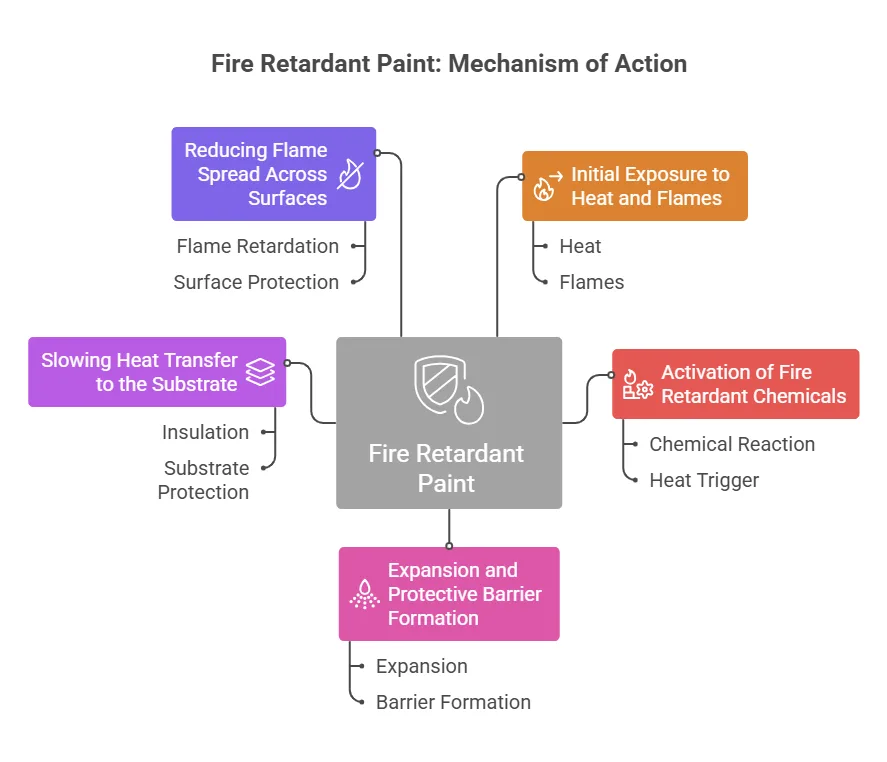
Fire retardant paint is specifically engineered to react when exposed to extreme heat and flames. Unlike conventional coatings that may burn or deteriorate rapidly, fire retardant paint undergoes a controlled chemical transformation that helps protect the underlying material. This process slows fire development, reduces heat transfer, and improves the overall fire resistance of the protected surface.
During a fire, the coating works through a series of stages that help create a protective barrier between the flames and the substrate. This reaction provides valuable additional time for evacuation, firefighting efforts, and structural protection.
Understanding how fire retardant paint behaves during a fire helps explain why it is widely used as part of passive fire protection systems in buildings and industrial facilities.
Initial Exposure to Heat and Flames
The fire protection process begins when the coated surface is exposed to high temperatures or direct flames.
At the early stages of a fire:
- Surface temperatures begin to rise rapidly.
- Heat starts transferring toward the substrate.
- Combustible materials may approach their ignition point.
- Structural components begin to experience thermal stress.
A conventional paint coating offers little resistance to these conditions and may quickly deteriorate. Fire retardant paint, however, is specifically formulated to respond to elevated temperatures and initiate protective reactions.
The coating remains stable under normal operating conditions but becomes active when exposed to fire, helping to reduce the rate at which heat penetrates the protected material.
This early response is critical because it slows the initial progression of fire and helps prevent rapid flame spread.
Activation of Fire Retardant Chemicals
As temperatures continue to increase, the specialized fire retardant chemicals within the coating become activated.
These ingredients are designed to react when exposed to heat and perform several protective functions, such as:
- Absorbing thermal energy
- Releasing non-combustible gases
- Reducing oxygen availability near the surface
- Promoting the formation of protective char
- Limiting flame propagation
In intumescent fire retardant coatings, this activation stage triggers the chemical expansion process that creates an insulating barrier.
The activated ingredients work together to:
- Slow combustion reactions
- Reduce heat transmission
- Delay structural damage
- Improve overall fire resistance
This chemical response is what differentiates fire retardant paint from ordinary decorative coatings.
Expansion and Protective Barrier Formation
One of the most important stages occurs when the coating begins to expand under intense heat.
In intumescent systems, the activated coating can expand many times its original thickness, creating a thick, foam-like char layer.
The expansion process typically involves:
- Exposure to elevated temperatures
- Activation of intumescent ingredients
- Expansion of the coating film
- Formation of a carbon-rich char layer
- Creation of an insulating protective barrier
This char layer acts as a shield between the fire and the substrate.
Benefits of the protective barrier include:
- Reduced direct flame contact
- Improved thermal insulation
- Slower temperature rise
- Enhanced structural protection
- Increased fire resistance performance
The thicker the insulating char layer, the greater its ability to protect the underlying material from extreme temperatures.
Slowing Heat Transfer to the Substrate
Heat transfer is one of the primary causes of structural failure during a fire. As temperatures increase, materials such as steel and timber can lose strength, deform, or ignite.
The insulating barrier created by fire retardant paint helps slow the movement of heat into the protected substrate.
This process helps:
- Maintain lower substrate temperatures
- Delay thermal degradation
- Protect structural integrity
- Reduce fire damage
- Extend fire resistance periods
For structural steel, slowing heat transfer is particularly important because steel can lose a significant portion of its load-bearing capacity when temperatures exceed critical levels.
For timber and other combustible materials, reduced heat transfer helps delay ignition and slow fire growth.
This insulation effect is one of the key reasons fire retardant paint is widely used in fire-rated construction systems.
Reducing Flame Spread Across Surfaces
In addition to protecting the substrate, fire retardant paint helps limit the spread of flames across coated surfaces.
Without protection, flames can quickly travel across walls, ceilings, wood surfaces, and structural components, increasing the speed and severity of a fire.
Fire retardant paint helps reduce flame spread by:
- Creating a protective barrier
- Limiting combustible surface exposure
- Interrupting combustion processes
- Reducing heat release
- Delaying ignition of adjacent materials
The result is:
- Slower fire growth
- Improved fire containment
- Greater evacuation time
- Reduced property damage
- Enhanced overall fire safety
This performance is especially valuable in:
- Commercial buildings
- Industrial facilities
- Warehouses
- Educational institutions
- Healthcare facilities
- Public infrastructure
By reducing flame spread and slowing heat transfer, fire retardant paint serves as an effective passive fire protection solution that helps protect people, property, and critical structural elements during a fire emergency.
Intumescent Fire Retardant Paint Technology
Intumescent fire retardant paint is one of the most advanced and widely used passive fire protection technologies available today. Unlike conventional coatings, intumescent paint is specifically designed to react when exposed to extreme heat, creating an insulating barrier that protects the underlying material from fire damage.
This technology is commonly used to protect structural steel, timber, and other building components in commercial, industrial, and infrastructure projects. By delaying temperature rise and reducing heat transfer, intumescent coatings help maintain structural stability during a fire and provide valuable additional time for evacuation and emergency response.
Because of its effectiveness, intumescent fire protection is widely specified in modern fire safety systems where maintaining the integrity of critical structural elements is essential.
What is Intumescent Paint?
Intumescent paint is a specialized fire protection coating that expands when exposed to high temperatures. Under normal conditions, it appears similar to conventional paint and can be applied using standard coating methods.
However, during a fire, the coating undergoes a chemical reaction that transforms it into a thick insulating layer.
Key characteristics of intumescent paint include:
- Fire-reactive technology
- Passive fire protection performance
- Thermal insulation properties
- Minimal impact on architectural appearance
- Compatibility with steel, timber, and other substrates
Intumescent coatings are commonly used on:
- Structural steel beams
- Steel columns
- Roof trusses
- Fire doors
- Timber structures
- Industrial support systems
Their primary purpose is to delay the heating of structural components and improve fire resistance performance.
How Intumescent Coatings Expand Under Heat
The unique effectiveness of intumescent paint comes from its ability to expand dramatically when exposed to fire.
As temperatures rise, the coating undergoes a controlled chemical reaction involving specialized ingredients within the paint formulation.
The process typically occurs in several stages:
- Exposure to high temperatures
- Activation of intumescent compounds
- Release of gases within the coating
- Expansion of the coating layer
- Formation of a protective insulating barrier
During this reaction, the coating can expand many times its original thickness.
This expansion creates:
- A low-density insulating layer
- Increased thermal resistance
- Protection against direct flame exposure
- Reduced heat transfer to the substrate
The expanded layer acts as a thermal shield that significantly slows the effects of fire on the protected structure.
Formation of Insulating Char Layers
One of the most important functions of intumescent paint is the creation of an insulating char layer.
When activated by heat, the coating transforms into a carbon-rich foam-like structure known as char.
The char layer provides several critical benefits:
- Thermal insulation
- Heat absorption
- Flame shielding
- Protection from direct fire exposure
- Reduced substrate temperature rise
The char acts as a barrier between:
- The fire
- The structural material being protected
This insulating layer slows the movement of heat into the substrate and helps preserve the integrity of the protected component.
The effectiveness of the char layer depends on:
- Coating formulation
- Applied thickness
- Fire exposure conditions
- Environmental factors
- Quality of application
A properly applied intumescent coating system can generate a robust char layer capable of providing significant fire protection during an emergency.
Protecting Structural Materials from High Temperatures
High temperatures can rapidly weaken structural materials, increasing the risk of collapse and extensive fire damage.
Intumescent coatings help protect several critical building materials.
Structural Steel
Steel is one of the most common applications for intumescent paint.
Although steel is non-combustible, it loses strength as temperatures increase.
Without protection, steel may:
- Deform under load
- Lose load-bearing capacity
- Experience structural instability
- Contribute to premature building failure
Intumescent paint helps delay these effects by insulating the steel and slowing temperature rise.
Timber and Wood
Timber structures can ignite and burn when exposed to fire.
Intumescent coatings help:
- Delay ignition
- Reduce flame spread
- Protect decorative wood surfaces
- Improve overall fire resistance
Other Construction Materials
Intumescent technology may also be used on:
- Fire doors
- Service penetrations
- Cable supports
- Architectural elements
- Industrial equipment supports
Protecting these materials helps improve overall building safety and fire performance.
Fire Resistance Ratings and Performance
Intumescent fire retardant paint is designed to achieve specific fire resistance ratings based on standardized testing.
These ratings indicate how long a protected structure can maintain its performance during fire exposure.
Common fire resistance ratings include:
- 30 Minutes
- 60 Minutes
- 90 Minutes
- 120 Minutes
- 180 Minutes (specialized applications)
The required rating depends on factors such as:
- Building occupancy
- Structural design
- Fire risk assessment
- Local regulations
- Insurance requirements
Several variables influence performance, including:
- Coating thickness
- Surface preparation quality
- Primer compatibility
- Environmental exposure conditions
- Application workmanship
To verify performance, intumescent coatings are tested according to recognized fire protection standards established by organizations such as:
- ASTM International
- British Standards Institution
- Bureau of Indian Standards
Properly tested and certified intumescent systems provide documented evidence of their fire resistance capabilities and help support compliance with building and fire safety regulations.
By combining heat-activated expansion, insulating char formation, and proven fire resistance performance, intumescent fire retardant paint remains one of the most effective solutions for protecting structural materials and enhancing fire safety in modern buildings and industrial facilities.
Fire Retardant Paint vs Fire Resistant Paint
The terms fire retardant paint and fire resistant paint are often used interchangeably, but they are not exactly the same. While both coatings are designed to improve fire safety, they work in different ways and are intended for different levels of protection.
Understanding the differences between these coating technologies is essential when selecting a fire protection system for commercial buildings, industrial facilities, warehouses, and infrastructure projects. The correct choice depends on factors such as the substrate, fire resistance requirements, environmental conditions, and regulatory compliance needs.
Both coating types contribute to passive fire protection, but their mechanisms, applications, and performance characteristics differ significantly.
Key Differences in Fire Protection Mechanisms
The primary difference between fire retardant paint and fire resistant paint lies in how they respond to fire and protect the underlying surface.
Fire Retardant Paint
Fire retardant paint is designed to:
- Slow flame spread
- Delay ignition
- Reduce heat release
- Minimize fire growth
- Improve surface fire performance
Its main purpose is to control the development of fire during the early stages and reduce the rate at which flames spread across a surface.
When exposed to heat, fire retardant paint may:
- Release fire-suppressing compounds
- Form a protective surface layer
- Reduce combustion efficiency
- Delay ignition of combustible materials
These coatings help improve fire safety but may not necessarily provide extended structural fire resistance.
Fire Resistant Paint
Fire resistant paint, particularly intumescent coatings, is designed to:
- Protect structural elements from extreme heat
- Insulate substrates during fire exposure
- Maintain load-bearing capacity
- Provide certified fire resistance ratings
When exposed to high temperatures, fire resistant coatings expand and form a thick insulating char layer that protects the underlying structure.
This mechanism helps:
- Slow heat transfer
- Delay structural weakening
- Extend fire resistance periods
- Improve structural stability during a fire
As a result, fire resistant paint is commonly used where maintaining structural integrity is critical.
Surface Protection vs Structural Protection
Another important distinction is the level of protection provided.
Surface Protection with Fire Retardant Paint
Fire retardant paint primarily focuses on improving the fire performance of surface materials.
It helps:
- Reduce flame spread
- Lower fire propagation rates
- Improve reaction-to-fire characteristics
- Delay ignition
Common protected surfaces include:
- Timber panels
- Decorative wood finishes
- Interior walls
- Ceilings
- Fire doors
- Architectural elements
The emphasis is on reducing fire growth and limiting surface combustion.
Structural Protection with Fire Resistant Paint
Fire resistant paint focuses on protecting structural components from heat damage.
Its goal is to maintain the integrity of critical building elements such as:
- Structural steel beams
- Steel columns
- Load-bearing frameworks
- Roof trusses
- Industrial support structures
By insulating these components, fire resistant coatings help prevent premature structural failure during a fire.
This distinction makes fire resistant paint particularly important in buildings where structural collapse could pose significant safety risks.
Applications of Each Coating Type
The intended application often determines whether fire retardant paint or fire resistant paint is the most appropriate choice.
Common Applications of Fire Retardant Paint
Fire retardant paint is frequently used on:
- Wood and timber surfaces
- Fire doors
- Interior wall panels
- Decorative finishes
- Ceiling systems
- Public spaces
- Commercial interiors
Typical sectors include:
- Hotels
- Schools
- Hospitals
- Offices
- Residential buildings
- Retail facilities
The focus is on improving surface fire performance and occupant safety.
Common Applications of Fire Resistant Paint
Fire resistant paint is commonly applied to:
- Structural steel frameworks
- Industrial buildings
- Warehouses
- Manufacturing plants
- Power plants
- Oil & gas facilities
- Commercial high-rise structures
These applications require:
- Certified fire ratings
- Structural protection
- Long-duration fire resistance
- Building code compliance
The coating helps ensure that critical structural elements remain functional during a fire event.
Choosing the Right Fire Protection Solution
Selecting the right coating depends on the specific fire protection objectives of the project.
Consider the following factors:
Surface Material
Determine whether the substrate is:
- Steel
- Timber
- Concrete
- Gypsum board
- Composite materials
Different materials require different fire protection approaches.
Required Fire Performance
Ask whether the goal is to:
- Slow flame spread
- Delay ignition
- Protect structural integrity
- Achieve a certified fire resistance rating
The answer will influence the coating selection.
Regulatory Requirements
Building codes may require:
- Reaction-to-fire performance
- Fire resistance ratings
- Certified testing documentation
- Passive fire protection systems
Always verify local compliance requirements.
Environmental Conditions
Consider whether the coating will be used:
- Indoors
- Outdoors
- In high-humidity environments
- In industrial facilities
- In corrosive atmospheres
Environmental exposure can affect coating performance and durability.
Long-Term Protection Goals
For decorative surfaces and interior finishes, fire retardant paint may provide sufficient protection.
For critical structural components that must remain stable during a fire, fire resistant intumescent coatings are often the preferred solution.
Ultimately, both fire retardant paint and fire resistant paint play important roles in modern fire safety strategies. Fire retardant coatings help slow fire development and reduce flame spread, while fire resistant coatings provide enhanced thermal insulation and structural protection. Selecting the appropriate system ensures better fire performance, improved occupant safety, regulatory compliance, and long-term protection of buildings and industrial assets.
Materials Protected by Fire Retardant Paint
Fire retardant paint is a versatile fire protection solution that can be applied to a wide range of building materials and structural components. Its primary purpose is to reduce flame spread, slow heat transfer, and improve the fire resistance of surfaces that may be exposed to high temperatures during a fire.
By protecting critical building elements, fire retardant paint helps improve occupant safety, preserve structural integrity, and reduce property damage. These coatings are commonly used in commercial buildings, industrial facilities, warehouses, public infrastructure, and residential projects where fire safety is a priority.
Different materials respond differently to fire, which is why selecting the appropriate fire retardant coating system for each substrate is essential for achieving reliable fire protection performance.
Structural Steel and Steel Frameworks
Structural steel is one of the most important applications for fire retardant and intumescent coatings. Although steel is non-combustible, it rapidly loses strength when exposed to high temperatures.
During a fire, unprotected steel can:
- Expand and deform
- Lose load-bearing capacity
- Experience structural instability
- Increase the risk of collapse
Fire retardant paint helps protect steel by:
- Slowing temperature rise
- Reducing heat transfer
- Creating an insulating barrier
- Delaying structural failure
- Improving fire resistance ratings
Common steel applications include:
- Structural beams
- Steel columns
- Roof trusses
- Industrial frameworks
- Pipe racks
- Utility support structures
- Commercial building skeletons
Fire protection for steel is particularly important in high-rise buildings, industrial plants, warehouses, and infrastructure projects where structural stability must be maintained during a fire emergency.
Wood and Timber Surfaces
Wood is a widely used construction and decorative material, but it is also combustible and vulnerable to fire.
Fire retardant paint helps improve the fire performance of timber by:
- Delaying ignition
- Reducing flame spread
- Lowering heat release
- Protecting decorative finishes
- Improving fire resistance
Common timber applications include:
- Wooden doors
- Timber wall panels
- Ceiling systems
- Interior joinery
- Decorative cladding
- Architectural wood features
- Timber structural elements
Many fire retardant coatings are available in clear formulations that preserve the natural appearance of wood while providing enhanced fire protection.
This combination of safety and aesthetics makes fire retardant paint a popular choice for commercial interiors, hospitality projects, educational facilities, and public buildings.
Walls, Ceilings, and Partitions
Walls, ceilings, and partitions represent large surface areas that can contribute to fire spread if left unprotected.
Applying fire retardant paint to these surfaces helps:
- Reduce flame spread
- Improve compartmentation
- Slow fire progression
- Protect escape routes
- Enhance overall building fire performance
Common applications include:
- Gypsum board partitions
- Interior walls
- Ceiling systems
- Decorative wall panels
- Concrete surfaces
- Service corridors
- Public access areas
Benefits include:
- Improved fire containment
- Enhanced occupant safety
- Better protection of adjoining spaces
- Support for fire safety compliance
These coatings are commonly used in offices, hospitals, schools, hotels, shopping centers, and public buildings.
Fire Doors and Escape Routes
Fire doors and escape routes play a critical role in life safety during emergencies. Their purpose is to help contain fire and provide safe evacuation pathways for occupants.
Fire retardant paint can be used to protect:
- Fire-rated doors
- Door frames
- Stairwells
- Corridors
- Exit routes
- Emergency access pathways
Benefits include:
- Reduced flame spread
- Improved fire compartmentation
- Enhanced evacuation safety
- Protection of escape routes
- Support for passive fire protection systems
When combined with properly designed fire-rated assemblies, fire retardant coatings help ensure that critical evacuation routes remain functional for as long as possible during a fire.
Electrical Panels and Cable Trays
Electrical systems are common sources of fire risk in commercial and industrial facilities. Overheating, short circuits, equipment failures, and electrical faults can all contribute to fire incidents.
Fire retardant paint helps protect:
- Electrical panels
- Switchgear rooms
- Control cabinets
- Cable trays
- Cable support structures
- Utility shafts
- Service areas
Key advantages include:
- Reduced flame spread around electrical equipment
- Improved fire containment
- Protection of critical infrastructure
- Enhanced operational safety
- Reduced risk of fire propagation through cable systems
These applications are especially important in:
- Manufacturing facilities
- Data centers
- Power plants
- Utility infrastructure
- Commercial buildings
- Industrial processing plants
By protecting electrical systems and associated support structures, fire retardant paint helps improve facility safety and maintain operational continuity during emergency situations.
From structural steel and timber to walls, fire doors, and electrical infrastructure, fire retardant paint provides versatile fire protection across a wide range of materials. Its ability to enhance fire resistance, reduce flame spread, and support passive fire safety strategies makes it an essential component of modern building and industrial fire protection systems.
Benefits of Fire Retardant Paint Technology
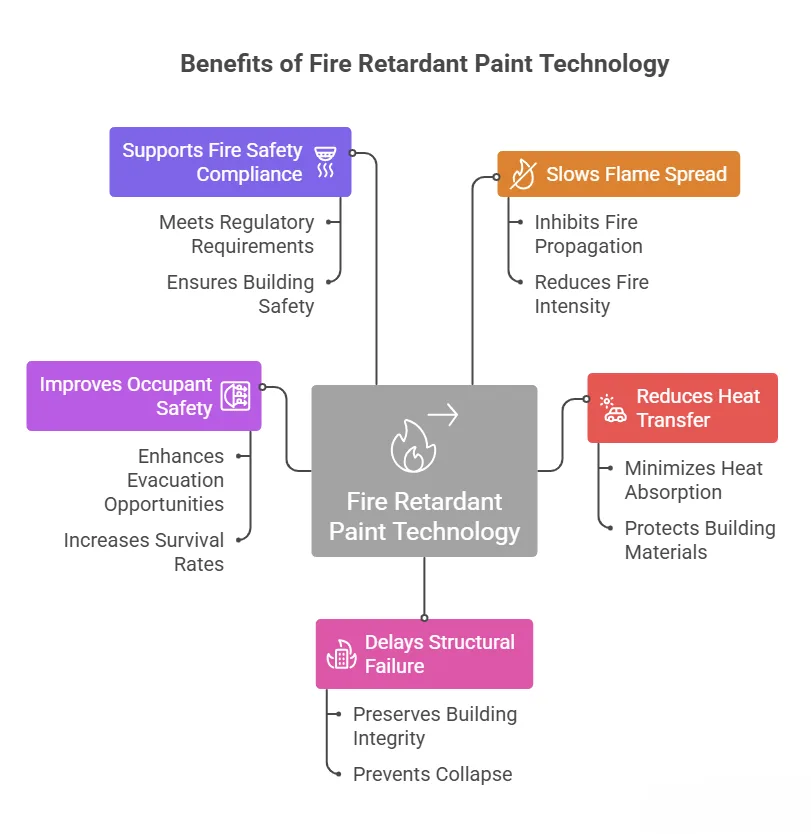
Fire retardant paint technology has become an essential part of modern passive fire protection systems. These specialized coatings are designed to improve the fire performance of buildings, industrial facilities, and infrastructure by slowing the spread of fire and protecting critical structural components from extreme heat.
Unlike active fire protection systems such as sprinklers and alarms, fire retardant paint works continuously without requiring activation. When exposed to high temperatures, it helps create a protective barrier that reduces heat transfer and delays fire-related damage.
The benefits of fire retardant paint extend beyond basic fire resistance. These coatings contribute to life safety, structural protection, regulatory compliance, and long-term asset preservation, making them a valuable investment for commercial, industrial, and public facilities.
Slows Flame Spread
One of the primary benefits of fire retardant paint is its ability to slow the spread of flames across coated surfaces.
During a fire, flames can rapidly travel through buildings by igniting nearby materials and spreading across walls, ceilings, doors, and structural elements. Fire retardant coatings help interrupt this process by reducing the speed at which combustion occurs.
Benefits of reduced flame spread include:
- Slower fire development
- Improved fire containment
- Reduced property damage
- Better protection of adjacent areas
- Increased emergency response time
Common surfaces that benefit from flame spread reduction include:
- Timber panels
- Fire doors
- Interior walls
- Ceiling systems
- Decorative wood finishes
- Cable support structures
By limiting flame propagation, fire retardant paint helps prevent small fires from escalating into major incidents.
Reduces Heat Transfer
Heat transfer is one of the most destructive aspects of a fire. Even when flames do not directly contact a structural element, heat can weaken materials and contribute to fire spread.
Fire retardant paint helps reduce heat transfer by creating a thermal barrier between the fire and the protected substrate.
This insulation effect helps:
- Lower substrate temperatures
- Delay heat penetration
- Protect sensitive materials
- Improve overall fire resistance
- Reduce thermal damage
For intumescent coatings, exposure to heat causes the paint to expand and form an insulating char layer that significantly slows the movement of heat.
Applications where heat reduction is especially important include:
- Structural steel
- Timber construction
- Fire doors
- Electrical equipment
- Industrial infrastructure
Reducing heat transfer plays a critical role in preserving structural stability and limiting fire damage.
Delays Structural Failure
Structural failure is one of the most serious consequences of a major fire. High temperatures can rapidly weaken load-bearing components and compromise the integrity of a building.
Fire retardant paint helps delay structural failure by protecting critical structural elements from excessive heat exposure.
For structural steel, the coating helps:
- Slow temperature rise
- Maintain load-bearing capacity
- Reduce thermal deformation
- Delay collapse risks
- Extend structural stability
For timber structures, fire retardant coatings help:
- Delay ignition
- Slow combustion
- Reduce charring rates
- Improve fire resistance performance
This protection provides valuable additional time for:
- Building evacuation
- Firefighter intervention
- Emergency response operations
- Fire suppression activities
The ability to delay structural failure is one of the main reasons fire retardant coatings are widely used in commercial buildings, industrial facilities, and infrastructure projects.
Improves Occupant Safety and Evacuation Time
Life safety is the primary objective of any fire protection strategy. Fire retardant paint contributes directly to occupant protection by slowing the progression of fire and reducing the speed at which hazardous conditions develop.
Benefits for occupants include:
- Additional evacuation time
- Improved escape route protection
- Reduced exposure to heat
- Better visibility in protected areas
- Increased emergency response opportunities
Buildings where occupant safety is particularly important include:
- Hospitals
- Schools
- Hotels
- Shopping centers
- Office buildings
- Public facilities
By slowing fire growth and delaying structural damage, fire retardant paint helps create safer conditions during emergency situations.
This additional response time can be critical in reducing injuries and improving overall fire safety outcomes.
Supports Fire Safety Compliance
Modern construction projects must comply with increasingly stringent fire safety regulations and building code requirements. Fire retardant paint can help support compliance by providing documented fire performance and passive fire protection capabilities.
Properly tested and certified coating systems may assist with:
- Building code compliance
- Fire safety regulations
- Occupancy requirements
- Insurance requirements
- Risk management programs
- Project specification standards
Fire retardant coatings are commonly evaluated according to standards established by:
- ASTM International
- British Standards Institution
- Bureau of Indian Standards
Using certified fire retardant paint systems provides:
- Verified fire performance
- Improved project documentation
- Greater regulatory confidence
- Easier inspection approval
- Enhanced long-term safety assurance
As fire safety requirements continue to evolve, fire retardant paint remains an important tool for achieving compliance while protecting people, property, and critical infrastructure.
By slowing flame spread, reducing heat transfer, delaying structural failure, improving occupant safety, and supporting regulatory compliance, fire retardant paint technology provides a comprehensive passive fire protection solution for modern buildings and industrial facilities.
Factors Affecting Fire Retardant Paint Performance
The effectiveness of fire retardant paint depends on more than just the quality of the coating itself. Several factors influence how well the coating performs during a fire and how long it maintains its protective properties throughout its service life.
Even a certified fire retardant coating may fail to deliver its intended fire resistance if it is applied incorrectly, installed at the wrong thickness, or exposed to unsuitable environmental conditions. Proper specification, application, inspection, and maintenance are essential for achieving reliable long-term fire protection.
Understanding these factors helps building owners, architects, contractors, and facility managers maximize the performance of fire retardant paint systems and ensure compliance with fire safety requirements.
Coating Thickness Requirements
Coating thickness is one of the most critical factors affecting fire retardant paint performance. Fire protection coatings are tested and certified at specific thicknesses to achieve defined fire resistance ratings.
Common fire ratings include:
- 30 minutes
- 60 minutes
- 90 minutes
- 120 minutes
- 180 minutes (special applications)
The required coating thickness depends on:
- Substrate type
- Fire resistance rating
- Structural design
- Environmental conditions
- Product specifications
Insufficient Thickness
Applying too little coating may result in:
- Reduced fire protection
- Faster heat transfer
- Lower fire resistance performance
- Failure to achieve specified fire ratings
Excessive Thickness
Applying more coating than recommended can cause:
- Cracking
- Sagging
- Poor curing
- Reduced adhesion
- Increased material costs
To ensure compliance, coating thickness should be verified using:
- Wet film thickness measurements
- Dry film thickness testing
- Quality control inspections
Maintaining the specified thickness is essential for achieving the intended level of fire protection.
Surface Preparation Quality
Surface preparation is the foundation of a successful fire retardant coating system. Even the best coating cannot perform properly if applied to a poorly prepared surface.
Common preparation requirements include:
- Removal of dirt and dust
- Elimination of grease and oil
- Rust removal from steel surfaces
- Repair of damaged areas
- Cleaning of contaminants
- Surface profiling where required
Poor preparation can lead to:
- Weak adhesion
- Blistering
- Peeling
- Delamination
- Premature coating failure
For steel structures, proper preparation often includes:
- Abrasive blasting
- Surface cleaning
- Application of approved primers
For timber and interior surfaces, preparation may involve:
- Sanding
- Cleaning
- Moisture control
- Repair of defects
Proper surface preparation ensures strong adhesion and long-term fire protection performance.
Environmental Conditions
Environmental conditions can significantly affect both the application process and the long-term durability of fire retardant paint.
Important factors include:
Temperature
Extreme temperatures can affect:
- Coating viscosity
- Drying times
- Curing performance
- Adhesion quality
Humidity
High humidity may cause:
- Extended drying periods
- Moisture entrapment
- Surface defects
- Reduced coating performance
Moisture Exposure
Outdoor structures may experience:
- Rain
- Condensation
- Water penetration
- Coastal exposure
UV Radiation
Exterior coatings exposed to sunlight may suffer:
- Fading
- Chalking
- Surface degradation
- Reduced service life
Selecting a coating system designed for the intended environment is critical for maintaining both fire resistance and durability.
Proper Application Methods
The application method used can directly influence coating performance and appearance.
Fire retardant paint may be applied using:
- Airless spray equipment
- Conventional spray systems
- Rollers
- Brushes
The choice depends on:
- Project size
- Surface geometry
- Coating type
- Desired finish quality
Common application challenges include:
- Uneven film thickness
- Missed areas
- Overspray
- Inadequate curing
- Improper mixing
To achieve optimal results, applicators should follow:
- Manufacturer instructions
- Recommended coverage rates
- Environmental guidelines
- Quality control procedures
Proper application helps ensure consistent protection across the entire surface and improves overall coating performance.
Maintenance and Inspection Practices
Fire retardant paint is not a “fit-and-forget” solution. Regular inspection and maintenance are necessary to ensure continued protection throughout the coating’s service life.
Routine inspections help identify:
- Mechanical damage
- Cracks and peeling
- Corrosion beneath coatings
- Moisture-related issues
- UV degradation
- Surface wear
Areas requiring special attention include:
- Structural connections
- High-traffic zones
- Exterior steelwork
- Industrial facilities
- Utility infrastructure
- Fire doors and escape routes
A proactive maintenance program should include:
- Scheduled visual inspections
- Thickness verification when necessary
- Repair of damaged areas
- Recoating when required
- Documentation of maintenance activities
Benefits of regular maintenance include:
- Extended coating lifespan
- Consistent fire protection performance
- Reduced repair costs
- Improved regulatory compliance
- Enhanced asset protection
By maintaining the coating system properly, building owners can ensure reliable fire protection for many years.
Ultimately, the performance of fire retardant paint depends on a combination of correct coating thickness, proper surface preparation, suitable environmental conditions, professional application methods, and ongoing maintenance. Paying attention to these factors helps maximize fire resistance, improve durability, and ensure long-term protection of buildings, structures, and critical assets.
Fire Testing and Certification Standards
Fire retardant paint must be tested and certified to verify its ability to perform under real fire conditions. Fire testing standards provide a consistent method for evaluating how coatings react to heat, flames, and prolonged fire exposure. These standards help architects, engineers, contractors, and building owners select coating systems that meet safety requirements and comply with applicable regulations.
Certification is especially important because fire retardant paint is often used to protect critical structural elements, escape routes, and high-risk areas. Products that have undergone recognized fire testing provide documented evidence of their performance and reliability.
Understanding the major fire testing standards and certification requirements helps ensure that the selected coating system delivers the intended level of fire protection.
ASTM Fire Testing Standards
ASTM International develops some of the most widely recognized fire testing standards used throughout the construction and industrial sectors.
ASTM standards evaluate key fire performance characteristics such as:
- Flame spread
- Heat release
- Fire resistance
- Smoke generation
- Thermal insulation performance
- Structural fire protection effectiveness
Common ASTM fire tests used for fire protection coatings include:
ASTM E84 – Surface Burning Characteristics
This test measures:
- Flame spread index
- Smoke development index
It is commonly used to assess how materials contribute to fire growth within a building.
ASTM E119 – Fire Tests of Building Construction Materials
This standard evaluates:
- Fire resistance performance
- Structural stability during fire exposure
- Heat transmission characteristics
It is frequently used for structural fire protection systems.
ASTM E605
This standard is commonly used for:
- Thickness verification
- Inspection of fireproofing materials
- Quality control of applied coatings
ASTM-compliant fire retardant coatings help provide confidence that the product has been evaluated using recognized testing procedures.
BS Fire Protection Standards
The British Standards Institution publishes internationally respected fire protection standards that are frequently specified in commercial and industrial projects.
BS standards address:
- Fire resistance performance
- Reaction-to-fire characteristics
- Structural fire protection
- Passive fire protection systems
- Building safety requirements
Commonly referenced BS standards include:
BS 476
A widely recognized series of fire tests used to evaluate:
- Building materials
- Structural elements
- Surface spread of flame
- Fire resistance performance
BS EN Fire Standards
These standards are used to assess:
- Fire resistance ratings
- Structural behavior during fire
- Product performance under standardized conditions
BS-certified fire protection coatings are commonly specified for:
- Commercial buildings
- Public infrastructure
- Educational facilities
- Healthcare projects
- Industrial facilities
These standards provide documented evidence of fire performance and support regulatory compliance.
IS Fire Safety Standards
In India, fire protection products may be evaluated according to standards developed by the Bureau of Indian Standards.
IS standards help establish requirements for:
- Fire resistance testing
- Building material performance
- Structural fire protection
- Construction safety practices
- Passive fire protection systems
These standards support:
- National building safety objectives
- Regulatory compliance
- Product quality assurance
- Fire safety verification
Applications commonly requiring compliance include:
- Commercial buildings
- Industrial facilities
- Public infrastructure
- Government projects
- Educational institutions
- Healthcare facilities
Using coatings tested according to applicable Indian standards helps ensure alignment with local regulations and construction requirements.
Fire Resistance Certification Requirements
Testing alone is not sufficient; fire retardant paint should also be supported by proper certification and documentation.
Fire resistance certification provides evidence that a coating system has been independently evaluated and meets specific performance criteria.
Important certification documents may include:
- Fire test reports
- Product approval certificates
- Technical data sheets
- Application guidelines
- Quality assurance documentation
- Inspection requirements
Certification typically verifies:
- Fire resistance rating
- Approved substrates
- Required coating thickness
- Environmental suitability
- System compatibility
- Installation requirements
Common fire resistance ratings include:
- 30 minutes
- 60 minutes
- 90 minutes
- 120 minutes
- 180 minutes
When specifying fire retardant paint, project teams should confirm:
- The coating has been tested by recognized organizations
- Fire ratings match project requirements
- Application procedures follow tested systems
- Approved primers and topcoats are used
- Documentation is available for inspections and approvals
Benefits of certified fire protection systems include:
- Verified fire performance
- Improved life safety
- Regulatory compliance
- Greater project confidence
- Easier approval processes
- Enhanced long-term reliability
By selecting coatings that comply with recognized ASTM, BS, and IS standards and are supported by proper certification, building owners and project teams can ensure dependable fire protection performance while meeting modern fire safety and building code requirements.
Common Applications of Fire Retardant Paint
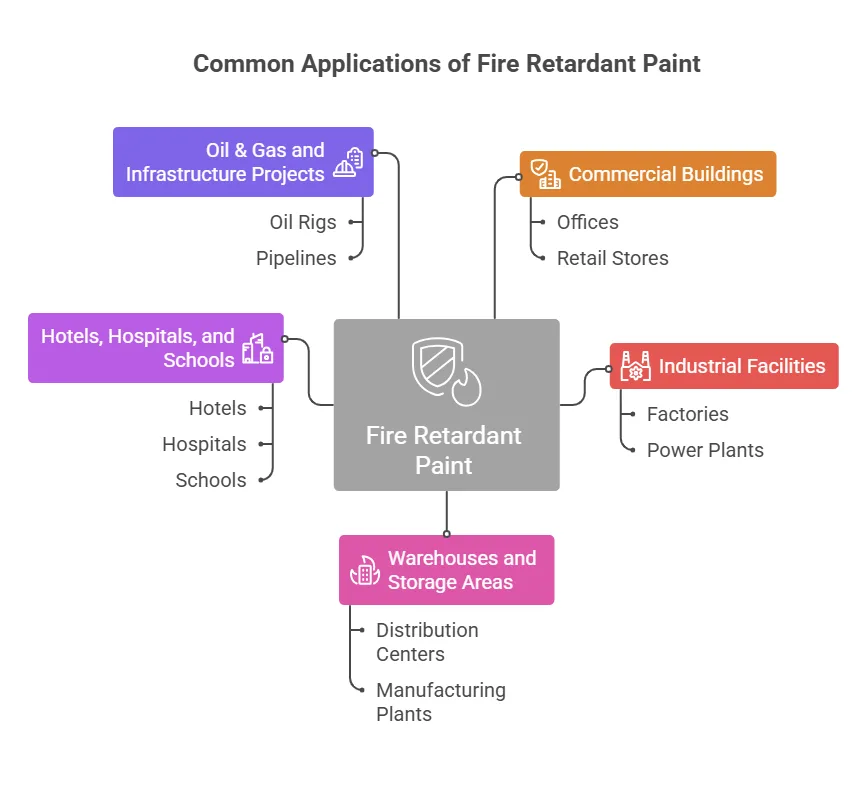
Fire retardant paint is widely used across commercial, industrial, and infrastructure sectors to improve fire safety and protect critical assets. Its ability to slow flame spread, reduce heat transfer, and enhance fire resistance makes it a valuable component of passive fire protection systems.
From office buildings and hospitals to manufacturing plants and oil refineries, fire retardant coatings help safeguard structures, occupants, and equipment during fire emergencies. The versatility of these coatings allows them to be applied to steel, timber, walls, ceilings, fire doors, and other building elements where enhanced fire performance is required.
The following are some of the most common applications of fire retardant paint in modern construction and industry.
Commercial Buildings
Commercial buildings often accommodate large numbers of occupants, making fire safety a critical design consideration. Fire retardant paint helps improve fire resistance and supports compliance with building regulations.
Common applications in commercial buildings include:
- Structural steel frameworks
- Fire doors and door frames
- Interior walls and partitions
- Ceiling systems
- Stairwells and escape routes
- Service corridors
Benefits include:
- Improved occupant safety
- Enhanced evacuation time
- Reduced fire spread between compartments
- Protection of structural elements
- Compliance with fire safety codes
Commercial facilities commonly using fire retardant coatings include:
- Office complexes
- Shopping malls
- Business parks
- Exhibition centers
- Mixed-use developments
By slowing the progression of fire, these coatings help reduce risks to people and property while supporting business continuity.
Industrial Facilities
Industrial environments often contain machinery, electrical systems, combustible materials, and high-value assets that require enhanced fire protection.
Fire retardant paint is frequently used to protect:
- Structural steel supports
- Production areas
- Equipment platforms
- Pipe racks
- Utility structures
- Maintenance workshops
Industrial facilities face unique fire hazards due to:
- High operating temperatures
- Electrical equipment
- Chemical storage
- Manufacturing processes
- Heavy machinery operations
Benefits of fire retardant coatings in industrial settings include:
- Reduced fire-related damage
- Improved structural stability
- Protection of critical infrastructure
- Enhanced worker safety
- Lower operational risks
These coatings play an important role in maintaining safety and operational resilience in industrial environments.
Warehouses and Storage Areas
Warehouses often contain large quantities of inventory, packaging materials, and storage systems that can contribute to rapid fire growth.
Fire retardant paint is commonly applied to:
- Steel warehouse structures
- Storage racks and support systems
- Fire doors
- Loading areas
- Distribution centers
- Storage compartments
Advantages include:
- Reduced flame spread
- Enhanced fire containment
- Improved protection of stored goods
- Extended evacuation and response time
- Reduced financial losses
For logistics and storage facilities, fire retardant coatings help protect valuable inventory while supporting fire safety objectives.
Hotels, Hospitals, and Schools
Buildings that accommodate large numbers of people require a high level of fire safety to protect occupants during emergencies.
Fire retardant paint is widely used in:
Hotels
- Guest room corridors
- Fire doors
- Decorative wood surfaces
- Ceiling systems
- Emergency exits
Hospitals
- Patient care areas
- Electrical rooms
- Service corridors
- Medical equipment zones
- Emergency access routes
Schools and Educational Facilities
- Classrooms
- Libraries
- Auditoriums
- Hallways
- Administrative buildings
Key benefits include:
- Increased evacuation time
- Improved occupant protection
- Reduced fire spread
- Enhanced compartmentation
- Compliance with safety regulations
These facilities prioritize life safety, making passive fire protection coatings an important component of their fire safety strategies.
Oil & Gas and Infrastructure Projects
Oil and gas facilities represent some of the most demanding environments for fire protection systems due to the presence of flammable materials and high-risk operations.
Fire retardant paint is commonly applied to:
- Structural steel frameworks
- Processing units
- Pipe supports
- Storage terminals
- Offshore platforms
- Utility structures
Benefits include:
- Protection against extreme heat exposure
- Improved structural integrity
- Reduced risk of catastrophic failure
- Enhanced asset protection
- Support for safety compliance programs
Infrastructure projects also rely heavily on fire retardant coatings, including:
- Power plants
- Transportation hubs
- Utility facilities
- Communication towers
- Water treatment plants
- Public infrastructure buildings
In these critical environments, fire retardant paint helps protect essential services, improve operational safety, and reduce the impact of fire-related incidents.
Across commercial buildings, industrial facilities, warehouses, public institutions, and high-risk infrastructure projects, fire retardant paint provides a proven and effective method of enhancing fire safety. Its ability to protect structures, assets, and occupants makes it an essential component of modern passive fire protection systems.
Frequently Asked Questions About How Fire Retardant Paint Works
How does fire retardant paint stop fire spread?
Fire retardant paint helps stop or slow fire spread by creating a protective barrier when exposed to heat and flames. The coating contains specialized fire-retardant compounds that reduce the rate of combustion and limit the movement of flames across a surface.
Many modern fire retardant paints use intumescent technology, which expands under high temperatures to form an insulating char layer. This barrier reduces heat transfer, protects the underlying material, and slows the progression of fire throughout a building or structure.
Benefits include:
- Reduced flame spread
- Delayed ignition of surfaces
- Lower heat transfer
- Improved fire containment
- Increased evacuation time
While fire retardant paint does not completely prevent fire, it significantly slows its development and improves overall fire safety.
What happens to fire retardant paint during a fire?
When exposed to fire, fire retardant paint undergoes a chemical reaction designed to protect the substrate beneath it.
The process typically follows these stages:
- Exposure to heat and flames
- Activation of fire-retardant chemicals
- Expansion of the coating (for intumescent systems)
- Formation of a thick insulating char layer
- Reduction of heat transfer to the protected surface
The char layer acts as a thermal shield that:
- Protects the substrate from direct flames
- Slows temperature rise
- Reduces structural damage
- Delays material failure
This reaction helps maintain the integrity of the protected surface for a longer period during a fire emergency.
Does fire retardant paint work on steel and wood?
Yes, fire retardant paint can be used on both steel and wood when the correct coating system is selected.
For Structural Steel
Fire retardant and intumescent coatings help:
- Reduce heat transfer
- Delay steel temperature rise
- Maintain load-bearing capacity
- Improve fire resistance ratings
This protection is critical because steel loses strength when exposed to high temperatures.
For Wood and Timber
Fire retardant paint helps:
- Delay ignition
- Reduce flame spread
- Lower heat release
- Improve fire performance
Common wood applications include:
- Fire doors
- Timber panels
- Decorative wood finishes
- Ceiling systems
- Architectural woodwork
Always choose a coating specifically tested and approved for the intended substrate.
How long does fire retardant paint remain effective?
The service life of fire retardant paint depends on several factors, including:
- Product quality
- Environmental conditions
- Surface preparation
- Application quality
- Maintenance practices
In properly maintained conditions, fire retardant coatings can remain effective for many years.
Factors that influence lifespan include:
- Exposure to moisture
- UV radiation
- Mechanical damage
- Chemical exposure
- Industrial environments
Regular inspections should be conducted to check for:
- Cracking
- Peeling
- Delamination
- Corrosion beneath coatings
- Surface wear
When maintained according to manufacturer recommendations, fire retardant paint can provide long-term fire protection throughout the life of a building component.
Can fire retardant paint be used indoors and outdoors?
Yes, fire retardant paint is available for both indoor and outdoor applications, but the coating system must be suitable for the specific environment.
Indoor Applications
Common indoor uses include:
- Walls and ceilings
- Fire doors
- Timber surfaces
- Corridors and stairwells
- Commercial interiors
Indoor coatings are typically designed for:
- Controlled environments
- Lower moisture exposure
- Decorative finishes
- Occupant safety requirements
Outdoor Applications
Outdoor fire retardant coatings are commonly used on:
- Structural steel
- Industrial facilities
- Warehouses
- Utility structures
- Infrastructure projects
Exterior systems often require:
- Weather resistance
- UV protection
- Moisture resistance
- Protective topcoats
Selecting the correct coating system for the environment is essential to ensure both fire protection performance and long-term durability.
By choosing certified fire retardant coatings designed for the intended application, building owners and facility managers can achieve reliable fire protection for both indoor and outdoor structures.
Conclusion – Understanding the Science Behind Fire Retardant Paint
Fire retardant paint is far more than a protective surface coating—it is a critical component of modern passive fire protection systems. By slowing flame spread, reducing heat transfer, and protecting structural materials during fire exposure, these specialized coatings help improve building safety and minimize the devastating impact of fire.
Whether applied to structural steel, timber, fire doors, walls, ceilings, or industrial infrastructure, fire retardant paint provides valuable additional time for evacuation, firefighting operations, and emergency response. As fire safety regulations continue to evolve, these coatings play an increasingly important role in protecting lives, property, and critical assets.
Understanding how fire retardant paint works allows architects, engineers, contractors, and facility managers to make informed decisions when selecting fire protection solutions for commercial, industrial, and public buildings.
Importance of Passive Fire Protection Technology
Passive fire protection is designed to work continuously without requiring activation from alarms, sprinklers, or suppression systems. Fire retardant paint is one of the most effective passive fire protection technologies available because it provides immediate protection when exposed to heat and flames.
Key advantages include:
- Continuous fire protection
- Reduced flame spread
- Improved fire containment
- Enhanced structural stability
- Increased evacuation time
- Support for comprehensive fire safety strategies
By integrating passive fire protection into building design, property owners can significantly improve overall fire resilience and safety performance.
Benefits of Fire Retardant Paint in Modern Construction
Modern construction projects increasingly rely on fire retardant coatings to meet safety standards while maintaining architectural flexibility.
Major benefits include:
- Protection for steel and timber structures
- Improved fire resistance performance
- Reduced heat transfer during fire exposure
- Enhanced occupant safety
- Compliance with fire regulations
- Preservation of aesthetic finishes
- Long-term durability
These advantages make fire retardant paint suitable for:
- Commercial buildings
- Industrial facilities
- Warehouses
- Hospitals
- Schools
- Hotels
- Infrastructure projects
As building designs become more complex, fire retardant coatings continue to provide a practical and effective fire protection solution.
Long-Term Safety and Structural Protection
One of the most significant benefits of fire retardant paint is its ability to provide long-term protection for critical building components.
When properly specified, applied, and maintained, these coatings help:
- Delay structural failure
- Protect load-bearing elements
- Reduce fire-related damage
- Preserve asset value
- Improve business continuity
- Enhance facility safety
For structural steel, fire retardant coatings help maintain strength during fire exposure. For timber and other combustible materials, they reduce ignition risks and slow fire growth.
This combination of structural and life-safety benefits makes fire retardant paint an essential investment in long-term building protection.
Choosing Certified Fire Protection Coating Systems
The effectiveness of fire retardant paint depends on selecting products that have been tested and certified according to recognized fire safety standards.
When choosing a fire protection coating system, consider:
- Fire resistance rating requirements
- Substrate compatibility
- Environmental exposure conditions
- Application requirements
- Maintenance expectations
- Certification and test documentation
Always verify that the coating system complies with relevant standards and has been tested for the intended application.
A certified fire protection system provides:
- Verified fire performance
- Regulatory compliance
- Reliable long-term protection
- Improved project confidence
- Enhanced safety assurance
Ultimately, fire retardant paint is a proven technology that combines science, engineering, and fire safety expertise to protect buildings and infrastructure. By understanding its performance and selecting certified coating systems, organizations can achieve safer, more resilient structures that are better prepared to withstand the challenges of fire emergencies.
Great content! Keep up the good work!