


Choosing the best rust protection paint in Vadodara is essential for protecting steel structures, machinery, pipelines, metal fabrication, and industrial equipment from corrosion. Metal surfaces are frequently exposed to moisture, humidity, chemicals, temperature changes, and outdoor weather conditions that can gradually cause rust and surface deterioration.
Rust protection paint helps create a protective barrier between the metal and its surrounding environment, reducing corrosion and extending the service life of metal assets. Different coating systems, such as epoxy anti-corrosive paints, zinc-rich primers, red oxide primers, and polyurethane topcoats, offer different levels of protection depending on the application and exposure conditions.
For industrial facilities, fabrication units, warehouses, and engineering projects, selecting the right rust protection coating involves considering the metal surface, operating environment, surface preparation, application method, and expected service life.
What Is the Best Rust Protection Paint in Vadodara?
The best rust protection paint in Vadodara depends on the metal surface, exposure conditions, and required level of corrosion resistance. Epoxy anti-corrosive paint is often suitable for industrial steel structures, machinery, tanks, and pipelines because it provides strong adhesion and helps protect metal against moisture and corrosion. Zinc-rich primers are commonly used for steel protection, while red oxide primers may be suitable for general metal applications under appropriate conditions. For outdoor environments, a compatible polyurethane topcoat can provide additional weather resistance and colour retention. When selecting a rust protection coating, consider surface preparation, primer compatibility, coating thickness, and curing requirements. ALTIC Paint, manufactured by UGAM Technology in Vadodara, offers industrial coating solutions for different metal protection requirements.
Introduction to Rust Protection Paint
Rust is a common problem affecting iron and steel surfaces exposed to moisture, oxygen, humidity, and changing weather conditions. In industrial environments, corrosion can damage machinery, structural steel, pipelines, storage tanks, and fabricated metal components. Over time, this deterioration may increase maintenance costs, reduce equipment life, and affect operational reliability.
Rust protection paint helps minimise corrosion by creating a protective layer between the metal surface and its surrounding environment. Depending on the application, the coating system may include an anti-corrosive primer, an intermediate coat, and a protective topcoat. Selecting the appropriate system is important for achieving reliable performance and long-term metal protection.
For industries, contractors, and fabricators in Vadodara, choosing the right rust protection paint requires evaluating the working environment, metal condition, and expected service life. Proper surface preparation and application are equally important for ensuring effective coating performance.
What Is Rust Protection Paint?
Rust protection paint is a specialised coating designed to protect iron and steel surfaces from corrosion caused by moisture, oxygen, humidity, and environmental exposure. It forms a protective barrier that helps prevent rust formation, improves metal durability, and extends the service life of industrial equipment and structures. Common coating options include epoxy anti-corrosive paints, zinc-rich primers, and red oxide primers, selected according to the metal surface and operating conditions.
Definition of Anti-Rust Paint
Anti-rust paint is a protective coating formulated to reduce or prevent corrosion on metal surfaces. It contains binders, pigments, and other additives that help create a protective film over iron and steel. Depending on the formulation, it may work by blocking moisture and oxygen, inhibiting corrosion, or providing sacrificial protection.
Anti-rust paint is commonly used on steel structures, machinery, pipelines, storage tanks, metal gates, railings, and fabricated components. Selecting the appropriate product depends on the environment, surface condition, and expected durability.
How Rust Protection Paint Works
Rust protection paint works by separating the metal surface from environmental factors that contribute to corrosion. Once applied and properly cured, the coating forms a protective layer that reduces direct contact with moisture, oxygen, and corrosive substances.
The protection mechanism depends on the coating system:
- Barrier protection: Epoxy coatings form a durable film that limits the penetration of moisture and corrosive agents.
- Corrosion inhibition: Certain primers contain pigments that help inhibit corrosion at the metal surface.
- Sacrificial protection: Zinc-rich primers can provide galvanic protection to steel when correctly formulated and applied.
- Environmental resistance: Compatible topcoats can improve resistance to weathering, sunlight, chemicals, and surface wear.
For effective results, rust removal, surface cleaning, correct coating thickness, and adequate curing are essential. Even a high-quality coating may fail prematurely if the metal surface is poorly prepared or the coating system is unsuitable for the operating environment.
Difference Between Rust Protection Paint and Regular Paint
Rust protection paint and regular decorative paint differ mainly in their purpose, formulation, and protective performance. Regular paint primarily enhances appearance and may provide some basic protection, whereas rust protection paint is specifically selected to reduce corrosion on metal surfaces.
| Comparison Factor | Rust Protection Paint | Regular Paint |
| Primary purpose | Protects metal against corrosion | Primarily improves appearance and finish |
| Formulation | May contain anti-corrosive pigments, specialised resins, or zinc | Formulated mainly for decorative or general protective use |
| Metal protection | Designed to provide corrosion protection when correctly applied | Corrosion protection depends on the product formulation |
| Industrial applications | Steel structures, machinery, tanks, and pipelines | General decorative and maintenance applications |
| Surface preparation | Requires appropriate metal cleaning and preparation | Preparation depends on the substrate and paint system |
| Durability | Depends on coating type, exposure, thickness, and application quality | Depends on paint formulation and service conditions |
For industrial metal protection, selecting a purpose-designed anti-rust coating system is generally preferable to relying on decorative paint alone. The primer and topcoat should be compatible with each other and suitable for the expected environmental exposure.
Why Metal Surfaces Need Rust Protection
Metal surfaces, particularly iron and steel, require proper rust protection to maintain their strength, durability, and appearance. Exposure to moisture, oxygen, humidity, chemicals, and changing weather conditions can gradually cause corrosion. In industrial environments, rust can damage structural steel, machinery, pipelines, storage tanks, and fabricated metal components, leading to higher maintenance costs and reduced service life. Applying a suitable rust protection paint helps minimise corrosion and preserve the performance of metal assets.
Common Causes of Rust Formation
Rust forms when iron or steel reacts with oxygen and moisture, producing iron oxides that gradually deteriorate the metal surface. Several environmental and operational factors can accelerate this process.
Common causes of rust formation include:
- Moisture and water exposure: Rainwater, condensation, and water accumulation can accelerate corrosion.
- High humidity: Moist air increases the likelihood of moisture forming on metal surfaces.
- Chemical exposure: Acids, salts, industrial chemicals, and corrosive vapours can damage unprotected metal.
- Surface damage: Scratches, chipped paint, and damaged coatings expose the underlying metal.
- Poor surface preparation: Oil, dirt, loose rust, and contaminants can weaken coating adhesion and reduce protection.
- Inadequate coating systems: An unsuitable primer, insufficient coating thickness, or incompatible topcoat can leave metal vulnerable to corrosion.
Selecting the correct anti-rust paint and following proper application procedures helps reduce these risks and improve coating performance.
Effects of Humidity, Moisture, and Industrial Exposure
Humidity and moisture are major factors contributing to corrosion, especially in industrial facilities, warehouses, fabrication units, and outdoor installations. When water collects on steel surfaces or condensation forms in poorly ventilated areas, corrosion can develop beneath damaged or inadequate coatings.
Industrial exposure can create additional challenges. Chemical fumes, airborne contaminants, process liquids, and temperature fluctuations may affect the performance of protective coatings. Metal surfaces in chemical plants, manufacturing facilities, pipelines, and storage areas may therefore require specialised anti-corrosive coating systems.
Epoxy anti-corrosive coatings are commonly considered for industrial metal protection because they provide a durable barrier against moisture and many corrosive substances. In outdoor environments, a compatible weather-resistant topcoat may provide additional protection against sunlight and changing weather conditions. The appropriate system depends on the specific chemicals, temperatures, and exposure levels involved.
Risks of Unprotected Steel and Iron Surfaces
Leaving steel and iron surfaces unprotected can result in gradual corrosion, reduced structural integrity, and increased maintenance requirements. As rust develops, the metal may lose material, protective finishes may deteriorate, and equipment can become less reliable.
The major risks include:
- Reduced structural strength: Advanced corrosion can weaken steel beams, supports, platforms, and fabricated structures.
- Equipment deterioration: Rust can affect machinery housings, metal components, and industrial equipment.
- Pipeline and tank damage: Corrosion may reduce metal thickness and, in severe cases, contribute to leakage or failure.
- Higher maintenance costs: Frequent cleaning, repair, repainting, and component replacement can increase operating expenses.
- Poor surface appearance: Rust stains and flaking finishes can affect the appearance of industrial and commercial facilities.
- Operational disruption: Serious corrosion damage may require equipment shutdowns or structural repairs.
Applying a suitable rust protection coating, supported by proper surface preparation and regular inspection, helps reduce these risks. For industrial projects in Vadodara, the coating should be selected according to the metal substrate, environmental exposure, and expected service life to achieve reliable long-term protection.
Best Types of Rust Protection Paint
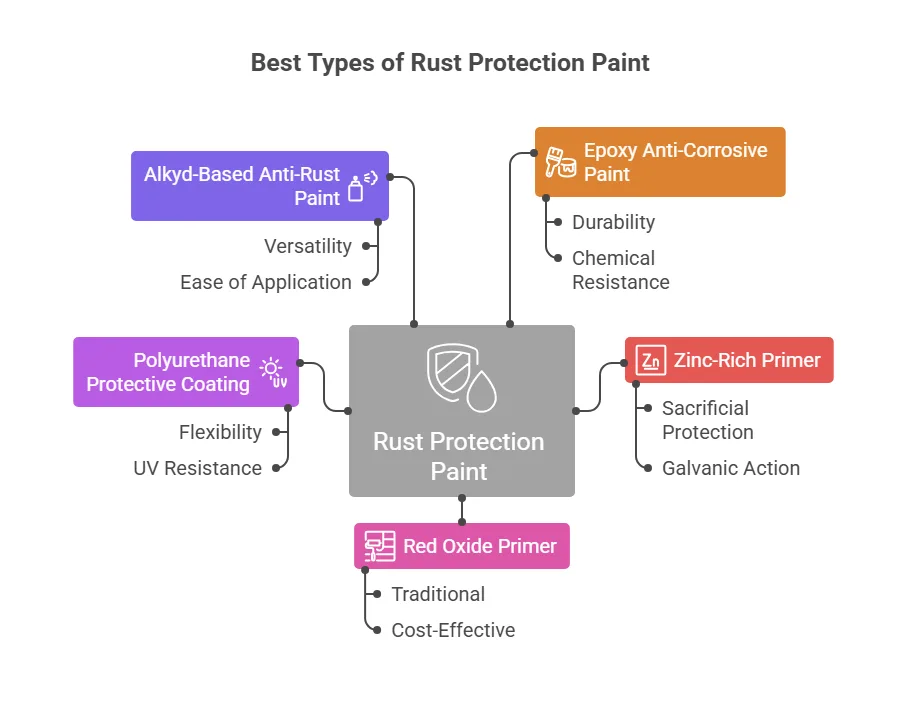
Choosing the right rust protection paint is essential for protecting metal surfaces against corrosion, moisture, chemicals, and outdoor weather conditions. Different coating systems provide different levels of protection depending on their formulation, application method, and operating environment. Common options include epoxy anti-corrosive paint, zinc-rich primer, red oxide primer, polyurethane protective coating, and alkyd-based anti-rust paint.
For industrial facilities, fabrication units, machinery, pipelines, and structural steel in Vadodara, the most suitable coating depends on the metal surface, exposure conditions, maintenance requirements, and expected service life.
Epoxy Anti-Corrosive Paint
Epoxy anti-corrosive paint is widely used for industrial metal protection because it offers strong adhesion, a durable coating film, and resistance to moisture and many chemicals. It is commonly applied to steel structures, industrial machinery, storage tanks, pipelines, and metal fabrication components.
Epoxy coatings are often selected for environments where metal surfaces face demanding operating conditions. They can provide an effective barrier against corrosive substances when applied over a properly prepared surface. Depending on the system, epoxy primers and intermediate coats can be combined with a compatible topcoat to improve overall performance.
Key benefits of epoxy anti-corrosive paint include:
- Strong adhesion to properly prepared metal surfaces.
- Resistance to moisture and many industrial chemicals.
- Durable protection for industrial steel and equipment.
- Suitability for various industrial coating systems.
- Potential to reduce maintenance when correctly specified and applied.
The coating should be selected according to the expected chemical exposure, operating temperature, and application requirements.
Zinc-Rich Primer
Zinc-rich primer is a specialised protective primer commonly used on steel structures exposed to demanding environments. It contains a high proportion of zinc dust, which can provide sacrificial or galvanic protection to steel when the coating is correctly formulated and applied.
Unlike conventional barrier coatings, zinc-rich primers can help protect steel even when small areas of the coating are damaged, provided the conditions for galvanic protection are met. They are commonly used in structural steel fabrication, industrial infrastructure, bridges, and other steel applications requiring enhanced corrosion protection.
Key advantages include:
- Sacrificial protection for suitable steel substrates.
- Use in industrial and structural steel coating systems.
- Compatibility with selected intermediate coats and topcoats.
- Suitability for certain demanding outdoor environments.
Correct surface preparation and compatibility with the complete coating system are essential. The product’s technical data sheet should specify suitable application conditions and compatible overcoating systems.
Red Oxide Primer
Red oxide primer is a traditional metal primer used to protect iron and steel surfaces and provide a base for subsequent paint coats. It is commonly used in general metal fabrication, gates, grills, railings, steel frames, and other applications where the exposure conditions are appropriate.
This primer helps improve coating adhesion and provides a protective layer beneath the finishing paint. However, its performance depends on the product formulation, surface preparation, film thickness, and environmental conditions.
Common applications include:
- Metal gates and railings.
- Steel doors and window frames.
- General fabrication work.
- Metal supports and frameworks.
- Maintenance painting for suitable steel components.
Red oxide primer may be a practical option for general-purpose metal protection, but more demanding industrial environments may require specialised epoxy or zinc-rich coating systems.
Polyurethane Protective Coating
Polyurethane protective coating is often used as a topcoat over a compatible primer or intermediate coating. It is valued for its weather resistance, surface durability, and ability to maintain colour and gloss under suitable exposure conditions.
For outdoor steel structures, industrial buildings, equipment, and fabricated metal components, polyurethane topcoats can help protect the underlying coating system against sunlight, rain, and environmental weathering.
Key benefits include:
- Good resistance to outdoor weathering in suitable formulations.
- Improved colour and gloss retention.
- Durable surface finish.
- Compatibility with selected epoxy primer systems.
- Additional protection for industrial and architectural metalwork.
Polyurethane coatings are not always intended to replace an anti-corrosive primer. For long-term corrosion protection, they are commonly used as part of a compatible multi-coat system. Product selection should account for chemical exposure, temperature, and application requirements.
Alkyd-Based Anti-Rust Paint
Alkyd-based anti-rust paint is commonly used for general-purpose metal protection in maintenance, fabrication, and decorative applications. Depending on the formulation, it can provide a protective finish for gates, railings, metal frames, machinery housings, and other metal surfaces exposed to relatively moderate conditions.
Alkyd coatings are often considered for projects where straightforward application, appearance, and routine maintenance are important. However, they may not provide the same level of chemical or industrial corrosion resistance as specialised epoxy systems in demanding environments.
Typical advantages include:
- Practical use in general metal maintenance.
- Suitable decorative finish for selected applications.
- Application over compatible primers.
- Availability in different colours and finishes.
- Suitability for certain indoor and outdoor metal surfaces.
Before selecting an alkyd-based coating, assess the exposure conditions and the manufacturer’s recommendations. For surfaces exposed to aggressive chemicals, persistent moisture, or severe industrial conditions, a more specialised protective coating may be necessary.
How to Choose Between Different Rust Protection Paints
| Paint Type | Common Applications | Main Protection Feature |
| Epoxy anti-corrosive paint | Industrial steel, machinery, tanks, pipelines | Durable barrier and chemical resistance, depending on formulation |
| Zinc-rich primer | Structural steel and industrial infrastructure | Sacrificial protection of suitable steel |
| Red oxide primer | Gates, grills, frames, general fabrication | Primer layer for general metal protection |
| Polyurethane protective coating | Outdoor structures and equipment | Weather resistance and colour retention |
| Alkyd-based anti-rust paint | General metalwork and maintenance | Protective decorative finish for suitable conditions |
For industrial projects in Vadodara, selecting the right rust protection paint requires evaluating the substrate, environment, and complete coating system rather than relying on the paint category alone. ALTIC Paint, manufactured by UGAM Technology in Vadodara, offers industrial coating solutions for different metal protection requirements. Consult the relevant technical data sheet to confirm suitability, surface preparation, application thickness, and compatibility with other coating layers.
Which Rust Protection Paint Is Best for Different Applications?
The best rust protection paint depends on the metal surface, operating environment, exposure to moisture or chemicals, and required service life. Industrial steel structures may require epoxy anti-corrosive coatings or zinc-rich primers, while gates, grills, and railings may be adequately protected with suitable metal primers and finishing paints. Selecting the right coating system helps reduce corrosion, minimise maintenance, and extend the life of metal components.
Structural Steel and Metal Fabrication
Structural steel and fabricated metal components are commonly used in industrial plants, warehouses, factories, commercial buildings, and infrastructure projects. These surfaces may be exposed to humidity, rain, airborne contaminants, and industrial pollutants that can accelerate corrosion.
Epoxy anti-corrosive paint and zinc-rich primers are common options for structural steel protection. Zinc-rich primers can provide sacrificial protection, while epoxy coatings form a durable barrier against moisture and corrosive substances. A compatible weather-resistant topcoat may be added for steel exposed to outdoor conditions.
Before application, remove loose rust, mill scale, oil, and other contaminants using an appropriate surface preparation method. The coating system should be selected according to the exposure category and project specifications.
Industrial Machinery and Equipment
Industrial machinery and equipment often operate in environments where metal surfaces encounter moisture, lubricants, chemicals, abrasion, and temperature fluctuations. Corrosion can affect equipment housings, support frames, fabricated components, and other exposed steel parts.
Epoxy anti-corrosive coatings are frequently considered for machinery and equipment because they offer strong adhesion and resistance to moisture and many chemicals. Where equipment is exposed to sunlight or outdoor weather, a compatible polyurethane topcoat may provide additional weathering resistance.
The coating selection should account for operating temperature, chemical contact, cleaning procedures, and mechanical wear. Moving parts, precision components, and surfaces exposed to specialised process chemicals may require different protection methods.
Gates, Grills, and Railings
Metal gates, grills, railings, and window frames are frequently exposed to rain, humidity, dust, and sunlight. Without suitable protection, rust can develop at joints, welds, edges, and damaged paint areas.
For these applications, a suitable anti-rust primer, such as a compatible red oxide primer, can be applied before the finishing paint. The topcoat helps improve appearance and provides additional protection against environmental exposure.
For longer-lasting results:
- Remove loose rust and peeling paint.
- Clean the surface of oil, grease, and dust.
- Apply a compatible metal primer.
- Use the recommended number of finishing coats.
- Inspect joints, corners, welds, and edges for coating gaps.
For gates and railings exposed to severe weather or coastal conditions, choose a coating system specifically rated for that environment.
Storage Tanks and Pipelines
Storage tanks and pipelines may experience internal or external corrosion depending on the material stored, operating temperature, moisture exposure, and surrounding environment. Corrosion can lead to coating failure, metal deterioration, leakage, and costly maintenance.
Epoxy coatings are commonly used for external protection of steel tanks and pipelines because of their barrier properties and resistance to many corrosive substances. Zinc-rich primers may also be suitable for certain external steel coating systems, while specialised internal linings may be required for tanks carrying water, chemicals, fuels, or other process materials.
The coating must be selected according to the stored substance, operating conditions, and applicable project requirements. Internal tank coatings should have documented compatibility with the specific contents. Surface preparation, weld treatment, coating thickness, and inspection are critical to achieving reliable protection.
Factory Sheds and Warehouses
Factory sheds and warehouses often contain steel columns, roof supports, trusses, purlins, and other structural metal components. These surfaces may be exposed to condensation, humid air, dust, rainwater ingress, and industrial pollutants.
Epoxy anti-corrosive coatings can be suitable for many prepared steel components, particularly where durability is important. For outdoor or sunlight-exposed surfaces, a compatible weather-resistant topcoat can improve resistance to environmental exposure.
When selecting a coating for a factory or warehouse, consider whether the steel is indoors or outdoors, the likelihood of condensation, the presence of chemicals, and the difficulty of future maintenance. Properly coating joints, edges, and welded areas helps reduce vulnerable points where corrosion may begin.
Commercial and Residential Buildings
Commercial and residential buildings contain numerous metal components, including stair railings, balconies, gates, grills, support structures, metal frames, and service installations. These components may require protection against moisture, rain, sunlight, and everyday wear.
For general metalwork, a suitable anti-rust primer followed by a compatible decorative topcoat may provide adequate protection under moderate exposure conditions. Red oxide primers may be suitable for certain general-purpose applications, while epoxy-based systems may be preferable where higher corrosion resistance is required.
The coating should match the metal substrate and exposure conditions. Outdoor metalwork requires particular attention to weather resistance, while metal surfaces in damp or chemically exposed areas may need a more specialised system.
Regular inspection and timely repair of chipped or peeling paint help prevent moisture from reaching the underlying metal and reduce the risk of corrosion spreading.
Choosing the Right Rust Protection Paint
| Application | Suitable coating options | Key consideration |
| Structural steel and fabrication | Epoxy coating, zinc-rich primer | Corrosion exposure and structural requirements |
| Industrial machinery | Epoxy anti-corrosive coating | Chemicals, abrasion, and operating temperature |
| Gates, grills, and railings | Anti-rust primer with compatible topcoat | Outdoor weathering and finish |
| Storage tanks and pipelines | Application-specific epoxy system or zinc-rich primer | Contents, exposure, and operating conditions |
| Factory sheds and warehouses | Epoxy coating with compatible topcoat where required | Condensation and indoor/outdoor exposure |
| Commercial and residential metalwork | Suitable metal primer and decorative topcoat | Moisture, appearance, and maintenance |
For industrial and construction projects in Vadodara, the most effective rust protection solution is one that matches the actual service environment. ALTIC Paint, manufactured by UGAM Technology in Vadodara, offers industrial coating solutions for different metal protection requirements. Always confirm product suitability, surface preparation, application thickness, and primer-topcoat compatibility through the relevant technical data sheet before starting a coating project.
How to Choose the Best Rust Protection Paint in Vadodara
Choosing the best rust protection paint in Vadodara requires evaluating the metal surface, operating environment, corrosion risk, and expected service life. A coating suitable for residential gates may not provide sufficient protection for industrial machinery, structural steel, or chemical storage tanks. Selecting the right primer and protective coating system helps improve adhesion, minimise corrosion, and reduce long-term maintenance costs.
Type and Condition of the Metal Surface
The type and condition of the metal surface are important factors when selecting rust protection paint. Iron, carbon steel, fabricated steel components, and machinery parts may require different coating systems depending on their surface condition and intended use.
New steel surfaces may require cleaning and removal of mill scale, oil, grease, and other contaminants before coating. Previously painted or corroded metal may need additional preparation, including removal of loose rust, peeling paint, and damaged coatings.
Epoxy anti-corrosive coatings are commonly considered for industrial steel surfaces, while zinc-rich primers may be suitable for specific structural steel applications. Red oxide primers can be used for certain general-purpose metalwork. Always select a product compatible with the substrate and follow the manufacturer’s surface preparation recommendations.
Indoor vs Outdoor Applications
Indoor and outdoor metal surfaces face different environmental conditions, which influence the choice of rust protection paint.
Indoor metal components in dry, controlled environments may require a different level of corrosion protection from surfaces exposed to rain, sunlight, humidity, and temperature fluctuations. However, industrial interiors with condensation, chemical vapours, or frequent washing may also require specialised protective coatings.
For outdoor steel structures, gates, railings, and exposed equipment, choose a coating system suitable for the expected weather conditions. Epoxy coatings can provide a durable protective barrier, but prolonged sunlight exposure may affect their appearance. A compatible polyurethane topcoat may help improve weather resistance and colour retention.
Industrial vs Residential Requirements
Industrial and residential applications differ in their exposure conditions, performance expectations, and maintenance requirements.
Industrial facilities may require rust protection for structural steel, machinery, pipelines, storage tanks, and fabricated components exposed to chemicals, moisture, abrasion, or demanding operating conditions. Epoxy anti-corrosive coatings and zinc-rich primers are commonly considered for suitable industrial applications.
Residential and commercial applications, such as gates, grills, balconies, railings, and metal frames, may use an appropriate anti-rust primer followed by a compatible decorative topcoat.
When selecting a coating, consider the intended application, expected durability, appearance, and maintenance schedule. Industrial coatings should also meet any relevant project specifications and operational requirements.
Moisture, Chemical, and Weather Exposure
Environmental exposure is one of the most important considerations when selecting rust protection paint. Moisture and oxygen can contribute to rust formation, while chemicals, salts, industrial pollutants, and temperature variations may accelerate corrosion or damage unsuitable coatings.
Before selecting a product, assess whether the metal surface will encounter:
- Rainwater, condensation, or persistent humidity.
- Acids, alkalis, solvents, or other industrial chemicals.
- Direct sunlight and outdoor weathering.
- High operating temperatures or temperature fluctuations.
- Abrasion, impact, or frequent cleaning.
Epoxy coatings may be suitable for many moisture-exposed industrial surfaces, while zinc-rich primers can provide sacrificial protection to suitable steel. Specialised coatings may be required for aggressive chemical exposure or elevated temperatures. Always verify chemical compatibility and temperature limits using the product’s technical data sheet.
Budget, Durability, and Maintenance Needs
The purchase price of rust protection paint is only one part of the overall cost. A coating system should also be evaluated based on surface preparation, application labour, coverage, required film thickness, maintenance frequency, and expected service life.
A lower-cost coating may be suitable for general-purpose metalwork under moderate exposure conditions. However, demanding industrial environments may justify a specialised coating system that offers better protection and reduces the need for frequent repairs.
When comparing products, consider the following factors:
- Initial cost: Paint price, primer requirements, and application expenses.
- Coverage: The area covered per litre at the specified film thickness.
- Durability: Suitability for the expected operating environment.
- Maintenance: Frequency of inspection, repair, and repainting.
- Application requirements: Surface preparation, mixing ratio, curing time, and compatible topcoats.
- Technical support: Availability of product data sheets and application guidance.
For industrial and commercial projects in Vadodara, ALTIC Paint, manufactured by UGAM Technology, offers industrial coating solutions for different metal protection requirements. Compare suitable coating systems according to their technical specifications, exposure suitability, and total lifecycle cost to select the right rust protection paint for your project.
Industrial Rust Protection Paint for Vadodara’s Industries
Vadodara is an important industrial centre with businesses involved in engineering, metal fabrication, manufacturing, chemicals, pharmaceuticals, and infrastructure. These industries depend on steel structures, machinery, pipelines, storage tanks, and fabricated metal components that may be exposed to moisture, chemicals, humidity, and other corrosive conditions.
Industrial rust protection paint helps protect these assets by forming a protective layer that reduces direct contact between metal and corrosive elements. Selecting the right coating system can help extend equipment life, reduce maintenance requirements, and support reliable industrial operations. Epoxy anti-corrosive coatings, zinc-rich primers, and other specialised protective coatings can be considered according to the application and exposure conditions.
Metal Fabrication and Engineering Units
Metal fabrication and engineering units work with steel plates, fabricated components, structural frames, support brackets, and welded assemblies. During storage, transportation, and service, these components may be exposed to moisture, dust, and outdoor weather conditions that contribute to rust formation.
Epoxy anti-corrosive paint and suitable metal primers can help protect fabricated steel components against corrosion. Zinc-rich primers may also be appropriate for structural steel systems requiring sacrificial protection.
Before applying a coating, remove loose rust, oil, grease, welding residues, and other contaminants. Selecting a compatible primer and topcoat helps improve adhesion and provides more consistent protection across the fabricated surface.
Manufacturing Plants and Industrial Machinery
Manufacturing plants use machinery, production equipment, support structures, metal housings, and industrial components that require dependable surface protection. Moisture, lubricants, chemical splashes, abrasion, and operating temperatures can affect coating performance.
Epoxy anti-corrosive coatings are commonly considered for suitable machinery and steel equipment because they provide a durable protective barrier and resistance to moisture and many chemicals. For equipment exposed to sunlight or outdoor weather, a compatible polyurethane topcoat may provide additional weather resistance.
The coating system should be selected according to the equipment’s operating temperature, chemical exposure, cleaning procedures, and mechanical wear. Moving parts and precision surfaces may require specialised protection rather than conventional paint.
Chemical and Pharmaceutical Facilities
Chemical and pharmaceutical facilities may contain pipelines, storage tanks, steel platforms, equipment supports, and process-related metal structures. Depending on the operation, these surfaces may encounter chemical vapours, cleaning agents, moisture, and occasional spills.
Protective coatings must be selected carefully to match the chemicals involved and the conditions under which the equipment operates. Epoxy-based coatings may be suitable for many industrial applications, but not every epoxy formulation is compatible with every chemical.
For tanks and pipelines, consider the difference between internal and external exposure. Internal linings must be specifically approved for contact with the stored material, while external coatings should suit the surrounding atmosphere and weather conditions. Consult the technical data sheet and relevant chemical-resistance information before choosing a coating.
Warehouses and Industrial Structures
Warehouses, factories, and industrial buildings often contain steel columns, roof trusses, beams, purlins, platforms, and support frames. These components may experience condensation, humidity, rainwater ingress, and airborne industrial contaminants.
Suitable epoxy coatings and zinc-rich primers can be considered for protecting structural steel, depending on the exposure category and project specifications. Where surfaces are exposed to direct sunlight, a compatible weather-resistant topcoat can help maintain the protective system.
Particular attention should be given to joints, welds, corners, edges, and areas where water may collect. Proper surface preparation, adequate coating thickness, and periodic inspection help identify early coating damage and reduce the risk of corrosion spreading.
Steel Fabricators and Industrial Contractors
Steel fabricators and industrial contractors need rust protection systems that match project specifications, site conditions, application schedules, and long-term performance requirements. Choosing an unsuitable primer or applying a coating over inadequately prepared metal can lead to premature peeling, blistering, and corrosion.
Before selecting a rust protection paint, contractors should evaluate the steel grade, surface condition, environmental exposure, specified dry film thickness (DFT), and compatibility of the primer, intermediate coat, and topcoat.
Important considerations include:
- Surface preparation: Remove rust, mill scale, grease, and loose contaminants using the specified preparation method.
- Coating compatibility: Ensure all layers are designed to work together.
- Application conditions: Follow recommended temperature, humidity, mixing, and curing requirements.
- Quality inspection: Check coating thickness, coverage, adhesion where required, and visible defects.
- Documentation: Review technical data sheets and relevant test reports against project specifications.
For industrial projects in Vadodara, ALTIC Paint, manufactured by UGAM Technology, offers industrial coating solutions for different metal protection requirements. Fabricators, contractors, and facility managers should select products according to the project’s technical specifications and actual service environment to achieve reliable corrosion protection.
Surface Preparation Before Applying Rust Protection Paint
Surface preparation is one of the most important steps in achieving effective and long-lasting rust protection. Even high-quality anti-corrosive paint may fail prematurely if it is applied over loose rust, oil, grease, dust, or poorly bonded old paint. Proper preparation improves coating adhesion, supports uniform coverage, and helps prevent peeling, blistering, and corrosion beneath the coating.
For industrial steel structures, machinery, pipelines, tanks, and fabricated metal components, the preparation method should be selected according to the existing surface condition and the coating manufacturer’s recommendations.
Rust and Loose Paint Removal
Before applying rust protection paint, remove loose rust, flaking paint, and other poorly bonded material from the metal surface. Existing corrosion can weaken coating adhesion and allow rust to continue developing beneath an inadequately prepared coating.
Depending on the surface condition, rust and loose paint can be removed using wire brushes, scrapers, power tools, or other suitable methods. Severely corroded steel may require more intensive surface preparation before a protective coating can be applied.
After removing loose material, inspect the surface for remaining corrosion, damaged areas, and coating defects. Ensure the prepared surface meets the cleanliness requirements specified for the selected rust protection system.
Degreasing and Surface Cleaning
Oil, grease, dust, salts, and other contaminants can prevent rust protection paint from bonding properly to metal. Thorough cleaning is therefore necessary before applying a primer or protective coating.
Use a suitable cleaning agent or degreasing method compatible with the substrate and coating system. Remove accumulated dirt, oily residues, and other contaminants, then ensure the surface is clean and sufficiently dry before coating.
For industrial applications, pay particular attention to welds, corners, joints, and areas around machinery components where grease and contaminants may accumulate. Avoid leaving cleaning-agent residues on the surface, as these can interfere with coating adhesion.
Mechanical Cleaning and Abrasive Blasting
Mechanical cleaning and abrasive blasting are common methods for preparing steel surfaces before industrial coating application. The appropriate method depends on the level of corrosion, project specifications, accessibility, and required coating performance.
Mechanical cleaning uses tools such as power wire brushes, grinders, and abrasive discs to remove rust, loose scale, and existing coating material. It can be useful for maintenance work and areas where abrasive blasting is impractical.
Abrasive blasting uses suitable abrasive media to remove rust, mill scale, and contaminants while creating a surface profile that helps the coating adhere. It is frequently specified for industrial steel structures, tanks, pipelines, and fabrication components requiring a controlled level of surface cleanliness.
The required preparation grade and surface profile should follow the coating manufacturer’s recommendations and applicable project standards. After preparation, remove residual dust and apply the primer within the specified time to minimise the risk of flash rusting or recontamination.
Selecting the Right Anti-Corrosive Primer
Once the metal surface has been properly prepared, selecting the correct anti-corrosive primer is essential for establishing a reliable coating system. The primer should be compatible with the metal substrate, the intended topcoat, and the environmental conditions.
Common primer options include:
- Epoxy primer: Often used for industrial steel protection because of its adhesion, durability, and barrier properties.
- Zinc-rich primer: Suitable for specified steel coating systems where sacrificial corrosion protection is required.
- Red oxide primer: Commonly used for general-purpose metalwork under appropriate exposure conditions.
The choice depends on the level of corrosion protection required, the operating environment, and the coating system specified for the project. For example, structural steel exposed to demanding outdoor conditions may require a different primer system from indoor metal frames or general fabrication components.
Before application, check the product’s technical data sheet for mixing ratios, application thickness, drying time, overcoating intervals, and compatible topcoats. Applying the primer evenly over a properly prepared surface helps establish a sound foundation for subsequent protective layers.
Key takeaway: Effective rust protection begins with correct surface preparation. Removing rust and contaminants, selecting the appropriate cleaning method, and applying a compatible anti-corrosive primer help improve coating performance and extend the service life of metal surfaces.
Step-by-Step Application Process

Applying rust protection paint correctly is essential for achieving strong adhesion, effective corrosion resistance, and long-lasting metal protection. Whether coating structural steel, industrial machinery, pipelines, tanks, or fabricated metal components, each stage must be completed according to the coating manufacturer’s recommendations. Proper surface preparation, primer application, protective coating, curing, and final inspection help reduce the risk of premature coating failure.
Inspecting and Preparing the Metal Surface
The first step is to inspect the metal surface for rust, peeling paint, oil, grease, dust, mill scale, and other contaminants. Identify areas with severe corrosion, damaged coatings, welds, joints, and edges that may require additional attention.
Remove loose rust and poorly bonded paint using suitable mechanical cleaning methods or abrasive blasting, depending on the surface condition and project requirements. Clean the surface using an appropriate degreasing method and ensure it is dry before applying the coating.
For industrial applications, follow the specified surface preparation standard and check that the surface profile and cleanliness meet the coating manufacturer’s requirements. Proper preparation helps the primer bond effectively with the metal.
Applying the Anti-Rust Primer
Once the surface is clean and properly prepared, apply a suitable anti-rust primer to establish the foundation of the protective coating system. The primer should be selected according to the metal substrate, environmental exposure, and intended topcoat.
Common options include epoxy primers for industrial corrosion protection, zinc-rich primers for suitable steel applications requiring sacrificial protection, and red oxide primers for certain general-purpose metal surfaces.
Apply the primer evenly using the recommended method, such as brushing, rolling, or spraying. Follow the product’s instructions for mixing ratios, application thickness, and drying time. Avoid thin spots, missed edges, and excessive film build that could affect the performance of the coating system.
Applying the Protective Paint or Topcoat
After the primer has reached the specified condition for overcoating, apply the compatible protective paint or topcoat. This layer helps provide additional protection against moisture, weathering, chemicals, abrasion, or other environmental factors, depending on the product formulation.
For industrial steel structures and machinery, an epoxy coating may provide a durable protective barrier. For outdoor applications, a compatible polyurethane topcoat may improve weather resistance and colour retention. Other coating systems may be appropriate depending on the operating environment.
Ensure the coating covers the entire specified surface, including corners, edges, welds, joints, and other vulnerable areas. Follow the recommended wet film thickness, dry film thickness, and recoat interval to achieve the required coating performance.
Drying and Curing
Drying and curing are essential stages in the application of rust protection paint. During this period, the coating develops the properties required for adhesion, hardness, and corrosion resistance. The time needed depends on the coating chemistry, film thickness, temperature, humidity, ventilation, and product formulation.
Some coatings become touch-dry relatively quickly but require additional time before recoating or returning the equipment to service. Two-component epoxy systems may also require accurate mixing and a specified curing period before they achieve their intended performance.
Follow the technical data sheet for drying time, curing conditions, and overcoating intervals. Avoid exposing the freshly coated surface to rain, dust, chemicals, or mechanical damage before it is ready. Do not assume that a dry-to-touch surface is fully cured.
Final Quality Inspection
After the coating has dried or cured as specified, inspect the finished surface to confirm that the application meets the project requirements. A thorough inspection helps identify defects that could compromise corrosion protection.
Important inspection points include:
- Coverage: Check for missed areas, pinholes, exposed metal, and uneven application.
- Coating thickness: Measure dry film thickness (DFT) where required to verify compliance with the specification.
- Surface finish: Look for runs, sagging, blistering, cracking, peeling, or other visible defects.
- Adhesion: Conduct adhesion testing where required by the project specification.
- Curing: Confirm that the coating has reached the required condition before service.
- Documentation: Record inspection results and any corrective work required.
Repair coating defects using the recommended preparation and touch-up procedure. For industrial projects, inspection should follow the relevant specification and coating manufacturer’s guidance.
Conclusion: A reliable rust protection system depends on more than choosing the right paint. Correct surface preparation, compatible primer and topcoat selection, controlled application thickness, proper curing, and quality inspection all contribute to effective corrosion protection and longer service life for metal surfaces.
Comparison of Rust Protection Paint Types
Selecting the right rust protection paint requires understanding how different coating systems perform under specific environmental and operating conditions. Epoxy paints, red oxide primers, zinc-rich primers, polyurethane topcoats, and water-based or solvent-based coatings each serve different purposes. Comparing their protective properties, application requirements, and maintenance needs helps identify the most suitable option for industrial, commercial, and residential metal surfaces.
Epoxy Paint vs Red Oxide Primer
Epoxy paint and red oxide primer are used for metal protection, but they serve different roles in a coating system. Epoxy paint is commonly selected for industrial applications requiring a durable protective barrier, while red oxide primer is generally used as a primer beneath a compatible finishing coat.
Epoxy coatings offer strong adhesion to properly prepared surfaces and resistance to moisture and many chemicals, depending on the formulation. Red oxide primers provide a base layer for suitable metal surfaces and are commonly used in general fabrication and maintenance work.
| Comparison Factor | Epoxy Paint | Red Oxide Primer |
| Primary purpose | Protective coating for metal | Primer beneath a finishing coat |
| Corrosion protection | Durable barrier when correctly specified | Basic protection depending on formulation and system |
| Chemical resistance | Generally good for compatible chemicals | Usually more limited |
| Common applications | Industrial steel, machinery, tanks | Gates, grills, frames, general fabrication |
| Finish | Depends on product formulation | Usually requires a compatible topcoat |
| Best suited for | Applications requiring higher-performance protection | General-purpose metal priming |
For demanding industrial environments, an appropriate epoxy coating system may be preferable. Red oxide primer can be a practical option for general metalwork under suitable exposure conditions.
Zinc-Rich Primer vs Standard Anti-Rust Primer
Zinc-rich primers differ from standard anti-rust primers in their corrosion protection mechanism. Zinc-rich primers contain a high proportion of zinc dust and can provide sacrificial protection to suitable steel when correctly formulated and applied. Standard anti-rust primers generally rely on barrier protection, corrosion-inhibiting pigments, or a combination of mechanisms.
Zinc-rich primers are commonly specified for certain structural steel applications, industrial infrastructure, and demanding environments. Standard anti-rust primers may be suitable for general fabrication, metal frames, and maintenance work where exposure conditions are less severe.
| Comparison Factor | Zinc-Rich Primer | Standard Anti-Rust Primer |
| Protection mechanism | Can provide sacrificial protection to steel | Usually barrier protection or corrosion inhibition |
| Typical use | Structural steel and specified industrial systems | General metalwork and maintenance |
| Surface preparation | Often requires controlled preparation | Depends on the product specification |
| Application requirements | Zinc content, surface profile, and system compatibility are important | Depends on primer formulation |
| Cost considerations | May have a higher initial cost | Often economical for general applications |
| Selection factor | Required corrosion performance and project specifications | Exposure conditions and intended service life |
The choice should depend on the required protection level, surface preparation standard, and compatibility with the intermediate coat or topcoat. Zinc-rich primers are not automatically the best choice for every metal surface.
Epoxy Coating vs Polyurethane Topcoat
Epoxy coatings and polyurethane topcoats often work together in industrial coating systems, but their primary functions differ. Epoxy coatings provide adhesion and a durable protective barrier, while polyurethane topcoats are frequently selected for improved weather resistance, colour retention, and surface durability.
Epoxy coatings are widely used on industrial steel, machinery, and other suitably prepared metal surfaces. However, some epoxy formulations can lose gloss or change colour after prolonged ultraviolet exposure. A compatible polyurethane topcoat can help protect the coating system in outdoor environments.
| Comparison Factor | Epoxy Coating | Polyurethane Topcoat |
| Main function | Corrosion protection and barrier performance | Weather-resistant protective finish |
| Adhesion | Generally strong on properly prepared substrates | Depends on the substrate and specified system |
| Chemical resistance | Good for many compatible chemicals | Varies by formulation and chemical exposure |
| UV exposure | Some formulations may chalk or change colour | Many formulations offer good UV and colour retention |
| Typical applications | Steel structures, machinery, industrial equipment | Outdoor steel, equipment, and exposed structures |
| Common system role | Primer, intermediate coat, or protective coat | Often used as the finishing coat |
For long-term outdoor metal protection, an epoxy primer or intermediate coat combined with a compatible polyurethane topcoat may be suitable. The complete system must be selected according to exposure conditions and product specifications.
Solvent-Based vs Water-Based Rust Protection Paint
Solvent-based and water-based rust protection paints differ in their carrier systems, application characteristics, drying behaviour, and handling requirements. Both can be useful for metal protection, but suitability depends on the product formulation and the environment in which it will be applied.
Solvent-based coatings are available in many industrial formulations and may offer suitable application and performance characteristics for demanding environments. Water-based coatings can offer lower volatile organic compound (VOC) content than comparable solvent-based products, although the actual VOC level depends on the formulation.
| Comparison Factor | Solvent-Based Paint | Water-Based Paint |
| Carrier | Organic solvents | Primarily water |
| VOC content | Often higher, depending on formulation | Often lower, depending on formulation |
| Drying behaviour | Depends on solvent evaporation and curing mechanism | Depends on water evaporation and curing mechanism |
| Application conditions | Requires appropriate ventilation and solvent safety measures | Sensitive to suitable temperature, humidity, and drying conditions |
| Corrosion protection | Depends on formulation and coating system | Depends on formulation and coating system |
| Best selection criteria | Performance requirements and application conditions | Performance requirements, VOC needs, and application conditions |
Neither type is automatically more durable or more corrosion-resistant than the other. Evaluate the technical data sheet, substrate compatibility, environmental conditions, safety requirements, and intended service life before choosing a product.
Which Rust Protection Paint Should You Choose?
The most suitable rust protection paint depends on the application and required performance. Epoxy coatings are commonly considered for industrial corrosion protection, zinc-rich primers for specified steel systems requiring sacrificial protection, red oxide primers for suitable general-purpose metalwork, and polyurethane topcoats for outdoor weather resistance.
For industrial projects in Vadodara, ALTIC Paint, manufactured by UGAM Technology, offers coating solutions for different metal protection requirements. Before finalising a coating system, verify surface preparation, primer compatibility, recommended dry film thickness, curing requirements, and exposure suitability against the manufacturer’s technical data sheet.
Benefits of Using High-Quality Rust Protection Paint
High-quality rust protection paint plays an important role in protecting iron and steel surfaces from corrosion, moisture, and environmental damage. For industrial facilities, manufacturing plants, warehouses, fabrication units, and commercial buildings in Vadodara, a suitable anti-corrosive coating helps maintain metal durability and reduce maintenance requirements.
Selecting the right coating system, combined with proper surface preparation and application, can protect valuable assets and support reliable long-term operations.
Prevents Rust and Corrosion
One of the primary benefits of rust protection paint is its ability to reduce corrosion by creating a protective barrier between the metal surface and environmental factors. Moisture, oxygen, humidity, and corrosive substances can gradually damage unprotected iron and steel.
Epoxy anti-corrosive coatings help limit the penetration of moisture and other corrosive agents when correctly specified and applied. Zinc-rich primers can provide additional sacrificial protection to suitable steel surfaces, while other anti-rust primers may be appropriate for general metal applications.
Choosing a coating suited to the operating environment helps minimise rust formation and protect metal components from premature deterioration.
Extends Metal Service Life
Corrosion can gradually reduce the thickness, strength, and reliability of metal components. Applying suitable rust protection paint helps preserve metal surfaces and can extend the service life of steel structures, machinery, pipelines, storage tanks, and fabricated components.
A properly selected coating system protects the metal from environmental exposure and helps reduce coating-related deterioration. This is particularly important for industrial facilities where replacing corroded components can require significant time, labour, and resources.
Regular inspections and timely repairs of damaged coating areas further support long-term metal protection.
Reduces Maintenance and Repair Costs
Rust can lead to repeated cleaning, repainting, component repairs, and premature replacement of metal equipment. High-quality rust protection paint can help reduce these expenses by providing a suitable protective layer against corrosion.
For industrial businesses, selecting a coating based on the expected exposure conditions and service life can improve maintenance planning. Durable coating systems may reduce the frequency of repainting when supported by proper surface preparation, correct application thickness, and appropriate curing.
When comparing products, consider the total lifecycle cost, including material, labour, surface preparation, application, inspection, and future maintenance, rather than focusing only on the initial purchase price.
Improves Industrial Asset Reliability
Industrial operations depend on reliable machinery, steel structures, pipelines, tanks, and support systems. Corrosion can damage these assets, increase maintenance requirements, and potentially disrupt production.
Rust protection coatings help maintain the condition of metal components by limiting exposure to corrosive environments. Epoxy anti-corrosive paints, zinc-rich primers, and other specialised coating systems can be selected according to the operating conditions and protection requirements.
For industries in Vadodara, choosing the correct coating system helps support equipment maintenance programmes and preserve the condition of valuable industrial assets. However, critical equipment should also undergo regular inspection and maintenance because paint alone cannot eliminate every corrosion risk.
Provides Long-Term Surface Protection
High-quality rust protection paint can provide long-term surface protection when the coating system is correctly selected, applied, and maintained. Its performance depends on factors such as the coating formulation, surface preparation, film thickness, curing conditions, and environmental exposure.
For example, epoxy coatings are commonly used to protect suitably prepared industrial steel, while compatible polyurethane topcoats can improve weather resistance for outdoor applications. Zinc-rich primers may be suitable for specified steel systems requiring sacrificial protection.
To achieve reliable results, follow the manufacturer’s technical data sheet for surface preparation, primer compatibility, application method, dry film thickness, and curing requirements. Periodic inspection and prompt repair of coating damage can help maintain the protective system.
Conclusion: High-quality rust protection paint helps prevent corrosion, extend metal service life, reduce maintenance costs, and improve industrial asset reliability. For industrial and commercial projects in Vadodara, ALTIC Paint, manufactured by UGAM Technology, offers industrial coating solutions for different metal protection requirements. Selecting the right product for the specific application is essential for achieving effective and lasting protection.
Common Rust Protection Paint Problems and Solutions
Rust protection paint helps protect metal surfaces from corrosion, but coating failures can occur when the wrong product is selected or application procedures are not followed correctly. Common problems include peeling, flaking, rust reappearing beneath the coating, poor adhesion, and incorrect dry film thickness (DFT).
For industrial steel structures, machinery, pipelines, and fabricated metal components, identifying the cause of coating failure is essential for restoring protection and preventing recurring maintenance issues.
Peeling and Flaking
Peeling and flaking occur when the paint film separates from the metal surface or from an underlying coating layer. This can expose the substrate to moisture and oxygen, allowing corrosion to develop.
Common causes:
- Inadequate removal of rust, oil, grease, or dust.
- Applying paint over loose or poorly bonded existing coatings.
- Using incompatible primers and topcoats.
- Applying the coating under unsuitable environmental conditions.
- Failing to follow recommended drying and recoating intervals.
Solutions:
Remove all loose and poorly bonded paint before recoating. Clean and prepare the affected surface according to the coating manufacturer’s recommendations. Check the compatibility of the primer and topcoat, then apply the coating at the specified thickness and allow sufficient drying or curing time.
Rust Reappearing After Painting
Rust may reappear after painting when corrosion remains beneath the coating or when moisture reaches the metal through pinholes, scratches, cracks, or damaged coating areas. Applying fresh paint over active rust without suitable preparation can also result in recurring corrosion.
Common causes:
- Incomplete rust removal.
- Moisture or soluble salts remaining on the surface.
- Insufficient coating thickness or incomplete coverage.
- Damage to the protective coating during installation or service.
- Selecting a coating system unsuitable for the exposure conditions.
Solutions:
Remove the failed coating and corrosion to the preparation standard required by the selected system. Clean the surface thoroughly and ensure it meets the specified cleanliness and dryness requirements. Apply a compatible anti-corrosive primer and protective topcoat, paying particular attention to edges, welds, joints, and other vulnerable areas.
For industrial steel exposed to demanding conditions, an appropriate epoxy coating or zinc-rich primer may be suitable, depending on the project requirements.
Poor Coating Adhesion
Poor coating adhesion occurs when paint does not bond adequately to the metal substrate or the previous coating layer. It can lead to blistering, peeling, premature coating failure, and reduced corrosion protection.
Common causes:
- Incorrect surface preparation.
- Oil, grease, dust, or other surface contaminants.
- An unsuitable surface profile.
- Applying paint over a surface that is too wet.
- Incompatible coating layers or incorrect mixing ratios for two-component products.
Solutions:
Inspect the surface and identify the cause of the adhesion failure before applying a replacement coating. Remove defective paint, clean the substrate, and prepare the surface according to the product’s technical data sheet. Verify primer and topcoat compatibility, follow the correct mixing procedure, and apply the coating under recommended environmental conditions.
For critical industrial applications, adhesion testing may be required as part of the quality inspection process.
Incorrect Dry Film Thickness (DFT)
Dry film thickness (DFT) is the thickness of a coating after it has dried or cured. Applying too little paint can leave the metal insufficiently protected, while excessive thickness may cause defects such as sagging, cracking, solvent entrapment, or incomplete curing, depending on the coating system.
Common causes:
- Incorrect application technique.
- Applying too few or too many coats.
- Failure to follow the specified spreading rate.
- Incorrect thinning or mixing.
- Not measuring the coating thickness during application.
Solutions:
Follow the manufacturer’s recommended DFT for each coat and the complete coating system. Use a suitable wet film thickness gauge during application and a dry film thickness gauge after curing, where required. Apply additional coats only as specified, respecting the recommended recoating intervals and maximum film thickness.
For industrial coating projects, record DFT measurements and compare them with the project specification to confirm that the coating meets the required standards.
How to Prevent Rust Protection Paint Failures
Preventing coating failures begins with selecting a suitable rust protection system and following the correct application procedure. Remove rust and contaminants, use compatible primer and topcoat products, monitor environmental conditions, and maintain the specified coating thickness.
Regular inspection is also important. Repair scratches, chipped paint, and other coating damage promptly to reduce the risk of corrosion spreading beneath the protective film.
For industrial projects in Vadodara, ALTIC Paint, manufactured by UGAM Technology, offers industrial coating solutions for different metal protection requirements. Always consult the relevant technical data sheet and project specifications to determine the correct preparation method, application conditions, and coating thickness for your application.
Expert Tips for Long-Lasting Rust Protection
Long-lasting rust protection depends on more than choosing a high-quality anti-rust paint. Proper surface preparation, compatible coating materials, correct application thickness, suitable curing conditions, and routine maintenance all contribute to the performance of a protective coating system. For industrial facilities in Vadodara, where metal assets may be exposed to humidity, monsoon moisture, dust, chemicals, and outdoor weather, following a systematic coating process helps reduce corrosion risks and extend the service life of steel structures, machinery, pipelines, and fabricated components.
Follow Proper Surface Preparation Standards
Surface preparation is one of the most important steps in achieving durable rust protection. Applying paint over loose rust, mill scale, grease, dust, moisture, or old, poorly adhered coatings can lead to premature peeling, blistering, and corrosion beneath the paint film.
Before application, inspect the metal surface and remove rust, loose paint, oil, and other contaminants using suitable cleaning methods. Depending on the condition of the substrate and the coating specification, preparation may involve manual wire brushing, mechanical power-tool cleaning, or abrasive blasting. Ensure that the surface is clean and sufficiently dry before applying the primer.
For industrial projects, follow the surface preparation requirements specified in the coating system’s technical data sheet and project specification. Appropriate preparation improves coating adhesion and helps the protective system perform as intended.
Select a Compatible Primer and Topcoat
The primer and topcoat should be selected as parts of a compatible coating system. Different products provide different forms of protection, and the correct choice depends on the metal substrate, operating environment, and expected service conditions.
For example, zinc-rich primers may provide sacrificial corrosion protection on suitably prepared steel, while epoxy coatings commonly provide a durable barrier against moisture and many industrial contaminants. Where improved exterior weathering and colour retention are required, a compatible polyurethane topcoat may be suitable.
However, not every primer and topcoat can be used together. Check the manufacturer’s recommendations for compatibility, recoating intervals, and intended applications. Selecting the complete coating system according to the exposure conditions is generally more effective than choosing individual products without considering how they work together.
Maintain the Recommended Dry Film Thickness
Dry film thickness (DFT) is the thickness of the coating after it has dried or cured. Maintaining the specified DFT is essential for achieving the intended level of corrosion protection.
If the coating is too thin, it may not provide the required barrier protection or coverage. Excessive thickness can also cause problems, including extended drying, solvent entrapment, cracking, or other defects, depending on the coating formulation and application method.
Follow the manufacturer’s recommended spreading rate, number of coats, and DFT requirements. On industrial projects, use a suitable dry film thickness gauge to check the coating after application and curing, in accordance with the project inspection procedure. Pay particular attention to edges, corners, welds, joints, and other areas where achieving uniform coverage can be difficult.
Follow Application and Curing Guidelines
Correct application and curing are necessary for the coating to develop its intended protective properties. Factors such as ambient temperature, surface temperature, humidity, ventilation, and the presence of moisture can affect application quality and curing time.
Before painting, review the product’s technical data sheet for the permitted application conditions, mixing ratio where applicable, recommended thinner, pot life, recoat interval, and curing requirements. Apply the coating using the specified brush, roller, or spray method, and avoid applying it when environmental conditions fall outside the manufacturer’s limits.
Do not assume that a coating is ready for service simply because it feels dry to the touch. Different products require different periods to reach handling strength, full cure, or chemical resistance. Allow the specified curing time before exposing the coated surface to service conditions.
Schedule Regular Inspection and Maintenance
Even a properly applied rust protection system can deteriorate over time due to abrasion, impact, weather exposure, chemical contact, or mechanical damage. Regular inspections help identify small defects before corrosion spreads beneath the coating.
Inspect steel structures, machinery, storage tanks, pipelines, gates, railings, and other protected surfaces for signs of rust, peeling, blistering, cracking, scratches, or discolouration. The inspection frequency should reflect the severity of the environment, the importance of the asset, and the coating manufacturer’s recommendations.
When damage is found, identify the underlying cause, prepare the affected area properly, and restore the coating using a compatible repair system. Keep records of inspection findings, coating repairs, and maintenance activities to support future planning.
For industrial facilities in Vadodara, a planned inspection and maintenance schedule can help reduce unexpected repair work and support the long-term performance of metal protection systems. ALTIC Paint, manufactured by UGAM Technology, provides industrial coating solutions for different application requirements. The appropriate product and maintenance procedure should always be selected according to the substrate, exposure conditions, and relevant technical specifications.
How to Select a Rust Protection Paint Manufacturer in Vadodara
Choosing the right rust protection paint manufacturer in Vadodara is an important step for businesses seeking reliable protection for steel structures, industrial machinery, pipelines, storage tanks, and fabricated metal components. The right manufacturer should offer suitable anti-corrosive coating solutions, clear technical documentation, practical application guidance, and products that match the project’s environmental and performance requirements.
Rather than selecting a coating based only on its initial price, industrial buyers should evaluate product quality, application suitability, technical support, and long-term maintenance costs. These factors help determine whether a rust protection system can provide dependable performance under the intended service conditions.
Evaluate Product Quality and Technical Documentation
Before selecting a rust protection paint manufacturer, review the quality information and technical documents available for the proposed coating. A reliable supplier should be able to provide relevant product documentation to help buyers understand the coating’s intended use, application process, and performance characteristics.
Important documents to review include:
- Technical Data Sheet (TDS): Provides information about recommended applications, surface preparation, application methods, drying time, and specified film thickness.
- Safety Data Sheet (SDS): Explains relevant handling, storage, personal protection, and safety precautions.
- Application guidelines: Describe the recommended preparation, mixing, application, and curing procedures where applicable.
- Test reports and certifications: Review these when specific performance claims or project standards require supporting evidence.
For industrial projects, confirm that the product documentation matches the actual coating being supplied. Where a project requires particular corrosion-resistance performance or compliance with a specified standard, request the relevant supporting documentation rather than relying solely on general marketing claims.
Check Product Suitability for Industrial Applications
Not every rust protection paint is suitable for every metal surface or industrial environment. The correct product depends on the substrate, exposure conditions, operating temperature, chemical contact, and expected service life.
For example, structural steel exposed to outdoor weather may require a different coating system from machinery operating inside a factory. Storage tanks and pipelines may need coatings selected according to their external environment or the materials they contain. Metal fabrication projects may also require a primer and topcoat combination compatible with the specified fabrication and installation process.
When evaluating a manufacturer in Vadodara, explain the application requirements clearly. Consider the following factors:
- Type and condition of the metal substrate.
- Indoor, outdoor, or partially exposed installation.
- Exposure to moisture, humidity, chemicals, and industrial pollutants.
- Mechanical abrasion, impact, or frequent cleaning.
- Required coating thickness, finish, and maintenance interval.
A manufacturer that can recommend a coating system based on these factors can help reduce the risk of product mismatch and premature coating failure.
Review Application Support and Coating Recommendations
The performance of rust protection paint depends on both product selection and application quality. Even a suitable coating can fail prematurely if the surface is inadequately prepared, the primer and topcoat are incompatible, or the specified film thickness and curing conditions are not maintained.
Before placing an order, check whether the manufacturer or supplier can provide clear application recommendations. Useful support may include guidance on rust removal, surface cleaning, primer selection, coating compatibility, application equipment, drying time, and inspection procedures.
For larger industrial projects, discuss the coating requirements with the technical team before starting application. Confirm whether the recommended system is appropriate for the actual exposure conditions and whether any project-specific requirements must be followed.
Practical technical guidance is particularly valuable for contractors, fabricators, maintenance teams, and industrial buyers who need consistent coating quality across multiple metal components or large surface areas.
Compare Performance, Coverage, and Lifecycle Cost
Comparing rust protection paints only by price per litre can lead to an incomplete purchasing decision. A lower-priced product may require additional coats, more frequent maintenance, or greater surface preparation and application effort. A higher-priced coating may offer benefits in a particular environment, but its suitability should be established through technical specifications rather than price alone.
When comparing manufacturers, evaluate:
| Evaluation factor | What to check |
| Product performance | Suitability for the intended substrate and exposure conditions |
| Coverage | Published coverage under the specified application conditions |
| Film thickness | Recommended wet and dry film thickness, where specified |
| Application requirements | Number of coats, preparation needs, and application method |
| Drying and curing | Time required before recoating or returning the asset to service |
| Maintenance | Expected inspection, repair, and recoating requirements |
| Total project cost | Material, labour, preparation, equipment, and future maintenance costs |
Actual coverage can vary with surface roughness, application technique, coating thickness, wastage, and the condition of the substrate. Use the manufacturer’s technical data and project requirements when estimating material quantities.
A lifecycle-cost comparison helps industrial buyers assess the overall cost of protecting their assets instead of focusing only on the initial purchase price.
Choose a Reliable Local Industrial Coating Supplier
Working with a local industrial coating manufacturer or supplier in Vadodara can make communication, product coordination, and project planning more convenient. Local availability may also help businesses coordinate material requirements and obtain application guidance when needed.
Before finalising a supplier, check its product range, technical responsiveness, documentation, order fulfilment capabilities, and experience with the type of application involved. Confirm the availability of the required product and packaging quantities, particularly for projects involving large steel structures, industrial plants, machinery, or pipelines.
For businesses seeking industrial coating solutions in Gujarat, ALTIC Paint, manufactured by UGAM Technology in Vadodara, offers a local point of contact for discussing coating requirements. Buyers should share their substrate details, exposure conditions, and project specifications to identify an appropriate rust protection system.
Ultimately, the best rust protection paint manufacturer is one that can support informed product selection with suitable technical documentation, application recommendations, and coating solutions aligned with the project’s performance requirements.
Frequently Asked Questions (FAQs)
Which Is the Best Rust Protection Paint in Vadodara?
The best rust protection paint in Vadodara depends on the metal surface, exposure conditions, and required level of corrosion resistance. For many industrial steel applications, epoxy anti-corrosive coatings can provide durable barrier protection. Zinc-rich primers may be suitable where sacrificial corrosion protection is required, while red oxide primers are commonly used for general metal priming. The right choice should consider surface preparation, coating thickness, compatibility, and maintenance requirements.
For industrial coating requirements, ALTIC Paint, manufactured by UGAM Technology in Vadodara, offers coating solutions for different applications. Consult the relevant technical data sheet to identify a suitable product for your project.
Which Paint Is Best for Preventing Rust on Steel?
The best paint for preventing rust on steel depends on whether the steel is used indoors, outdoors, or in an industrial environment. Epoxy coatings are often suitable for industrial steel because they provide a protective barrier against moisture and various contaminants. Zinc-rich primers may offer additional protection through sacrificial action when correctly specified and applied.
For outdoor steel structures, a compatible weather-resistant topcoat may also be necessary. Before selecting a coating, assess the steel’s condition, environmental exposure, and required service performance.
Is Epoxy Paint Suitable for Rust Protection?
Yes, epoxy paint can be suitable for rust protection when the product is formulated for the intended metal substrate and exposure conditions. Epoxy coatings generally provide strong adhesion and a protective barrier that helps limit moisture and contaminant contact with the metal.
However, epoxy coatings may have limited resistance to prolonged ultraviolet exposure and can experience surface chalking outdoors. Where exterior weathering and colour retention are important, a compatible UV-resistant topcoat, such as a suitable polyurethane coating, may be recommended. Always follow the manufacturer’s coating-system recommendations.
Can Rust Protection Paint Be Applied Directly Over Rust?
Rust protection paint should not automatically be applied directly over rust. Loose rust, scale, dirt, grease, and poorly adhered coatings can prevent proper adhesion and allow corrosion to continue beneath the paint film.
In most applications, the metal should be cleaned and prepared according to the coating manufacturer’s instructions before applying a suitable primer. Certain specialist coatings are designed for application over prepared, tightly adherent residual rust, but this depends on the product specification. Check the technical data sheet before painting over any remaining rust.
How Long Does Anti-Rust Paint Last?
The service life of anti-rust paint varies according to the coating system, surface preparation, film thickness, application quality, and environmental exposure. A coating used on protected indoor equipment may experience different conditions from one exposed to monsoon rain, industrial pollutants, chemicals, or coastal environments.
Regular inspections and prompt repair of scratches, peeling, or damaged areas can help maintain protection. Rather than relying on a fixed lifespan, select a coating based on the manufacturer’s performance information and establish a maintenance schedule appropriate for the asset.
Which Primer Is Best for Outdoor Metal Surfaces?
The best primer for outdoor metal surfaces depends on the substrate and the severity of exposure. Zinc-rich primers may be appropriate for suitably prepared steel where sacrificial protection is required. Epoxy primers are commonly used in industrial coating systems where adhesion and barrier protection are important, while red oxide primers may suit certain general-purpose metal applications.
Outdoor metalwork also needs a compatible topcoat designed for the expected weather and UV exposure. Consider the complete primer-and-topcoat system rather than selecting a primer in isolation.
How Many Coats Are Required for Rust Protection?
The number of coats depends on the coating system, the required dry film thickness (DFT), the application method, and the exposure conditions. A system may include one primer coat and one or more protective topcoats, while some specialist products have different application requirements.
Follow the manufacturer’s technical data sheet and the project specification for the recommended number of coats, spreading rate, recoat intervals, and film thickness. Applying too little coating can reduce protection, while excessive thickness may also cause defects. For industrial work, verify the finished coating thickness using an appropriate measurement method.
Where Can I Buy Industrial Rust Protection Paint in Vadodara?
Industrial rust protection paint can be sourced from industrial coating manufacturers and suppliers serving Vadodara and the wider Gujarat region. Before purchasing, confirm product suitability, technical documentation, packaging availability, and application support.
ALTIC Paint, manufactured by UGAM Technology in Vadodara, provides industrial coating solutions for different metal protection requirements. Visit alticpaint.com or contact the company to discuss your application, including the type of metal, operating environment, and required corrosion protection.
Conclusion – Choosing the Best Rust Protection Paint in Vadodara
Choosing the best rust protection paint in Vadodara requires understanding the metal substrate, environmental exposure, and performance requirements of the application. From industrial machinery and structural steel to storage tanks, pipelines, gates, and railings, selecting a suitable anti-corrosive coating system can help reduce rust formation, extend asset service life, and minimise maintenance requirements.
For industrial buyers, contractors, fabricators, and maintenance teams, the right solution involves more than selecting a paint based on price. Product quality, surface preparation, primer compatibility, coating thickness, application procedures, and long-term maintenance all contribute to effective metal protection.
Selecting the Right Coating for Your Application
The first step is to identify the coating requirements of the metal surface. Epoxy anti-corrosive coatings are often suitable for industrial applications requiring barrier protection, while zinc-rich primers may be appropriate where sacrificial corrosion protection is needed. Red oxide primers and other anti-rust products may suit specific general-purpose applications.
Consider whether the surface will be exposed to moisture, chemicals, outdoor weather, abrasion, or industrial pollutants. Review the manufacturer’s technical data sheet and select a coating system designed for those conditions. For demanding industrial environments, ensure that the complete primer and topcoat combination meets the project’s requirements.
Improving Long-Term Metal Protection
Long-term rust protection depends on using the right products and applying them as a compatible system. Properly prepared surfaces, suitable primers, recommended coating thickness, and adequate curing help create a protective layer that limits the contact of moisture and corrosive contaminants with the metal.
Regular inspections are equally important. Identifying scratches, peeling, blistering, and early signs of corrosion allows timely repairs before the damage becomes more extensive. A planned maintenance approach can help preserve coated surfaces and reduce unexpected repair costs.
Importance of Proper Application and Maintenance
Even a high-quality rust protection paint may underperform if application instructions are ignored. Remove rust and contaminants as required, follow the recommended application method, maintain the specified dry film thickness, and allow sufficient drying and curing time before returning the asset to service.
For businesses seeking industrial coating solutions in Gujarat, ALTIC Paint, manufactured by UGAM Technology in Vadodara, offers a local point of contact for discussing metal protection requirements. Visit alticpaint.com to learn more and enquire about suitable coating solutions.
Ultimately, selecting the best rust protection paint involves matching the coating to the application, following proper preparation and application practices, and maintaining the protected surface over time. These steps help support reliable corrosion control and the long-term performance of industrial metal assets.