

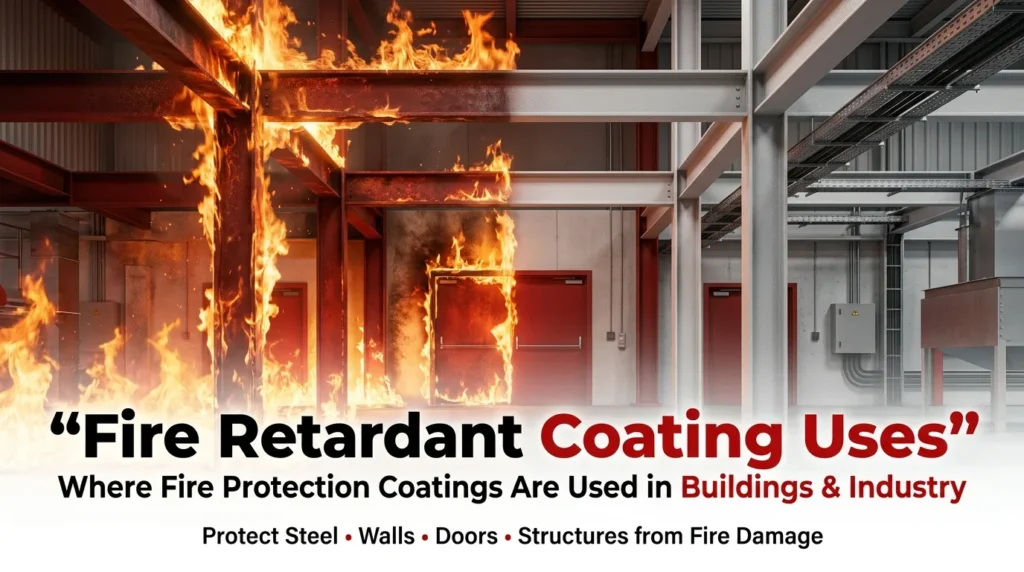
Fire safety is an essential requirement in modern construction, industrial facilities, and public infrastructure. As buildings become larger and more complex, protecting structural materials from fire exposure has become a critical part of design and risk management. One of the most effective passive fire protection solutions used today is fire retardant coating.
Fire retardant coatings are specially formulated to slow flame spread, reduce heat transfer, and improve the fire resistance of surfaces exposed to high temperatures. Unlike conventional paints, these coatings are engineered to react during a fire—helping protect the substrate beneath and delaying damage for a specific period.
They are used across a wide range of applications because they provide both safety performance and flexibility in design. Fire retardant coatings can be applied to steel, wood, walls, ceilings, electrical systems, and industrial equipment without significantly affecting the appearance or function of the surface.
These coatings are commonly used in:
- Structural steel and load-bearing frameworks
- Fire doors and timber surfaces
- Commercial interiors
- Warehouses and factories
- Electrical panels and cable trays
- Oil & gas and heavy industrial facilities
- Hotels, hospitals, schools, and public buildings
In many systems, fire retardant coatings use intumescent technology, which expands under heat to form an insulating char layer. This barrier protects the material beneath from direct flame and rapid temperature rise, helping maintain structural integrity and slowing the spread of fire.
The growing use of fire retardant coatings is driven by several factors:
- Increasing fire safety regulations
- Greater focus on occupant protection
- Demand for passive fire protection systems
- Protection of structural steel in modern architecture
- Reduced property damage and business interruption risk
- Compliance with building codes and insurance requirements
Because they can be applied across so many surfaces and industries, fire retardant coatings have become a practical and widely specified fire protection solution.
Introduction to Fire Retardant Coatings
Fire retardant coatings are widely used in modern construction and industrial fire protection to improve the fire resistance of surfaces exposed to heat and flame. As fire safety regulations become stricter and buildings become more complex, these coatings have become an important part of passive fire protection strategies across many industries.
Applied to steel, wood, walls, ceilings, and utility infrastructure, fire retardant coatings help slow flame spread, reduce heat transfer, and protect critical building components during a fire. They are used to enhance safety, reduce fire-related damage, and provide additional time for evacuation and emergency response.
Because they can be applied across a variety of materials without significantly changing the appearance of the surface, fire retardant coatings offer both practical fire protection and design flexibility.
What is a Fire Retardant Coating?
A fire retardant coating is a specialized protective coating designed to slow the spread of fire across a surface and improve the material’s resistance to heat and flame exposure.
Unlike ordinary paint, it is formulated with fire-resistant ingredients that react when exposed to high temperatures. These coatings help reduce how quickly a material ignites, burns, or transfers heat.
Depending on the product type, fire retardant coatings may:
- Slow flame spread across the surface
- Reduce ignition speed
- Lower heat transfer into the substrate
- Delay structural weakening during fire exposure
- Reduce overall fire damage
Many systems use intumescent technology, which expands under heat to form a thick insulating char layer that protects the material beneath from direct flame and rising temperatures.
Fire retardant coatings are commonly applied to:
- Structural steel
- Fire doors
- Wood panels and timber finishes
- Interior walls and ceilings
- Electrical cable trays
- Industrial equipment and support structures
They are often selected when both fire resistance and long-term surface protection are required.
Why Fire Retardant Coatings Are Important
Fire retardant coatings play a critical role in building and industrial safety because they provide passive fire protection that remains active at all times.
During a fire emergency, these coatings help:
- Slow the spread of flames through a building
- Delay heat penetration into structural materials
- Protect steel from reaching critical failure temperatures
- Reduce ignition risk on combustible materials like wood
- Improve building compartmentation
- Support safer evacuation routes
- Give emergency responders more time to act
Their importance is especially clear in high-risk environments where fire can spread quickly or where structural failure would have severe consequences.
Key benefits include:
- Improved occupant safety
- Reduced property damage
- Better protection of assets and equipment
- Lower risk of structural collapse
- Support for fire safety compliance
- Reduced business interruption after fire incidents
Because they work automatically during fire exposure without any mechanical activation, fire retardant coatings are a dependable long-term fire protection solution.
Growing Demand for Fire Protection Across Industries
Demand for fire retardant coatings continues to increase across construction, infrastructure, and industrial sectors due to growing awareness of fire safety and stricter regulatory requirements.
Several factors are driving this growth, including:
- Stronger building fire safety regulations
- Increased use of exposed structural steel in modern architecture
- Greater focus on life safety in commercial buildings
- Higher insurance and risk management requirements
- Demand for durable passive fire protection systems
- Increased investment in industrial and infrastructure development
Fire retardant coatings are now commonly specified in:
- Warehouses and logistics facilities
- Manufacturing plants
- Office buildings
- Shopping malls
- Hotels
- Hospitals
- Schools
- Airports
- Oil & gas facilities
- Power plants
- Public infrastructure projects
Their versatility, fire performance, and ability to protect multiple surface types make them a preferred solution for architects, contractors, facility managers, and industrial operators seeking safer, code-compliant buildings and long-term fire protection.
How Fire Retardant Coatings Work
Fire retardant coatings are engineered to react during fire exposure and protect the underlying material from heat and flames. Unlike standard paints, these coatings are designed specifically to improve fire resistance, reduce flame spread, and delay damage to structural and architectural surfaces.
When exposed to elevated temperatures, the coating forms a protective barrier that slows the transfer of heat to the substrate beneath. This helps preserve the integrity of the material, reduces fire growth, and improves the overall fire performance of the building.
Whether applied to steel, wood, walls, ceilings, or utility systems, fire retardant coatings act as an important protective layer during a fire emergency.
Flame Resistance & Heat Barrier Technology
The primary purpose of a fire retardant coating is to create resistance between the fire and the protected surface. It helps delay ignition, reduce burning speed, and lower the amount of heat transferred into the material.
This is achieved through heat-resistant coating technology that may:
- Slow the ignition of combustible materials
- Reduce surface burning rates
- Limit flame spread across the surface
- Reduce heat penetration into steel or timber
- Help contain fire within a localized area for longer
The coating acts as a thermal shield, helping prevent rapid temperature rise in the substrate.
This is especially important for:
- Structural steel, which can weaken quickly under heat
- Wood surfaces, which are combustible and can ignite rapidly
- Interior finishes where fire can spread across connected surfaces
By delaying heat transfer, the coating helps extend the fire resistance of the material and improves building safety.
Intumescent Expansion Under High Temperatures
Many fire retardant coatings use intumescent technology, one of the most effective methods of passive fire protection.
Under normal conditions, the coating appears like a standard paint or finish. However, when exposed to fire or extreme temperatures, it undergoes a chemical reaction and expands significantly—often many times its original thickness.
This process generally includes:
- Heat activating fire-reactive ingredients inside the coating
- Expansion of the coating film
- Swelling into a foam-like carbon layer
- Formation of a thick insulating char barrier
The expanded char layer:
- Shields the substrate from direct flame contact
- Slows heat penetration
- Helps maintain lower substrate temperatures
- Delays structural weakening
This reaction is especially useful on:
- Steel beams and columns
- Fire doors
- Timber panels
- Commercial building frameworks
- Industrial steel structures
Because the coating only expands during fire exposure, it remains visually unobtrusive during everyday use.
How Coatings Slow Flame Spread
Fire retardant coatings help interrupt the natural spread of fire across a surface. Without protection, flames can travel rapidly through exposed materials, increasing heat levels and spreading to nearby areas.
These coatings help slow that process by:
- Delaying surface ignition
- Lowering the rate of combustion
- Reducing heat release from the coated material
- Creating a barrier between flames and the substrate
- Limiting flame movement between connected surfaces
This added resistance helps reduce how quickly fire moves through:
- Structural frameworks
- Timber finishes
- Wall and ceiling systems
- Utility areas and service spaces
Slowing flame spread can:
- Reduce fire damage
- Improve compartmentation between building zones
- Provide additional evacuation time
- Support firefighting efforts during the early stages of a fire
Even a short delay in flame spread can make a significant difference during an emergency.
Role of Passive Fire Protection Systems
Fire retardant coatings are classified as a passive fire protection system. Passive fire protection is built directly into the building or structure and provides protection automatically without requiring activation.
Examples of passive fire protection include:
- Fire retardant coatings
- Intumescent paint systems
- Fire-rated walls
- Fire doors
- Firestopping systems
- Compartmentation barriers
This differs from active fire protection, which requires a response or activation during a fire.
Examples of active fire protection include:
- Fire alarms
- Sprinkler systems
- Smoke detectors
- Fire extinguishers
- Automatic suppression systems
The key advantage of passive fire protection is that it is always in place and ready to perform.
Fire retardant coatings contribute to passive fire protection by:
- Protecting structural elements continuously
- Slowing fire spread before active systems fully engage
- Supporting building stability during evacuation
- Helping active systems operate more effectively by buying critical response time
When combined with alarms, sprinklers, and emergency planning, fire retardant coatings become an essential part of a complete fire safety strategy for buildings and industrial facilities.
Fire Retardant Coating Uses on Structural Steel
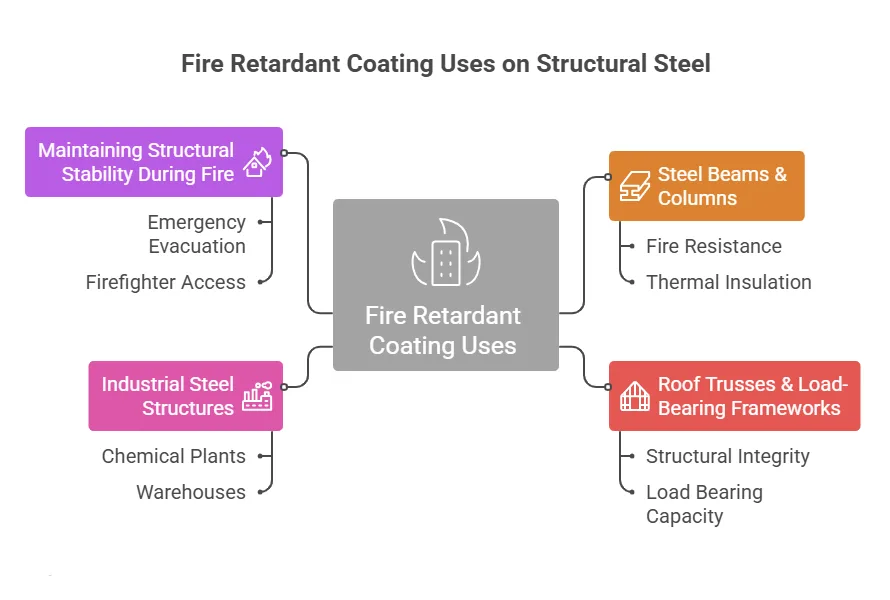
Structural steel is one of the most important applications for fire retardant coatings in modern construction and industrial fire protection. While steel does not burn, it can rapidly lose strength when exposed to high temperatures. Without fire protection, steel can soften, deform, and eventually fail during a fire, putting the entire structure at risk.
Fire retardant coatings help protect steel by slowing heat transfer and delaying the temperature rise of the metal. This helps maintain structural integrity for longer, giving occupants more time to evacuate and emergency teams more time to respond.
Because of this, fire retardant coatings are widely used across commercial buildings, warehouses, factories, and infrastructure projects where steel is a primary load-bearing material.
Steel Beams & Columns
Steel beams and columns are among the most common structural elements protected with fire retardant coatings. These components carry significant loads throughout the building, so maintaining their performance during a fire is critical.
Common protected steel elements include:
- Main support columns
- Horizontal beams
- Floor support framing
- Mezzanine structures
- Staircase support steel
- Perimeter structural steel
Fire retardant coatings on these elements help:
- Reduce heat transfer into the steel
- Delay critical temperature rise
- Extend fire resistance ratings
- Maintain load-bearing performance longer during fire exposure
These systems are often designed to meet fire resistance requirements such as:
- 30 minutes
- 60 minutes
- 90 minutes
- 120 minutes or more
depending on building code and project specifications.
Roof Trusses & Load-Bearing Frameworks
Roof trusses and load-bearing steel frameworks are also commonly protected with fire retardant coatings. These elements play a critical role in supporting roof systems and distributing structural loads across the building.
Typical applications include:
- Steel roof trusses
- Rafters
- Purlins
- Portal frames
- Roof support assemblies
- Exposed architectural steel frameworks
If exposed to fire without protection, rising temperatures can weaken these components and lead to:
- Roof sagging
- Structural deformation
- Loss of load-bearing capacity
- Partial or total collapse
Applying fire retardant coating helps insulate the steel and preserve stability for a longer duration, reducing the risk of sudden failure.
This is especially important in:
- Warehouses
- Factories
- Large-span industrial buildings
- Aircraft hangars
- Commercial atriums
- Shopping malls
where roof structures often cover wide open spaces.
Industrial Steel Structures
Fire retardant coatings are heavily used on structural steel in industrial facilities where fire risk may be elevated due to machinery, fuel sources, heat-generating processes, or stored materials.
Common industrial applications include:
- Manufacturing plants
- Warehouses
- Storage facilities
- Oil & gas plants
- Refineries
- Power generation facilities
- Processing units
- Utility buildings
Steel components often protected include:
- Pipe racks
- Support frames
- Equipment platforms
- Catwalks
- Storage tank supports
- Heavy machinery support structures
These coatings help improve fire resistance while also supporting long-term protection of critical infrastructure and operational assets.
In harsh environments, the fire retardant coating system may also be paired with anti-corrosion primers or protective topcoats for added durability.
Maintaining Structural Stability During Fire
The most important reason for applying fire retardant coatings to structural steel is to maintain stability during fire exposure.
Although steel is non-combustible, it begins to lose strength as temperatures rise. Under severe fire conditions, this can lead to:
- Steel expansion
- Bending or twisting
- Loss of stiffness
- Reduced load-bearing capacity
- Structural instability
Fire retardant coatings slow this process by creating a thermal barrier between the flames and the steel surface.
This helps:
- Delay the steel from reaching critical temperatures
- Maintain the shape and strength of the structure
- Reduce the likelihood of early collapse
- Protect escape routes and occupied spaces
- Support firefighting operations
- Improve overall building resilience during fire
By preserving structural performance during the most critical stages of a fire, fire retardant coatings provide valuable time for evacuation, emergency response, and fire control—making them an essential part of fire-safe steel construction in both buildings and industrial facilities.
Fire Retardant Coating Uses on Wood & Timber Surfaces
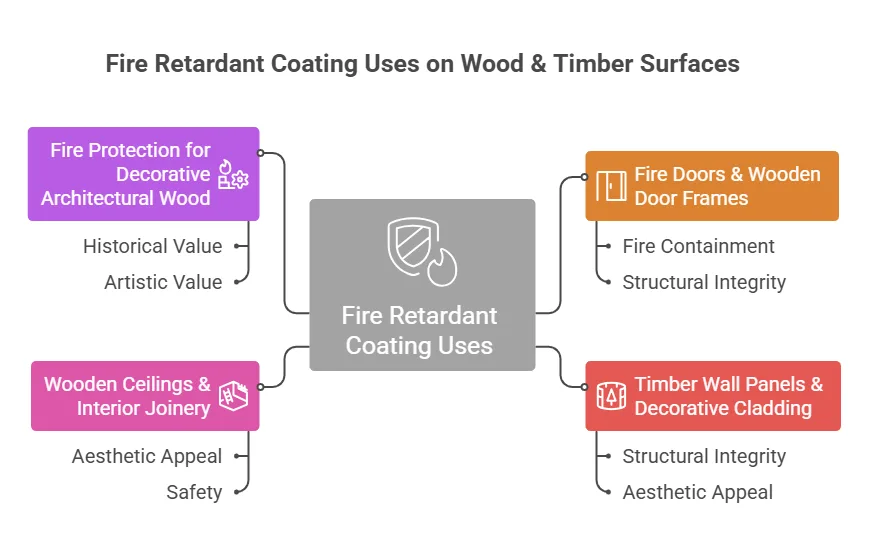
Wood and timber are widely used in modern architecture for their natural appearance, warmth, and design flexibility. From fire doors and wall panels to ceilings and decorative finishes, timber remains a popular material in commercial, hospitality, and residential spaces. However, because wood is combustible, it requires additional protection to improve fire performance and meet fire safety requirements.
Fire retardant coatings are commonly applied to wood and timber surfaces to reduce flame spread, delay ignition, and improve fire resistance without significantly changing the appearance of the material. These coatings allow architects and builders to preserve the aesthetic value of timber while enhancing safety and compliance.
They are widely used in both visible decorative finishes and functional fire-rated building components.
Fire Doors & Wooden Door Frames
One of the most common uses of fire retardant coating on wood is for fire doors and wooden door frames. Fire-rated doors play an important role in compartmentation, helping slow the movement of fire and smoke between rooms or building zones.
Fire retardant coatings applied to these surfaces help:
- Reduce ignition speed
- Slow flame spread across the wood
- Improve the fire resistance of door assemblies
- Support compartmentation and escape route protection
- Help maintain compliance with fire door requirements
Common applications include:
- Fire-rated wooden doors
- Door frames
- Door leaves
- Architraves
- Timber door trims
These coatings are frequently used in:
- Hotels
- Offices
- Hospitals
- Schools
- Apartment buildings
- Public buildings
where fire doors are part of the required fire safety design.
Timber Wall Panels & Decorative Cladding
Timber wall panels and decorative wood cladding are widely used in interior architecture because they add warmth, texture, and a premium finish to a space. Fire retardant coatings allow these surfaces to maintain their design appeal while improving fire safety performance.
Typical applications include:
- Timber wall cladding
- Veneer panels
- Decorative wood feature walls
- Acoustic wall panels
- Corridor wall linings
- Reception and lobby finishes
Benefits of coating timber wall systems include:
- Slower surface ignition
- Reduced flame spread across connected timber surfaces
- Improved fire classification of the finish
- Better protection in high-occupancy interiors
- Support for code compliance without sacrificing aesthetics
Clear or low-build systems are often used to preserve the visible wood grain.
Wooden Ceilings & Interior Joinery
Wooden ceilings and interior joinery are another common application for fire retardant coatings, especially in decorative commercial interiors.
Common protected elements include:
- Timber ceiling panels
- Slatted wood ceilings
- Coffered ceilings
- Decorative beams
- Joinery details
- Built-in cabinetry
- Wall trims and moldings
Because ceilings can contribute to vertical flame spread, fire retardant coating helps reduce how quickly fire moves across overhead surfaces.
Key benefits include:
- Delayed ignition
- Reduced flame spread overhead
- Improved fire resistance in occupied spaces
- Enhanced safety in corridors, halls, and assembly areas
- Preservation of decorative timber finishes
These systems are often used in:
- Hotels
- Restaurants
- Auditoriums
- Conference halls
- Offices
- Luxury interiors
where both design and safety are important.
Fire Protection for Decorative Architectural Wood
Architectural wood features are increasingly used in modern building design, from exposed timber ceilings to custom paneling and decorative millwork. Fire retardant coatings make it possible to use these finishes more safely by improving their fire performance while retaining their natural appearance.
Applications include:
- Exposed timber beams
- Decorative columns
- Wooden partitions
- Feature ceilings
- Staircase finishes
- Interior wood sculptures or feature elements
- Custom architectural millwork
These coatings are particularly valuable because they can offer:
- Transparent or clear finishes
- Minimal impact on texture or grain appearance
- Added fire resistance without hiding the design
- Long-term protection for exposed timber surfaces
This makes them ideal for spaces where visual aesthetics are just as important as fire safety.
By applying fire retardant coatings to wood and timber surfaces, designers and builders can preserve the beauty of natural wood while improving fire resistance, reducing risk, and helping ensure safer, code-compliant interiors across commercial and architectural projects.
Fire Retardant Coating Uses in Commercial Buildings
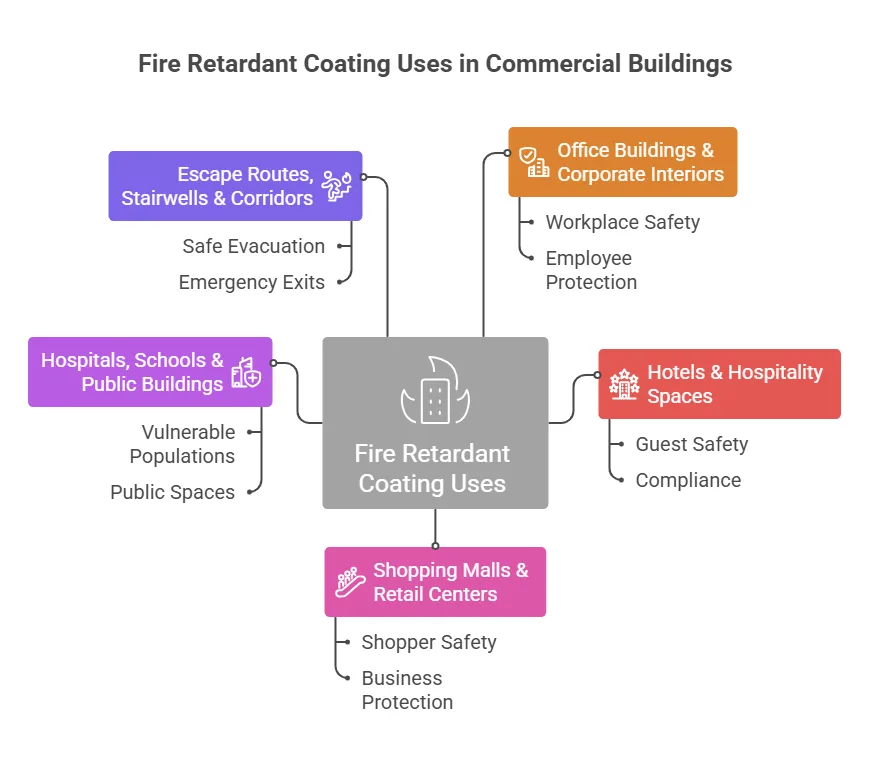
Fire retardant coatings are widely used throughout commercial buildings to improve fire safety, reduce the spread of flames, and protect both structural and interior surfaces during fire exposure. Commercial spaces often have high occupancy levels, valuable assets, and complex building layouts, making fire protection an essential part of design, construction, and long-term maintenance.
These coatings help protect key building elements while supporting compliance with fire safety regulations and improving occupant safety during emergencies. They are commonly applied to structural steel, wood finishes, walls, ceilings, utility spaces, and critical circulation routes throughout commercial properties.
Because they can provide strong fire resistance while maintaining architectural appearance, fire retardant coatings are frequently specified in modern commercial projects.
Office Buildings & Corporate Interiors
Office buildings rely on fire retardant coatings to protect both structural frameworks and interior finishes. With large floor areas, shared workspaces, meeting rooms, and high daily occupancy, slowing fire spread is critical to life safety and business continuity.
Common office applications include:
- Structural steel columns and beams
- Interior walls and ceilings
- Fire-rated partitions
- Timber wall panels and decorative finishes
- Electrical rooms and service shafts
- Ceiling voids and exposed building services
Benefits include:
- Slower flame spread through occupied spaces
- Protection of load-bearing steel structures
- Improved evacuation time for occupants
- Reduced damage to office assets and infrastructure
- Support for building fire code compliance
Fire retardant coatings are especially useful in open-plan office environments with exposed architectural finishes.
Hotels & Hospitality Spaces
Hotels and hospitality buildings require a high level of fire protection because they combine guest accommodation, public gathering spaces, kitchens, corridors, and service infrastructure within one building.
Fire retardant coatings are commonly used on:
- Fire doors and timber door frames
- Decorative wall cladding
- Wooden ceilings
- Structural steel frameworks
- Corridor wall finishes
- Lobby feature panels
- Service and utility areas
They help provide:
- Improved guest safety during emergencies
- Protection of evacuation routes
- Reduced fire spread between rooms and corridors
- Preservation of decorative architectural finishes
- Compliance with hospitality fire safety regulations
Because many hospitality spaces use decorative wood, exposed finishes, and premium interior materials, clear or decorative fire retardant coatings are often preferred.
Shopping Malls & Retail Centers
Shopping malls and retail centers typically involve large public spaces, multiple tenants, complex mechanical systems, and significant foot traffic. Fire retardant coatings are used to protect structural and interior surfaces while reducing fire risk across shared spaces.
Common applications include:
- Structural steel frames
- Shopfront timber finishes
- Ceiling systems
- Public atriums
- Food court structures
- Utility shafts and service corridors
- Back-of-house storage areas
These coatings help:
- Protect large-span steel structures
- Reduce flame spread through shared retail zones
- Improve fire separation between occupancies
- Protect visitors, staff, and inventory
- Support safer evacuation from high-occupancy areas
They are especially important in malls where fire can spread rapidly through open atrium layouts.
Hospitals, Schools & Public Buildings
Fire retardant coatings are also widely used in public buildings where occupant safety is especially critical. In facilities such as hospitals and schools, safe evacuation may be slower or more complex, making passive fire protection even more important.
Common applications include:
- Patient corridors and wards
- Classrooms and lecture halls
- Auditoriums
- Administrative offices
- Waiting areas
- Public lobbies
- Interior timber finishes
- Fire-rated doors and partitions
Key benefits include:
- Additional evacuation time during emergencies
- Protection of vulnerable occupants
- Slower fire spread through circulation spaces
- Improved compartmentation between building zones
- Support for strict public building safety regulations
These coatings help protect essential services while maintaining safe and usable environments for staff, visitors, patients, and students.
Escape Routes, Stairwells & Corridors
Escape routes are among the most critical areas in any commercial building, and fire retardant coatings are commonly applied here to help keep these pathways safer during an emergency.
Typical protected areas include:
- Stairwells
- Emergency exits
- Exit corridors
- Lift lobbies
- Fire escape enclosures
- Protected passageways
Fire retardant coatings in these areas help:
- Reduce flame spread along walls and ceilings
- Protect structural steel surrounding exit routes
- Maintain safer evacuation paths
- Delay heat penetration into enclosed escape areas
- Improve visibility and accessibility for occupants and emergency responders
Protecting these circulation zones is essential because they are the primary paths occupants rely on during evacuation.
Across offices, hotels, malls, hospitals, schools, and public infrastructure, fire retardant coatings continue to be an important fire safety solution—helping commercial buildings improve protection, reduce fire damage, and support safer evacuation and long-term compliance.
Industrial Uses of Fire Retardant Coatings
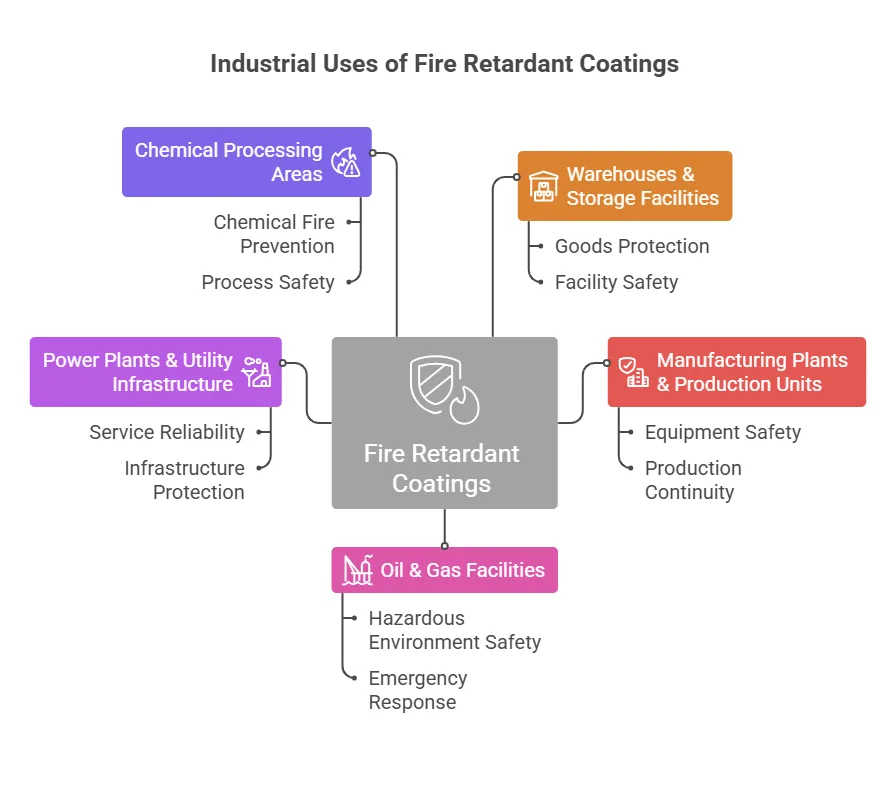
Fire retardant coatings are widely used across industrial environments where fire risks are often higher due to heat-generating equipment, flammable materials, fuel storage, electrical systems, and continuous operations. In these settings, a fire can lead to severe structural damage, equipment loss, operational downtime, and safety risks for workers.
Applying fire retardant coatings helps improve fire resistance, reduce flame spread, and protect critical industrial assets during fire exposure. These coatings are commonly used on structural steel, storage systems, processing equipment supports, utility infrastructure, and service areas.
Because they provide reliable passive fire protection without interfering with operations, fire retardant coatings are an essential part of industrial fire safety planning.
Warehouses & Storage Facilities
Warehouses and storage facilities often contain high volumes of stored goods, packaging materials, pallet systems, machinery, and logistics infrastructure. This creates a significant fire load and increases the need for effective fire protection.
Fire retardant coatings are commonly applied to:
- Structural steel beams and columns
- Roof trusses and support frames
- Storage mezzanines
- Loading bay structures
- Fire doors
- Internal partitions
- Utility and electrical service areas
Key benefits include:
- Slower flame spread through storage zones
- Protection of steel frameworks during fire exposure
- Reduced risk of structural collapse
- Protection of inventory and stored materials
- Improved evacuation time for staff
- Reduced business interruption after fire incidents
These coatings are especially valuable in large-span warehouses where structural stability is critical.
Manufacturing Plants & Production Units
Manufacturing facilities contain machinery, production lines, electrical systems, process heat, and moving equipment—all of which can increase fire risk.
Fire retardant coatings are often used on:
- Steel columns and roof structures
- Machine support frames
- Processing platforms
- Conveyor supports
- Utility rooms
- Service shafts
- Fire-rated wall systems
- Maintenance access platforms
They help:
- Protect critical load-bearing structures
- Reduce heat transfer to structural steel
- Slow fire spread across production zones
- Support safer shutdown and emergency response procedures
- Protect expensive machinery and plant infrastructure
In high-output manufacturing environments, fire retardant coatings also help reduce potential losses from downtime and damage to production assets.
Oil & Gas Facilities
Oil & gas facilities present some of the most demanding fire protection requirements due to the presence of fuels, hydrocarbons, high operating temperatures, and explosive risk.
Fire retardant coatings are commonly used on:
- Pipe racks
- Structural steel supports
- Processing platforms
- Tank supports
- Access stairways
- Equipment skids
- Offshore structures
- Storage terminals
Benefits include:
- Improved resistance to fire and extreme heat exposure
- Protection of structural steel in hydrocarbon fire scenarios
- Delayed heat impact on support systems
- Protection of critical processing infrastructure
- Enhanced plant resilience during emergency conditions
Because of the harsh environment, these systems are often combined with corrosion-resistant primers and protective topcoats for long-term durability.
Power Plants & Utility Infrastructure
Power plants and utility infrastructure require continuous operation and contain critical systems that must remain protected in the event of a fire. Fire retardant coatings are widely used to protect both the structure and operational infrastructure of these facilities.
Typical applications include:
- Steel support structures
- Turbine platforms
- Cable trays
- Control rooms
- Generator housings
- Transformer support structures
- Service tunnels
- Utility enclosures
These coatings help:
- Protect essential infrastructure from heat damage
- Reduce fire spread around electrical systems
- Maintain structural integrity during emergency events
- Improve safety for operations personnel
- Support continuity of power generation and utility services
They are commonly specified in thermal power plants, renewable energy infrastructure, substations, and utility service buildings.
Chemical Processing Areas
Chemical processing facilities often involve high temperatures, combustible materials, pressurized systems, and chemical exposure—all of which increase the complexity of fire protection.
Fire retardant coatings are commonly applied in:
- Processing units
- Reactor support structures
- Pipe bridges
- Equipment platforms
- Storage tank support frames
- Utility corridors
- Loading stations
- Maintenance access structures
These coatings help:
- Slow flame spread in high-risk process areas
- Protect steel structures from heat-related failure
- Reduce damage to essential equipment supports
- Improve worker safety during emergencies
- Support safer shutdown procedures and fire response
In these environments, coating systems are often selected not only for fire resistance but also for compatibility with chemical exposure, humidity, and aggressive industrial conditions.
Across warehouses, manufacturing plants, oil & gas sites, power facilities, and chemical processing areas, fire retardant coatings provide essential long-term protection—helping industries improve fire safety, protect infrastructure, reduce downtime, and maintain safer working environments.
Fire Retardant Coating Uses for Electrical Protection
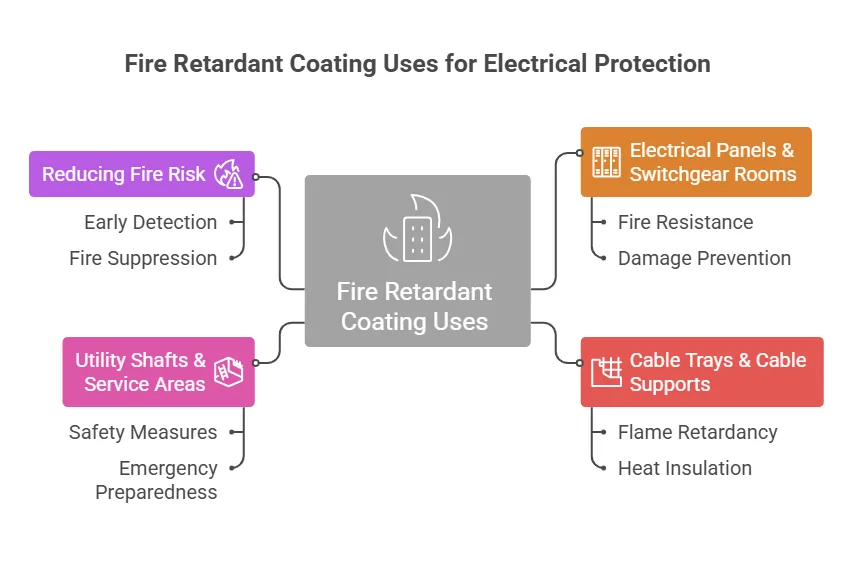
Electrical systems are one of the most common sources of fire in commercial and industrial environments. Overloaded circuits, overheating equipment, short circuits, damaged insulation, and electrical faults can all trigger fires that spread rapidly through surrounding infrastructure.
Fire retardant coatings are widely used around electrical installations to reduce fire risk, slow flame spread, and protect critical systems during fire exposure. These coatings form part of a broader passive fire protection strategy designed to improve safety, protect essential services, and reduce damage to equipment and infrastructure.
They are commonly applied in electrical rooms, utility spaces, cable management systems, and service corridors where fire protection is essential for operational continuity and life safety.
Electrical Panels & Switchgear Rooms
Electrical panels and switchgear rooms contain critical power distribution equipment and are often considered high-risk fire zones due to the concentration of electrical load and continuous operation.
Fire retardant coatings are commonly used on:
- Electrical panel enclosures
- Switchgear cabinets
- Control panels
- Distribution boards
- Panel support structures
- Fire-rated walls surrounding electrical rooms
- Structural steel within service spaces
These coatings help:
- Reduce the spread of fire from electrical faults
- Protect nearby surfaces from heat exposure
- Improve compartmentation within electrical rooms
- Delay damage to surrounding infrastructure
- Support safer access for emergency response and shutdown procedures
Because electrical rooms are central to building operations, protecting them helps reduce wider disruption during fire incidents.
Cable Trays & Cable Supports
Cable trays and cable support systems are another important application for fire retardant coatings. Electrical cables can act as pathways for flame spread, allowing fire to move quickly between floors, rooms, or service zones if left unprotected.
Fire retardant coatings are commonly applied to:
- Cable trays
- Cable ladders
- Cable supports
- Cable containment systems
- Conduit supports
- Junction areas
Benefits include:
- Slower flame spread along cable routes
- Reduced heat transfer between grouped cables
- Better protection of critical electrical infrastructure
- Reduced risk of fire traveling between compartments through service penetrations
- Improved resilience of communication and power systems during fire exposure
These systems are especially important in facilities with dense cable networks such as factories, hospitals, data centers, and utility plants.
Utility Shafts & Service Areas
Utility shafts and service areas carry essential building services including electrical wiring, communication systems, mechanical services, and control infrastructure. Because multiple systems are concentrated in confined spaces, these areas can become fire spread pathways if not properly protected.
Fire retardant coatings are commonly used in:
- Vertical utility shafts
- Service risers
- Mechanical rooms
- Electrical service corridors
- Plant rooms
- Ceiling service voids
- Maintenance access zones
They help:
- Improve fire compartmentation between building levels
- Protect structural surfaces around service penetrations
- Slow the spread of fire through enclosed service zones
- Reduce heat transfer around electrical infrastructure
- Support safer containment of fire in technical areas
Protecting these spaces is especially important in multi-story buildings and industrial facilities where services run through multiple floors.
Reducing Fire Risk Around Electrical Systems
The overall purpose of using fire retardant coatings in electrical protection is to reduce the likelihood and severity of fire-related damage around electrical systems.
These coatings contribute to fire safety by helping to:
- Slow flame spread caused by electrical faults
- Reduce ignition risk on surrounding surfaces
- Protect adjacent structural steel and wall systems
- Limit heat transfer through service areas
- Support fire compartmentation around electrical infrastructure
- Protect essential power and communication systems for longer during fire exposure
- Improve safety for building occupants and maintenance personnel
They are widely used in:
- Warehouses
- Manufacturing plants
- Commercial buildings
- Hospitals
- Airports
- Data centers
- Power plants
- Utility facilities
By adding passive fire protection around electrical systems, fire retardant coatings help improve operational resilience, reduce equipment damage, support safer evacuation, and protect critical building services when fire emergencies occur.
Benefits of Using Fire Retardant Coatings
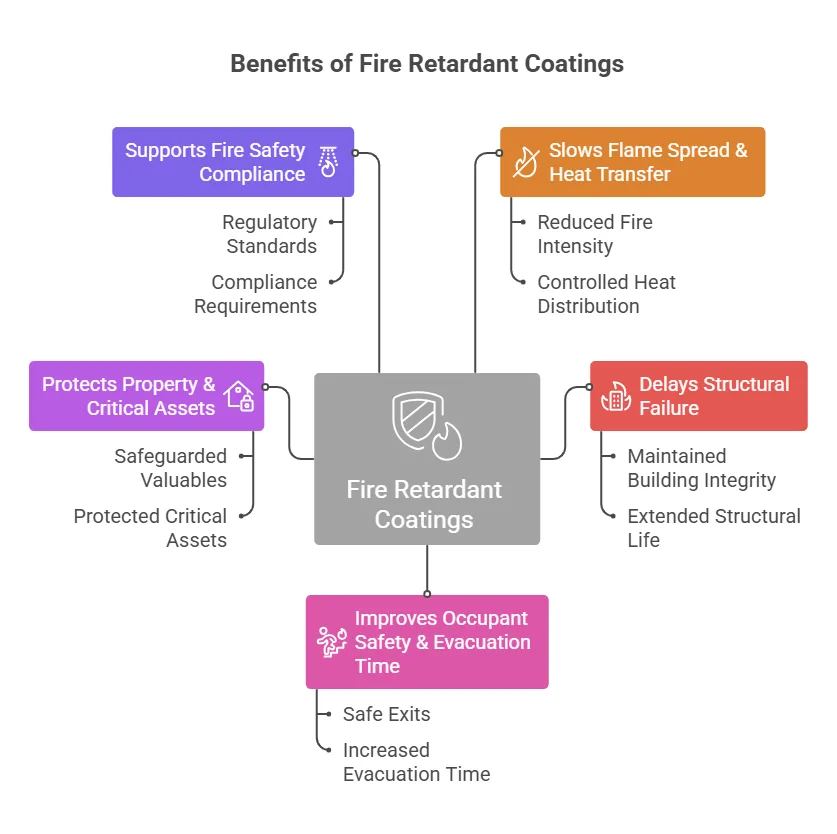
Fire retardant coatings offer a practical and effective way to improve fire safety across buildings, industrial facilities, and critical infrastructure. They are widely used because they provide passive fire protection without affecting day-to-day operations or significantly altering the appearance of the surface.
Whether applied to structural steel, wood, walls, ceilings, or electrical systems, fire retardant coatings help reduce fire damage, improve building resilience, and support long-term safety planning.
Their value goes beyond fire resistance alone—they also help protect occupants, preserve assets, and support regulatory compliance.
Slows Flame Spread & Heat Transfer
One of the biggest advantages of fire retardant coatings is their ability to slow the spread of flames across a surface.
When exposed to heat, the coating creates a protective barrier that helps:
- Delay ignition
- Reduce the speed at which flames move across the substrate
- Lower heat transfer into the material beneath
- Limit the spread of fire between adjacent surfaces
This is especially important in buildings where fire can spread quickly through:
- Structural frameworks
- Timber finishes
- Wall panels
- Ceiling systems
- Cable routes and service areas
By slowing fire growth, the coating helps contain damage and reduces how quickly the fire can move through the building.
Delays Structural Failure
Fire retardant coatings are especially important on structural steel because steel can rapidly lose strength when exposed to high temperatures.
Without protection, steel may:
- Expand under heat
- Twist or bend
- Lose stiffness
- Fail structurally
Fire retardant coatings help insulate the steel and delay temperature rise, allowing the structure to remain stable for longer.
This helps:
- Maintain load-bearing capacity during fire exposure
- Reduce the risk of collapse
- Protect roof systems, columns, and beams
- Improve structural resilience during emergency conditions
This added time is critical in warehouses, factories, commercial buildings, and public infrastructure where structural stability directly impacts life safety.
Improves Occupant Safety & Evacuation Time
A key benefit of fire retardant coatings is improved safety for building occupants.
By slowing flame spread and delaying structural failure, these coatings help create more time during the early stages of a fire emergency.
This extra time supports:
- Safer evacuation of occupants
- Improved visibility and access to escape routes
- More effective emergency response
- Reduced panic during evacuation
- Better conditions for firefighters entering the building
This is particularly important in:
- Offices
- Hotels
- Hospitals
- Schools
- Shopping malls
- Public assembly spaces
where large numbers of people may need to exit quickly and safely.
Protects Property & Critical Assets
Fire retardant coatings also help protect valuable property, equipment, and infrastructure from severe fire damage.
Protected assets may include:
- Structural steel frameworks
- Machinery and production equipment
- Inventory and stored materials
- Electrical systems
- Utility infrastructure
- Interior architectural finishes
- Fire doors and partitions
Benefits include:
- Reduced fire-related repair costs
- Lower risk of equipment loss
- Protection of critical business operations
- Reduced downtime after fire incidents
- Improved long-term asset preservation
For industrial facilities, this protection can significantly reduce operational disruption and financial losses following a fire.
Supports Fire Safety Compliance
Fire retardant coatings are commonly specified to help buildings meet local fire safety regulations and project compliance requirements.
They can support compliance with recognized standards from organizations such as:
- ASTM International
- British Standards Institution
- Bureau of Indian Standards
- Underwriters Laboratories
They are often used to help meet requirements related to:
- Fire resistance ratings
- Structural fire protection
- Flame spread control
- Building code approvals
- Inspection and certification processes
- Insurance risk management
Using certified fire retardant coating systems helps architects, contractors, and building owners demonstrate compliance while improving long-term fire performance.
Overall, fire retardant coatings provide a valuable combination of safety, durability, asset protection, and regulatory support—making them an essential solution for modern fire-safe construction and industrial fire protection.
How to Choose the Right Fire Retardant Coating for Your Application
Choosing the right fire retardant coating is essential for achieving reliable fire performance, long-term durability, and regulatory compliance. Not every coating is suitable for every surface or environment, so selection should be based on the specific application, exposure conditions, and fire protection requirements of the project.
Whether protecting structural steel in a warehouse, timber finishes in a hotel, or electrical infrastructure in an industrial facility, selecting the correct coating system helps ensure both safety and performance over time.
Below are the key factors to consider when specifying a fire retardant coating.
Surface Type & Material Compatibility
The first step is identifying the surface that needs protection. Fire retardant coatings are formulated for specific substrates, and using the correct system is critical for adhesion, durability, and fire resistance.
Common substrates include:
- Structural steel
- Wood and timber
- Fire doors
- Concrete surfaces
- Gypsum board and partitions
- Cable trays
- Utility structures
- Decorative architectural finishes
Each material behaves differently under heat exposure, so the coating must be compatible with both the substrate and the intended fire rating.
Key considerations include:
- Surface porosity
- Existing coating condition
- Primer compatibility
- Surface texture
- Interior or exposed finish requirements
- Adhesion performance
For example:
- Steel typically requires a compatible anti-corrosion primer before fire retardant coating application
- Wood may require a clear or decorative finish to preserve appearance
- Utility infrastructure may require a more durable industrial-grade system
Proper compatibility improves performance and extends coating life.
Required Fire Resistance Rating
Fire resistance rating is one of the most important selection criteria.
Fire retardant coatings are typically designed to provide protection for a defined period under fire exposure, such as:
- 30 minutes
- 60 minutes
- 90 minutes
- 120 minutes or more
The required rating depends on:
- Building code requirements
- Occupancy type
- Structural design
- Fire risk assessment
- Insurance requirements
- Project specifications
Higher ratings generally require greater coating thickness or a different coating system.
Typical examples include:
- Commercial interiors → lower or moderate fire rating requirements
- Structural steel in multi-story buildings → higher fire resistance requirements
- Industrial processing facilities → application-specific fire performance requirements
The selected coating must be tested and approved for the required rating on the specific substrate.
Indoor vs Outdoor Conditions
Environmental exposure has a major impact on coating performance. Fire retardant coatings for indoor use may not always be suitable for exterior applications.
Indoor environments generally involve:
- Controlled temperatures
- Lower UV exposure
- Lower weather exposure
- Reduced moisture variation
Outdoor environments may expose the coating to:
- Rain
- Humidity
- UV radiation
- Temperature fluctuations
- Condensation
- Corrosive airborne contaminants
Outdoor systems often require:
- Weather-resistant topcoats
- Additional moisture protection
- UV-resistant finishing layers
- Corrosion-resistant primers for steel
Common outdoor applications include:
- Exterior steel frameworks
- Industrial support structures
- Stair towers
- Warehouses
- Utility enclosures
Choosing a system rated for the correct exposure environment is essential for long-term durability.
Environmental & Chemical Exposure
Industrial and commercial environments can expose coatings to conditions beyond fire, including chemicals, abrasion, moisture, or aggressive cleaning processes.
These conditions can affect the lifespan and performance of the coating if not considered during specification.
Potential exposure factors include:
- High humidity
- Water washdown
- Oil and grease
- Solvents
- Chemical fumes
- Salt exposure
- Corrosive atmospheres
- Mechanical impact or abrasion
- Heavy traffic maintenance areas
Common examples include:
- Manufacturing plants
- Chemical processing facilities
- Oil & gas sites
- Warehouses
- Power plants
- Coastal buildings
In these environments, a complete system may include:
- Surface primer
- Fire retardant coating
- Protective topcoat for environmental resistance
This layered approach helps protect both fire performance and coating durability.
Certification & Fire Testing Standards
The final and most important step is verifying that the coating has been tested and certified for the intended use.
A fire retardant coating should be supported by recognized fire testing and certification documentation to confirm performance under fire exposure.
Common certifications may include standards from:
- ASTM International
- British Standards Institution
- Bureau of Indian Standards
- Underwriters Laboratories
Before specifying a product, it is helpful to review:
- Fire resistance test reports
- Technical data sheets
- Approved application thickness ranges
- Surface preparation guidelines
- Primer and topcoat compatibility
- Compliance certificates
- Maintenance recommendations
Choosing a tested and certified coating ensures:
- Verified fire performance
- Easier code approval
- Greater project confidence
- Better support during inspections
- Long-term compliance with fire safety regulations
By evaluating substrate compatibility, required fire rating, environmental exposure, and certification requirements, project teams can choose the right fire retardant coating system for safer, longer-lasting fire protection across commercial and industrial applications.
Frequently Asked Questions About Fire Retardant Coating Uses
Below are some of the most common questions about where fire retardant coatings are used and how they perform across different applications.
Where are fire retardant coatings commonly used?
Fire retardant coatings are used wherever additional fire resistance is needed to protect surfaces, structures, or building components from heat and flame exposure.
Common applications include:
- Structural steel beams and columns
- Roof trusses and steel frameworks
- Fire doors and wooden door frames
- Timber wall panels and decorative wood finishes
- Walls, ceilings, and partitions
- Electrical panels and switchgear rooms
- Cable trays and utility shafts
- Warehouses and storage facilities
- Manufacturing plants
- Commercial buildings such as offices, hotels, malls, and hospitals
They are especially common in spaces where slowing fire spread and protecting load-bearing elements is critical for safety and compliance.
Can fire retardant coatings be used on steel and wood?
Yes. Fire retardant coatings are widely used on both steel and wood, although the coating system is typically selected based on the substrate.
Steel Applications
On steel, fire retardant coatings help:
- Slow heat transfer into the metal
- Delay weakening under high temperatures
- Maintain load-bearing strength longer during fire exposure
Typical steel applications include:
- Structural columns
- Beams
- Roof supports
- Pipe racks
- Industrial frameworks
Wood Applications
On wood, fire retardant coatings help:
- Reduce ignition speed
- Slow flame spread across the surface
- Improve fire performance of decorative or structural timber
Common wood applications include:
- Fire doors
- Timber cladding
- Ceiling panels
- Decorative architectural wood
- Interior joinery
Different formulations may be used depending on the finish and performance required.
Are fire retardant coatings suitable for commercial buildings?
Yes. Fire retardant coatings are widely used in commercial buildings and are often part of the building’s overall fire safety strategy.
They are commonly applied in:
- Office buildings
- Hotels
- Shopping malls
- Restaurants
- Hospitals
- Schools
- Public buildings
- Auditoriums
- Retail spaces
Commercial applications often include:
- Structural steel protection
- Fire-rated walls and ceilings
- Fire doors
- Decorative wood finishes
- Utility and service areas
- Escape routes and stairwells
These coatings help improve occupant safety, support evacuation planning, and assist with compliance with fire safety regulations.
Can fire retardant coatings be used outdoors?
Yes—many fire retardant coatings are suitable for outdoor use when specified as part of an approved exterior system.
Outdoor applications may include:
- External steel frameworks
- Warehouse structures
- Stair towers
- Roof support steel
- Utility enclosures
- Industrial support structures
Exterior environments can expose coatings to:
- Rain
- Humidity
- UV radiation
- Temperature fluctuations
- Corrosion
For this reason, outdoor fire retardant coating systems often include:
- Primer
- Fire retardant coating
- Weather-resistant topcoat
Using the correct exterior-grade system helps maintain both fire performance and durability over time.
How long does a fire retardant coating last?
The lifespan of a fire retardant coating depends on several factors, including:
- Product quality
- Surface preparation
- Correct application thickness
- Indoor or outdoor exposure
- Moisture and environmental conditions
- UV exposure
- Mechanical wear or impact
- Inspection and maintenance frequency
When properly applied and maintained, fire retardant coatings can provide long-term protection for many years.
General performance can vary between:
- Interior systems → typically longer service life due to controlled conditions
- Exterior systems → may require more maintenance because of weather exposure
Routine inspection is recommended to check for:
- Cracking
- Peeling
- Impact damage
- Moisture exposure
- Surface wear
- Loss of coating thickness
With proper maintenance and timely repair, fire retardant coatings can continue to provide reliable fire protection throughout the life of the building or structure.
Conclusion – Why Fire Retardant Coating Uses Continue to Expand
Fire retardant coatings have become an essential part of modern fire protection across buildings, infrastructure, and industrial facilities. Their ability to slow flame spread, reduce heat transfer, and protect structural and architectural surfaces makes them one of the most practical passive fire protection solutions available today.
From structural steel and timber finishes to electrical systems and utility spaces, these coatings are used across a wide range of applications because they provide reliable protection without compromising functionality or design. As construction standards evolve and fire safety expectations continue to rise, the use of fire retardant coatings continues to grow across both commercial and industrial sectors.
Importance of Fire Protection Across Different Surfaces
Every material responds differently during a fire, which is why fire protection must be tailored to the surface being protected.
Fire retardant coatings are used on:
- Structural steel to delay heat-related weakening
- Wood and timber to reduce ignition and flame spread
- Walls and ceilings to improve compartmentation
- Fire doors to help maintain separation between spaces
- Electrical panels and cable trays to reduce fire spread through service areas
- Industrial structures exposed to heat, chemicals, or operational risk
This versatility makes fire retardant coatings valuable across many environments, including offices, hotels, warehouses, factories, hospitals, schools, and heavy industrial facilities.
By improving fire performance across multiple substrates, these coatings strengthen the overall fire safety strategy of the building.
Long-Term Safety & Structural Benefits
Beyond immediate fire resistance, fire retardant coatings offer long-term performance and protection for both people and property.
Key long-term benefits include:
- Reduced flame spread across critical surfaces
- Delayed structural failure during fire exposure
- Protection of load-bearing steel and timber components
- Improved occupant safety and evacuation time
- Reduced damage to assets, equipment, and interiors
- Lower repair and replacement costs after fire incidents
- Improved resilience of commercial and industrial infrastructure
- Support for long-term maintenance and risk management planning
When inspected and maintained correctly, these coatings can continue delivering dependable fire protection for many years.
Choosing the Right Coating for Each Application
The effectiveness of any fire retardant coating depends on selecting the right system for the application.
Key factors to review include:
- Surface type and material compatibility
- Required fire resistance rating
- Indoor or outdoor exposure
- Moisture and UV conditions
- Chemical or industrial exposure
- Desired appearance or decorative finish
- Maintenance expectations
- Fire certification and testing documentation
A properly specified coating system may include:
- Surface preparation
- Primer
- Fire retardant coating
- Protective topcoat where required
Matching the coating to the environment and performance requirement helps ensure both durability and fire safety performance.
Final Recommendations for Fire-Safe Buildings & Industrial Projects
For architects, contractors, facility managers, and industrial operators, fire retardant coatings are a practical investment in long-term safety.
Best practice recommendations include:
- Identify fire risks early during project planning
- Protect critical structural and architectural surfaces
- Select coatings tested for the required fire rating
- Verify compatibility with steel, wood, or other substrates
- Follow manufacturer application thickness requirements
- Review certification documents before installation
- Schedule regular inspections after application
- Repair damaged areas promptly to maintain performance
As fire safety regulations continue to evolve, fire retardant coatings remain a trusted solution for protecting buildings, preserving structural integrity, reducing fire damage, and improving life safety.
Whether used in commercial interiors, warehouses, electrical systems, or heavy industrial infrastructure, fire retardant coatings continue to expand because they deliver what every project needs most—reliable protection, long-term durability, and safer environments during fire emergencies.