

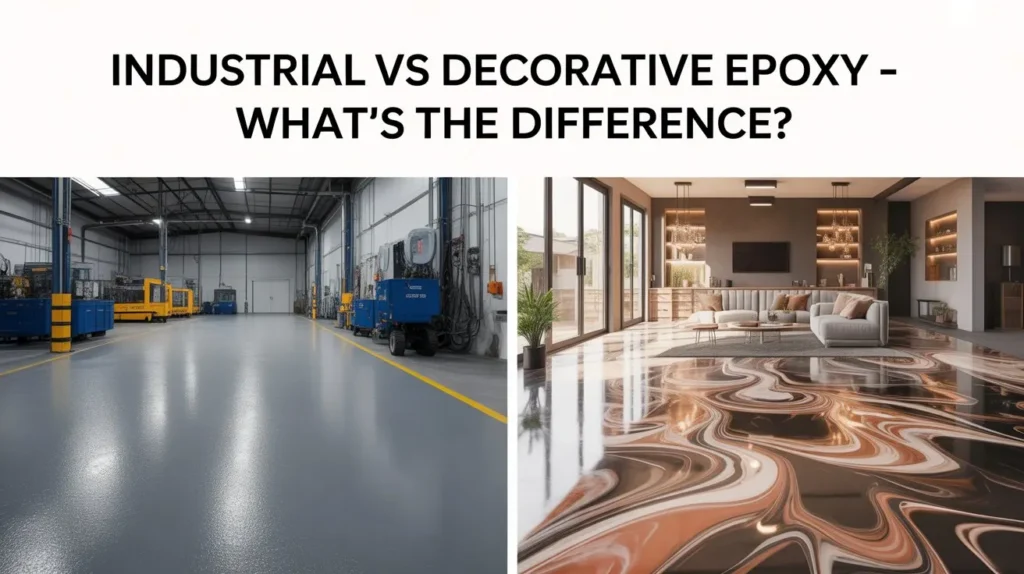
Epoxy flooring has become one of the most popular surface solutions in industrial, commercial, and even residential spaces. However, not all epoxy systems are the same. The two major categories—industrial epoxy and decorative epoxy—serve very different purposes.
While industrial epoxy focuses on strength, durability, and performance under extreme conditions, decorative epoxy emphasizes aesthetics along with moderate durability. Choosing the right system depends on your environment, load requirements, chemical exposure, and design expectations.
In this detailed guide, we’ll compare industrial vs decorative epoxy in terms of composition, strength, thickness, performance, cost, maintenance, and applications.
Introduction to Epoxy Flooring
Epoxy flooring is created by mixing epoxy resin and a hardener, forming a rigid plastic-like material that bonds strongly to concrete and metal surfaces. Once cured, epoxy creates a seamless, durable, and non-porous surface.
Why epoxy is widely used:
However, epoxy systems are formulated differently depending on whether the goal is heavy-duty industrial protection or decorative enhancement.
What Is Industrial Epoxy?
Industrial epoxy is a high-performance coating system designed for extreme environments. It is engineered to withstand heavy machinery, chemical spills, forklift traffic, and constant mechanical stress.
Key Characteristics of Industrial Epoxy:
Industrial epoxy is commonly used in:
Its primary goal is protection and structural reinforcement rather than aesthetics.
What Is Decorative Epoxy?
Decorative epoxy flooring combines functionality with visual appeal. While it still provides durability, its main purpose is to enhance the appearance of floors.
Key Characteristics of Decorative Epoxy:
Common applications include:
Decorative epoxy offers moderate strength but focuses more on visual impact.
Composition Differences
Although both systems use resin and hardener, their formulations differ significantly.
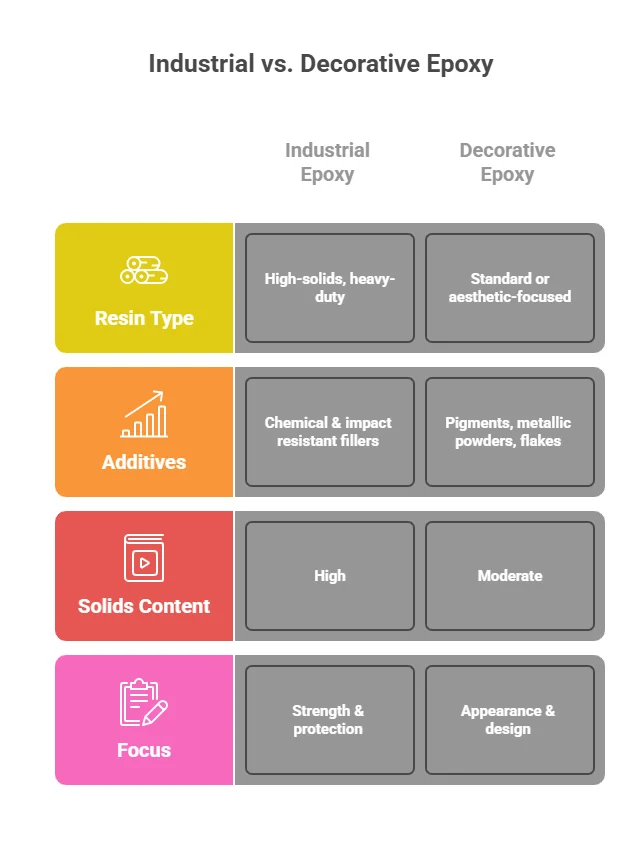
Industrial epoxy often includes additives for chemical resistance and mechanical strength. Decorative epoxy includes color pigments, metallic elements, and design aggregates.
Thickness & Strength Comparison
Thickness plays a major role in durability.
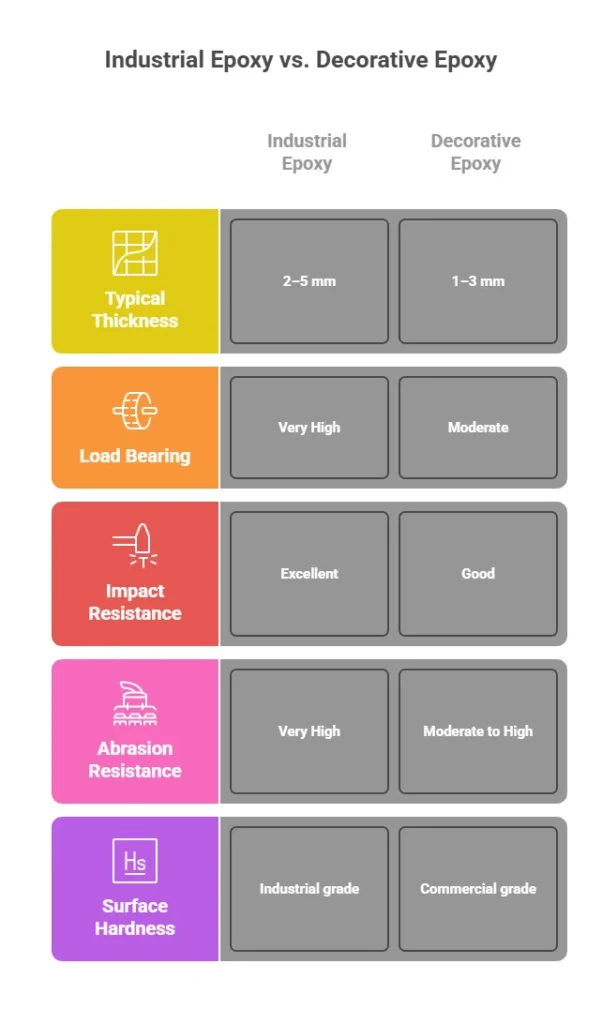
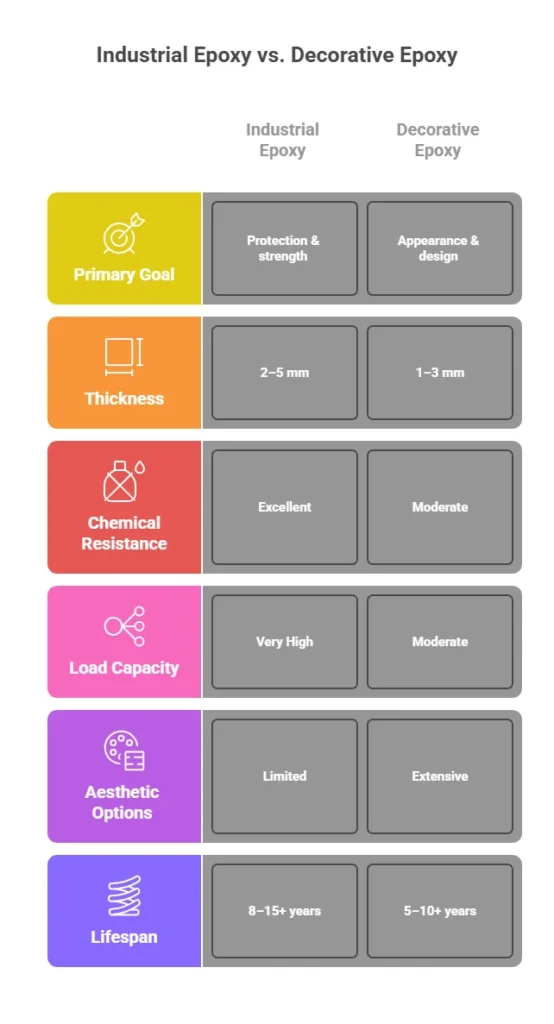
Industrial systems are thicker and more resistant to mechanical stress. Decorative systems are thinner but sufficient for commercial traffic.
Performance Comparison
Load-Bearing Capacity
Industrial epoxy supports:
Decorative epoxy handles:
Chemical Resistance
Industrial epoxy resists:
Decorative epoxy provides moderate chemical resistance but may not withstand harsh industrial chemicals.
Abrasion Resistance
Industrial systems are designed for high friction and wear, while decorative systems are suitable for controlled environments with moderate movement.
UV Stability
Decorative epoxy may include UV-stable topcoats to prevent yellowing in exposed areas. Industrial epoxy is usually installed indoors where UV exposure is limited.
Slip Resistance
Both systems can incorporate anti-slip aggregates, but industrial floors often require higher slip resistance for safety compliance.
Appearance & Finish Comparison
Industrial Epoxy Finish
Decorative Epoxy Finish
Decorative epoxy offers far more design flexibility.
Application Areas
Industrial Epoxy Used In:
Decorative Epoxy Used In:
Cost Comparison
Cost varies depending on thickness, system type, and preparation requirements.
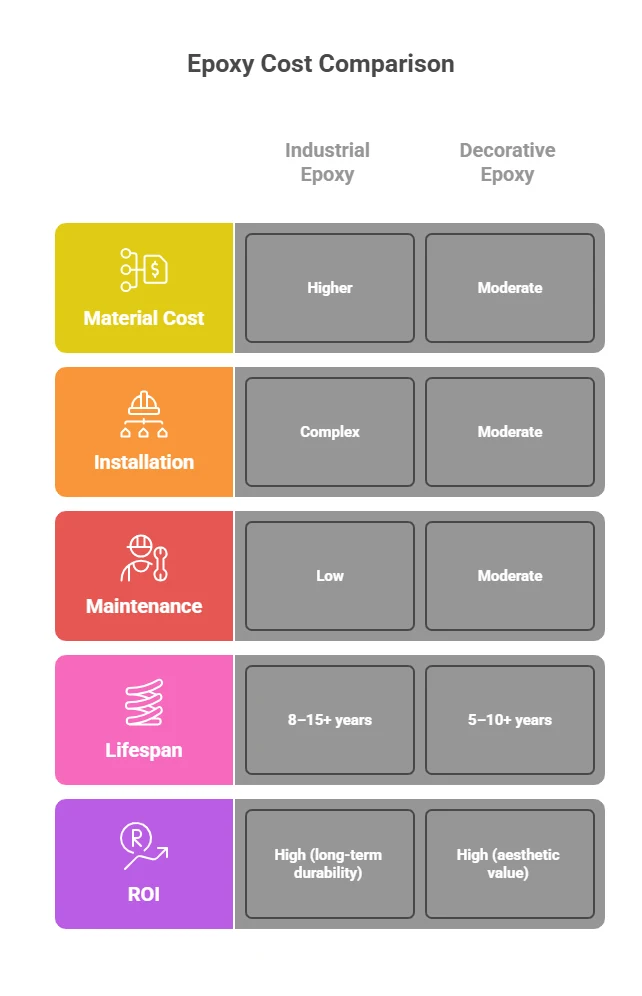
Industrial epoxy may cost more initially but offers excellent long-term value in demanding environments.
Maintenance Requirements
Industrial Epoxy Maintenance
Decorative Epoxy Maintenance
Industrial epoxy typically requires less cosmetic maintenance.
Pros and Cons
Industrial Epoxy
Advantages:
Limitations:
Decorative Epoxy
Advantages:
Limitations:
Which One Should You Choose?
Choosing between industrial and decorative epoxy depends on your priorities.
Choose Industrial Epoxy If:
Choose Decorative Epoxy If:
- Visual appeal is important
- The space is customer-facing
- Traffic is moderate
- You want a modern, high-gloss finish
- Custom design is required
Key Decision Factors
Before selecting a system, consider:
- Traffic intensity
- Chemical exposure level
- Environmental conditions
- Budget
- Design expectations
- Long-term maintenance plan
A professional site assessment ensures proper system selection.
Final Comparison Summary
Conclusion
Both industrial and decorative epoxy flooring systems have their own advantages. Industrial epoxy is built for strength, durability, and long-term protection in demanding environments. Decorative epoxy enhances aesthetics while still offering solid performance for commercial and residential spaces.
The right choice depends on your operational requirements, traffic conditions, and design goals. Investing in the appropriate epoxy system ensures better performance, lower maintenance costs, and a longer-lasting floor.
For best results:
- Conduct a professional site evaluation
- Select high-quality materials
- Ensure proper surface preparation
- Hire experienced installation professionals
A well-installed epoxy floor not only improves safety and functionality but also adds long-term value to your property.