

Choosing the right flooring system is essential for industrial and commercial environments where durability, safety, and long-term performance matter. Among the most widely used solutions are epoxy flooring and PU (polyurethane) flooring. Both offer advanced protection, but their properties, performance, and applications differ significantly.
This detailed guide explains every aspect of epoxy vs PU flooring to help you make the right decision.
Introduction to Industrial Flooring Systems
Importance of Choosing the Right Flooring System
Industrial floors are exposed to heavy machinery, chemical spills, constant traffic, and environmental stress. Selecting the right flooring system ensures durability, reduces maintenance costs, and improves workplace safety. A poor choice can lead to frequent repairs, operational downtime, and safety risks.
Overview of Epoxy and PU Flooring
Epoxy flooring is a rigid and high-strength system that bonds strongly with concrete, making it ideal for heavy-duty indoor environments. PU flooring, on the other hand, is flexible and elastic, designed to handle temperature changes and dynamic conditions without cracking.
Growing Demand in Industrial and Commercial Sectors
With increasing industrialization and stricter hygiene standards, epoxy and PU flooring systems are widely used in warehouses, factories, pharmaceutical units, food processing plants, and commercial buildings. Businesses prefer these systems for their durability and long-term cost efficiency.
What Is Epoxy Flooring?
Definition of Epoxy Flooring
Epoxy flooring is a protective surface system created by applying epoxy coating over concrete. Once cured, it forms a hard, seamless, and durable layer suitable for heavy-duty applications.
Composition (Epoxy Resin + Hardener)
It consists of epoxy resin and a hardener that react chemically to form a rigid thermoset material. This structure provides strength and strong adhesion.
How Epoxy Flooring Works
After application, epoxy penetrates the concrete surface and cures into a seamless layer that protects against chemicals, moisture, and mechanical stress.
Key Properties of Epoxy Flooring
Epoxy flooring offers high strength, excellent chemical resistance, abrasion resistance, and a smooth, hygienic finish with long service life.
What Is PU (Polyurethane) Flooring?
Definition of PU Flooring
PU flooring is a flexible and durable coating system designed to withstand temperature changes, movement, and impact.
Composition and Chemical Structure
It is formed by the reaction of polyols and isocyanates, resulting in a flexible polymer structure.
How PU Flooring Works
PU creates an elastic layer that expands and contracts with temperature changes, preventing cracks and damage.
Key Properties of PU Flooring
PU flooring provides flexibility, thermal resistance, UV stability, and good chemical resistance, making it suitable for dynamic environments.
Epoxy vs PU Flooring – Key Differences Overview
Basic Comparison Introduction
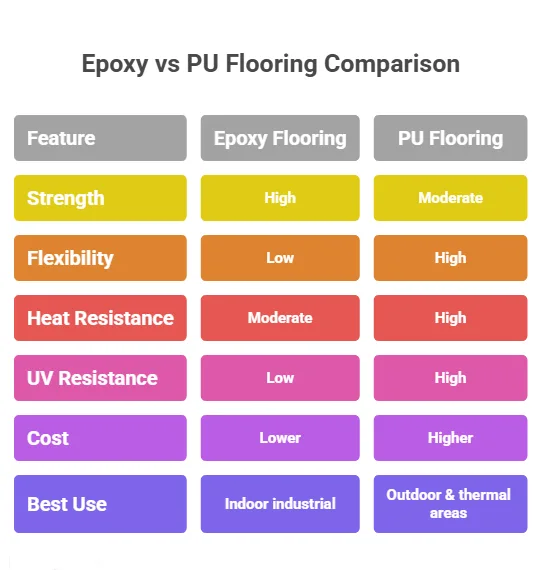
The primary difference lies in behavior: epoxy is rigid and strong, while PU is flexible and adaptable. This difference impacts performance in various conditions.
When to Choose Which System
Epoxy is best for heavy-duty indoor use with minimal temperature variation. PU is ideal for environments with thermal changes, outdoor exposure, or dynamic loads.
Composition and Chemical Structure
Epoxy Chemical Composition
Epoxy consists of resin and hardener forming a dense, cross-linked structure that delivers high strength and rigidity.
PU Chemical Composition
PU is formed from polyols and isocyanates, creating a flexible and resilient polymer.
Flexibility vs Rigidity
Epoxy is rigid and strong, while PU is flexible and absorbs movement and stress.
Reaction and Curing Process
Epoxy cures into a hard thermoset material, whereas PU cures into a flexible structure capable of handling environmental changes.
Durability and Strength Comparison
Compressive Strength
Epoxy offers very high compressive strength, making it suitable for heavy machinery. PU provides moderate strength but better flexibility.
Impact Resistance
Epoxy resists heavy impacts but may crack under extreme stress. PU absorbs impact due to its elastic nature.
Load-Bearing Capacity
Epoxy supports heavy loads, while PU is better for dynamic load conditions.
Long-Term Performance
Epoxy performs well in stable environments, while PU performs better in fluctuating conditions.
Flexibility and Crack Resistance
Epoxy Rigidity
Epoxy is rigid and may develop cracks under movement or thermal expansion.
PU Flexibility
PU is flexible and can absorb stress without cracking.
Performance Under Thermal Expansion
PU adapts to temperature changes, while epoxy may fail under extreme variations.
Suitability for Dynamic Surfaces
PU is ideal for dynamic environments where movement or vibration occurs.
Heat and Temperature Resistance
Epoxy Temperature Limits
Epoxy performs well under moderate temperatures but may degrade under high heat.
PU Heat Resistance
PU offers excellent resistance to high temperatures and thermal shock.
Performance in High-Temperature Environments
PU is preferred in kitchens, food plants, and heat-exposed areas.
Best Choice for Thermal Shock Areas
PU is the better choice due to its flexibility and thermal stability.
Chemical Resistance Comparison
Resistance to Acids and Alkalis
Epoxy provides strong resistance to a wide range of chemicals. PU also resists chemicals but varies by formulation.
Oil and Solvent Resistance
Epoxy performs better in oil and solvent-heavy environments.
Performance in Chemical Industries
Epoxy is commonly used in chemical plants due to its strong resistance.
Long-Term Exposure Effects
Epoxy maintains stability under prolonged chemical exposure, while PU may vary depending on formulation.
UV Stability and Outdoor Performance
Epoxy and UV Exposure
Epoxy is not UV stable and may yellow over time.
PU UV Resistance
PU offers better UV resistance, making it suitable for outdoor use.
Yellowing Issues
Epoxy tends to discolor under sunlight, while PU maintains appearance.
Outdoor Suitability
PU is preferred for outdoor applications.
Surface Finish and Aesthetics
Epoxy Finish Options
Epoxy offers glossy, smooth, and seamless finishes with decorative options.
PU Finish Options
PU provides matte or satin finishes with functional aesthetics.
Gloss vs Matte Appearance
Epoxy is typically glossy, while PU offers more natural finishes.
Decorative Possibilities
Epoxy is more suitable for decorative applications like metallic or flake finishes.
Application Process Comparison
Surface Preparation Requirements
Both require proper surface preparation, including cleaning and grinding.
Installation Complexity
Epoxy is relatively easier to install compared to PU.
Curing Time Differences
Epoxy generally cures faster, while PU may require controlled conditions.
Environmental Conditions During Application
PU is more sensitive to humidity and temperature during application.
Thickness and System Build
Epoxy Thickness Range
Typically ranges from 1 mm to 5 mm depending on application.
PU Thickness Range
Usually ranges from 2 mm to 4 mm.
Layering Systems
Both systems involve primer, base coat, and top coat layers.
Performance Based on Thickness
Higher thickness improves durability and load resistance.
Maintenance and Lifespan
Cleaning Requirements
Both systems are easy to clean with regular maintenance.
Repair and Recoating
Epoxy may require recoating in heavy-use areas, while PU may need less frequent repairs.
Lifespan Comparison
Epoxy lasts 8–15 years; PU offers similar or longer life in dynamic environments.
Long-Term Cost Efficiency
Both systems are cost-effective over time when properly maintained.
Cost Comparison
Material Cost
Epoxy is generally more affordable than PU.
Installation Cost
PU installation may be more expensive due to complexity.
Maintenance Cost
Both have low maintenance costs.
Return on Investment
Epoxy offers better ROI for static environments, while PU excels in dynamic conditions.
Applications of Epoxy Flooring
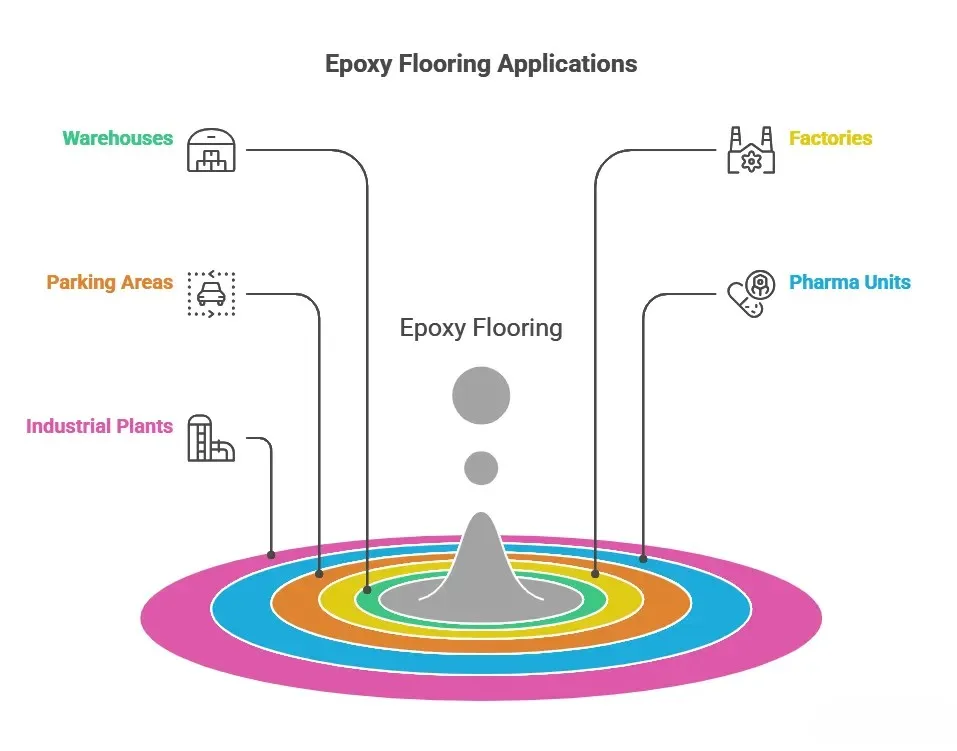
Epoxy is ideal for heavy-duty indoor applications requiring strength and durability.
Applications of PU Flooring
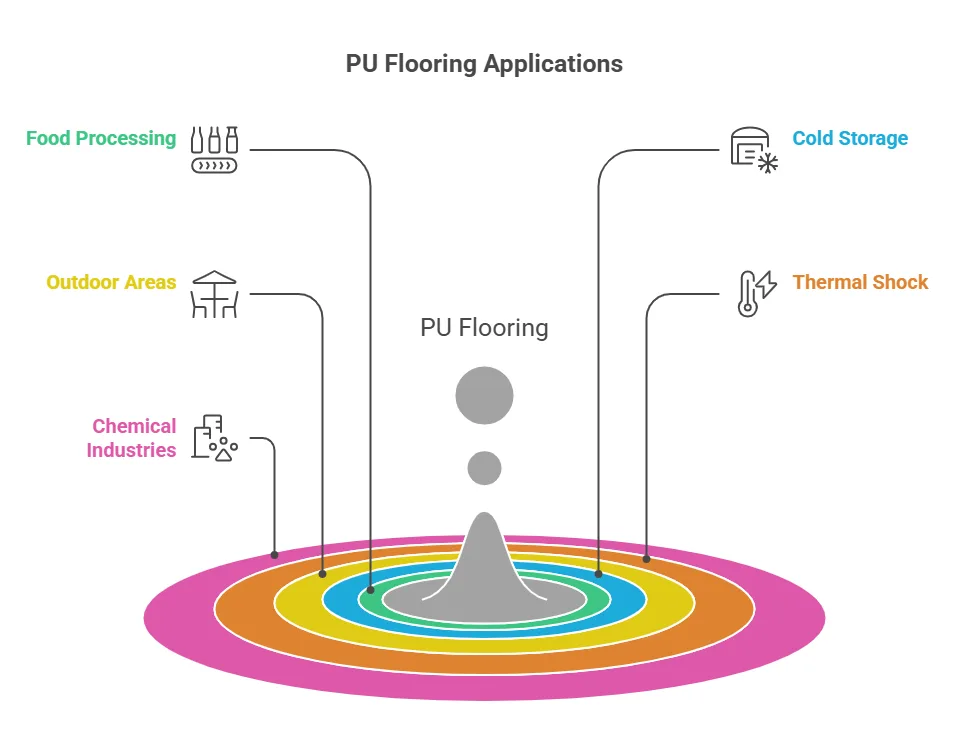
PU is best suited for environments with temperature changes and movement.
Pros and Cons
Epoxy Flooring Advantages & Limitations
Epoxy offers high strength, chemical resistance, and cost-effectiveness but lacks flexibility and UV stability.
PU Flooring Advantages & Limitations
PU provides flexibility, heat resistance, and UV stability but is more expensive and complex to install.
Epoxy vs PU Flooring Comparison Table
Which Flooring Should You Choose?
Based on Industry Type
Heavy industries → Epoxy
Food & thermal industries → PU
Based on Environment Conditions
Stable indoor → Epoxy
Dynamic or outdoor → PU
Based on Budget
Lower budget → Epoxy
Performance-focused → PU
Expert Recommendation
Choose based on application needs, not just cost. A professional assessment ensures the best results.
Conclusion
Summary of Key Differences
Epoxy is strong and rigid, ideal for heavy-duty indoor use. PU is flexible and heat-resistant, suitable for dynamic environments.
Final Recommendation
Select epoxy for strength and durability, and PU for flexibility and temperature resistance.
Importance of Professional Installation
Proper installation ensures long-term performance, durability, and return on investment. Always rely on experienced professionals for best results.